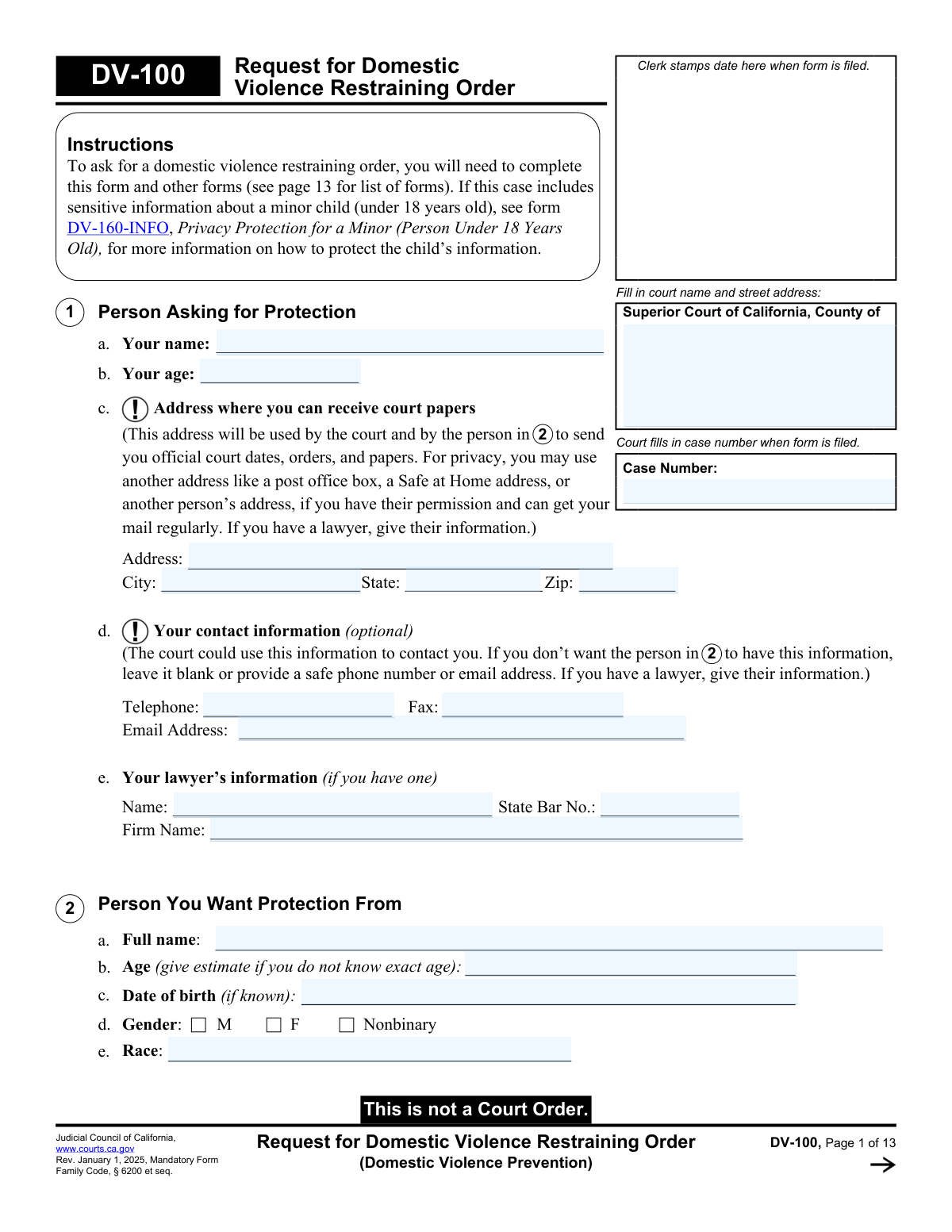
Yes! You can use AI to fill out Form DV-100, Request for Domestic Violence Restraining Order (Domestic Violence Prevention)

Form DV-100, the Request for Domestic Violence Restraining Order, is a legal document used in California to ask a court for protection from abuse by someone with whom you have a close relationship, such as a spouse, partner, or family member. It initiates the legal process for obtaining a restraining order, which can mandate the abuser to cease contact, stay away, and follow other court-ordered restrictions. Today, this form can be filled out quickly and accurately using AI-powered services like Instafill.ai, which can also convert non-fillable PDF versions into interactive fillable forms.
DV-100 is part of the domestic violence forms and restraining order forms categories on Instafill.
DV-100 has a very complex Form Complexity Index of 93/100 — 381 fillable fields across 13 pages. Instafill’s AI completes it accurately in under a minute.

Form specifications

Form name: Form DV-100, Request for Domestic Violence Restraining Order (Domestic Violence Prevention)
Number of fields: 381
Number of pages: 14
FCI: Very Complex (93/100)
Language: English
Our AI automatically handles information lookup, data retrieval, formatting, and form filling.
It takes less than a minute to fill out DV-100 using our AI form filling.
Securely upload your data. Information is encrypted in transit and deleted immediately after the form is filled out.
Preview of Form DV-100, Request for Domestic Violence Restraining Order (Domestic Violence Prevention)

Instafill Demo: How to fill out PDF forms in seconds with AI

How to Fill Out DV-100 Online for Free in 2026

Are you looking to fill out a DV-100 form online quickly and accurately? Instafill.ai offers the #1 AI-powered PDF filling software of 2026, allowing you to complete your DV-100 form in just 37 seconds or less.
Follow these steps to fill out your DV-100 form online using Instafill.ai:
  1. 1 Navigate to Instafill.ai and upload or select the DV-100 form.
  2. 2 Provide your personal information and details for anyone else needing protection.
  3. 3 Enter the information for the person you need protection from and specify your relationship to them.
  4. 4 Describe the incidents of abuse in detail, including dates, what happened, and any harm caused. The AI can help structure this narrative.
  5. 5 Select the specific protective orders you are requesting, such as no-contact, stay-away, or move-out orders.
  6. 6 If applicable, add requests related to child custody, property control, or protection for animals.
  7. 7 Review all the information populated by the AI for accuracy, then e-sign and download the completed form to file with the appropriate California Superior Court.

Our AI-powered system ensures each field is filled out correctly, reducing errors and saving you time.

Why Choose Instafill.ai for Your Fillable DV-100 Form?

Speed

Complete your DV-100 in as little as 37 seconds.

Up-to-Date

Always use the latest 2026 DV-100 form version.

Cost-effective

No need to hire expensive lawyers.

Accuracy

Our AI performs 10 compliance checks to ensure your form is error-free.

Security

Your personal information is protected with bank-level encryption.

Frequently Asked Questions About DV-100

DV-100 has a Form Complexity Index of 93 out of 100, placing it in the very complex complexity tier. This score is calculated deterministically from the form’s own structure using Instafill’s published Form Complexity Index methodology, so it can be reproduced and independently verified — it is not a subjective estimate.

For DV-100 specifically, the score reflects 381 fillable fields across 13 pages, grouped into 105 sections, and 218 conditional fields that only apply depending on earlier answers, 8 tables or repeating lists, plus 1 page of printed instructions. The number of fields is the largest factor in the base score (weighted 36%), followed by how difficult those fields are to complete based on their type, where free-text and signature fields count for more than simple checkboxes (26%). The number of pages that actually contain fields (15%), the amount of conditional “fill-only-if” logic (16%), and how many sections the form is divided into (7%) account for the rest of the base. On top of that base, the index adds points for tables and repeating lists, bundled instruction pages, and dense page layouts — capturing difficulty the base alone can miss.

In practical terms, a very complex score means the form is exceptionally demanding — a very large number of fields, often combined with tables, dense pages or extensive conditional logic. Instafill removes that effort entirely: our AI reads your information, maps each value to the correct field — including the conditional ones — and completes DV-100 accurately in under a minute, with every field available for you to review before you download. See exactly how the Form Complexity Index is calculated.

Form DV-100, the Request for Domestic Violence Restraining Order, is used to ask a California court to grant legal protection against someone who has been abusive and with whom you have a qualifying relationship.

You can file this form if you have a close relationship with the person you need protection from, such as being married, divorced, dating, related, or having lived together. If your relationship is not listed in Section 3, you may need to file for a different type of restraining order.

You need to provide their full name and an estimated age if you don't know their exact date of birth. Providing as much identifying information as you know helps the court and law enforcement.

Be specific about the most recent and past incidents of abuse, including dates, what was said or done, who else was there, and if police were called. If you run out of space, you can attach Form DV-101 or a separate sheet of paper.

Yes, in Section 8, you can list your children or other family members you live with who also need protection. You will need to explain why they are at risk.

You must disclose this information in Section 9 of the form. If the judge grants the restraining order, the person will be legally required to turn in, sell, or store any firearms and ammunition they possess.

You must also complete Form DV-109 (Notice of Court Hearing), DV-110 (Temporary Restraining Order), and CLETS-001 (Confidential CLETS Information). If you are requesting child custody, you will need additional forms like DV-105.

After filing, you must arrange for another adult or the sheriff to formally deliver ('serve') copies of the filed papers to the person you are seeking protection from. The court will schedule a hearing date to make a decision on a long-term order.

Yes, in Section 13, you can request a 'Move-Out Order.' You will need to explain your legal right to live at that address, for example, by showing your name is on the lease or deed.

Yes, you can ask the judge to make orders for child support (Section 24), spousal support (Section 25), and payment for expenses caused by the abuse (Section 23). These requests are typically decided at your court hearing.

If your PDF is a flat, non-fillable image, you can use a service like Instafill.ai. It can convert the document into an interactive form that you can easily complete and save online.

Yes, services like Instafill.ai use AI to accurately identify and auto-fill form fields, which can save you time and help reduce errors. This is particularly useful for complex legal documents.

Simply upload the DV-100 form to the Instafill.ai platform. Their AI will make the form fillable, allowing you to type your information directly into the fields, save your progress, and download the completed document for filing.

Compliance DV-100
Validation Checks by Instafill.ai

1
Ensures Relationship Eligibility for DVRO
This check verifies that at least one relationship box is checked in Section 3 ('Your Relationship to the Person in 2'). This is a fundamental requirement for a Domestic Violence Restraining Order (DVRO). If no qualifying relationship is selected, the filer is not eligible for this specific type of order and the form submission should be rejected with guidance to seek other types of restraining orders.
2
Prohibits Future Dates for Abuse Incidents
This validation ensures that any date entered for an abuse incident (e.g., in Sections 5a, 6a, 7a) is not in the future. Events described on the form must have already occurred. If a future date is entered, the system should flag it as an error and require the user to enter a date that is on or before the current date.
3
Validates Consistency Between Respondent's Age and Date of Birth
This check confirms that the respondent's age provided in Section 2b is consistent with the date of birth in Section 2c, if both are provided. For example, a date of birth of '06/03/1989' should correspond to an age of 34 or 35, depending on the current date. A significant discrepancy indicates a data entry error that could cause confusion or legal issues and should be flagged for correction.
4
Requires Child's Name if 'Have a Child Together' is Checked
This validation ensures that if the filer checks box 3a ('We have a child or children together'), they must provide the name(s) of the child(ren) in the corresponding text field. Failing to name the child leaves the form incomplete and prevents the court from understanding the full family structure. The submission should be blocked until the child's name is provided.
5
Verifies Protected Persons for Child-Related Stay-Away Orders
This check ensures that if a stay-away order is requested for a 'children’s school or childcare' (Section 11a), the child must be listed as a protected person in Section 8. Requesting protection for a child's location without officially including the child in the order is a logical contradiction. The system should prompt the user to add the child to Section 8 or remove the request for the child's school.
6
Confirms Cross-Form Dependency for Child Custody Requests
This validation checks if Section 15 ('Child Custody and Visitation') is checked. If it is, the system should flag that the user must also complete and attach form DV-105 ('Request for Child Custody and Visitation Orders'). This is a critical procedural requirement, and failing to include the necessary form will result in an incomplete filing and delay any custody-related orders.
7
Validates Marital Status for Property Restraint Request
This check verifies that if the filer requests a property restraint order in Section 20, they have also indicated they are 'married or registered domestic partners' in Section 3. This order is legally restricted to parties with this relationship status. If the criteria are not met, the request in Section 20 should be disallowed or flagged as a potential error.
8
Ensures Debt Details are Provided for Payment Request
This validation confirms that if the user checks 'Yes' in Section 22 to ask the judge to order the respondent to pay debts, they must fill out the details for at least one debt in section 22a. A 'Yes' response without any specified debts is incomplete and provides no actionable information for the court. The form should not be accepted until the debt details are provided or the 'Yes' box is unchecked.
9
Validates Marital Status for Spousal Support Request
This check ensures that if a request for spousal support is made in Section 25, the filer has indicated they are 'married or a registered domestic partner' with the respondent in Section 3. Spousal support is contingent on this legal relationship. If the relationship does not qualify, the system should prevent this request or warn the user of the ineligibility.
10
Mandatory Signature Date Check
This validation ensures that the 'Date' field in Section 33, next to the filer's signature, is filled out. A signature without a date can render a legal document invalid, as it's impossible to determine when it was signed under penalty of perjury. The submission must be blocked until a valid date is entered.
11
Petitioner's Address for Service Completeness
This check verifies that the petitioner's address in Section 1c contains all necessary components (street address, city, state, and zip code). This address is legally required for the court and the other party to serve official documents. An incomplete address will halt the legal process, so the system should require all fields to be completed.
12
Logical Consistency of Abuse Incident Dates
This validation compares the primary date of abuse listed in a section (e.g., 7a) with the dates mentioned in the detailed narrative for that same section. For instance, if 7a lists a date in 2025 but the narrative describes events in 2023 and 2024, it indicates a significant inconsistency. The system should flag this discrepancy to the user for review and correction to ensure the timeline presented to the court is clear and accurate.

Common Mistakes in Completing DV-100

Providing Vague or Emotional Abuse Descriptions

Filers often use general terms like 'he was abusive' or focus on emotional impact without stating facts. A judge requires specific, factual details to issue an order, such as dates, locations, direct quotes, a description of physical actions, and any witnesses. Vague statements weaken the request and may lead to denial; always describe events clearly and factually.

Using Incorrect or Future Dates

In a stressful situation, it's easy to mistype a date or, as seen in the sample data, enter a date that is in the future (e.g., '07/19/2025'). These errors severely damage credibility and can lead a judge to question the accuracy of the entire petition, causing delays or denial. It is crucial to double-check all dates for accuracy before submitting the form.

Using an Unsafe Contact Address

People frequently list their current residential address in Section 1c, not realizing this information becomes part of the record served on the other person, potentially revealing their location. This is a major safety risk. To avoid this, use a secure alternative like a P.O. Box, a lawyer's address, or a state-provided 'Safe at Home' address to protect your privacy while ensuring you receive court documents.

Failing to Justify Protection for Children or Others

A common mistake is to list children or other family members in Section 8 but leave the justification field blank. A judge cannot legally extend the restraining order to others without a specific reason. You must explain how the person has also threatened, abused, or put each listed individual at risk to ensure they are included in the protective order.

Omitting Related Court Cases

Applicants often forget to list other legal cases with the person they are seeking protection from, such as divorce, child custody, or criminal matters in Section 4. This information is vital for the judge to have a complete picture and avoid issuing conflicting court orders. Failing to disclose these cases can complicate and delay the legal process.

Relying Solely on Attachments Without Summarizing

While attachments are necessary for detailed accounts, simply writing 'See attachment' in the abuse description sections (5, 6, and 7) is insufficient. The judge needs a concise summary of the most recent and severe incidents directly on the form itself to quickly grasp the situation. Use the provided space for a summary and then refer to the attachment for the full narrative.

Forgetting to Request Specific Orders

A filer might describe an issue, like the abuser showing up at their job, but then forget to check the corresponding box in the 'Stay-Away Order' section (12). The court can only grant the protections that are explicitly requested. It is essential to carefully review Sections 10-26 and check every box that applies to the protection you need.

Submitting an Illegible or Incomplete Form

Handwritten forms can be difficult to read, and missing information in key sections can cause the court clerk to reject the filing, delaying urgent protection. If the form is a non-fillable PDF, it can be hard to complete cleanly. Using an AI-powered tool like Instafill.ai can convert the document into an interactive, fillable version and help validate data to ensure all required fields are completed legibly and accurately.

Forgetting to Sign and Date the Form

An unsigned or undated declaration in Section 33 is not legally valid and will be rejected by the court, bringing the process to a halt. This simple oversight is a common reason for filing delays, which can be dangerous in an emergency. Always perform a final check to ensure you have signed and dated the form before submitting it.
Saved over 80 hours a year

“I was never sure if my IRS forms like W-9 were filled correctly. Now, I can complete the forms accurately without any external help.”

Kevin Martin Green

Your data stays secure with advanced protection from Instafill and our subprocessors

Robust compliance program

Transparent business model

You’re not the product. You always know where your data is and what it is processed for.

ISO 27001, HIPAA, and GDPR

Our subprocesses adhere to multiple compliance standards, including but not limited to ISO 27001, HIPAA, and GDPR.

Security & privacy by design

We consider security and privacy from the initial design phase of any new service or functionality. It’s not an afterthought, it’s built-in, including support for two-factor authentication (2FA) to further protect your account.

Fill out DV-100 with Instafill.ai

Worried about filling PDFs wrong? Instafill securely fills form-dv-100-request-for-domestic-violence-restraining-order-domestic-violence-prevention forms, ensuring each field is accurate.

Related forms by category

domestic violence forms Form DV-100, Request for Domestic Violence Restraining Order, Dakota County CDA New Admissions Informal Review Request Form (Housing Choice Voucher Program) and HUD Form 5382, Certification of Domestic Violence, Dating Violence, Sexual Assault, or Stalking, and Alternate Documentation, DV-100, Request for Domestic Violence Restraining Order (Domestic Violence Prevention), Form DV-200, Proof of Personal Service (CLETS) (Domestic Violence Prevention), Judicial Council of California Form DV-110, Temporary Restraining Order (CLETS-TRO) (Domestic Violence Prevention), Form DV-109, Notice of Court Hearing (Domestic Violence Prevention), Form DV-101, Description of Abuse (Domestic Violence Prevention), Form DV-108, Request for Orders to Prevent Child Abduction (Domestic Violence Prevention), Form DV-116, Order on Request to Continue Court Hearing (Temporary Restraining Order) (CLETS-TRO) (Domestic Violence Prevention), Form DV-130, Restraining Order After Hearing (Order of Protection) (Domestic Violence Prevention), Form DV-105, Request for Child Custody and Visitation Orders (Domestic Violence Prevention), Form DV-140, Child Custody and Visitation Order (Domestic Violence Prevention), Form DV-145, Order to Prevent Child Abduction (Domestic Violence Prevention), State of Michigan Form MC 282, Domestic Violence Screening for Referral to Mediation, MC 282a, Domestic Violence Screening, Form CR-161, Criminal Protective Order—Other Than Domestic Violence (CLETS—CPO), Form CR-162, Order to Surrender Firearms, Firearm Parts, and Ammunition in Domestic Violence Case (CLETS—CPO), Form CR-102, Domestic Violence Plea Form With Waiver of Rights—Misdemeanor (Criminal), Form CR-160, Criminal Protective Order—Domestic Violence (CLETS—CPO), Form DV-120, Response to Request for Domestic Violence Restraining Order (Domestic Violence Prevention) · + 27 more →
restraining order forms Form DV-100, Request for Domestic Violence Restraining Order, DV-100, Request for Domestic Violence Restraining Order (Domestic Violence Prevention), Judicial Council of California Form DV-110, Temporary Restraining Order (CLETS-TRO) (Domestic Violence Prevention), Form DV-116, Order on Request to Continue Court Hearing (Temporary Restraining Order) (CLETS-TRO) (Domestic Violence Prevention), Form DV-130, Restraining Order After Hearing (Order of Protection) (Domestic Violence Prevention), Form CH-110, Temporary Restraining Order (CLETS-TCH) (Civil Harassment Prevention), Form CH-120, Response to Request for Civil Harassment Restraining Orders, Form CH-130, Civil Harassment Restraining Order After Hearing (CLETS-CHO), Order on Request to Modify/Terminate Civil Harassment Restraining Order (Civil Harassment Prevention), Form CH-620, Response to Request to Modify/Terminate Civil Harassment Restraining Order (Civil Harassment Prevention), Form CIV-025, Application and Order for Reissuance of Order to Show Cause and Temporary Restraining Order, Form CD-190, Application for Temporary Restraining Order (Claim and Delivery), Order on Request to Continue Hearing (Temporary Restraining Order) (CLETS-TCH) (Civil Harassment Prevention), Form CH-610, Notice of Hearing on Request to Modify/Terminate Civil Harassment Restraining Order (Civil Harassment Prevention), Form CH-700, Request to Renew Restraining Order (Civil Harassment Prevention), Form CH-730, Order Renewing Civil Harassment Restraining Order (CLETS), Form DV-120, Response to Request for Domestic Violence Restraining Order (Domestic Violence Prevention), Form DV-300, Request to Change or End Restraining Order (Domestic Violence Prevention), Form DV-310, Notice of Court Hearing and Temporary Order to Change or End Restraining Order (Domestic Violence Prevention), Form DV-315, Request to Reschedule Hearing to Change or End Restraining Order (Domestic Violence Prevention) · + 56 more →