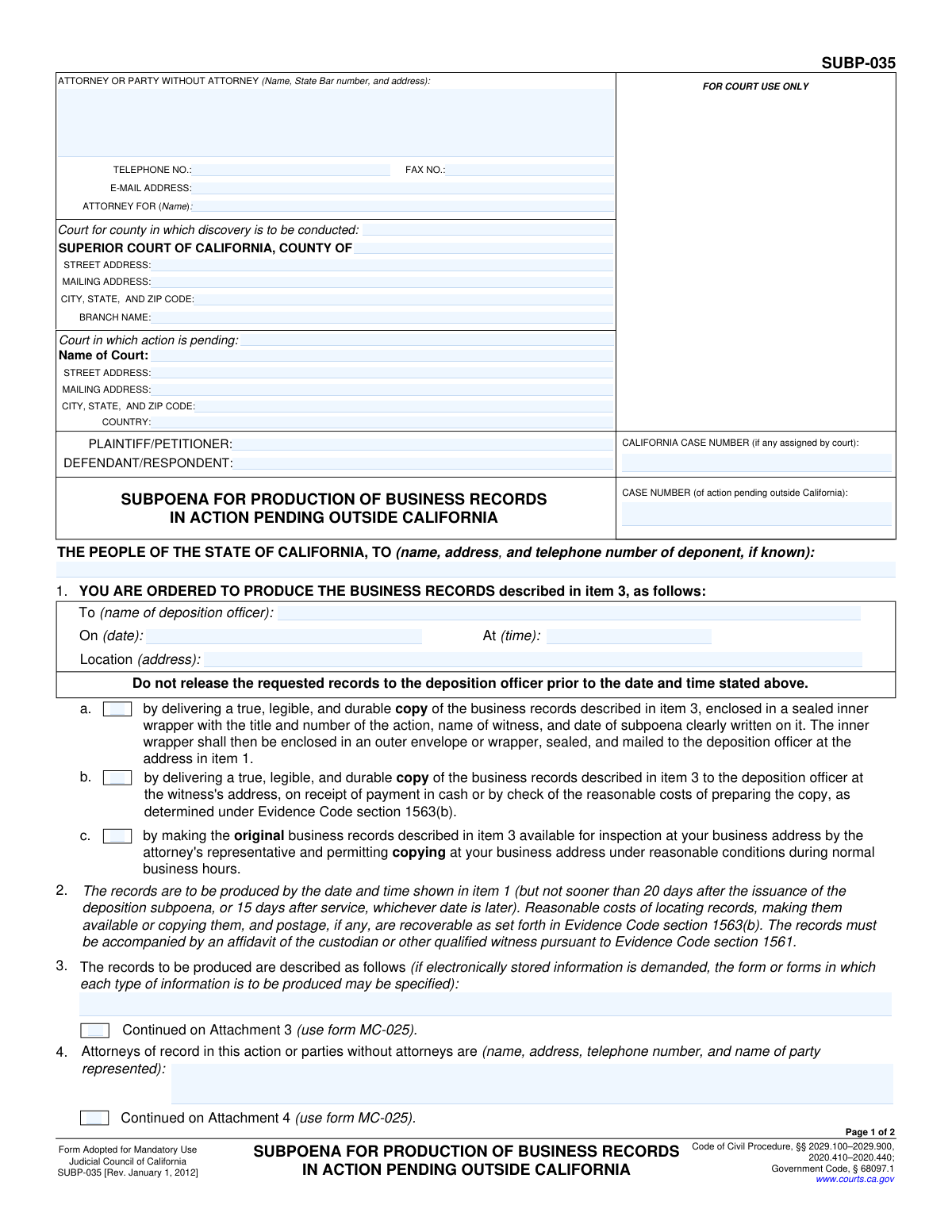
Yes! You can use AI to fill out Form SUBP-035, Subpoena for Production of Business Records in Action Pending Outside California

The SUBP-035 form is a legal document used in California to issue a subpoena for business records required for a lawsuit that is active in a different state. It is a critical tool for interstate discovery, allowing parties to obtain evidence from California-based entities under the authority of a California court. Today, this form can be filled out quickly and accurately using AI-powered services like Instafill.ai, which can also convert non-fillable PDF versions into interactive fillable forms.
SUBP-035 is part of the California business forms and California court forms categories on Instafill.
Our AI automatically handles information lookup, data retrieval, formatting, and form filling.
It takes less than a minute to fill out SUBP-035 using our AI form filling.
Securely upload your data. Information is encrypted in transit and deleted immediately after the form is filled out.

Form specifications

Form name: Form SUBP-035, Subpoena for Production of Business Records in Action Pending Outside California
Number of fields: 68
Number of pages: 1
Language: English
main-image

Instafill Demo: How to fill out PDF forms in seconds with AI

How to Fill Out SUBP-035 Online for Free in 2026

Are you looking to fill out a SUBP-035 form online quickly and accurately? Instafill.ai offers the #1 AI-powered PDF filling software of 2026, allowing you to complete your SUBP-035 form in just 37 seconds or less.
Follow these steps to fill out your SUBP-035 form online using Instafill.ai:
  1. 1 Navigate to Instafill.ai, search for Form SUBP-035, and select it to begin filling.
  2. 2 Provide the court information for both the California county where discovery will occur and the out-of-state court where the case is pending.
  3. 3 Enter the full names of the plaintiff/petitioner and defendant/respondent, along with the case number from the out-of-state action.
  4. 4 Identify the deponent (the person or entity whose records are being requested) and specify the details for record production, including the date, time, and location.
  5. 5 Clearly and specifically describe the business records to be produced in item 3, noting if electronically stored information is demanded.
  6. 6 List the names, addresses, and contact information for all attorneys of record or parties without attorneys in the action.
  7. 7 Review the entire subpoena for accuracy, then have the issuing party sign and date the form before it is served on the deponent.

Our AI-powered system ensures each field is filled out correctly, reducing errors and saving you time.

Why Choose Instafill.ai for Your Fillable SUBP-035 Form?

Speed

Complete your SUBP-035 in as little as 37 seconds.

Up-to-Date

Always use the latest 2026 SUBP-035 form version.

Cost-effective

No need to hire expensive lawyers.

Accuracy

Our AI performs 10 compliance checks to ensure your form is error-free.

Security

Your personal information is protected with bank-level encryption.

Frequently Asked Questions About Form SUBP-035

This form is a legal subpoena used to compel a California-based business or entity to produce business records for a lawsuit that is currently pending in a court outside of California.

An attorney or a party to a lawsuit that is filed in another state needs to fill out this form to obtain business records from a person or entity located within California.

You are legally ordered to produce the business records described in Item 3 of the form. You must deliver them to the specified deposition officer by the date and time listed, along with a signed affidavit from the custodian of records.

You must identify the out-of-state court where the lawsuit is pending, as well as the California Superior Court in the county where the discovery (the production of records) is set to occur.

Item 1 gives you three options: mail a sealed copy to the deposition officer, allow the officer to pick up a copy at your business, or permit the attorney's representative to inspect and copy the original records at your business address during normal hours.

The records must be produced by the date specified in Item 1, which cannot be sooner than 20 days after the subpoena was issued or 15 days after you were served, whichever date is later.

Yes, the form states that you can recover the reasonable costs for locating, copying, and any postage required to produce the records, as set forth in California Evidence Code section 1563(b).

This is a required legal document signed by the person responsible for the records, swearing that the copies provided are true, legible, and durable copies of the original business records.

Failure to obey the subpoena may result in being held in contempt of court. You could also be liable for a $500 penalty plus all damages resulting from your failure to comply.

Yes, as stated in Item 5, if you are served with an objection or a motion to quash, you must not produce the records until you receive a specific court order or an agreement from all parties involved.

You must be specific and clearly list all the records you are requesting. For electronically stored information, you can also specify the format in which you want it produced (e.g., PDF, .csv).

Yes, services like Instafill.ai use AI to accurately auto-fill form fields, which can save you significant time and help prevent common errors.

You can use a service like Instafill.ai to fill out the form online. Simply upload the SUBP-035 PDF, and the platform will make the fields interactive for you to complete and download.

If you have a non-fillable or 'flat' PDF, you can upload it to a service like Instafill.ai. It can convert the document into an interactive, fillable form that you can easily complete on your computer.

Compliance SUBP-035
Validation Checks by Instafill.ai

1
Production Date Legal Compliance
This check ensures the production date in item 1 is not sooner than 20 days after the issuance date or 15 days after the service date, whichever is later. This is a crucial legal requirement under the California Code of Civil Procedure to provide the recipient with adequate time to respond. A failure in this validation would render the subpoena legally defective and potentially unenforceable.
2
Service Date After Issuance Date
Validates that the 'Date of delivery' in the Proof of Service section is on or after the 'Date issued' on page 2. A subpoena cannot be legally served before it has been officially issued by the attorney or court. An invalid service date would nullify the proof of service and could require the subpoena to be re-served at additional cost and delay.
3
Mandatory Case and Party Identification
Ensures that the 'CASE NUMBER (of action pending outside California)', 'PLAINTIFF/PETITIONER', and 'DEFENDANT/RESPONDENT' fields are all filled out. This information is fundamental for identifying the specific legal action to which the subpoena pertains. Without it, the subpoena is ambiguous and cannot be properly filed, served, or enforced.
4
Dual Court Jurisdiction Completeness
Verifies that both the California court ('SUPERIOR COURT OF CALIFORNIA, COUNTY OF') and the out-of-state court ('Name of Court') are specified. The form's purpose is to bridge two jurisdictions, so identifying both courts is essential for establishing legal authority. Missing information for either court makes the legal basis of the subpoena unclear and subject to challenge.
5
Records Description Presence
This check confirms that the text field in item 3, describing the records to be produced, is not empty. If the field is empty, it then verifies that the 'Continued on Attachment 3' checkbox is selected. A subpoena is invalid and unenforceable if it does not clearly and specifically state what business records are being requested.
6
Exclusive Production Method Selection
Validates that exactly one of the three production method checkboxes (item 1.a, 1.b, or 1.c) is selected. Selecting multiple or no methods creates ambiguity for the receiving party on how to comply with the records request. The form should enforce a single, clear instruction for production to avoid confusion and non-compliance.
7
Issuing Authority and Date Completeness
Verifies that the 'Date issued', 'TYPE OR PRINT NAME', and 'TITLE' fields are all completed by the person issuing the subpoena. These fields establish the authenticity and authority of the document, showing when it was created and by whom. An unissued or unsigned subpoena has no legal effect and will be rejected.
8
Proof of Service Core Details
If the Proof of Service section is being completed, this validation ensures that 'Person served (name)', 'Address where served', 'Date of delivery', and 'Time of delivery' are all filled out. These details constitute the core facts required to legally prove that the deponent was properly notified. Incomplete information can lead to a successful legal challenge of the service's validity.
9
Conditional Witness Fee Amount
Checks that if the checkbox for witness fees being 'paid' (1.e.(1)) or 'tendered' (1.e.(3)) is selected, the corresponding monetary amount field is filled with a value greater than zero. This ensures consistency and provides a clear record of the financial transaction related to the service. An empty amount field would make the declaration about payment incomplete and questionable.
10
Process Server Status Identification
Ensures that at least one checkbox from item 4.a through 4.g is selected to identify the status of the person who served the subpoena. This is required to establish that service was performed by an individual authorized or qualified to do so under California law. Failure to declare the server's status can invalidate the proof of service.
11
Attorney/Party Contact Information Presence
Validates that the 'ATTORNEY OR PARTY WITHOUT ATTORNEY' section contains a name, address, and at least one valid contact method (phone number or email). This information is critical for the court, the recipient, and other parties to communicate regarding the subpoena. Missing contact details can cause significant delays and communication breakdowns.
12
Deponent Identification Completeness
Verifies that the name and address of the deponent to whom the subpoena is directed are filled in the section starting 'THE PEOPLE OF THE STATE OF CALIFORNIA, TO...'. This is the most fundamental information, as it specifies who is being legally ordered to produce records. A subpoena without a named recipient is meaningless and unenforceable.
13
Email Address Format
Validates that the value entered in the 'E-MAIL ADDRESS' field follows a standard email format (e.g., [email protected]). This ensures that the provided contact information is syntactically correct and usable for electronic communication. An invalid format would prevent opposing counsel or the court from contacting the filing party via email.
14
Attachment Checkbox Logic
Checks if 'Continued on Attachment 3' or 'Continued on Attachment 4' is checked. If so, it flags that a corresponding attachment (form MC-025) should be included with the submission. While not a hard failure, this serves as a crucial reminder to ensure all parts of the legal document are present, preventing an incomplete filing.

Common Mistakes in Completing SUBP-035

Confusing California and Out-of-State Court Information

Users often incorrectly enter the information for the court where the action is pending into the section for the California Superior Court, or vice versa. This happens due to the presence of two distinct court information blocks on the first page. This error can cause the subpoena to be issued from or filed in the wrong jurisdiction, leading to rejection by the court clerk and significant delays. To avoid this, carefully distinguish between the 'Court for county in which discovery is to be conducted' (the California court) and the 'Court in which action is pending' (the out-of-state court).

Incorrectly Calculating the Production Date

The form specifies that records are due 'not sooner than 20 days after the issuance of the deposition subpoena, or 15 days after service, whichever date is later.' A frequent mistake is setting a production date that is too early, which violates the Code of Civil Procedure. This can result in a successful motion to quash the subpoena by the opposing party or the deponent, forcing the process to be restarted. Always calculate the date carefully from both the issuance and anticipated service dates to ensure compliance.

Providing a Vague or Overly Broad Description of Records

In Section 3, parties often use ambiguous language like 'all documents relating to the matter' instead of providing a specific and particularized description of the records sought. This ambiguity can lead to objections, motions to quash for being 'overly broad and burdensome,' and the deponent producing either too few or too many irrelevant documents. To prevent this, clearly itemize the categories of documents, specify date ranges, and identify custodians or subject matters with precision.

Failing to Properly Identify the Deponent

The subpoena is often addressed to a company's general name (e.g., 'ABC Corporation') without specifying the recipient as the 'Custodian of Records' or 'Person Most Knowledgeable.' This can cause confusion within the receiving organization, leading to delays or the subpoena being ignored. It is crucial to direct the subpoena to the specific role responsible for record-keeping to ensure it is routed correctly and complied with promptly.

Omitting Required Attorneys or Unrepresented Parties

Section 4 requires listing all attorneys of record and unrepresented parties in the action. It is a common oversight to forget to include all parties, especially in multi-party litigation. Failing to list and serve all parties can be grounds for an objection or motion to quash, as all parties have a right to be aware of discovery requests. Double-check the case docket to ensure every party's representative is accurately listed.

Neglecting Special Notice Requirements for Consumer or Employee Records

If the subpoena seeks personal records of a consumer or employment records of an employee, specific additional steps are required under CCP §1985.3 and §1985.6, including serving a 'Notice to Consumer or Employee'. Many filers overlook Section 5 and fail to complete and serve the required notice, which is a fatal error. This failure will invalidate the subpoena for those records, requiring the process to start over. AI-powered tools like Instafill.ai can help identify when these additional requirements may apply.

Missing or Incorrect Signature and Title on Issuance

An unsigned subpoena is not valid. Paralegals or assistants may fill out the form but forget to have the authorized person (e.g., the attorney of record) sign it before issuance. Additionally, the 'Title' of the person signing is sometimes left blank. An invalid signature or missing title can lead to the subpoena being rejected by the deponent or challenged by opposing counsel. Always ensure the form is properly signed, dated, and the signer's title is clearly printed.

Incomplete or Inaccurate Proof of Service

The Proof of Service on page 2 is often filled out incorrectly by the process server or the attorney's office. Common errors include misstating the date or time of delivery, failing to check the box for whether witness fees were paid, or entering the wrong fee amount. An improper Proof of Service can create enforcement issues if the deponent fails to comply, as there is no valid record of service. This section must be filled out meticulously by the person who actually performed the service.

Failing to Specify the Format for Electronically Stored Information (ESI)

Section 3 allows the requesting party to specify the form in which electronically stored information (ESI) should be produced (e.g., native files, PDF, TIFF). Many filers neglect to make this specification, which can lead to receiving data in a useless or difficult-to-manage format. This oversight can result in disputes and the need for further negotiation or motions to compel. To avoid this, be explicit about the desired format for any ESI requested.

Inconsistent Case Information Across Pages

The form requires the Plaintiff/Petitioner, Defendant/Respondent, and out-of-state case number to be entered on both page 1 and page 2. A common data entry error is to have typos or inconsistencies between the two pages. While seemingly minor, this sloppiness can cause confusion or be used to challenge the validity of the document. Using a tool like Instafill.ai, which can convert flat PDFs into fillable forms and auto-populate repeating fields, helps ensure perfect consistency and prevents this type of error.
Saved over 80 hours a year

“I was never sure if my IRS forms like W-9 were filled correctly. Now, I can complete the forms accurately without any external help.”

Kevin Martin Green

Your data stays secure with advanced protection from Instafill and our subprocessors

Robust compliance program

Transparent business model

You’re not the product. You always know where your data is and what it is processed for.

ISO 27001, HIPAA, and GDPR

Our subprocesses adhere to multiple compliance standards, including but not limited to ISO 27001, HIPAA, and GDPR.

Security & privacy by design

We consider security and privacy from the initial design phase of any new service or functionality. It’s not an afterthought, it’s built-in, including support for two-factor authentication (2FA) to further protect your account.

Fill out SUBP-035 with Instafill.ai

Worried about filling PDFs wrong? Instafill securely fills form-subp-035-subpoena-for-production-of-business-records-in-action-pending-outside-california forms, ensuring each field is accurate.

Related forms by category

California business forms CALIFORNIA FORM 3520-BE, Business Entity or Group Nonresident Power of Attorney Declaration, Form SC-103, Fictitious Business Name (Small Claims), Form SUBP-010, Deposition Subpoena for Production of Business Records
California court forms Judicial Council of California Form SC-105, Request for Court Order and Answer (Small Claims), Judicial Council of California Form SC-120, Defendant’s Claim and ORDER to Go to Small Claims Court (Small Claims), Judicial Council of California Form SER-001, Request for Sheriff to Serve Court Papers, Judicial Council of California Form SER-001, Request for Sheriff to Serve Court Papers, Affidavit for Collection of Personal Property California Probate Code Section 13100, Form POS-040, Proof of Service—Civil, Declaration of Facts of Death (California Superior Court), declaration-of-marriage-for-court-proceeding-california-family-law, ADOPT-200, Adoption Request, ADOPT-200, Stepparent Adoption Request, ADOPT-210, Adoption Agreement, ADOPT-310, Contact After Adoption Agreement, Judicial Council of California Form ADOPT-200, Adoption Request, Form ADR-107, Mediation Attendance Sheet, Form ADR-110, Order Appointing Referee, Form ADR-109, Stipulation or Motion for Order Appointing Referee, Form ADR-102, Request for Trial De Novo After Judicial Arbitration, Form ADR-108, Referee's Report (Code Civ. Proc., §§ 638, 639), Form ADR-106, Petition to Confirm, Correct, or Vacate Contractual Arbitration Award, Form ADR-104, Rejection of Award and Request for Trial After Attorney-Client Fee Arbitration · + 557 more →