Fill out brokerage account forms
with AI.
Brokerage account forms are the essential paperwork required to open, manage, and modify investment accounts with major financial institutions. They cover a wide range of activities, from initial account applications and asset transfers to beneficiary designations and account upgrades. These forms are critical because they establish the legal and regulatory framework for your investments, ensuring compliance with federal laws while protecting your assets. Whether you are moving funds between accounts or setting up a specialized self-directed retirement plan, having the correct documentation is the first step in successful wealth management.
By continuing, you acknowledge Instafill's Privacy Policy and agree to get occasional product update and promotional emails.
About brokerage account forms
This category is vital for individual investors, business owners, and trustees who interact with firms such as Fidelity, Charles Schwab, Merrill Lynch, or Vanguard. You might encounter these forms when opening a joint brokerage account, designating a Transfer on Death (TOD) beneficiary to avoid probate, or authorizing a qualified charitable distribution from an IRA. Businesses also use these documents to certify authorized signers or open specialized accounts like a Business Investor Account (BIA). Because these forms often require sensitive financial data and detailed personal information, accuracy is paramount to avoid processing delays or legal complications.
Managing this paperwork doesn't have to be a manual burden. Tools like Instafill.ai use AI to fill these brokerage forms in under 30 seconds, handling your data accurately and securely to streamline your financial administrative tasks.
Every form on this page can be completed without typing. Instafill is form filling software that reads a PDF and fills it for you — including flat and scanned documents that carry no fillable fields at all.
Forms in This Category
The forms in this category have a median Form Complexity Index of 62/100 (Moderate), measured across 34 forms by field count, input difficulty, length, conditional logic and structure. See how it is calculated.
- Enterprise-grade security & data encryption
- 99%+ accuracy powered by AI
- 1,000+ forms from all industries
- Complete forms in under 60 seconds
How to Choose the Right Form
Opening a New Personal Account
If you are starting a new investment journey, your choice depends on the provider and the account's tax status. For standard taxable accounts, use the BlackRock New Account Application For Non-Retirement Accounts or the Schwab One® Account Application for Personal Accounts. If you are looking for a retirement-specific self-directed option, the Merrill Edge® Self-Directed BASIC™ Retirement Account Application or the Charles Schwab PCRA Self-Directed Brokerage Account are the primary choices for individual control.
Business, Trust, and Estate Management
Managing assets for an entity requires specific documentation to establish authority and tax status.
- For Corporations and LLCs: Use the Merrill Business Investor Account (BIA) application or the Schwab One® Account Application for Incorporated Organizations.
- For Trusts: The New Fidelity Account® — Trust — Brokerage or the Merrill Edge® Self-Directed Trust Cash Management Account® are designed to capture grantor and trustee details.
- For Authorized Signers: If you need to update who can trade on a business account, use the Fidelity® Brokerage Business Account Certification.
Moving Assets and Transfers
To consolidate your portfolio or move funds between institutions, look for transfer-specific forms. Use the TIAA Brokerage Incoming Account Transfer Form to bring assets into TIAA, or the Vanguard Brokerage Account CREST Transfer Form for foreign securities. If you are simply moving money between two accounts you already own at the same firm, use the Move Assets from My Schwab Brokerage Account form.
Updating Features and Beneficiaries
Existing account holders often need to add features or plan for the future.
- Adding Owners: Use the Merrill Edge® Self-Directed (CMA) Additional Account Owner Booklet to convert an individual account to a joint one.
- Estate Planning: To ensure assets bypass probate, complete the TIAA Brokerage Individual Transfer on Death Account Agreement.
- Trading Options: To gain approval for complex trades, you must submit the Option Information — Individual, Joint and Trust Accounts form.
- Banking Features: To add checkwriting or debit cards to a standard account, use the Brokerage Corestone Account Application or Update Your Schwab or Schwab One® Account.
Form Comparison
| Form | Primary Action | Account Type | Key Requirement |
|---|---|---|---|
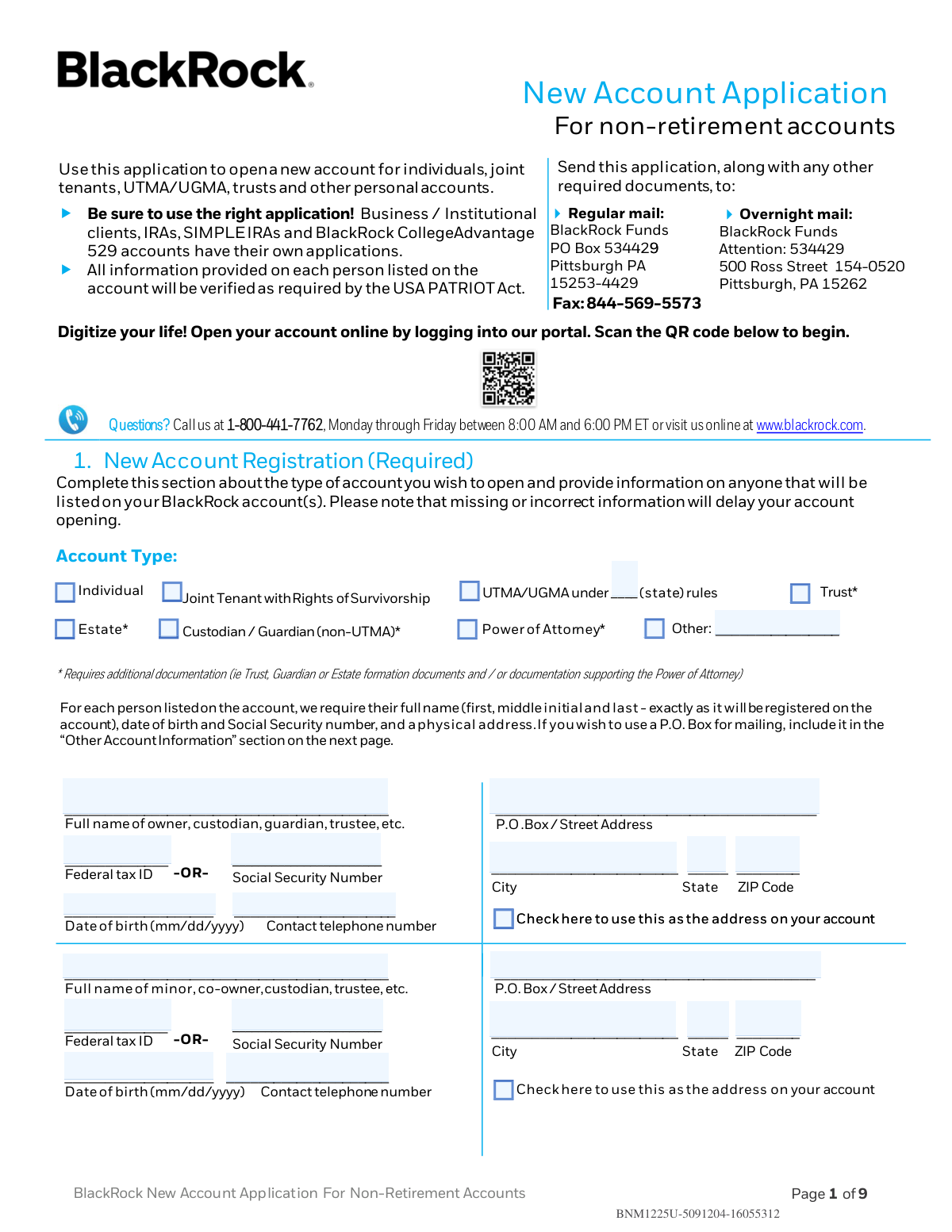
| BlackRock New Account Application For Non-Retirement Accounts | Establishes a new non-retirement investment account for individuals or trusts. | Individual, Joint, or Trust non-retirement accounts. | Requires personal financial data and USA PATRIOT Act compliance information. |
| Brokerage Corestone Account Application | Upgrades standard accounts to premium versions with banking features. | Existing American Century personal brokerage accounts. | Selection of enhanced features like checkwriting and debit cards. |
| Charles Schwab PCRA Self-Directed Brokerage Account | Opens a self-directed window for employer-sponsored retirement plans. | Personal Choice Retirement Account (PCRA). | Requires existing retirement plan details and participant information. |
| Fidelity® Brokerage Business Account Certification | Updates or confirms authorized individuals for business account management. | Fidelity brokerage accounts held by business entities. | Official legal documentation verifying current authorized personnel. |
| Fidelity Change of Account Registration: Changing to an Individual, Joint, or Custodial Brokerage Account | Modifies ownership structure or adds/removes owners on an account. | Non-retirement brokerage accounts (Individual, Joint, Custodial). | Detailed information for all current, new, and removed owners. |
| Merrill Edge® Self-Directed BASIC™ Retirement Account Application | Establishes a self-managed retirement account for U.S. residents. | Personal Retirement Accounts (IRA, Roth IRA). | Requires beneficiary designations and employment status details. |
| Merrill Edge® Self‑Directed Business Investor Account (BIA Account) Account Application Booklet and Agreements | Opens a new investment account for business legal entities. | Corporations, LLCs, Partnerships, and Sole Proprietorships. | Business tax status, principal information, and entity documentation. |
| Move Assets from My Schwab Brokerage Account | Authorizes the internal transfer of cash or securities between accounts. | Existing Charles Schwab brokerage accounts. | Specific instructions for asset lots and cost basis methods. |
| Open a Schwab One® Brokerage Account | Establishes a standard personal brokerage account for trading securities. | Individual or Joint personal accounts. | Standard personal, financial, and employment information for all holders. |
| Schwab One® Account Application for Incorporated Organizations | Opens a brokerage account for U.S.-based incorporated entities. | C-Corps, S-Corps, and Non-profit organizations. | Identification of beneficial owners and persons with significant control. |
| TIAA Brokerage Incoming Account Transfer Form | Consolidates assets from an external institution into TIAA management. | Individual TIAA Brokerage accounts. | Copy of a recent statement from the delivering firm. |
| Vanguard Brokerage Account CREST Transfer Form | Converts physical foreign security certificates into electronic format. | Vanguard Brokerage Accounts holding foreign securities. | Submission of original physical certificates for electronic processing. |
Tips for brokerage account forms
When filling out account applications or registration changes, ensure your name is written exactly as it appears on your driver's license or passport. Brokerage firms use strict verification protocols, and even minor discrepancies like using a nickname can cause the application to be rejected during the KYC (Know Your Customer) review.
If you are opening an account for a trust, LLC, or corporation, have your formation documents or trust agreements ready. Most brokerage forms for businesses and trusts require you to submit these supplemental documents to prove the authority of the signers and the legal standing of the entity.
When using incoming transfer forms to move funds from another firm, a single incorrect digit in the account number can result in a failed ACATS transfer. Always refer to a recent statement from the delivering institution to verify the account number and the exact name of the firm before submitting the request.
Many people overlook the Transfer on Death (TOD) or beneficiary sections when opening a new brokerage account. Completing these sections is a critical step that allows your assets to bypass probate and pass directly to your heirs, saving them significant time and legal fees in the future.
Review the instructions for ownership changes or high-value transfers to see if a Medallion Signature Guarantee is required. Unlike a standard notary, this specific type of certification must be obtained at a physical financial institution and is often mandatory for validating the transfer of securities.
AI-powered tools like Instafill.ai can complete these complex brokerage forms in under 30 seconds with high accuracy. This is a massive time-saver for those managing multiple accounts, and you can rest assured that your sensitive financial data stays secure throughout the automated filling process.
Frequently Asked Questions
Anyone looking to invest in securities like stocks, bonds, or mutual funds needs these forms to establish a legal relationship with a broker. They are also used by existing clients for updating account information, designating beneficiaries, or moving assets between different investment vehicles.
An individual application is for a single owner, while a joint application allows two or more people to share ownership and control of the assets. Joint accounts often include rights of survivorship, which means that if one owner passes away, the other automatically inherits the account balance.
You generally use an 'Incoming Account Transfer' or 'ACAT' form provided by your new broker to initiate the process. You will need to provide details about the delivering institution and your current account number to authorize the electronic movement of your securities and cash.
Yes, most major firms like Schwab, Fidelity, and Merrill offer specific applications for business entities, such as LLCs or Corporations, and legal trusts. These forms require additional information about authorized signers, beneficial owners, and the legal documents establishing the entity.
Most applications require a government-issued ID, Social Security or Tax ID number, and employment information to comply with federal regulations like the USA PATRIOT Act. If you are opening an account for a trust or business, you may also need to provide trust certificates or articles of incorporation.
Manually filling out these detailed forms can take 20 to 30 minutes, especially when gathering financial data and beneficiary details. Using AI tools like Instafill.ai can reduce this time to under 30 seconds by accurately extracting information from your existing documents and placing it directly into the form fields.
Yes, AI-powered services like Instafill.ai can streamline the process of filling out brokerage applications and transfer forms. These tools can read data from your source documents and populate the PDF accurately, ensuring you do not miss critical fields required by financial institutions.
A Transfer on Death agreement allows you to name beneficiaries who will receive your account assets directly upon your passing. This is a vital estate planning tool because it allows assets to bypass the probate process, making the transfer faster and less expensive for your heirs.
You should use a registration change form when the underlying assets stay the same but the legal ownership structure changes, such as moving an individual account into a living trust. Opening a new account is usually reserved for starting a completely separate investment strategy or a different tax-advantaged status.
Yes, specialized forms like the Divorce Transfer Instruction Form are used to move IRA or brokerage assets to a former spouse. These forms ensure the transfer is documented correctly for tax purposes, often allowing the move to be treated as a non-taxable event under IRS rules.
Many brokers provide specific 'Update' or 'Account Upgrade' forms to add cash management features. These applications allow you to request checkwriting privileges, a debit card, or online bill-pay services to be linked directly to your existing investment portfolio.
Glossary
- Form Complexity Index
- Instafill’s 0–100 measure of how much effort a form takes to complete, calculated deterministically from the form’s own structure rather than estimated. It combines the number of fillable fields (the largest factor), how difficult those fields are to complete based on their type, the number of pages that contain fields, the amount of conditional “fill-only-if” logic, and how many sections the form is divided into, then adds modifiers for tables and repeating lists, bundled instruction pages, and dense page layouts. A higher score means the form is harder to fill out by hand. The forms in this category have a median Form Complexity Index of 62/100 (Moderate). See exactly how it is calculated.
- Cost Basis
- The original value of an asset for tax purposes, usually the purchase price. This information is used to calculate capital gains or losses when you sell or transfer securities.
- Transfer on Death (TOD)
- A legal designation that allows the assets in a brokerage account to pass directly to named beneficiaries upon the owner's death, bypassing the lengthy probate court process.
- UGMA/UTMA
- Acronyms for the Uniform Gifts to Minors Act and Uniform Transfers to Minors Act. These are custodial accounts used by adults to manage and protect assets for a minor until they reach the age of majority.
- SIPC (Securities Investor Protection Corporation)
- A non-profit corporation that provides limited insurance coverage to investors if their brokerage firm fails or goes bankrupt, protecting the cash and securities in the account.
- Required Minimum Distribution (RMD)
- The minimum amount that the IRS requires you to withdraw from your retirement accounts each year once you reach a certain age, typically 73.
- Qualified Charitable Distribution (QCD)
- A direct transfer of funds from an IRA to a qualified charity. This allows you to donate to a cause while satisfying your RMD requirements without the distribution being counted as taxable income.
- Rule 72(t)
- An IRS rule that allows you to take a series of 'substantially equal periodic payments' from a retirement account before age 59½ without paying the standard 10% early withdrawal penalty.
- Beneficial Owner
- An individual who enjoys the benefits of ownership of an account even though the legal title is held in another name, such as a business or trust. Banks are required to identify these individuals to prevent financial crimes.
- Letter of Authorization (LOA)
- A formal document signed by an account holder that provides specific instructions to the brokerage firm, such as authorizing a one-time asset transfer or a change in account status.