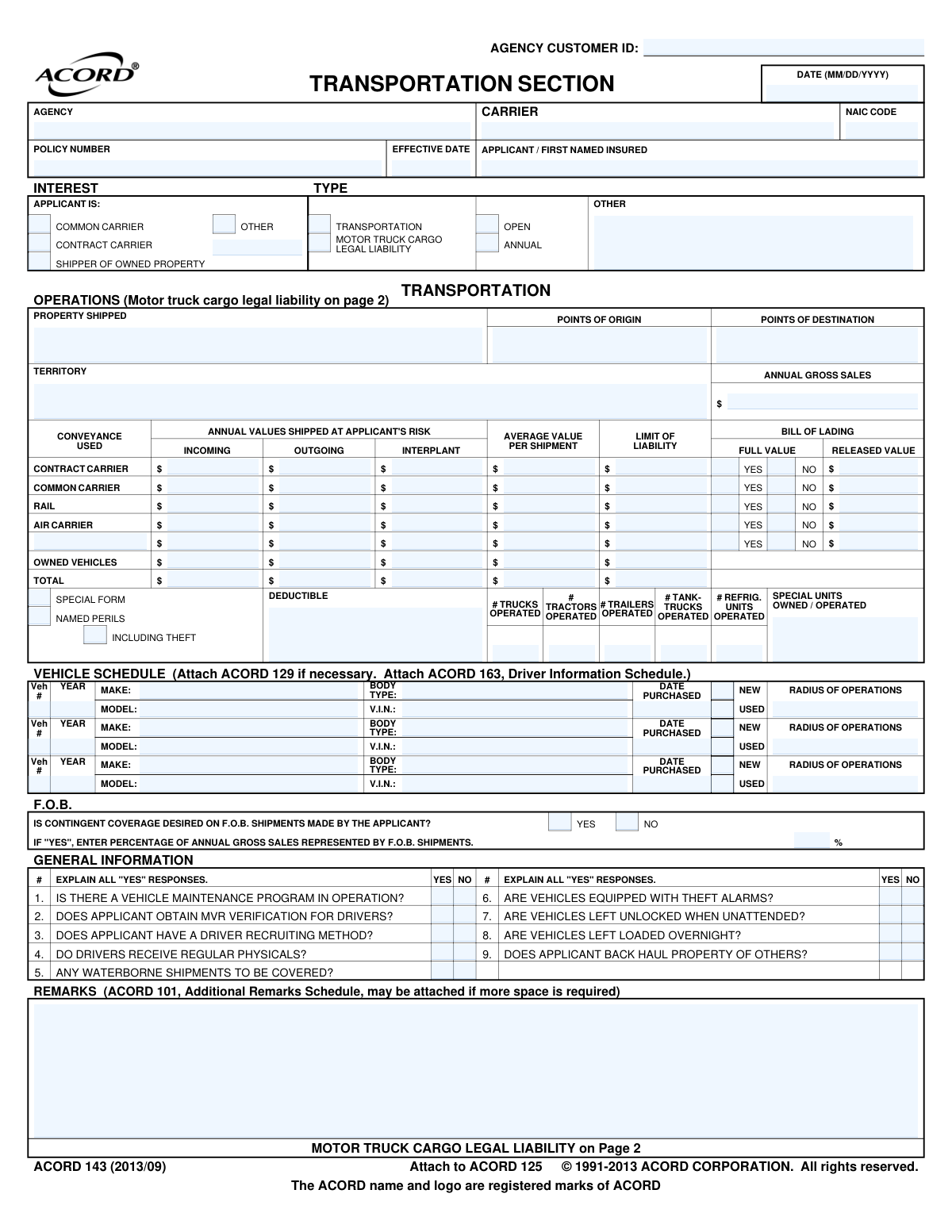
Yes! You can use AI to fill out ACORD 143, Transportation / Motor Truck Cargo Section
ACORD 143, the Transportation / Motor Truck Cargo Section, is a standardized insurance application used by businesses to apply for coverage for goods in transit. It collects detailed information about the applicant's operations, vehicles, types of cargo, routes, and safety procedures, which underwriters use to assess risk and determine policy terms and premiums. Today, this form can be filled out quickly and accurately using AI-powered services like Instafill.ai, which can also convert non-fillable PDF versions into interactive fillable forms.
Our AI automatically handles information lookup, data retrieval, formatting, and form filling.
It takes less than a minute to fill out ACORD 143 using our AI form filling.
Securely upload your data. Information is encrypted in transit and deleted immediately after the form is filled out.
Form specifications
| Form name: | ACORD 143, Transportation / Motor Truck Cargo Section |
| Number of fields: | 284 |
| Number of pages: | 1 |
| Language: | English |
Instafill Demo: How to fill out PDF forms in seconds with AI
How to Fill Out ACORD 143 Online for Free in 2026
Are you looking to fill out a ACORD 143 form online quickly and accurately? Instafill.ai offers the #1 AI-powered PDF filling software of 2026, allowing you to complete your ACORD 143 form in just 37 seconds or less.
Follow these steps to fill out your ACORD 143 form online using Instafill.ai:
- 1 Navigate to Instafill.ai and upload or select the ACORD 143 form.
- 2 Provide basic applicant, agency, and policy information in the designated sections.
- 3 Detail your transportation operations, specifying if you are a common carrier, contract carrier, or shipper, and describe the property being transported.
- 4 Complete the vehicle schedule with information for each vehicle, including make, model, year, VIN, and radius of operations.
- 5 Answer the general information questions regarding driver screening, vehicle maintenance, security measures, and cargo handling procedures.
- 6 Specify the desired coverage, limits of liability, and deductibles for either the Transportation or Motor Truck Cargo Legal Liability sections.
- 7 Review all AI-populated data for accuracy, then e-sign and submit the completed application to your insurance agent or carrier.
Our AI-powered system ensures each field is filled out correctly, reducing errors and saving you time.
Why Choose Instafill.ai for Your Fillable ACORD 143 Form?
Speed
Complete your ACORD 143 in as little as 37 seconds.
Up-to-Date
Always use the latest 2026 ACORD 143 form version.
Cost-effective
No need to hire expensive lawyers.
Accuracy
Our AI performs 10 compliance checks to ensure your form is error-free.
Security
Your personal information is protected with bank-level encryption.
Frequently Asked Questions About Form ACORD 143
This form is used to apply for transportation or motor truck cargo insurance. It gathers detailed information about your business operations, the goods you transport, and your vehicles to help insurers assess risk and determine coverage.
Businesses that transport goods, such as common carriers, contract carriers, or companies shipping their own property, need to fill out this form. It is a standard supplement to the main commercial insurance application (ACORD 125).
The 'Transportation' section (page 1) is generally for businesses insuring their own property while it's being shipped. The 'Motor Truck Cargo Legal Liability' section (page 2) is for carriers hauling goods for others, covering their legal responsibility for that cargo.
You will need the year, make, model, body type, and Vehicle Identification Number (VIN) for each vehicle. You also need to provide the purchase date, radius of operations, and whether it was bought new or used.
If you need more space to list all your vehicles, you should attach a separate vehicle schedule, such as the ACORD 129 form. It is important to list all vehicles that will be used under the policy.
Target commodities are goods that are highly susceptible to theft, such as electronics, alcohol, pharmaceuticals, or metals. You must list these specifically as they represent a higher risk and may affect your coverage and premium.
This refers to the maximum distance your vehicles typically travel from their home base. This information helps the insurer understand the geographic scope of your risk, whether it's local, intermediate, or long-haul.
'Full Value' means the carrier is liable for the full value of the cargo, while 'Released Value' limits the carrier's liability to a specific, lower amount per pound or item. This choice significantly impacts insurance needs and costs.
On page 2, in the 'General Information' section, question #13 asks 'DOES THE APPLICANT HIRE OWNER OPERATORS?'. You must check 'YES' and be prepared to provide more details about your arrangement with them.
This form is an attachment to the main ACORD 125 Commercial Insurance Application. You should submit both forms together to your insurance agent or broker for processing.
Yes, services like Instafill.ai use AI to accurately auto-fill form fields from your saved information, which can save you significant time and reduce errors. This is especially helpful for recurring information like your business name, address, and vehicle details.
Simply upload the ACORD 143 PDF to the Instafill.ai platform. The AI will make the form fillable and help you complete the fields by suggesting information from your profile, ensuring a faster and more accurate submission.
You can use a service like Instafill.ai to solve this problem. Upload the flat, non-fillable PDF, and the platform will automatically convert it into an interactive, fillable form that you can complete and sign digitally.
Compliance ACORD 143
Validation Checks by Instafill.ai
1
Validates Vehicle Identification Number (VIN) Format
This check ensures that the Vehicle Identification Number (VIN) entered in the vehicle schedule is exactly 17 alphanumeric characters long, conforming to the international standard. A valid VIN is crucial for accurately identifying a specific vehicle for coverage and claims processing. If the VIN is invalid, the submission will be rejected, requiring the user to correct the entry to prevent policy errors.
2
Ensures Vehicle Model Year is Logically Valid
This validation confirms that the 'YEAR' for each vehicle is a four-digit number that is not in the future and is after a reasonable historical year, such as 1950. This prevents data entry errors like typos or impossible dates, which could lead to incorrect rating and valuation of the vehicle. An invalid year will trigger an error message prompting the user for correction.
3
Exclusive Selection for New/Used Vehicle Status
This check verifies that for each vehicle listed, either 'NEW' or 'USED' is selected, but not both. A vehicle cannot be simultaneously new and used, and this check prevents a logical contradiction in the data. A failed validation would require the user to choose only one of these mutually exclusive options to ensure data integrity for underwriting.
4
Conditional Requirement for 'YES' Answer Explanations
The form requires that all 'YES' responses in the General Information section be explained. This validation checks that if any of the 'YES' checkboxes are selected, the corresponding 'REMARKS' section is not empty and contains a relevant explanation. This additional context is critical for the underwriter to assess risk, and failure to provide it will halt the submission process until the required explanations are added.
5
Specification for 'Other' Applicant Type
This rule validates that if the 'OTHER' checkbox is selected under 'APPLICANT IS:', the adjacent text field for description is filled out. This ensures that the nature of the applicant's business is clearly defined when it doesn't fit standard categories. Without this information, the underwriter cannot properly assess the risk, so the form will be considered incomplete.
6
F.O.B. Contingent Coverage Percentage Requirement
This check ensures that if the applicant answers 'YES' to desiring contingent coverage on F.O.B. shipments, the 'PERCENTAGE OF ANNUAL GROSS SALES REPRESENTED BY F.O.B. SHIPMENTS' field is populated with a valid number. This percentage is essential for calculating the correct premium for this specific coverage. If the field is empty after a 'YES' response, the form will be flagged as incomplete.
7
Commodity Revenue Percentage Summation
This validation calculates the sum of all percentages entered in the 'LIST TARGET COMMODITIES' section under '% OF GROSS REVENUES'. The total sum must not exceed 100%. This ensures the breakdown of hauled commodities is logical and accurate, which directly impacts risk assessment and rating. If the sum exceeds 100%, an error will be displayed, forcing the user to correct the percentages.
8
Logical Consistency of Distance Values
This check verifies that the 'MAXIMUM DISTANCE' entered is greater than or equal to the 'AVERAGE DISTANCE'. It is logically impossible for an average distance to be greater than the maximum distance traveled. This validation prevents data entry errors and ensures the operational territory information is coherent for underwriting purposes.
9
Logical Consistency of Terminal Values
For each terminal location listed, this rule ensures that the 'MAXIMUM VALUE AT TERMINAL' is greater than or equal to the 'AVERAGE VALUE AT TERMINAL'. This check prevents logical errors in data entry that could lead to underinsuring property stored at terminals. A failed validation would require the user to review and correct the entered values.
10
Standard Date Format Validation
This validation ensures that all date fields, such as 'EFFECTIVE DATE' and 'DATE PURCHASED', are entered in the specified MM/DD/YYYY format and represent a valid calendar date. Consistent and correct date formatting is essential for system processing, determining policy terms, and establishing timelines. An invalid format will prevent submission and prompt the user to correct the entry.
11
Bill of Lading Released Value Logic
This check validates the logic for the Bill of Lading section. If 'Full Value' is 'NO', it implies a released value bill of lading is used, and therefore the 'RELEASED VALUE' amount field must be populated. This information is critical for understanding the carrier's liability and the need for additional coverage. If the amount is missing when required, the section is considered incomplete.
12
Conditional Requirement for Filing Docket Number
This rule verifies that if the 'I.C.C. FILING REQUIRED' or other docket indicator checkbox is selected, the corresponding 'DOCKET NO.' field is filled in. This number is a mandatory identifier for regulatory filings with transportation authorities. Missing this information when required would render the filing incomplete and legally non-compliant, so the form submission will be blocked until it is provided.
13
Total Vehicle Count Consistency
This validation cross-references the number of vehicles detailed in the 'VEHICLE SCHEDULE' against the summary counts entered in the 'OWNED / OPERATED' section (e.g., # Trucks, # Tractors). The total number of scheduled vehicles must match the sum of the individual counts. This ensures internal consistency and provides underwriters with an accurate count of the total vehicle exposure.
14
Completeness of Header Information
This check ensures that essential header fields such as 'APPLICANT / FIRST NAMED INSURED', 'EFFECTIVE DATE', and 'CARRIER' are not empty. This information is fundamental for identifying the insured party, the policy period, and the insurance company. A submission lacking this core data is invalid and will be rejected at the outset.
Common Mistakes in Completing ACORD 143
Applicants frequently make typos when entering the 17-character Vehicle Identification Number (VIN), transposing letters or numbers. This happens due to manual data entry from registration documents or the vehicle itself. An incorrect VIN can lead to delays in quoting, the inability to verify a vehicle's history, and could even result in a claim being denied for an improperly identified vehicle. To avoid this, carefully double-check the VIN against official documents; AI-powered tools like Instafill.ai can also help by validating the format and checksum of the VIN during entry.
The form requires a written explanation for every 'YES' answer in the General Information sections, but applicants often check the box and move on. This oversight forces underwriters to halt processing and issue a request for more information, significantly delaying the quoting process. To prevent this, treat each 'YES' answer as a two-part task: check the box, then immediately navigate to the 'REMARKS' section to provide a detailed explanation, referencing the question number.
In the 'PROPERTY HAULED' or 'TARGET COMMODITIES' section, applicants often write 'General Freight' which is insufficient for underwriting. The type of cargo hauled is a primary factor in assessing risk, with items like electronics, alcohol, or pharmaceuticals carrying much higher risk than paper goods. Vague descriptions can lead to incorrect pricing or denial of a claim if the lost cargo is a high-risk commodity the insurer was unaware of. Always list the specific types of goods you transport most frequently, especially any that are high-value or perishable.
This form contains two distinct main sections: 'TRANSPORTATION' on page 1 for businesses insuring their own goods in transit (Shippers), and 'MOTOR TRUCK CARGO LEGAL LIABILITY' on page 2 for businesses hauling goods for others (Carriers). Applicants frequently fill out the wrong section, leading to a quote for incorrect coverage. This fundamental error wastes time and results in a policy that doesn't cover the applicant's actual legal liability. Carefully identify your role (Shipper or Carrier) and complete only the relevant section.
Applicants may guess their annual gross receipts or confuse them with net profit, leading to inaccurate figures. These values are critical for calculating premiums and assessing the scale of the operation. Submitting incorrect data can result in being overcharged or, more dangerously, underinsured, and material misrepresentation could jeopardize coverage entirely. Always refer to your most recent financial statements and consult with your accountant to provide accurate past figures and realistic future projections.
An applicant might underestimate the maximum distance their vehicles travel from their home base, or misunderstand the insurer's definitions of 'Local', 'Intermediate', and 'Long Haul'. This is a critical rating factor, and misstating it can lead to incorrect premiums. More importantly, a claim that occurs outside the declared radius of operation could be denied. To avoid this, determine the furthest zone your vehicles regularly service and state that distance, rounding up to be safe.
The form provides space for only a few vehicles, with an instruction to 'Attach ACORD 129 if necessary' for additional vehicles. Applicants with larger fleets sometimes try to squeeze information into the margins or forget to attach the supplemental schedule altogether. This results in an incomplete application and, critically, leaves vehicles uninsured. If your fleet exceeds the space on the main form, you must complete and attach the ACORD 129 Vehicle Schedule.
When listing terminal locations on page 2, applicants often provide the address but leave the 'AVERAGE VALUE AT TERMINAL' and 'MAXIMUM VALUE AT TERMINAL' fields empty. This information is crucial for the insurer to understand accumulation risk (the total value of cargo at risk in one place). Without it, the underwriter cannot set an appropriate limit or premium, causing delays. Before filling out the form, calculate the typical and peak values of cargo stored at each terminal.
In the Motor Truck Cargo section, fields for ICC/State docket numbers and filing requirements are often left blank or filled with incorrect information. These filings are a legal requirement for many carriers, and the insurance company often performs the filing on their behalf. Missing or incorrect numbers will prevent the insurer from completing these filings, which can stop a trucking company from operating legally. Always verify your active DOT, MC, or other regulatory numbers from official sources before applying.
The form asks whether cargo is shipped under a 'Full Value' or 'Released Value' Bill of Lading (BOL), but many applicants are unsure of the difference or use both and don't specify. This distinction is critical as it defines the carrier's level of liability in a loss, which the insurance is meant to cover. Stating the wrong BOL type can create a major gap between your legal liability and your insurance coverage. Review your standard shipping contracts to accurately report which type of BOL you use.
Saved over 80 hours a year
“I was never sure if my IRS forms like W-9 were filled correctly. Now, I can complete the forms accurately without any external help.”
Kevin Martin Green
Your data stays secure with advanced protection from Instafill and our subprocessors

Robust compliance program
Transparent business model
You’re not the product. You always know where your data is and what it is processed for.
ISO 27001, HIPAA, and GDPR
Our subprocesses adhere to multiple compliance standards, including but not limited to ISO 27001, HIPAA, and GDPR.
Security & privacy by design
We consider security and privacy from the initial design phase of any new service or functionality. It’s not an afterthought, it’s built-in, including support for two-factor authentication (2FA) to further protect your account.
Fill out ACORD 143 with Instafill.ai
Worried about filling PDFs wrong? Instafill securely fills acord-143-transportation-motor-truck-cargo-section forms, ensuring each field is accurate.