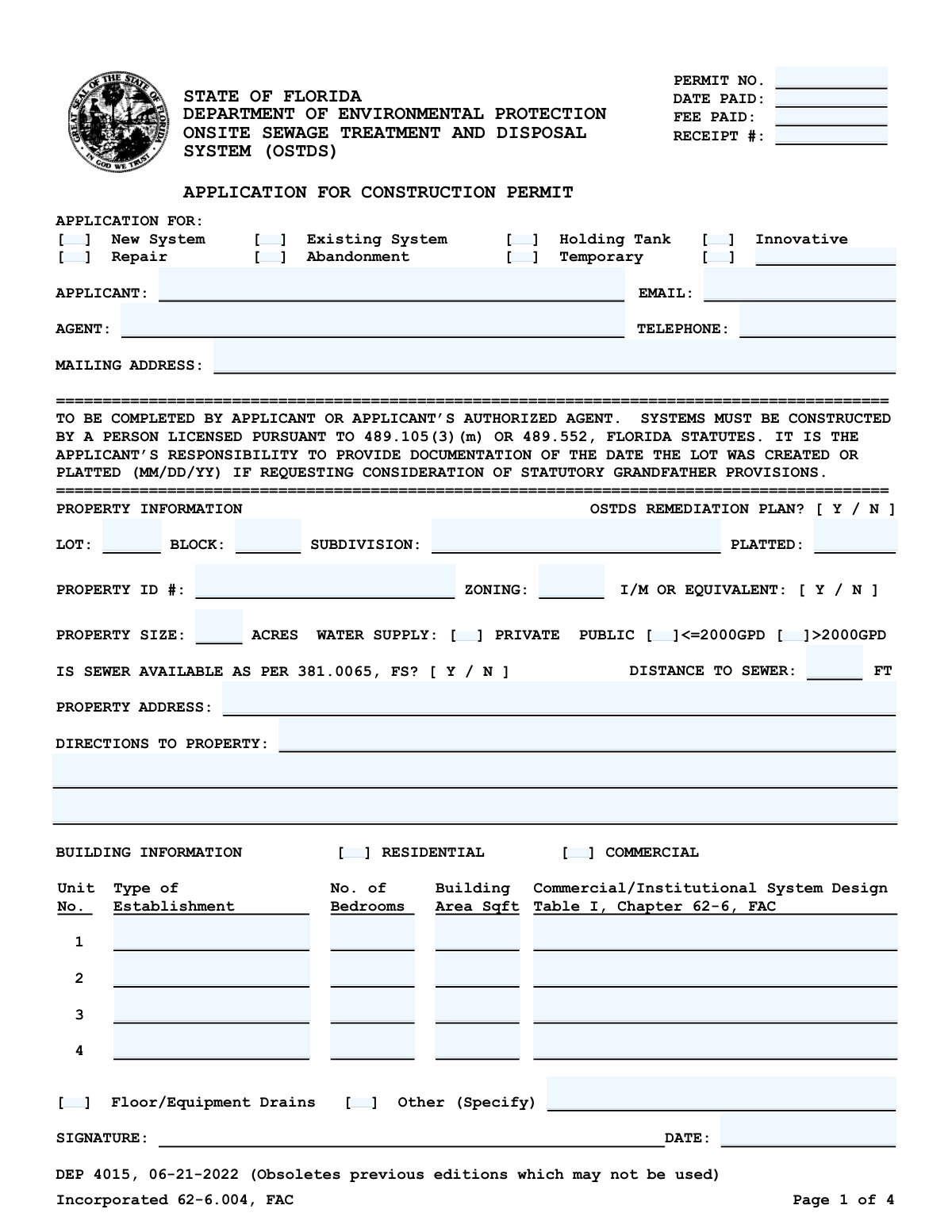
Yes! You can use AI to fill out Form DEP 4015, Application for Construction Permit, Onsite Sewage Treatment and Disposal System (OSTDS)

Form DEP 4015 is the State of Florida's official application for a permit to construct, repair, or modify an Onsite Sewage Treatment and Disposal System (OSTDS), commonly known as a septic system. This document is crucial for property owners and contractors to ensure their sewage systems comply with state environmental and health regulations, protecting public health and Florida's water resources. Today, this form can be filled out quickly and accurately using AI-powered services like Instafill.ai, which can also convert non-fillable PDF versions into interactive fillable forms.
Our AI automatically handles information lookup, data retrieval, formatting, and form filling.
It takes less than a minute to fill out DEP 4015 using our AI form filling.
Securely upload your data. Information is encrypted in transit and deleted immediately after the form is filled out.

Form specifications

Form name: Form DEP 4015, Application for Construction Permit, Onsite Sewage Treatment and Disposal System (OSTDS)
Number of pages: 7
Filled form examples: Form DEP 4015 Examples
Language: English
Categories: permit application forms, construction forms, permit forms
main-image

Instafill Demo: How to fill out PDF forms in seconds with AI

How to Fill Out DEP 4015 Online for Free in 2026

Are you looking to fill out a DEP 4015 form online quickly and accurately? Instafill.ai offers the #1 AI-powered PDF filling software of 2026, allowing you to complete your DEP 4015 form in just 37 seconds or less.
Follow these steps to fill out your DEP 4015 form online using Instafill.ai:
  1. 1 Navigate to Instafill.ai and upload or select the Florida DEP 4015 form.
  2. 2 Use the AI assistant to fill in applicant, agent, and property information, including name, address, and property ID number.
  3. 3 Specify the application type (e.g., New System, Repair) and provide detailed building information, such as residential/commercial use and number of bedrooms.
  4. 4 Complete the site plan section by either drawing on the provided grid or uploading a prepared site plan document with all required features.
  5. 5 Fill out the Site Evaluation and System Specifications, including soil profiles, water table data, and setback measurements, often with information provided by a certified engineer or health department official.
  6. 6 If applicable, complete the Existing System and System Repair Evaluation section, including tank certifications and details about the system failure.
  7. 7 Review all sections for accuracy, e-sign the application, and submit it with the required fees and attachments to the local County Health Department.

Our AI-powered system ensures each field is filled out correctly, reducing errors and saving you time.

Why Choose Instafill.ai for Your Fillable DEP 4015 Form?

Speed

Complete your DEP 4015 in as little as 37 seconds.

Up-to-Date

Always use the latest 2026 DEP 4015 form version.

Cost-effective

No need to hire expensive lawyers.

Accuracy

Our AI performs 10 compliance checks to ensure your form is error-free.

Security

Your personal information is protected with bank-level encryption.

Frequently Asked Questions About Form DEP 4015

This form, DEP 4015, is an application to the Florida Department of Environmental Protection for a permit to construct, repair, modify, or abandon an Onsite Sewage Treatment and Disposal System, commonly known as a septic system.

The property owner (listed as 'Applicant') or their legally authorized representative (listed as 'Agent') must complete and sign the application. Certain technical sections, like the Site Evaluation, must be completed by a qualified professional.

You must submit a detailed site plan drawn to scale, a floor plan of the residence or building, and potentially a copy of the property's legal description or deed. All required attachments are listed on the form.

The site plan must show property boundaries, dimensions, buildings, swimming pools, wells, water lines, and the proposed location of all septic system components. It must also show pertinent features on adjacent properties if they are within 75 feet of your lot.

You must count all rooms designed primarily for sleeping, as well as any other areas that are expected to be used for sleeping accommodations. This helps determine the required size and capacity of the septic system.

The Property ID Number is a unique identifier for your property, which can typically be found on your property tax bill or on the county property appraiser's website. The form notes it may be a 27-character number or a section/township/range/parcel number.

Yes, but the requirements are slightly different for a repair. For example, the site plan for a repair application is not required to be drawn to scale, and you will need to complete the 'Existing System and System Repair Evaluation' on page 4.

The completed application, along with all required documents and fees, must be submitted to your local County Health Department for review and processing.

Florida statutes may require a property to connect to a public sewer system if it is available within a certain distance. This question helps the health department determine if an onsite system is permissible for your property.

Yes, services like Instafill.ai use AI to accurately auto-fill form fields, which can save you time and help prevent common errors. This is especially useful for complex forms with many fields like this one.

You can use a service like Instafill.ai to fill out the form online. Simply upload the PDF, and the tool will make it an interactive, fillable form that you can complete, save, and print from your computer.

If you have a non-fillable PDF, you can use a tool like Instafill.ai to instantly convert it into an interactive, fillable form. This allows you to easily type your information into the fields instead of printing and filling it out by hand.

Compliance DEP 4015
Validation Checks by Instafill.ai

1
Validates Property ID Number Format
This check ensures the 'PROPERTY ID #' field contains exactly 27 characters as specified in the form instructions. This ID is crucial for uniquely identifying the property parcel in state and county records. If the format is incorrect, the application cannot be processed as the property cannot be accurately located and cross-referenced.
2
Ensures an Application Type is Selected
This validation confirms that at least one checkbox under the 'APPLICATION FOR' section has been selected. The application type (e.g., New System, Repair) dictates which form sections are required and how the permit is processed. Failure to select a type will result in an incomplete application and rejection.
3
Conditional Requirement for Distance to Sewer
This check enforces a conditional rule: if 'IS SEWER AVAILABLE' is marked 'Y' (Yes), then the 'DISTANCE TO SEWER' field must contain a positive numerical value. This information is critical for determining eligibility for an onsite system under Florida Statutes 381.0065. An application with available sewer but no specified distance will be considered incomplete.
4
Validates Building Information Based on Type
This check ensures that if 'RESIDENTIAL' is selected, the 'No. of Bedrooms' field is filled with a positive integer. Conversely, if 'COMMERCIAL' is selected, the 'Commercial/Institutional System Design' field must contain data. This ensures the sewage flow calculations are based on the correct parameters for the building's usage, which is fundamental for system design.
5
Verifies Authorized Sewage Flow Exceeds Estimated Flow
This is a critical logical check that validates the 'Authorized Sewage Flow' is greater than or equal to the 'Total Estimated Sewage Flow'. As per form instructions, if the lot cannot support the estimated sewage needs, the application must be denied. This prevents the installation of undersized systems that are destined to fail.
6
Ensures Sufficient Unobstructed Area
This validation confirms that the 'Unobstructed Area Available' is greater than or equal to the 'Unobstructed Area Required'. The unobstructed area is necessary for the drainfield and a potential repair area, and regulations require a minimum size. If the available area is insufficient, the site is not suitable for the proposed system and the permit will be denied.
7
Validates Single Water Supply Selection
This check ensures that exactly one of the three 'WATER SUPPLY' checkboxes (PRIVATE, PUBLIC <=2000GPD, PUBLIC >2000GPD) is selected. The type of water supply directly impacts the calculation for 'Authorized Sewage Flow' and setback requirements. Selecting none or multiple options makes it impossible to correctly evaluate the application.
8
Validates Platted Date Format and Logic
This check ensures the 'PLATTED' date is provided in a valid date format (e.g., MM/DD/YY) and is not a date in the future. The platted date is essential for determining if statutory grandfather provisions apply to the lot. An invalid or future date would prevent proper legal assessment of the property's status.
9
Conditional Requirement for Flood Elevation Data
This validation ensures that if 'SITE SUBJECT TO FREQUENT FLOODING' is marked 'Yes', then the '10 YEAR FLOOD ELEVATION' and 'SITE ELEVATION' fields are completed. This data is vital for designing a system that will function correctly and not pose an environmental hazard during flood events. Missing this information for a flood-prone site will halt the review process.
10
Verifies Contiguous and Logical Soil Profile Depths
This check iterates through the 'SOIL PROFILE INFORMATION' tables to ensure that for each layer, the 'TO' depth is greater than the 'FROM' depth. It also verifies that the layers are contiguous, meaning the 'FROM' depth of a layer matches the 'TO' depth of the layer above it. Inaccurate or illogical soil data invalidates the entire site evaluation.
11
Ensures Failure Details are Provided for Repair Applications
This check is triggered if the 'Application For' type is 'Repair'. It verifies that at least one 'NATURE OF FAILURE' and one 'FAILURE SYMPTOM' checkbox is selected on Page 4. This information is mandatory for diagnosing the existing system's problem and designing an appropriate repair, and its absence makes the repair application incomplete.
12
Cross-Validates Authorized Flow Calculation
This complex validation checks that the 'Authorized Sewage Flow' value is correctly calculated based on other fields. It verifies the flow against the 'Net Usable Area' and the selected 'WATER SUPPLY' type (1500 GPD/acre for private, 2500 GPD/acre for public). An incorrect calculation indicates a misunderstanding of regulations and will lead to application rejection.

Common Mistakes in Completing DEP 4015

Incorrect Property ID Format

Applicants often enter a local county property appraiser ID or a shorter parcel number instead of the required 27-character Property ID number. This happens due to confusion between local and state-level identifiers. An incorrect ID can lead to processing delays as officials must manually search for the correct property, and it may cause the application to be rejected outright. To avoid this, carefully locate the full 27-character number from official property records before filling out the form.

Miscalculating Property Size in Acres

The form requires property size in acres, but applicants often have this information in square feet and make errors during conversion. A common mistake is entering the square footage value directly or using an incorrect conversion formula, leading to an inaccurate 'Authorized Sewage Flow' calculation. This can result in the application being denied if the authorized flow appears insufficient for the proposed system. Always divide the total square footage by 43,560 to get the correct acreage.

Submitting an Inadequate Site Plan

A frequent reason for rejection is submitting a site plan that is not drawn to scale or is missing critical information. The instructions clearly require a to-scale drawing showing boundaries, dimensions, easements, wells, water bodies, and all proposed system components. Submitting a freehand sketch or omitting features like adjacent wells within 75 feet will halt the review process until a compliant plan is provided. Since this form is a non-fillable PDF, using a tool like Instafill.ai can help by converting it to a fillable format, making it easier to manage alongside digital site plan files.

Omitting Mandatory Attachments

Applicants frequently overlook the list of required attachments, such as a floor plan for residences or a legal description if the lot is not in a recorded subdivision. Forgetting to include these documents with the application is a guaranteed cause for delay, as the department cannot proceed with the review without a complete package. Create a checklist from the form's instructions to ensure all necessary documents, like the site plan and floor plan, are included before submission.

Incorrectly Counting Bedrooms

The form's definition of a bedroom includes any room 'expected to routinely provide sleeping accommodations,' which can be broader than a standard real estate definition. Applicants may undercount bedrooms by excluding dens or offices that could be used for sleeping, resulting in an undersized system design. An undersized system will fail to get a permit and, if built, would be inadequate for the dwelling's actual use. Carefully review all rooms and their potential uses against the statute's definition.

Confusing Estimated vs. Authorized Sewage Flow

On page 3, applicants or their agents must calculate both the 'Total Estimated Sewage Flow' based on building use and the 'Authorized Sewage Flow' based on property size. A critical error is having an estimated flow that exceeds the authorized flow, which results in an automatic application denial. This often happens from miscalculating property acreage or misinterpreting the usage tables. Double-check both calculations to ensure the property can legally support the proposed system.

Incomplete or Inaccurate Soil Profile Data

The 'Site Evaluation' section requires detailed soil profile information, including Munsell colors and USDA textures, which must be completed by a qualified professional. This section is often submitted with missing data points or inaccuracies, which prevents the approval of the system design. Since this data determines the type and size of the drainfield, any errors can lead to a request for a new site evaluation, causing significant delays and extra costs.

Missing or Invalid Tank Certification for Repairs

For repair applications, page 4 requires a licensed contractor to certify that the existing tanks were pumped and inspected, and are free of defects. Applicants sometimes attempt to fill this section themselves or the contractor omits crucial details like the pumping date, company name, or how the tank volume was verified. An incomplete or uncertified section will prevent the issuance of a repair permit. Ensure the contractor fills out this section completely and signs it.

Vague 'Directions to Property'

Applicants often provide ambiguous or unhelpful directions, especially for properties without an assigned street address. Phrases like 'turn left at the big rock' are insufficient and can delay the site evaluation for days or weeks while the health department requests clarification. To prevent this, provide clear, step-by-step directions from a major, easily identifiable intersection, or better yet, attach a marked-up area map as suggested by the form.

Incorrectly Identifying Applicant vs. Agent

The form distinguishes between the 'Applicant' (the property owner) and the 'Agent' (a legally authorized representative like a contractor or engineer). People often confuse these roles, putting the contractor's name in the applicant field or vice-versa. This can lead to communication issues, as official correspondence may be sent to the wrong party, and can raise questions about legal authorization to act on the owner's behalf. AI-powered tools like Instafill.ai can help prevent this by using smart field recognition to guide users to enter the correct information in the appropriate fields.
Saved over 80 hours a year

“I was never sure if my IRS forms like W-9 were filled correctly. Now, I can complete the forms accurately without any external help.”

Kevin Martin Green

Your data stays secure with advanced protection from Instafill and our subprocessors

Robust compliance program

Transparent business model

You’re not the product. You always know where your data is and what it is processed for.

ISO 27001, HIPAA, and GDPR

Our subprocesses adhere to multiple compliance standards, including but not limited to ISO 27001, HIPAA, and GDPR.

Security & privacy by design

We consider security and privacy from the initial design phase of any new service or functionality. It’s not an afterthought, it’s built-in, including support for two-factor authentication (2FA) to further protect your account.

Fill out DEP 4015 with Instafill.ai

Worried about filling PDFs wrong? Instafill securely fills form-dep-4015-application-for-construction-permit-onsite-sewage-treatment-and-disposal-system-ostds forms, ensuring each field is accurate.