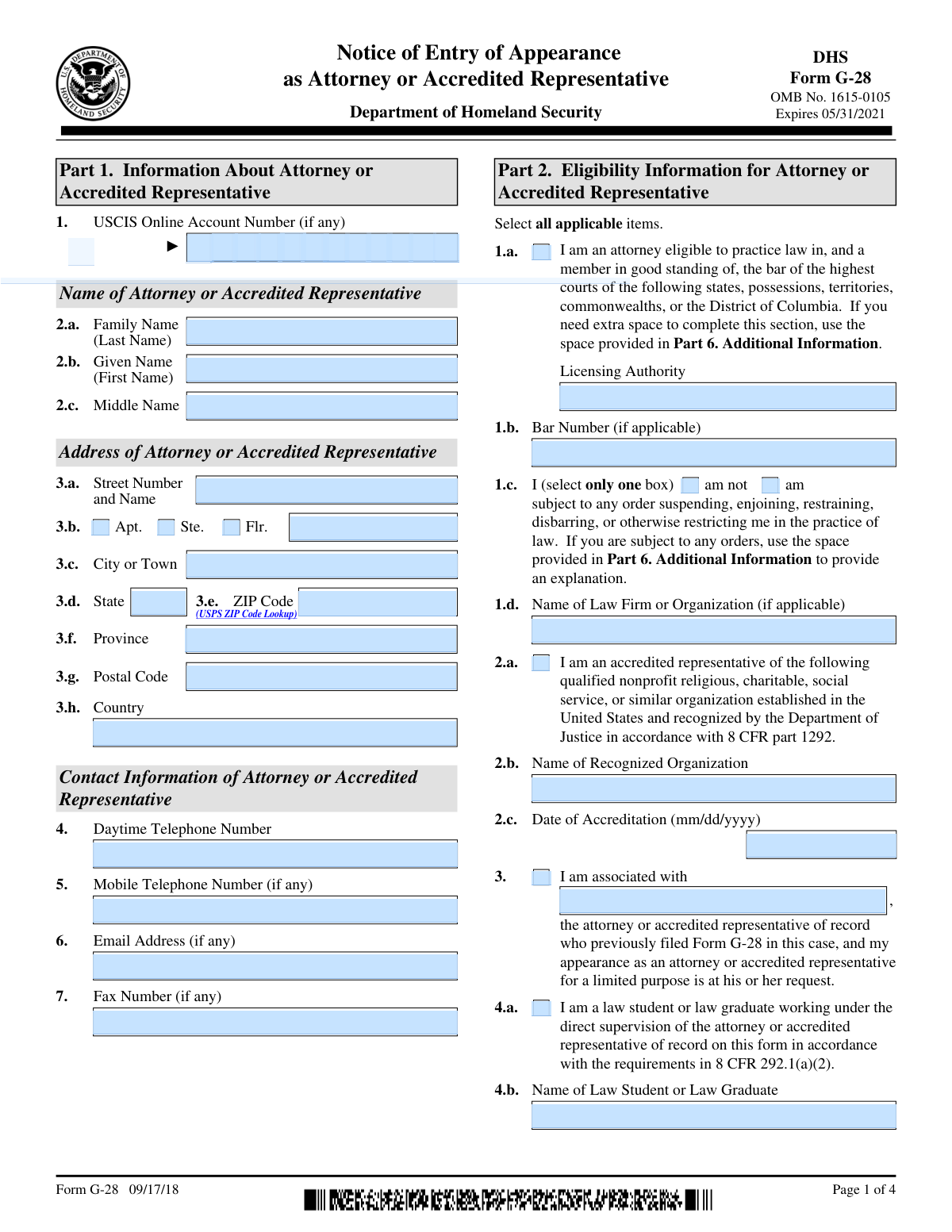
Yes! You can use AI to fill out Form G-28, Notice of Entry of Appearance as Attorney or Accredited Representative
Form G-28, Notice of Entry of Appearance as Attorney or Accredited Representative, is a Department of Homeland Security (DHS) document used by attorneys and accredited representatives to notify agencies like USCIS, ICE, and CBP that they are representing a client in an immigration case. Filing this form is crucial as it establishes the legal relationship, allowing the representative to act on the client's behalf and receive official communications regarding the case. Today, this form can be filled out quickly and accurately using AI-powered services like Instafill.ai, which can also convert non-fillable PDF versions into interactive fillable forms.
Our AI automatically handles information lookup, data retrieval, formatting, and form filling.
It takes less than a minute to fill out G-28 using our AI form filling.
Securely upload your data. Information is encrypted in transit and deleted immediately after the form is filled out.
Form specifications
| Form name: | Form G-28, Notice of Entry of Appearance as Attorney or Accredited Representative |
| Number of pages: | 4 |
| Language: | English |
Instafill Demo: How to fill out PDF forms in seconds with AI
How to Fill Out G-28 Online for Free in 2026
Are you looking to fill out a G-28 form online quickly and accurately? Instafill.ai offers the #1 AI-powered PDF filling software of 2026, allowing you to complete your G-28 form in just 37 seconds or less.
Follow these steps to fill out your G-28 form online using Instafill.ai:
- 1 Navigate to Instafill.ai and upload or select Form G-28.
- 2 Enter the attorney or accredited representative's information in Part 1, including name, contact details, and law firm.
- 3 Complete Part 2 to confirm eligibility, providing bar membership or accreditation details as required.
- 4 In Part 3, specify the agency (USCIS, ICE, or CBP), the specific matter, and provide the client's information.
- 5 Ensure the client completes Part 4, providing their consent to representation, signature, and preferences for receiving notices.
- 6 As the attorney or representative, review the entire form for accuracy and provide your signature in Part 5.
- 7 Use the AI tool to finalize the document, then securely download, print, or e-file the completed Form G-28.
Our AI-powered system ensures each field is filled out correctly, reducing errors and saving you time.
Why Choose Instafill.ai for Your Fillable G-28 Form?
Speed
Complete your G-28 in as little as 37 seconds.
Up-to-Date
Always use the latest 2026 G-28 form version.
Cost-effective
No need to hire expensive lawyers.
Accuracy
Our AI performs 10 compliance checks to ensure your form is error-free.
Security
Your personal information is protected with bank-level encryption.
Frequently Asked Questions About Form G-28
Form G-28, Notice of Entry of Appearance as Attorney or Accredited Representative, is used to notify U.S. immigration agencies (USCIS, ICE, CBP) that an attorney or accredited representative is representing a client in an immigration matter. It establishes the legal relationship and authorizes the representative to act on the client's behalf.
An attorney or an accredited representative who is representing an applicant, petitioner, beneficiary, or respondent in a matter before the Department of Homeland Security (DHS) must file Form G-28. The form must be signed by both the representative and the client.
An accredited representative is a non-attorney who is authorized by the Department of Justice (DOJ) to provide immigration legal services. They must be affiliated with a DOJ-recognized nonprofit, religious, charitable, or social service organization.
Yes, you must file a separate, signed Form G-28 for each individual application, petition, or appeal. If you are filing multiple forms for the same client at the same time, you should include a G-28 with each one.
Your bar information is entered in Part 2 of the form. You must list the state or jurisdiction where you are a member in good standing and provide your bar number, if applicable.
You must provide your client's full name, mailing address, and contact information. It is also crucial to include their Alien Registration Number (A-Number) and USCIS Online Account Number, if they have one.
Yes, in Part 4, your client can authorize USCIS to send original notices and secure documents (like a Green Card or EAD) directly to your business address. By default, USCIS sends copies of notices to both you and your client.
Yes, the client's signature in Part 4 is mandatory. This signature confirms their consent to your representation and authorizes DHS to release their case information to you.
If you are a law student or law graduate working under the direct supervision of an attorney, you can be listed on the G-28. The supervising attorney must be identified as the representative of record, and you must also sign the form in Part 5.
Form G-28 should be filed along with the specific application, petition, or request it pertains to. If a case is already pending, you should file the G-28 with the USCIS office that has jurisdiction over that case.
Part 6 is used to provide any information that doesn't fit in the standard fields of the form. For example, you can use this space to explain an order restricting your practice of law or to list multiple bar admissions.
Yes, services like Instafill.ai use AI to auto-fill form fields accurately and save time. This is particularly useful for attorneys and representatives who handle many cases and need to fill out repetitive information quickly.
To fill out the form online, you can upload the G-28 PDF to Instafill.ai. The platform will convert it into a user-friendly, fillable format that you can complete, sign electronically, and download or share.
If you have a non-fillable or 'flat' PDF, you can use a service like Instafill.ai to make it interactive. The tool automatically detects the fields, allowing you to type your information directly into the form on your computer.
Compliance G-28
Validation Checks by Instafill.ai
1
Attorney/Representative Name Completeness
This check ensures that the Family Name (Last Name) and Given Name (First Name) fields in Part 1 for the attorney or accredited representative are not empty. These fields are essential for identifying the legal representative filing the form. If this validation fails, the form cannot be processed as the primary representative is not identified.
2
Exclusive Eligibility Status Selection
This validation verifies that at least one, and only one, primary eligibility status is selected from the main categories in Part 2 (Attorney, Accredited Representative, Associated Attorney, Law Student). While the form says 'select all applicable', the primary role must be clear. This check prevents ambiguity about the filer's capacity to represent the client. A failure would require the user to clarify their primary role.
3
Conditional Attorney Bar Information
This check ensures that if the box for 'I am an attorney' (Part 2, 1.a) is selected, then the 'Licensing Authority' (1.c) and 'Bar Number' (1.d) fields are filled. This information is critical for verifying the attorney's credentials and good standing. Failure to provide this information when claiming attorney status would render the eligibility claim incomplete and invalid.
4
Conditional Accredited Representative Information
This validation confirms that if the 'I am an accredited representative' box (Part 2, 2.a) is checked, the 'Name of Recognized Organization' (2.b) and 'Date of Accreditation' (2.c) are provided. This is necessary to confirm the representative's affiliation and accreditation status with a DOJ-recognized organization. Without this information, the claim of being an accredited representative cannot be verified.
5
Accreditation Date Validity
This check validates that the 'Date of Accreditation' (Part 2, 2.c) is in the correct 'mm/dd/yyyy' format and is not a future date. An invalid or future date would be illogical and could indicate a data entry error or fraudulent claim. This ensures the representative was accredited before or on the date of filing.
6
Disciplinary Action Explanation Requirement
This validation ensures that if the representative selects 'am subject to any order...' (Part 2, 1.b), an explanation is provided in Part 6. This is a critical integrity check to ensure transparency regarding any restrictions on the representative's practice. A failure to provide the required explanation would result in an incomplete and potentially misleading form.
7
Exclusive Agency Selection
This check verifies that only one agency box (USCIS, ICE, or CBP) is selected in Part 3, Item 1. The form explicitly states to 'select only one box' to define the jurisdiction for this notice of appearance. Selecting multiple or no agencies would create ambiguity and prevent the form from being routed correctly.
8
Conditional Matter/Form Number Entry
This validation ensures that once an agency is selected in Part 3 (Item 1, 2, or 3), the corresponding text field for 'form numbers or specific matter' (1.b, 2.b, or 3.b) is filled. The form is meaningless without specifying the case it applies to. This check guarantees the notice of appearance can be linked to a specific immigration proceeding.
9
Client Name or Entity Name Requirement
This check ensures that either the client's individual name (Part 3, 6.a and 6.b) or the 'Name of Entity' (Part 3, 7.a) is provided. The form must identify who is being represented. If 'Name of Entity' is provided, the 'Title of Authorized Signatory' (7.b) also becomes required to identify the individual acting for the entity.
10
Alien Registration Number (A-Number) Format
This check validates that if a Client's A-Number (Part 3, 8) is entered, it follows the standard USCIS format, which is the letter 'A' followed by 7 to 9 digits. This ensures data integrity and facilitates correct record retrieval in DHS systems. An incorrectly formatted number could lead to processing delays or failure to link the form to the client's file.
11
US Address Completeness
This validation verifies that for any U.S. address on the form (for the representative or the client), the 'Street Number and Name', 'City or Town', 'State', and 'ZIP Code' fields are all completed. A complete address is mandatory for official correspondence. An incomplete address will cause notices to be returned as undeliverable.
12
ZIP Code Format Validation
This check ensures that any 'ZIP Code' entered (e.g., Part 1, 3.e and Part 3, 13.e) is a valid 5-digit or 9-digit (ZIP+4) format. This is crucial for mail delivery from government agencies. An invalid ZIP code will cause processing delays and returned mail.
13
Client Signature and Date Requirement
This validation confirms that the client or authorized signatory has signed (Part 4, 2.a) and dated (Part 4, 2.b) the form. The client's signature is legal consent for representation and information release, making it one of the most critical elements. The form is invalid without the client's signature and a valid, non-future signature date.
14
Attorney Signature and Date Requirement
This check ensures the attorney or accredited representative has signed (Part 5, 1.a) and dated (Part 5, 1.b) the form. The representative's signature is a declaration under penalty of perjury that the information is true and correct. The form cannot be accepted without the representative's signature and a valid, non-future date.
15
Logical Signature Date Sequence
This check compares the client's signature date (Part 4, 2.b) with the attorney's signature date (Part 5, 1.b). Logically, the client consents to representation before or on the same day the attorney signs to enter their appearance. An attorney signature date that precedes the client's would be illogical and may indicate an error.
16
Conditional Law Student Signature
This validation ensures that if the 'I am a law student or law graduate' box is checked in Part 2 (4.a), then the 'Signature of Law Student or Law Graduate' (Part 5, 2.a) and the corresponding signature date (2.b) are present. This is required to confirm the student's declaration and their role under the supervision of the primary representative. The form would be incomplete for the student's appearance without their signature.
Common Mistakes in Completing G-28
In Part 3, filers must select the agency for the appearance (USCIS, ICE, or CBP), but the instruction 'select only one box' is frequently overlooked. Checking multiple boxes because a case spans different agencies will lead to processing errors or rejection of the form. A separate Form G-28 must be filed for each agency and specific matter. To avoid this, carefully read the instructions and file a distinct G-28 for each agency appearance.
When filing with USCIS, Part 3 requires listing the specific form numbers (e.g., I-485, I-130) for which the appearance is being entered. Many submitters enter generic terms like 'Immigration Status' or leave the field blank, which prevents USCIS from linking the G-28 to the correct application. This failure means the attorney will not be recognized on the case or receive correspondence. Always list all specific form numbers or provide a clear description of the matter.
Part 3, Item 13 explicitly requests the client's mailing address and warns against using the attorney's address unless it's a designated safe mailing address. Attorneys or paralegals often input their own business address out of habit. This can cause the client to miss critical, time-sensitive notices from USCIS. To prevent this, always enter the client's actual, current mailing address in this section.
The Alien Registration Number (A-Number) and case Receipt Number are the primary identifiers for linking the G-28 to the correct file. These fields are often left blank or filled with incorrect numbers, making it impossible for officials to process the representation. This leads to the attorney not being recognized and missing case updates. Always verify these numbers with the client and on case documents before filing.
A G-28 is a legal document that is invalid without signatures from both the representative (Part 5) and the client (Part 4). It is a very common and critical error to miss one or both signatures and dates, often due to haste. An unsigned form will be rejected outright, nullifying the representation and causing significant delays until a properly executed form is refiled. Using a final review checklist can help catch this simple but costly mistake.
In Part 4, the client must elect where USCIS sends notices and secure documents, but the options are often misunderstood. If not selected correctly, important documents like Green Cards or Employment Authorization Documents (EADs) could be mailed to the client's address instead of the attorney's office, risking loss or theft. Attorneys must clearly explain these options to the client to ensure the desired boxes are checked, preventing lost documents and costly replacement processes.
Attorneys must provide their bar number and the specific licensing authority in Part 2. This information is sometimes omitted or entered incorrectly, especially by attorneys licensed in multiple states. Incomplete or invalid bar information can lead USCIS to question the attorney's eligibility to practice, resulting in a rejection of the G-28 and delaying representation. This can be avoided by carefully verifying and entering all current bar admission details.
In Part 2, Item 1.b, representatives must state whether they are subject to any order restricting their practice of law. Some may incorrectly check 'am not' to avoid perceived complications, which is a serious misrepresentation. Failing to disclose this information can lead to sanctions and jeopardize the client's case. It is essential to answer this question truthfully and use Part 6 to provide any required explanations.
The 'Additional Information' section (Part 6) is frequently used to provide extra details, but filers often forget to include the corresponding Page, Part, and Item Number. Without this reference, the added information is contextless and will be disregarded by the adjudicating officer. This can lead to a Request for Evidence (RFE) or an adverse decision based on incomplete information. AI-powered tools like Instafill.ai can help structure this data correctly to ensure it's properly associated with the right field.
In Part 3, Item 5, the form requires selecting the client's role (Applicant, Petitioner, Beneficiary, etc.). In complex cases with multiple parties, it's easy to select the wrong role, causing confusion for USCIS about who exactly is being represented. This can lead to notices being sent to the wrong party or the representation being applied to the wrong person's file. Always confirm the client's specific role in the petition being filed before making a selection. Since this form is a non-fillable PDF, a tool like Instafill.ai can convert it into a smart, fillable version, using rules to help prevent such selection errors.
Saved over 80 hours a year
“I was never sure if my IRS forms like W-9 were filled correctly. Now, I can complete the forms accurately without any external help.”
Kevin Martin Green
Your data stays secure with advanced protection from Instafill and our subprocessors

Robust compliance program
Transparent business model
You’re not the product. You always know where your data is and what it is processed for.
ISO 27001, HIPAA, and GDPR
Our subprocesses adhere to multiple compliance standards, including but not limited to ISO 27001, HIPAA, and GDPR.
Security & privacy by design
We consider security and privacy from the initial design phase of any new service or functionality. It’s not an afterthought, it’s built-in, including support for two-factor authentication (2FA) to further protect your account.
Fill out G-28 with Instafill.ai
Worried about filling PDFs wrong? Instafill securely fills form-g-28-notice-of-entry-of-appearance-as-attorney-or-accredited-representative forms, ensuring each field is accurate.