
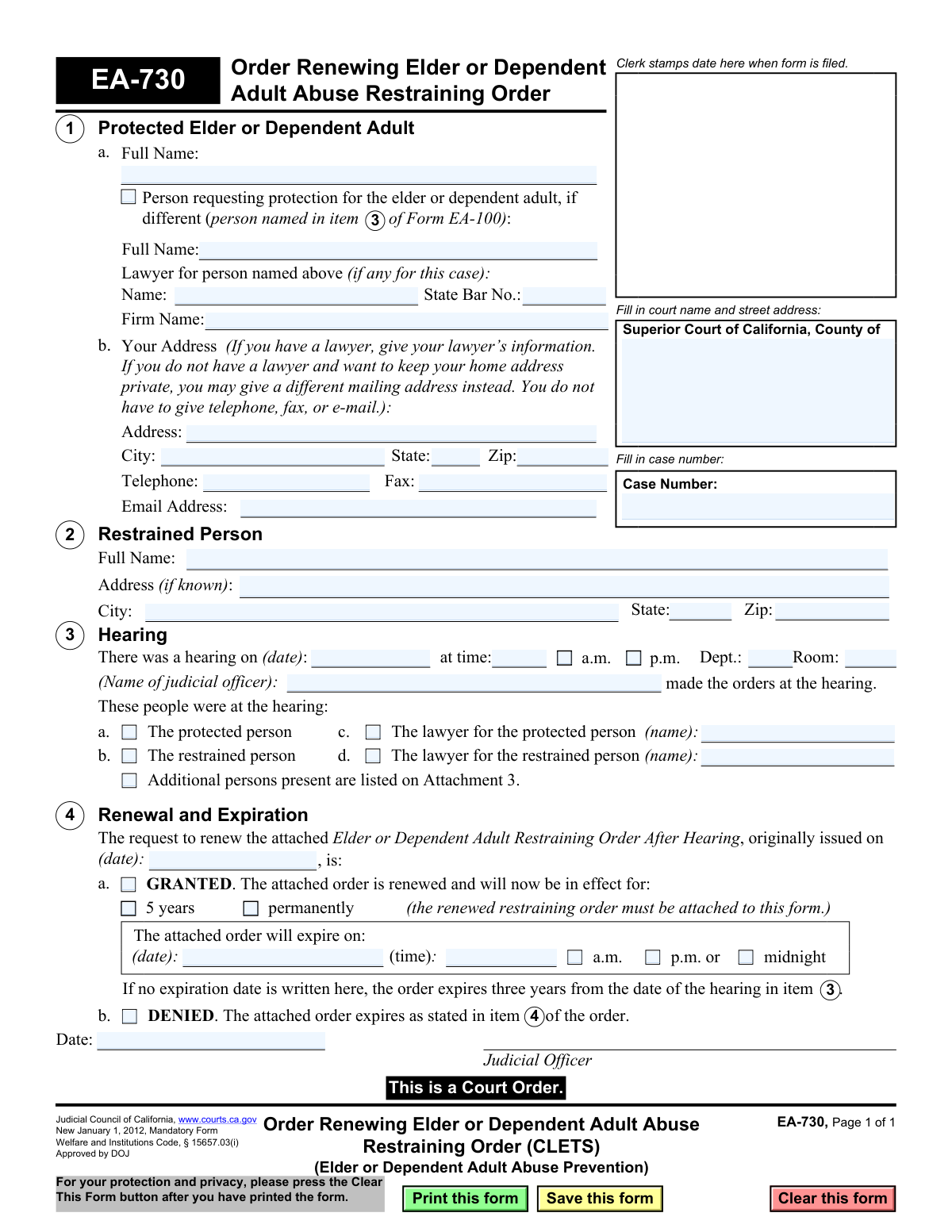
Yes! You can use AI to fill out Form EA-730, Order Renewing Elder or Dependent Adult Abuse Restraining Order (CLETS) (Elder or Dependent Adult Abuse Prevention)
Don't type 49 fields by hand. Tell our AI about yourself, or upload a document you already have, and it fills every field in seconds. You check it, then download, print or sign.
The AI does the filling. You just check it.
No typing into boxes, nothing to install.
What this form asks for
The AI fills all of it, from your answers or your documents.
The AI checks your answers before you download
12 checks built for this form, so a wrong date or a missing answer is caught before anyone else sees it.
This check ensures the 'Case Number' field is not empty and conforms to the court's expected format. The case number is the primary identifier for the legal proceeding, and its absence or incorrect format would make it impossible to file the order correctly. A validation failure would prevent submission until a valid case number is entered.
Validates that the full names for both the 'Protected Elder or Dependent Adult' (Item 1) and the 'Restrained Person' (Item 2) are provided. These fields are critical for the order's legal validity and for entry into law enforcement systems like CLETS. An order cannot be enforced without clearly identifying all parties involved.
Ensures that the hearing date, time, and the name of the judicial officer in Item 3 are all filled out. This information is essential for the official record, confirming when and by whose authority the order was made. If this information is missing, the order's authenticity and legal standing could be questioned.
This validation performs a logical check on three key dates: the original order issue date (Item 4), the hearing date (Item 3), and the judicial officer's signature date. The sequence must be: Original Order Date ≤ Hearing Date ≤ Signature Date. This prevents illogical or impossible timelines, such as an order being signed before the hearing even occurred.
Verifies that in Item 4, either the 'GRANTED' checkbox or the 'DENIED' checkbox is selected, but not both. This is the core decision of the order, and it must be unambiguous. A failure would occur if neither is checked or if both are checked, as the outcome of the renewal request would be unclear.
If the 'GRANTED' checkbox in Item 4 is selected, this check ensures that a renewal period ('5 years' or 'permanently') is also chosen. This is crucial for defining the new terms of the restraining order. If an order is granted renewal without a specified duration, its enforceability and expiration are ambiguous.
And 6 more checks
- Future Expiration Date Logic
- Conditional Lawyer Name Entry
- State Bar Number Format
- Court Information Presence
- Valid Address State and ZIP Code
- Hearing Attendance Confirmation
Let AI fill out your EA-730
No typing. Every field filled in seconds, checked, ready to sign.
How to Fill Out EA-730 Online for Free in 2026
What the AI walks you through.
- Navigate to Instafill.ai and upload or select Form EA-730.
- Enter the court and case information, including the Superior Court name, county, and specific case number.
- Identify the full name and address of the protected elder/dependent adult and the restrained person.
- Input the details of the hearing, such as the date, time, department, and the names of the judicial officer and all persons present.
- Indicate the judge's decision by checking whether the renewal is 'GRANTED' or 'DENIED' and specify the new expiration date and time if granted.
- Review all the auto-filled information for accuracy, ensuring all names, dates, and legal details are correct before the judge signs.
- Obtain the judicial officer's signature and the date to officially validate and enact the court order.
Common Mistakes in Completing EA-730
The ones the AI is built to catch.
Incomplete Court or Case Number
Using Incorrect or Partial Names
Confusing the Petitioner with the Protected Person
Exposing a Confidential Home Address
Incorrectly Documenting Hearing Information
Ambiguous Renewal and Expiration Details
Entering the Wrong Date for the Original Order
Omitting Required Lawyer Information
Failing to Attach the Original Order
Frequently Asked Questions About EA-730
Is it really free for 7 days?
Can I fill other forms too?
How do I cancel?
How does the AI fill out EA-730?
What happens to my information?
How complex is EA-730 to fill out?
What is Form EA-730, the Order Renewing Elder or Dependent Adult Abuse Restraining Order?
Do I fill out this form to renew my restraining order?
If I don't fill out this form, which one do I use to ask for a renewal?
What information is needed for Form EA-730?
If my renewal is granted, how long will the new restraining order last?
What happens if no expiration date is written on my renewed order?
What does it mean if the 'DENIED' box is checked in Section 4?
What should I do with this form after I receive it from the court?
What does '(CLETS)' mean on the form?
Who is the 'Protected Person' and who is the 'Restrained Person'?
Can I use an AI tool to help with my restraining order renewal?
How can I fill out the required court forms online?
What if the PDF for my request form is not fillable?
Get your EA-730 filled out by AI
$0 today. Cancel before Oct 31 and you pay nothing.
Other forms like this one
California court forms: Judicial Council of California Form SC-105, Request for Court Order and Answer (Small Claims), Judicial Council of California Form SC-120, Defendant’s Claim and ORDER to Go to Small Claims Court (Small Claims), Judicial Council of California Form SER-001, Request for Sheriff to Serve Court Papers, Judicial Council of California Form SER-001, Request for Sheriff to Serve Court Papers, Affidavit for Collection of Personal Property California Probate Code Section 13100, Form POS-040, Proof of Service—Civil, Declaration of Facts of Death (California Superior Court), declaration-of-marriage-for-court-proceeding-california-family-law, ADOPT-200, Adoption Request, ADOPT-200, Stepparent Adoption Request, ADOPT-210, Adoption Agreement, ADOPT-310, Contact After Adoption Agreement, Judicial Council of California Form ADOPT-200, Adoption Request, Form ADR-107, Mediation Attendance Sheet, Form ADR-110, Order Appointing Referee, Form ADR-109, Stipulation or Motion for Order Appointing Referee, Form ADR-102, Request for Trial De Novo After Judicial Arbitration, Form ADR-108, Referee's Report (Code Civ. Proc., §§ 638, 639), Form ADR-106, Petition to Confirm, Correct, or Vacate Contractual Arbitration Award, Form ADR-104, Rejection of Award and Request for Trial After Attorney-Client Fee Arbitration
restraining order forms: Form DV-100, Request for Domestic Violence Restraining Order, DV-100, Request for Domestic Violence Restraining Order (Domestic Violence Prevention), Judicial Council of California Form DV-110, Temporary Restraining Order (CLETS-TRO) (Domestic Violence Prevention), Form DV-116, Order on Request to Continue Court Hearing (Temporary Restraining Order) (CLETS-TRO) (Domestic Violence Prevention), Form DV-130, Restraining Order After Hearing (Order of Protection) (Domestic Violence Prevention), Form CH-110, Temporary Restraining Order (CLETS-TCH) (Civil Harassment Prevention), Form CH-120, Response to Request for Civil Harassment Restraining Orders, Form CH-130, Civil Harassment Restraining Order After Hearing (CLETS-CHO), Order on Request to Modify/Terminate Civil Harassment Restraining Order (Civil Harassment Prevention), Form CH-620, Response to Request to Modify/Terminate Civil Harassment Restraining Order (Civil Harassment Prevention), Form CIV-025, Application and Order for Reissuance of Order to Show Cause and Temporary Restraining Order, Form CD-190, Application for Temporary Restraining Order (Claim and Delivery), Order on Request to Continue Hearing (Temporary Restraining Order) (CLETS-TCH) (Civil Harassment Prevention), Form CH-610, Notice of Hearing on Request to Modify/Terminate Civil Harassment Restraining Order (Civil Harassment Prevention), Form CH-700, Request to Renew Restraining Order (Civil Harassment Prevention), Form CH-730, Order Renewing Civil Harassment Restraining Order (CLETS), Form DV-120, Response to Request for Domestic Violence Restraining Order (Domestic Violence Prevention), Form DV-300, Request to Change or End Restraining Order (Domestic Violence Prevention), Form DV-310, Notice of Court Hearing and Temporary Order to Change or End Restraining Order (Domestic Violence Prevention), Form DV-315, Request to Reschedule Hearing to Change or End Restraining Order (Domestic Violence Prevention)
Let AI fill out your EA-730
Your trial starts once a card is added. You pay nothing before Oct 31.
Our AI already knows this form, all 49 fields of it. Skip the typing: tell it about yourself, or upload what you have, and it fills the whole form in seconds.
- AI fills every field on the form, checkboxes included
- No typing into boxes: answer a few questions, or upload a document you already have, an old copy of this form, a photo of a document
- The AI checks the answers; you review and change anything before you download
- Download the finished PDF, print it, or sign it online
- Encrypted, and never used to train AI
Cancel before Oct 31 and you pay nothing.
A card is needed to start the trial. Cancel in two clicks from your account.
Terms · Privacy