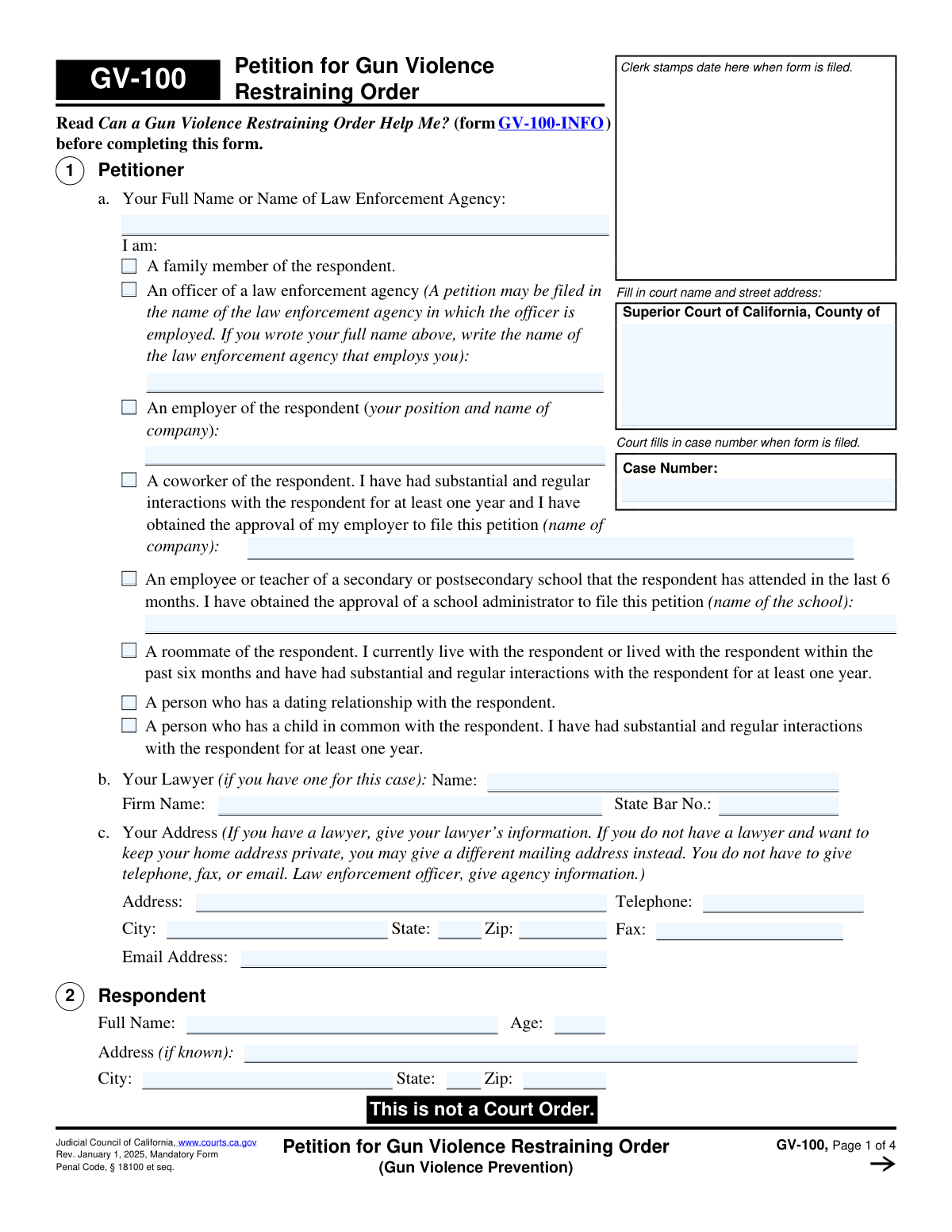
Yes! You can use AI to fill out Form GV-100, Petition for Gun Violence Restraining Order

The California Form GV-100, Petition for Gun Violence Restraining Order, is used to ask a court to temporarily prohibit a person from having firearms, ammunition, or magazines because they pose a significant danger of self-harm or harm to others. It can be filed by family members, law enforcement, employers, coworkers, and certain school personnel. This legal action is a critical tool for preventing gun violence by intervening when there are clear warning signs of potential danger. Today, this form can be filled out quickly and accurately using AI-powered services like Instafill.ai, which can also convert non-fillable PDF versions into interactive fillable forms.
GV-100 is part of the California court forms and restraining order forms categories on Instafill.
Our AI automatically handles information lookup, data retrieval, formatting, and form filling.
It takes less than a minute to fill out GV-100 using our AI form filling.
Securely upload your data. Information is encrypted in transit and deleted immediately after the form is filled out.

Form specifications

Form name: Form GV-100, Petition for Gun Violence Restraining Order
Number of fields: 126
Number of pages: 1
Language: English
main-image

Instafill Demo: How to fill out PDF forms in seconds with AI

How to Fill Out GV-100 Online for Free in 2026

Are you looking to fill out a GV-100 form online quickly and accurately? Instafill.ai offers the #1 AI-powered PDF filling software of 2026, allowing you to complete your GV-100 form in just 37 seconds or less.
Follow these steps to fill out your GV-100 form online using Instafill.ai:
  1. 1 Navigate to Instafill.ai and upload the GV-100 PDF or select it from their form library.
  2. 2 Provide your information as the petitioner, including your name, relationship to the respondent, and contact details.
  3. 3 Enter the respondent's personal information, such as their full name, age, and last known address.
  4. 4 Clearly state the reasons for requesting the order, detailing specific threats, acts of violence, or other behaviors that demonstrate a risk of harm.
  5. 5 List any known firearms, firearm parts, or ammunition the respondent possesses, including types, quantities, and locations, if known.
  6. 6 Review the entire form after the AI has populated the fields to ensure all information is accurate and complete.
  7. 7 Electronically sign the declaration under penalty of perjury and download the completed form to file with the appropriate Superior Court of California.

Our AI-powered system ensures each field is filled out correctly, reducing errors and saving you time.

Why Choose Instafill.ai for Your Fillable GV-100 Form?

Speed

Complete your GV-100 in as little as 37 seconds.

Up-to-Date

Always use the latest 2026 GV-100 form version.

Cost-effective

No need to hire expensive lawyers.

Accuracy

Our AI performs 10 compliance checks to ensure your form is error-free.

Security

Your personal information is protected with bank-level encryption.

Frequently Asked Questions About Form GV-100

This form is used to ask a California court to temporarily prohibit a person from having, buying, or possessing firearms, ammunition, and body armor because they pose a significant danger of harming themselves or others.

As listed in Section 1, you can file this petition if you are a family member, law enforcement officer, employer, coworker, recent teacher/school employee, roommate, dating partner, or co-parent of the person in question. Some categories, like coworkers, require employer approval to file.

That is acceptable. In Section 5, you can either list the details you know or check box 5b to state that you believe the person possesses firearms but you lack specific information.

In Section 6, you must explain how the person poses a danger. You should include specific facts about threats, acts of violence, recent firearm acquisitions, violations of other protective orders, or any other evidence of an increased risk for violence.

A final Gun Violence Restraining Order, granted after a court hearing, can last for a period between one and five years. You must state the length of time you are requesting in Section 7 of the form.

No. As stated in Section 9, if you choose to have the sheriff or marshal serve the papers, they will do so for free.

Yes, you can ask the court for a Temporary Gun Violence Restraining Order by completing Section 10. This temporary order provides immediate protection and lasts until the date of the scheduled court hearing.

No, you are not required to list your home address. Section 1c explicitly states that if you do not have a lawyer, you may provide a different, safe mailing address to keep your home address private.

You should file the petition in the Superior Court of the county where the respondent lives, as specified in Section 3, 'Venue'.

The court will set a hearing date, and you must arrange for the respondent to be personally served with a copy of the petition and the notice of the hearing. This must be done at least five days before the hearing, unless the court approves a shorter time.

Yes, services like Instafill.ai use AI to help you accurately auto-fill form fields, which can save time and reduce the risk of errors on complex legal documents like this.

You can use a service like Instafill.ai to complete the form digitally. Simply upload the GV-100 PDF to their platform, and the AI will create an interactive version for you to fill out online.

If you have a non-fillable or 'flat' PDF, you can use a tool like Instafill.ai. It can convert the static document into an interactive, fillable form that you can easily complete on your computer.

Compliance GV-100
Validation Checks by Instafill.ai

Common Mistakes in Completing GV-100

Insufficient Justification for the Order

In Section 6, petitioners often provide a vague or purely emotional narrative instead of specific, factual events. The court needs concrete examples of threats, violent acts, recent firearm acquisitions, or other behaviors listed on the form to justify removing someone's rights. A weak explanation can lead to the petition being denied. To avoid this, detail each incident with dates, locations, and specific actions or words used by the respondent.

Failing to Protect Personal Address

Petitioners concerned for their safety may mistakenly write their home address in Section 1c, missing the instruction that they can provide a different, safer mailing address. This can put the petitioner at risk of retaliation from the respondent, who will be served a copy of the form. Always use a P.O. Box or an alternative safe address if you have privacy concerns; do not leave it blank.

Incomplete Respondent Information

Leaving fields in Section 2 blank or providing partial information, such as a nickname instead of a full legal name, is a frequent error. Inaccurate or incomplete data makes it difficult for the court to properly identify the respondent and for law enforcement to serve the order. This can cause significant delays or dismissal of the petition. Use the full legal name and provide the most complete address and description you can.

Omitting Other Court Case History

Petitioners often check 'No' or leave Section 4 blank, even when the respondent has a history of other legal issues like domestic violence or criminal cases. This information is critical as it helps the judge see a pattern of dangerous behavior. Failing to disclose known cases weakens the petition; it is better to provide partial information than none at all.

Forgetting to Justify Urgent Requests

In Sections 10 and 11, petitioners request a temporary order or a shortened notice period but forget to explain why it is necessary. The court cannot grant these ex parte requests without a compelling reason, such as immediate danger of violence or fear the respondent will hide their firearms. Failure to provide a written justification will almost certainly result in the request being denied.

Vague or Incomplete Firearm Descriptions

In Section 5, many people check box 5b ('no further specific information') out of uncertainty, even if they know some details. Providing any known information in 5a—such as 'long rifle' or 'black handgun seen in a car glovebox'—is better than nothing. Specific details strengthen the petition and give law enforcement crucial information for safely securing the weapons, while vagueness can undermine the perceived urgency.

Forgetting to Sign and Date the Petition

Submitting an unsigned or undated form is a simple but critical error that renders the entire petition invalid. The signature in Section 13 confirms that the information is true under penalty of perjury. An unsigned form will be immediately rejected by the court clerk, forcing you to start the filing process over again.

Ignoring the 'Less Restrictive Alternatives' Requirement

Section 6 requires the petitioner to explain why less restrictive alternatives to a GVRO are inadequate, a legal point many filers overlook. A judge needs to know why other options, such as involving family or mental health services, were tried and failed or are not appropriate for the situation. Neglecting this part of the narrative can be a reason for a judge to deny the order.

Leaving Requested Order Duration Blank

In Section 7, petitioners must specify the number of years (from one to five) they are requesting the order to be in effect and justify that length. People often forget to fill in the number of years or provide a reason for their request. This ambiguity forces the judge to guess the petitioner's intent and may result in a shorter order than desired.

Incorrectly Selecting Petitioner Relationship

In Section 1, a petitioner might check the wrong box defining their relationship to the respondent or fail to include required information, such as employer approval for a coworker petition. This mistake can challenge the petitioner's legal standing to file the petition in the first place. Carefully read each category and ensure you meet all stated criteria before checking the box.
Saved over 80 hours a year

“I was never sure if my IRS forms like W-9 were filled correctly. Now, I can complete the forms accurately without any external help.”

Kevin Martin Green

Your data stays secure with advanced protection from Instafill and our subprocessors

Robust compliance program

Transparent business model

You’re not the product. You always know where your data is and what it is processed for.

ISO 27001, HIPAA, and GDPR

Our subprocesses adhere to multiple compliance standards, including but not limited to ISO 27001, HIPAA, and GDPR.

Security & privacy by design

We consider security and privacy from the initial design phase of any new service or functionality. It’s not an afterthought, it’s built-in, including support for two-factor authentication (2FA) to further protect your account.

Fill out GV-100 with Instafill.ai

Worried about filling PDFs wrong? Instafill securely fills form-gv-100-petition-for-gun-violence-restraining-order forms, ensuring each field is accurate.

Related forms by category

California court forms Judicial Council of California Form SC-105, Request for Court Order and Answer (Small Claims), Judicial Council of California Form SC-120, Defendant’s Claim and ORDER to Go to Small Claims Court (Small Claims), Judicial Council of California Form SER-001, Request for Sheriff to Serve Court Papers, Judicial Council of California Form SER-001, Request for Sheriff to Serve Court Papers, Affidavit for Collection of Personal Property California Probate Code Section 13100, Form POS-040, Proof of Service—Civil, Declaration of Facts of Death (California Superior Court), declaration-of-marriage-for-court-proceeding-california-family-law, ADOPT-200, Adoption Request, ADOPT-200, Stepparent Adoption Request, ADOPT-210, Adoption Agreement, ADOPT-310, Contact After Adoption Agreement, Judicial Council of California Form ADOPT-200, Adoption Request, Form ADR-107, Mediation Attendance Sheet, Form ADR-110, Order Appointing Referee, Form ADR-109, Stipulation or Motion for Order Appointing Referee, Form ADR-102, Request for Trial De Novo After Judicial Arbitration, Form ADR-108, Referee's Report (Code Civ. Proc., §§ 638, 639), Form ADR-106, Petition to Confirm, Correct, or Vacate Contractual Arbitration Award, Form ADR-104, Rejection of Award and Request for Trial After Attorney-Client Fee Arbitration · + 434 more →
restraining order forms Form DV-100, Request for Domestic Violence Restraining Order, DV-100, Request for Domestic Violence Restraining Order (Domestic Violence Prevention), Judicial Council of California Form DV-110, Temporary Restraining Order (CLETS-TRO) (Domestic Violence Prevention), Form DV-116, Order on Request to Continue Court Hearing (Temporary Restraining Order) (CLETS-TRO) (Domestic Violence Prevention), Form DV-130, Restraining Order After Hearing (Order of Protection) (Domestic Violence Prevention), Form CH-110, Temporary Restraining Order (CLETS-TCH) (Civil Harassment Prevention), Form CH-120, Response to Request for Civil Harassment Restraining Orders, Form CH-130, Civil Harassment Restraining Order After Hearing (CLETS-CHO), Order on Request to Modify/Terminate Civil Harassment Restraining Order (Civil Harassment Prevention), Form CH-100, Request for Civil Harassment Restraining Orders (Civil Harassment Prevention), Form CH-620, Response to Request to Modify/Terminate Civil Harassment Restraining Order (Civil Harassment Prevention), Form CIV-025, Application and Order for Reissuance of Order to Show Cause and Temporary Restraining Order, Form CD-190, Application for Temporary Restraining Order (Claim and Delivery), Order on Request to Continue Hearing (Temporary Restraining Order) (CLETS-TCH) (Civil Harassment Prevention), Form CH-610, Notice of Hearing on Request to Modify/Terminate Civil Harassment Restraining Order (Civil Harassment Prevention), Form CH-700, Request to Renew Restraining Order (Civil Harassment Prevention), Form CH-730, Order Renewing Civil Harassment Restraining Order (CLETS), Form DV-120, Response to Request for Domestic Violence Restraining Order (Domestic Violence Prevention), Form DV-300, Request to Change or End Restraining Order (Domestic Violence Prevention), Form DV-310, Notice of Court Hearing and Temporary Order to Change or End Restraining Order (Domestic Violence Prevention) · + 37 more →