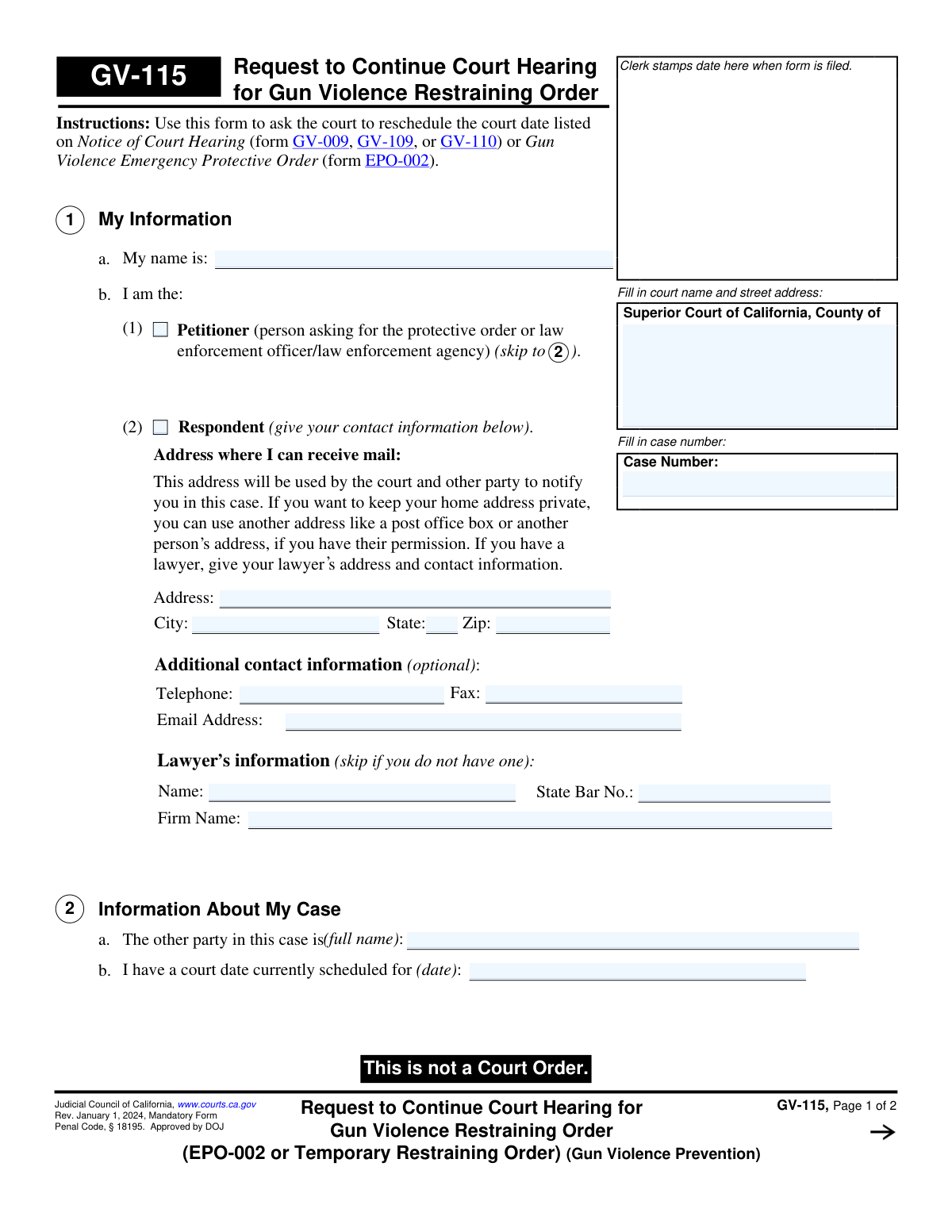
Yes! You can use AI to fill out Form GV-115, Request to Continue Court Hearing for Gun Violence Restraining Order (EPO-002 or Temporary Restraining Order)
Form GV-115, officially titled 'Request to Continue Court Hearing for Gun Violence Restraining Order,' is a mandatory form in California used by either a petitioner or respondent to ask the court to reschedule a hearing. It is essential for managing case timelines, often used when a party needs more time to properly serve legal documents. Today, this form can be filled out quickly and accurately using AI-powered services like Instafill.ai, which can also convert non-fillable PDF versions into interactive fillable forms.
Our AI automatically handles information lookup, data retrieval, formatting, and form filling.
It takes less than a minute to fill out GV-115 using our AI form filling.
Securely upload your data. Information is encrypted in transit and deleted immediately after the form is filled out.
Form specifications
| Form name: | Form GV-115, Request to Continue Court Hearing for Gun Violence Restraining Order (EPO-002 or Temporary Restraining Order) |
| Number of fields: | 37 |
| Number of pages: | 1 |
| Language: | English |
Instafill Demo: How to fill out PDF forms in seconds with AI
How to Fill Out GV-115 Online for Free in 2026
Are you looking to fill out a GV-115 form online quickly and accurately? Instafill.ai offers the #1 AI-powered PDF filling software of 2026, allowing you to complete your GV-115 form in just 37 seconds or less.
Follow these steps to fill out your GV-115 form online using Instafill.ai:
- 1 Navigate to Instafill.ai and upload your GV-115 form, or select it from the platform's template library.
- 2 In Section 1, provide your personal information and specify whether you are the petitioner or the respondent in the case.
- 3 Enter the case information in Section 2, including the name of the other party and the current court date that needs to be rescheduled.
- 4 In Section 3, check the appropriate box and provide a clear reason for requesting the continuance, such as needing more time to serve papers.
- 5 Complete Section 4 by indicating whether a temporary restraining order is currently in effect and providing any related details.
- 6 Use Instafill.ai's review feature to check all entered information for accuracy and completeness before finalizing the document.
- 7 Sign and date the declaration under penalty of perjury, then download the completed form to be filed with the court.
Our AI-powered system ensures each field is filled out correctly, reducing errors and saving you time.
Why Choose Instafill.ai for Your Fillable GV-115 Form?
Speed
Complete your GV-115 in as little as 37 seconds.
Up-to-Date
Always use the latest 2026 GV-115 form version.
Cost-effective
No need to hire expensive lawyers.
Accuracy
Our AI performs 10 compliance checks to ensure your form is error-free.
Security
Your personal information is protected with bank-level encryption.
Frequently Asked Questions About Form GV-115
Form GV-115, 'Request to Continue Court Hearing for Gun Violence Restraining Order,' is used to ask the court to reschedule a court date related to a Gun Violence Emergency Protective Order (EPO-002) or a Temporary Restraining Order (TRO).
This form can be completed by either the petitioner (the person who requested the protective order) or the respondent (the person the order is against) to request a postponement of the scheduled hearing.
A common reason, listed directly on the form, is that the petitioner was unable to serve the court papers to the respondent in time for the hearing. You can also provide other specific reasons for needing to reschedule in section 3.
If the court grants your request to continue the hearing, the existing Temporary Gun Violence Restraining Order or Emergency Protective Order will remain in effect until the new court date, unless the court orders otherwise.
You will need your case number, the name of the other party, the currently scheduled court date, and a clear reason for your request. If you are the respondent, you may also need to state whether you have complied with firearm relinquishment orders.
You must file the completed form with the clerk at the Superior Court where your hearing is scheduled. The court's name and address should be filled in at the top of the form.
The form states you can use an alternative address, such as a post office box or another person's address (with their permission), to receive mail for the case. This allows you to keep your home address private.
Yes, if you are the respondent and a temporary order is in effect, you must answer question 4b about whether you have turned in, sold, or stored your prohibited items like guns and ammunition.
After you file the form, the court will review your request. The judge will decide whether or not to grant the continuance and reschedule the hearing.
If you have a non-fillable PDF, you can use a service like Instafill.ai. It can convert flat, non-interactive PDFs into fillable forms that you can complete easily on your computer.
Yes, AI-powered services like Instafill.ai can help you fill out this form. They use AI to accurately auto-fill form fields with your information, which saves time and helps reduce errors.
To fill out this form using Instafill.ai, you would typically upload the form to their platform, let the AI assist in filling out the fields with your saved information, and then download the completed, ready-to-file document.
No, you are not required to have a lawyer to fill out and file Form GV-115. The form is designed to be used by individuals representing themselves, but you always have the option to consult with an attorney.
Compliance GV-115
Validation Checks by Instafill.ai
1
Case Number Consistency Across Pages
This check ensures that the Case Number entered on page 1 (field CaseNumber_ft[0]) is identical to the Case Number entered in the header of page 2 (field P2Header[0].CaseNumber_ft[0]). This is critical for document integrity and to ensure all pages of the filing are correctly associated with the same case. A mismatch could lead to the form being rejected or misfiled by the court clerk.
2
Exclusive Filer Role Selection
Validates that exactly one of the two checkboxes in section 1b, 'Petitioner' (PartyDef_cb[0]) or 'Respondent' (PartyDef_cb[0]), is selected. The form requires a clear identification of the filer's role in the case to be processed correctly. Failure to select one and only one role makes the request ambiguous and will result in a processing error.
3
Mandatory Filer Name
Ensures that the filer's name in section 1a ('My name is:') is not empty. This field is fundamental for identifying the individual making the request to the court. Without this information, the form is incomplete and has no legal standing, leading to immediate rejection.
4
Conditional Respondent Contact Information
This validation checks that if the filer identifies as the 'Respondent' in section 1b, then their contact address fields (Street, City, State, Zip) are completed. This information is legally required for the court and the other party to send official notices. If this information is missing, the court cannot process the request as it cannot guarantee proper notification.
5
Valid Email Address Format
Verifies that the value entered into the Email Address field (ProtectedEmail_ft[0]) conforms to a standard email format (e.g., '[email protected]'). While optional, if an email is provided, it must be valid to ensure successful electronic communication from the court. An invalid format would prevent the user from receiving important case updates electronically.
6
Mandatory Other Party Name
This check confirms that the full name of the other party in the case is provided in section 2a (RestrainedFullName_ft[0]). Identifying the other party is essential for the court to understand the context of the request and to provide proper notification. The form cannot be processed without this crucial piece of information.
7
Future Hearing Date Requirement
Validates that the date entered for the currently scheduled court date in section 2b (CurrentHearing_dt[0]) is a valid date that occurs in the future. A request to continue a hearing that has already passed is logically invalid. The system should reject any past or current-day dates to prevent nonsensical submissions.
8
Reason for Continuance Selection
Ensures that at least one of the reasons for the continuance request in section 3 is selected. The filer must either check the box for 'could not get the papers served' (MultilineCheckBox[0]) or the box for 'other reasons' (ReasonOther_cb[0]). The court requires a justification for the request, and failure to provide one will result in the request being denied.
9
Conditional Explanation for 'Other Reasons'
If the checkbox for 'other reasons' (ReasonOther_cb[0]) in section 3 is selected, this validation ensures the corresponding text area (Below_ft[0]) is not empty. The court requires a specific, written explanation if the standard reason is not applicable. An empty explanation field makes the selection invalid and the request incomplete.
10
Exclusive Current Order Status
Verifies that exactly one of the three options ('Yes', 'No', or 'I don't know') is selected in section 4a regarding an active restraining order. This information is critical for the judge to understand the current status of protections and make an informed decision about the continuance. Selecting none or multiple options makes the form invalid.
11
Conditional Order Date Entry
This check is triggered if the user answers 'Yes' to the question in section 4a. It ensures that a date is entered in the 'Date the order was made' field (DateField1[0]) and that this date is in the past. This provides the court with necessary context about the existing order; failure to provide it when required makes the section incomplete.
12
Respondent-Specific Prohibited Items Declaration
This validation applies only if the filer is the 'Respondent' and answered 'Yes' or 'I don't know' in section 4a. It requires that the respondent must answer the question in 4b about whether they have turned in their firearms ('Yes' or 'No'). This is a critical compliance check, and failure to answer when required will halt the processing of the form.
13
Mandatory Signature Date
Ensures the 'Date' field (SigDate[0]) next to the filer's signature is filled out with a valid date. The signature date legally attests to when the declaration was made under penalty of perjury. A missing date invalidates the declaration and the entire form submission.
14
Mandatory Printed Name for Signature
Validates that the 'Type or print your name' field (T14[0]) is completed in the declaration section. This field clarifies the identity of the signatory, whose signature might be illegible. A missing printed name can cause ambiguity and lead to the court rejecting the document.
15
Numeric State Bar Number Format
Checks that if a value is entered for the 'State Bar No.' (ProtectedLawyerBar_no[0]), it contains only numeric characters. State Bar numbers are numerical identifiers, and entering non-numeric text would indicate an error. This ensures data quality for attorney records associated with the case.
Common Mistakes in Completing GV-115
Filers often mistype, partially enter, or completely omit the case number on the first page. This error usually happens when rushing or not having the original court documents handy for reference. An incorrect case number can cause the court clerk to reject the filing or misfile the document, leading to significant delays and the possibility of missing the original court date. To avoid this, carefully copy the full, correct case number from the Notice of Court Hearing (form GV-009) or the existing restraining order.
It is a very common oversight to fill in the case number on the first page but forget to repeat it at the top of the second page. Court documents are processed individually, and if the pages become separated, the second page becomes an 'orphan' document with no case to link it to. This will render the request incomplete and likely lead to its denial. Always double-check that all required fields, including repeated ones, are filled out on every page of the form.
In Section 1, the filer must correctly identify as either the 'Petitioner' (the person who asked for the order) or the 'Respondent' (the person the order is against). Under the stress of a legal situation, it's easy to confuse these terms and check the wrong box. This fundamental error creates immediate confusion for the court, misrepresents your legal standing, and can cause the request to be rejected outright. Carefully read the descriptions and refer to your original court papers to confirm your role before checking a box.
When using the free-text area in Section 3b, many people provide weak or overly simple reasons like 'I need more time' or 'I am unavailable.' A judge needs to see 'good cause' to grant a continuance, and vague justifications are rarely sufficient, leading to a denial of the request. To be successful, provide a clear, specific, and compelling reason, such as a documented medical emergency, a pre-scheduled and unavoidable work commitment, or the recent hiring of an attorney who needs time to prepare.
Section 4 asks if a temporary order is in effect and explicitly instructs the filer to attach a copy. A frequent mistake is checking 'Yes' but failing to include the physical copy of the EPO-002 or temporary restraining order with the submission. This omission forces court staff to search for the order in the system, which slows down the processing of your request and can cause delays. Always make a copy of the current order and staple it to your completed GV-115 form before filing.
Section 4b specifically asks the respondent if they have turned in their firearms and related items as required by the existing order. Respondents may skip this question due to oversight, confusion, or an unwillingness to answer. This is a critical question for the court regarding public safety and compliance, and leaving it blank will be viewed negatively and may jeopardize the continuance request. Respondents must answer this question truthfully and completely.
Forgetting to sign and date the form at the bottom of page 2 is the most common reason for rejection of any legal document. A filer may carefully complete the entire form but overlook the final step, rendering the entire request invalid because it is not declared 'under penalty of perjury.' An unsigned form will be immediately rejected by the clerk, meaning your request will not be heard. Always perform a final review, paying special attention to the signature and date fields.
The form warns that the address provided in Section 1 will be used for official mail and shared with the other party. Some individuals, especially respondents in contentious cases, list their private home address without realizing this, potentially compromising their safety. To avoid this risk, use a secure alternative like a P.O. Box or, with explicit permission, the address of a trusted third party. This protects your privacy while ensuring you receive all court notices.
In Section 2a, the form requires the full name of the other party in the case. Filers sometimes use a nickname, a partial name, or misspell the name, creating ambiguity for the court clerk. This can cause administrative delays while the clerk tries to match the request to the correct case file. To prevent this, use the other party's full legal name exactly as it appears on the original court documents, such as the Petition for the Gun Violence Restraining Order.
This form is often available as a non-fillable PDF, leading people to print it, fill it out by hand, and submit a scan. This frequently results in illegible handwriting, which can cause the court clerk to misinterpret information or reject the form entirely. AI-powered tools like Instafill.ai can convert these flat PDFs into clean, fillable versions, ensuring the final document is legible, professional, and less prone to data entry errors, which increases the likelihood of it being accepted by the court.
Saved over 80 hours a year
“I was never sure if my IRS forms like W-9 were filled correctly. Now, I can complete the forms accurately without any external help.”
Kevin Martin Green
Your data stays secure with advanced protection from Instafill and our subprocessors

Robust compliance program
Transparent business model
You’re not the product. You always know where your data is and what it is processed for.
ISO 27001, HIPAA, and GDPR
Our subprocesses adhere to multiple compliance standards, including but not limited to ISO 27001, HIPAA, and GDPR.
Security & privacy by design
We consider security and privacy from the initial design phase of any new service or functionality. It’s not an afterthought, it’s built-in, including support for two-factor authentication (2FA) to further protect your account.
Fill out GV-115 with Instafill.ai
Worried about filling PDFs wrong? Instafill securely fills form-gv-115-request-to-continue-court-hearing-for-gun-violence-restraining-order-epo-002-or-temporary-restraining-order forms, ensuring each field is accurate.