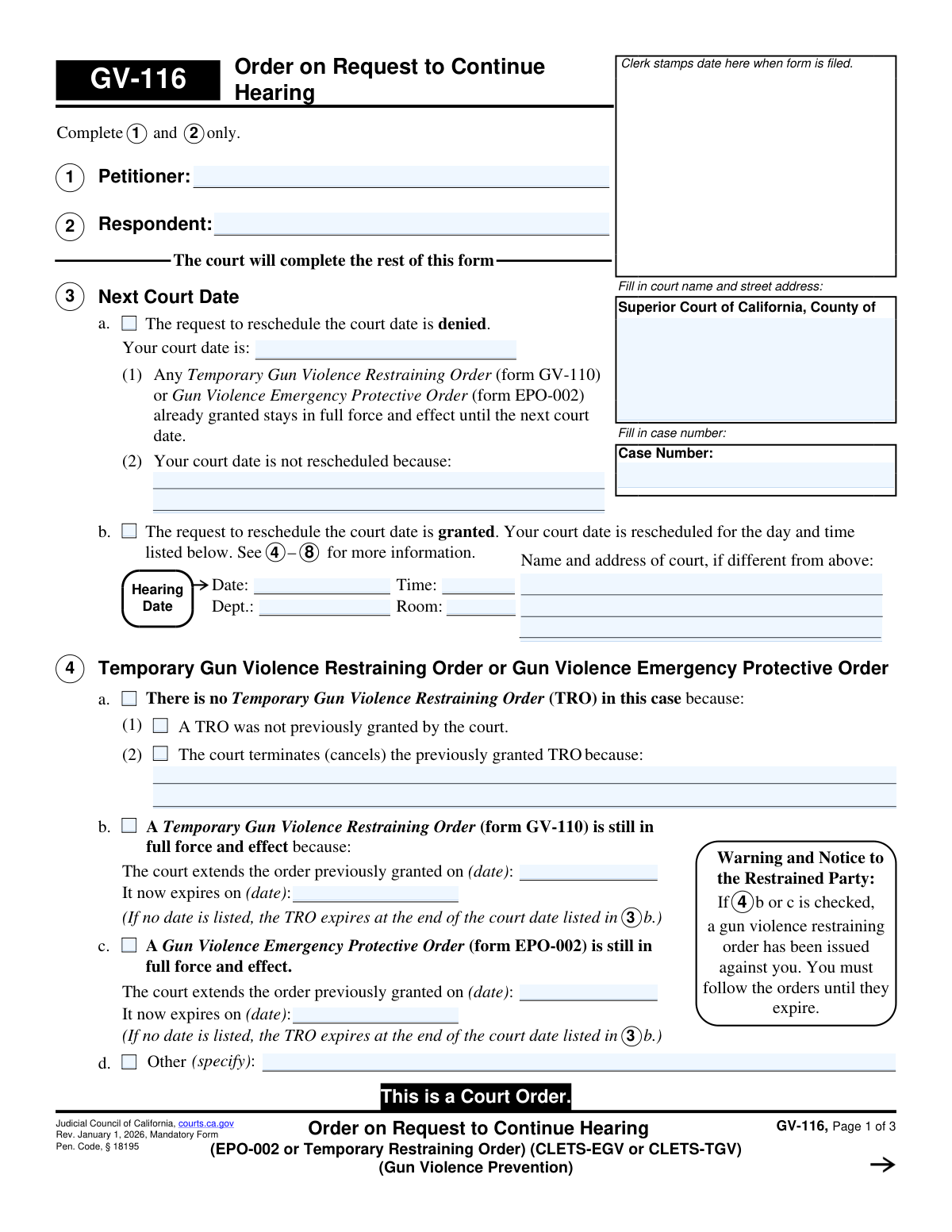
Yes! You can use AI to fill out Form GV-116, Order on Request to Continue Hearing (EPO-002 or Temporary Restraining Order) (CLETS-EGV or CLETS-TGV) (Gun Violence Prevention)

Form GV-116, Order on Request to Continue Hearing, is a judicial document used in California courts to formalize a judge's decision regarding the postponement of a hearing for a gun violence restraining order. It specifies whether the continuance is granted, sets a new hearing date, and clarifies the status of any existing temporary restraining orders. Today, this form can be filled out quickly and accurately using AI-powered services like Instafill.ai, which can also convert non-fillable PDF versions into interactive fillable forms.
GV-116 is part of the California court forms and restraining order forms categories on Instafill.
Our AI automatically handles information lookup, data retrieval, formatting, and form filling.
It takes less than a minute to fill out GV-116 using our AI form filling.
Securely upload your data. Information is encrypted in transit and deleted immediately after the form is filled out.

Form specifications

Form name: Form GV-116, Order on Request to Continue Hearing (EPO-002 or Temporary Restraining Order) (CLETS-EGV or CLETS-TGV) (Gun Violence Prevention)
Number of fields: 63
Number of pages: 1
Language: English
main-image

Instafill Demo: How to fill out PDF forms in seconds with AI

How to Fill Out GV-116 Online for Free in 2026

Are you looking to fill out a GV-116 form online quickly and accurately? Instafill.ai offers the #1 AI-powered PDF filling software of 2026, allowing you to complete your GV-116 form in just 37 seconds or less.
Follow these steps to fill out your GV-116 form online using Instafill.ai:
  1. 1 Navigate to Instafill.ai, then upload your GV-116 form or select it from the platform's template library.
  2. 2 Use the AI-powered tool to accurately fill in the court name, street address, and case number in the designated fields.
  3. 3 Enter the petitioner's full name in the section labeled 'Petitioner'.
  4. 4 Enter the respondent's full name in the section labeled 'Respondent'.
  5. 5 Review the information you have entered to ensure it is correct, as the remainder of the form will be completed by the court.
  6. 6 Download and print the partially completed form to file with the court clerk for the judge's review and signature.

Our AI-powered system ensures each field is filled out correctly, reducing errors and saving you time.

Why Choose Instafill.ai for Your Fillable GV-116 Form?

Speed

Complete your GV-116 in as little as 37 seconds.

Up-to-Date

Always use the latest 2026 GV-116 form version.

Cost-effective

No need to hire expensive lawyers.

Accuracy

Our AI performs 10 compliance checks to ensure your form is error-free.

Security

Your personal information is protected with bank-level encryption.

Frequently Asked Questions About Form GV-116

Form GV-116 is a court order that communicates the court's decision on a request to continue (reschedule) a hearing for a Gun Violence Restraining Order. It specifies the new court date and clarifies whether any existing temporary orders remain in effect.

You only need to complete your name and the other party's name in sections 1 and 2. The court is responsible for filling out the rest of the form, as it is an official court order.

Check Section 3, 'Next Court Date'. The court will check a box to show if the request was granted and will list the new hearing date, time, and location if it was rescheduled.

Look at Section 4. This section will clearly state if the previously granted Temporary Restraining Order or Emergency Protective Order is extended and remains in effect, or if it has been terminated by the court.

Serving the order means you must formally deliver a copy of this completed form to the other party in the case. Section 6 will specify who must perform the service, the method (e.g., in-person or by mail), and the deadline.

No, Section 7 of the form states that the sheriff or marshal will serve this order for free. You will need to bring a copy of all the papers that need to be served to the sheriff's or marshal's office.

Yes, Section 8 indicates that you may be able to attend your hearing remotely via phone or video conference. You should visit your court's website for specific instructions on how to appear remotely.

Section 5, 'Reason Court Date Is Rescheduled,' explains why the hearing was moved. Common reasons include the other party not being served yet or for other 'good cause' as determined by the court.

The form advises requesting accommodations at least five days before the hearing. You can contact the clerk's office or use Form MC-410, 'Disability Accommodation Request,' to ask for services like an interpreter or assistive listening system.

While the court completes most of this form, services like Instafill.ai can use AI to help you accurately fill in your information in sections 1 and 2. These tools are especially helpful for auto-filling other related legal forms, saving time and preventing errors.

Upload the GV-116 PDF to the Instafill.ai platform. The service will make the form interactive, allowing you to easily type the petitioner and respondent names before printing the form for filing with the court.

You can use a service like Instafill.ai to convert the flat, non-fillable PDF into an interactive form. This allows you to type information directly into the fields for a clean, professional appearance and easy record-keeping.

CLETS stands for the California Law Enforcement Telecommunications System. This indicates that the information from this court order, particularly regarding the restraining order's status, must be entered into this statewide law enforcement database.

Compliance GV-116
Validation Checks by Instafill.ai

1
Case Number Consistency Across Pages
This check verifies that the 'Case Number' entered on page 1 (field GV-116[0].Page1[0].Caption[0].CN[0].CaseNumber[0]) is identical to the case numbers on page 2 (GV-116[0].Page2[0].PxCaption[0].CaseNumber[0]) and page 3 (GV-116[0].Page3[0].P3Header[0].CaseNumber[0]). Maintaining consistency is crucial for ensuring all pages of the order are correctly associated with the same legal case file. A mismatch could lead to filing errors and legal invalidity of parts of the order.
2
Mandatory Party Identification
Validates that the 'Petitioner' (field 1) and 'Respondent' (field 2) name fields are not empty. These fields are essential for legally identifying the parties involved in the gun violence restraining order case. Failure to provide this information would render the order unenforceable and invalid as it would not be clear who the order applies to.
3
Mutually Exclusive Hearing Decision in Section 3
Ensures that only one of the primary outcomes in section 3 is selected: either the request to reschedule is denied (3a) or it is granted (3b). The form logic dictates that a hearing cannot be both rescheduled and not rescheduled simultaneously. If both options are selected, the form is ambiguous and cannot be processed, requiring user correction.
4
Completeness of New Hearing Information
If the checkbox indicating the request to reschedule is granted (section 3b) is checked, this validation ensures that the new 'Date', 'Time', and 'Dept.' or 'Room' are all filled in. This information is critical for notifying the parties of the new hearing details. An incomplete entry would defeat the purpose of rescheduling the hearing and could result in a party missing their court date.
5
Future Hearing Date Requirement
Verifies that the new hearing 'Date' entered in section 3b is a date in the future, relative to the date the form is being completed. Scheduling a hearing for a past date is a logical impossibility and a data entry error. This check prevents the entry of invalid hearing dates that would cause confusion and require immediate correction.
6
Mutually Exclusive TRO Status in Section 4
This check confirms that conflicting options within section 4 are not selected simultaneously. For example, a Temporary Restraining Order (TRO) cannot be both terminated (4a(2)) and extended (4b). This validation prevents the creation of a legally contradictory and unenforceable order regarding the status of the TRO.
7
Logical TRO Extension Dates
When a TRO is extended (section 4b is checked), this validation ensures the 'It now expires on' date is chronologically after the 'previously granted on' date. An extension must move the expiration date into the future. An invalid date sequence would make the order nonsensical and legally void.
8
TRO Expiration Aligns with New Hearing Date
If a new TRO expiration date is specified in section 4b or 4c, this check ensures that the expiration date is on or after the new hearing date specified in section 3b. The purpose of extending the TRO is to keep it in effect until the hearing. An expiration date before the hearing would create a dangerous gap in protection for the petitioner.
9
Reason for Reschedule Requirement
If the hearing is rescheduled (section 3b is checked), this validation ensures that a reason is provided in section 5 by checking either box 5a or 5b. The court requires a justification for continuing a hearing. Failure to provide a reason would result in an incomplete and potentially rejectable court order.
10
Specification for 'Other' Reason in Section 5a
If the 'Other' checkbox for good cause is selected in section 5a(2), this check verifies that the corresponding text field is not empty. The court requires a specific explanation when a standard reason is not applicable. An empty 'Other' field makes the justification for the continuance unclear and incomplete.
11
Service Date Completeness
This validation checks that if any option in section 6 requiring service by a specific date is selected (e.g., 6a(2), 6a(3), 6b(2), etc.), the corresponding date field is filled. The service deadline is a critical component of the order, defining the timeframe for legal notification. Missing this date makes that part of the order unenforceable.
12
Logical Service Deadline
Verifies that any service deadline date entered in section 6 is before the new hearing date entered in section 3b. A party must be served with the order before the hearing occurs to have adequate notice. A service date after the hearing date is illogical and would invalidate the service requirement.
13
Attached Pages Count Format
Ensures that the value entered in 'Number of pages attached' (section 10) is a non-negative integer (e.g., 0, 1, 5). This field is used by the clerk to verify that the filing is complete. Entering text or a negative number would be invalid and cause processing errors.
14
Judicial Officer Date and Clerk's Certificate Date Logic
This check validates that the 'Date' next to the Judicial Officer's signature and the 'Date' on the Clerk's Certificate are both valid dates. Furthermore, it ensures the Clerk's Certificate date is on or after the Judicial Officer's signature date. The clerk certifies a copy of the order after it has been signed by the judge, so the dates must be in the correct chronological order.

Common Mistakes in Completing GV-116

Filling Out Sections Reserved for the Court

The form explicitly instructs the filer to 'Complete 1 and 2 only. The court will complete the rest of this form.' A common mistake is to attempt to fill out sections 3 through 10, which can cause confusion and lead to the form's rejection by the court clerk. Always read instructions at the top of a form and only complete the sections designated for you. This ensures the form is processed smoothly without unnecessary delays.

Entering an Incorrect or Incomplete Case Number

The case number is the primary identifier that links this order to the correct court file. Entering the wrong number, a partial number, or leaving it blank can cause the document to be misfiled or rejected, delaying the court's order. Always double-check the case number against previous court documents and ensure it is written on every page where a field is provided. AI-powered tools like Instafill.ai can help prevent this by auto-filling the correct case number consistently across all related forms.

Using Inconsistent Party Names

The names for the Petitioner (Section 1) and Respondent (Section 2) must exactly match the names used on the initial petition and all other official case documents. Using nicknames, abbreviations, or different spellings can create legal ambiguity and procedural problems. To avoid this, carefully copy the full legal names as they appear on the original case filing.

Misinterpreting Service Requirements

Section 6, which is completed by the court, outlines who must provide a copy of the order to whom and by what deadline. Parties often misunderstand the difference between 'personal service' and 'service by mail,' or they miss the deadline entirely. Failure to properly serve the order as directed can result in the case being dismissed or delayed, so it is critical to read this section carefully and seek legal advice if you are unsure of the requirements.

Overlooking the New Hearing Date and Time

If the request to continue the hearing is granted, the court will list a new date, time, and location in Section 3b. Parties may be focused on the status of the restraining order and overlook this critical scheduling information. Missing the new court date can have severe consequences, such as the case being decided in your absence, so you must carefully review Section 3 and mark your calendar with the new hearing details.

Incorrectly Assuming a Temporary Order is Extended

A petitioner might believe that because the hearing was rescheduled, their Temporary Restraining Order (TRO) is automatically extended, but this is not always the case. The court specifies the order's status in Section 4, and it may have been terminated, or the extension may have a specific new expiration date. You must read Section 4 carefully to understand if you are still protected by an order and until when.

Forgetting to Enter the Case Number on All Pages

This three-page form includes a case number field at the top of each page. Filers often complete it on the first page but forget the subsequent ones. If the pages become separated during processing by the clerk, those without a case number can be lost from the file, rendering the order incomplete. To prevent this, make it a habit to fill in the case number on every single page.

Submitting a Form with Illegible Handwriting

Court forms must be filled out clearly for clerks to enter the information into the court's system accurately. Illegible handwriting can lead to misspelled names or incorrect dates, causing significant processing delays or legal errors. If the form is a non-fillable PDF, use block capital letters or consider a tool like Instafill.ai, which can convert it into a fillable version, allowing you to type information clearly.

Reversing Petitioner and Respondent Information

In the stress of a legal situation, it's easy to mistakenly write your name in the 'Respondent' field (Section 2) and the other party's name in the 'Petitioner' field (Section 1). This fundamental error creates significant confusion, will likely cause the form to be rejected, and can delay your hearing. The Petitioner is the person who initiated the case, so always double-check that the names are in the correct boxes before filing.

Failing to Serve All Required Documents

The service instructions in Section 6 may require a party to serve more than just this GV-116 order, sometimes referencing 'all documents listed on form GV-109, item 5.' A common mistake is to serve only the current order and forget the other required forms from the case. This constitutes improper service and can be grounds for the opposing party to request another delay or even a dismissal at the next hearing.
Saved over 80 hours a year

“I was never sure if my IRS forms like W-9 were filled correctly. Now, I can complete the forms accurately without any external help.”

Kevin Martin Green

Your data stays secure with advanced protection from Instafill and our subprocessors

Robust compliance program

Transparent business model

You’re not the product. You always know where your data is and what it is processed for.

ISO 27001, HIPAA, and GDPR

Our subprocesses adhere to multiple compliance standards, including but not limited to ISO 27001, HIPAA, and GDPR.

Security & privacy by design

We consider security and privacy from the initial design phase of any new service or functionality. It’s not an afterthought, it’s built-in, including support for two-factor authentication (2FA) to further protect your account.

Fill out GV-116 with Instafill.ai

Worried about filling PDFs wrong? Instafill securely fills form-gv-116-order-on-request-to-continue-hearing-epo-002-or-temporary-restraining-order-clets-egv-or-clets-tgv-gun forms, ensuring each field is accurate.

Related forms by category

California court forms Judicial Council of California Form SC-105, Request for Court Order and Answer (Small Claims), Judicial Council of California Form SC-120, Defendant’s Claim and ORDER to Go to Small Claims Court (Small Claims), Judicial Council of California Form SER-001, Request for Sheriff to Serve Court Papers, Judicial Council of California Form SER-001, Request for Sheriff to Serve Court Papers, Affidavit for Collection of Personal Property California Probate Code Section 13100, Form POS-040, Proof of Service—Civil, Declaration of Facts of Death (California Superior Court), declaration-of-marriage-for-court-proceeding-california-family-law, ADOPT-200, Adoption Request, ADOPT-200, Stepparent Adoption Request, ADOPT-210, Adoption Agreement, ADOPT-310, Contact After Adoption Agreement, Judicial Council of California Form ADOPT-200, Adoption Request, Form ADR-107, Mediation Attendance Sheet, Form ADR-110, Order Appointing Referee, Form ADR-109, Stipulation or Motion for Order Appointing Referee, Form ADR-102, Request for Trial De Novo After Judicial Arbitration, Form ADR-108, Referee's Report (Code Civ. Proc., §§ 638, 639), Form ADR-106, Petition to Confirm, Correct, or Vacate Contractual Arbitration Award, Form ADR-104, Rejection of Award and Request for Trial After Attorney-Client Fee Arbitration · + 557 more →
restraining order forms Form DV-100, Request for Domestic Violence Restraining Order, DV-100, Request for Domestic Violence Restraining Order (Domestic Violence Prevention), Judicial Council of California Form DV-110, Temporary Restraining Order (CLETS-TRO) (Domestic Violence Prevention), Form DV-116, Order on Request to Continue Court Hearing (Temporary Restraining Order) (CLETS-TRO) (Domestic Violence Prevention), Form DV-130, Restraining Order After Hearing (Order of Protection) (Domestic Violence Prevention), Form CH-110, Temporary Restraining Order (CLETS-TCH) (Civil Harassment Prevention), Form CH-120, Response to Request for Civil Harassment Restraining Orders, Form CH-130, Civil Harassment Restraining Order After Hearing (CLETS-CHO), Order on Request to Modify/Terminate Civil Harassment Restraining Order (Civil Harassment Prevention), Form CH-100, Request for Civil Harassment Restraining Orders (Civil Harassment Prevention), Form CH-620, Response to Request to Modify/Terminate Civil Harassment Restraining Order (Civil Harassment Prevention), Form CIV-025, Application and Order for Reissuance of Order to Show Cause and Temporary Restraining Order, Form CD-190, Application for Temporary Restraining Order (Claim and Delivery), Order on Request to Continue Hearing (Temporary Restraining Order) (CLETS-TCH) (Civil Harassment Prevention), Form CH-610, Notice of Hearing on Request to Modify/Terminate Civil Harassment Restraining Order (Civil Harassment Prevention), Form CH-700, Request to Renew Restraining Order (Civil Harassment Prevention), Form CH-730, Order Renewing Civil Harassment Restraining Order (CLETS), Form DV-120, Response to Request for Domestic Violence Restraining Order (Domestic Violence Prevention), Form DV-300, Request to Change or End Restraining Order (Domestic Violence Prevention), Form DV-310, Notice of Court Hearing and Temporary Order to Change or End Restraining Order (Domestic Violence Prevention) · + 52 more →