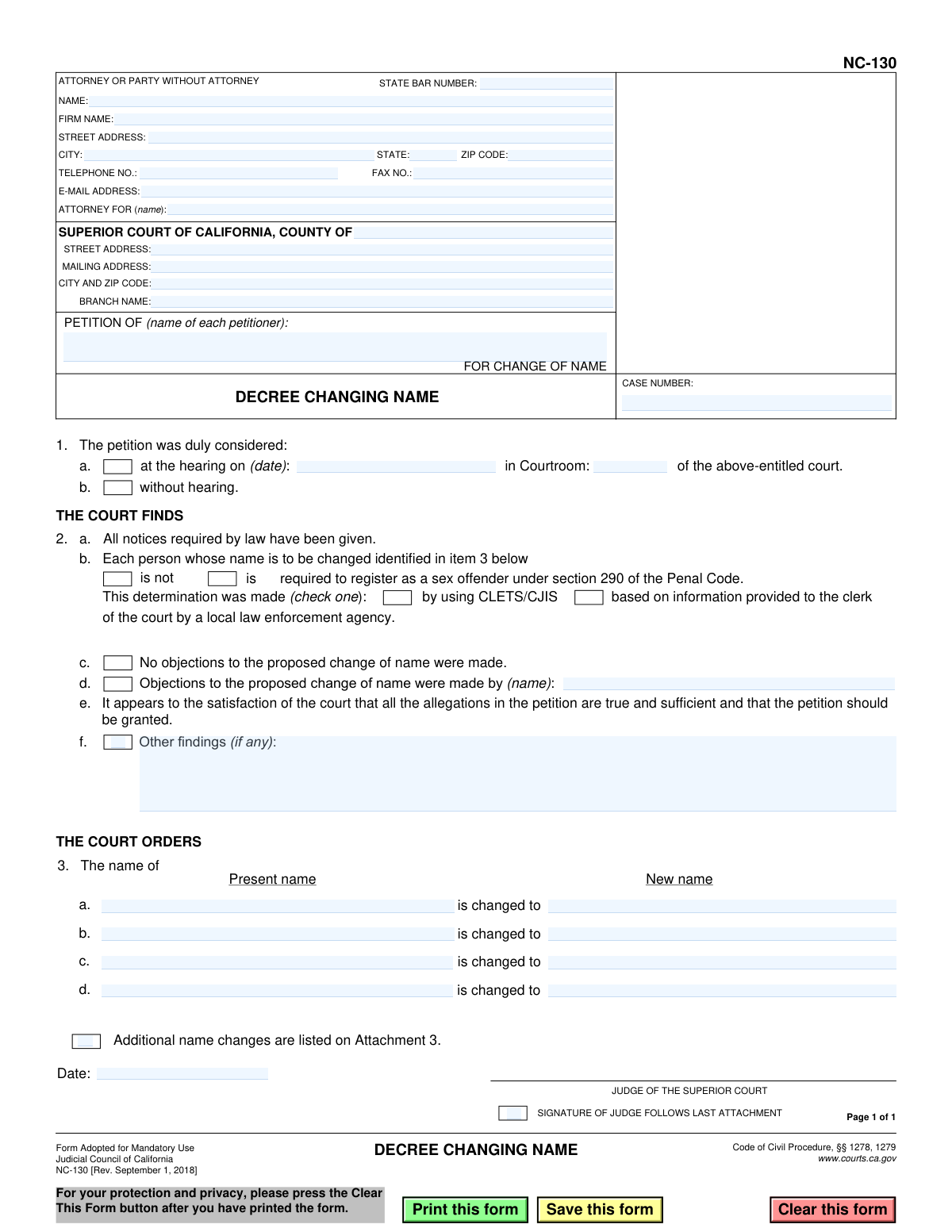
Yes! You can use AI to fill out Form NC-130, Decree Changing Name

The Decree Changing Name (Form NC-130) is the final legal document issued by a California Superior Court judge that officially grants a petitioner's request for a name change. It serves as the court's formal order and legal proof that the name change has been approved, detailing the old name and the new name. Today, this form can be filled out quickly and accurately using AI-powered services like Instafill.ai, which can also convert non-fillable PDF versions into interactive fillable forms.
NC-130 is part of the California court forms and name change forms categories on Instafill.
Our AI automatically handles information lookup, data retrieval, formatting, and form filling.
It takes less than a minute to fill out NC-130 using our AI form filling.
Securely upload your data. Information is encrypted in transit and deleted immediately after the form is filled out.

Form specifications

Form name: Form NC-130, Decree Changing Name
Number of fields: 46
Number of pages: 1
Language: English
main-image

Instafill Demo: How to fill out PDF forms in seconds with AI

How to Fill Out NC-130 Online for Free in 2026

Are you looking to fill out a NC-130 form online quickly and accurately? Instafill.ai offers the #1 AI-powered PDF filling software of 2026, allowing you to complete your NC-130 form in just 37 seconds or less.
Follow these steps to fill out your NC-130 form online using Instafill.ai:
  1. 1 Navigate to Instafill.ai and upload or select Form NC-130, the Decree Changing Name.
  2. 2 Provide the court information, including the county, court address, and the specific case number for the name change petition.
  3. 3 Enter the petitioner's details or their attorney's information in the top section of the form.
  4. 4 Indicate the court's findings by checking the appropriate boxes regarding the hearing, any objections, and other determinations made by the judge.
  5. 5 Clearly list the present name(s) and the corresponding new name(s) as ordered by the court in the designated fields.
  6. 6 Review all the information populated by the AI to ensure accuracy and completeness before the decree is presented for signature.
  7. 7 Download the completed form to be printed and submitted to the court for the judge's signature and official filing.

Our AI-powered system ensures each field is filled out correctly, reducing errors and saving you time.

Why Choose Instafill.ai for Your Fillable NC-130 Form?

Speed

Complete your NC-130 in as little as 37 seconds.

Up-to-Date

Always use the latest 2026 NC-130 form version.

Cost-effective

No need to hire expensive lawyers.

Accuracy

Our AI performs 10 compliance checks to ensure your form is error-free.

Security

Your personal information is protected with bank-level encryption.

Frequently Asked Questions About Form NC-130

This is the final court order signed by a judge that officially grants your request to change your name. It is not the initial application; it is the legal document that finalizes the name change process in California.

No, this is the final decree. To begin the process, you must first file a 'Petition for Change of Name' (Form NC-100) with the court.

Typically, the petitioner (the person requesting the name change) or their attorney prepares the form by filling in the case information at the top. A judge then reviews it, makes findings, and signs it to make the order official.

This crucial section is where the judge's order is recorded. It will list your current legal name ('Present name') and the new name you are being granted ('New name').

Yes, the form provides space to list several name changes. If you need more space than provided, you can use an attachment, as indicated by the checkbox for 'Attachment 3'.

Once the decree is signed and filed, it becomes a legal court order. You can then obtain certified copies from the court clerk to update your name on your driver's license, social security card, passport, and other official records.

It depends. The form has options for the decree to be granted after a hearing or 'without hearing' if all legal requirements are met and no one objects to your petition.

The court is required by law to check if the person changing their name is a registered sex offender. This finding affects the notification requirements you must follow after the name change is granted.

If someone files an objection, the court will hold a hearing to consider it. The judge will note any objections on the decree form before deciding whether to grant your petition.

Processing time varies by court and caseload. After you submit the proposed decree, it will be routed to the judge for review and signature, which can take anywhere from a few days to several weeks.

Yes, services like Instafill.ai use AI to help you accurately fill out the required fields, such as your case and contact information. This can save time and help prevent errors before submitting the form to the court.

You can use a service like Instafill.ai to upload the form and fill it out electronically. The platform guides you through the fields you need to complete, making the process simple and efficient.

If you have a non-fillable or 'flat' PDF, you can upload it to a service like Instafill.ai. Their technology can convert it into an interactive, fillable form that you can easily complete online.

Compliance NC-130
Validation Checks by Instafill.ai

1
Case Number Presence and Format
This check ensures that the 'CASE NUMBER' field is not empty and conforms to the standard format used by the court system. The case number is a critical identifier for tracking the legal proceeding. Failure to provide a valid case number will prevent the form from being correctly filed and associated with the proper court record.
2
Petitioner Name Completeness
Validates that the 'PETITION OF (name of each petitioner)' field is filled in. This field identifies the primary individual(s) seeking the name change and is essential for the decree's legal validity. An empty petitioner name field makes the document legally insufficient as it's unclear who the order applies to.
3
Court County Specification
Ensures that the 'COUNTY OF' field in the court information section is completed. This specifies the jurisdiction of the court issuing the decree, which is a fundamental requirement for the document's authority. A missing county name would render the decree invalid as it would not be tied to a specific legal jurisdiction.
4
Mandatory Sex Offender Status Selection
Verifies that one of the two radio buttons in section 1.b ('is' or 'is not' required to register as a sex offender) has been selected. This finding is a mandatory part of the decree as required by law. Failure to make a selection results in an incomplete and legally non-compliant court order.
5
Mandatory Hearing Determination Selection
Checks that one of the two options in section 1.c ('at the hearing' or 'without hearing') is selected. This clarifies the procedural basis on which the court considered the petition. An omission here creates ambiguity about the judicial process followed, potentially invalidating the decree.
6
Conditional Hearing Date Requirement
If the 'at the hearing' option is selected in section 1.c, this validation ensures the corresponding date field is filled with a valid date. The date of the hearing is a critical piece of information when the decree is granted based on that event. If the option is selected but the date is missing, the record is incomplete.
7
Conditional Courtroom Requirement
If the 'at the hearing' option is selected, this check ensures the 'in Courtroom' field is not empty. Specifying the courtroom provides a complete record of the hearing's location. Leaving this blank when a hearing occurred would result in an incomplete legal record of the proceedings.
8
Logical Date Sequence
Compares the 'Decree Date' at the bottom of the form with the 'Hearing Date' in section 1.c. The decree date must be on or after the hearing date. A decree dated before the hearing is logically impossible and would indicate a data entry error that must be corrected for the document to be valid.
9
Name Change Pair Completeness
For each row in section 3, this check ensures that if a 'Present name' is entered, a corresponding 'New name' is also entered, and vice-versa. A name change requires both the original and the new name to be legally effective. An incomplete pair would make that specific name change order void.
10
At Least One Name Change Required
Validates that at least one full 'Present name' and 'New name' pair is completed in section 3, or that the 'Additional name changes are listed on Attachment 3' box is checked. The entire purpose of the decree is to change a name, so the document must specify at least one change. A decree with no name changes listed is a nullity.
11
Distinct Present and New Names
For each completed name change pair in section 3, this check verifies that the 'Present name' is not identical to the 'New name'. A legal name change requires the new name to be different from the present one. If the names are the same, it indicates a likely error and the change has no legal effect.
12
Conditional 'Other Findings' Text
Ensures that if the 'Other findings' checkbox in section 1.e is checked, the adjacent text area is not empty. Checking the box indicates that additional findings are part of the decree, and therefore the text of those findings must be provided. An empty text field would contradict the checked box and create an incomplete order.
13
Decree Date Requirement
Verifies that the 'Date' field near the judge's signature line is filled with a valid date. This date is the official date the decree was signed and becomes effective. A missing date renders the entire document legally invalid as its effective date is unknown.
14
Attorney Bar Number Validation
Checks if the 'ATTORNEY FOR' field is filled. If it is, this validation ensures the 'STATE BAR NUMBER' field is also filled, and preferably contains only numbers. This is important for correctly identifying the legal counsel of record. A missing bar number for a listed attorney makes the filing incomplete.
15
Email Address Format Validation
This check ensures that if a value is entered into the 'E-MAIL ADDRESS' field, it conforms to a standard email format (e.g., [email protected]). This helps ensure that communications sent to this address will be delivered successfully. An invalid format could lead to missed communications from the court.

Common Mistakes in Completing NC-130

Omitting or Mismatching the Case Number

The case number is assigned when the initial petition is filed and must be written identically on all subsequent documents, including this Decree. People often forget to add it or make a typo, which will prevent the document from being associated with the correct case file. A mismatched case number will cause the court clerk to reject the filing, leading to significant delays in getting the name change finalized.

Inaccurate Present or New Names

In section 3, the 'Present name' must be the person's full, current legal name, and the 'New name' must be the exact name requested in the petition. Common errors include using nicknames, initials, or making spelling mistakes. Any discrepancy can render the decree invalid for the purpose of updating other legal documents like a driver's license, passport, or social security card, requiring a corrected order to be filed.

Pre-filling Sections Reserved for the Court

Petitioners often mistakenly fill out sections like 'THE COURT FINDS' or check boxes in section 1 regarding the hearing, which are reserved for the judge. While you are submitting a 'proposed' decree, these judicial findings must be left blank for the court to complete. Pre-filling these sections can lead to the form's rejection, as it appears to presume the court's decision.

Incomplete or Incorrect Party Contact Information

The top-left box requires the complete contact information for the self-represented party ('Party Without Attorney') or their lawyer. People frequently leave this section incomplete or, if self-represented, mistakenly write their own name in the 'ATTORNEY FOR' field. This can cause delays if the court needs to mail notices or contact the filer, and incomplete forms may be rejected outright.

Forgetting the Attachment for Additional Names

The form provides space for only four name changes. If the petition includes more people (e.g., a large family), filers must check the box for 'Attachment 3' and include a separate page with the additional names. A common mistake is to forget the attachment or fail to check the box, resulting in an incomplete order that doesn't legally change the names of everyone intended.

Entering Incorrect Court Address or Branch Name

The caption requires the specific county, street address, and branch name of the Superior Court where the petition was filed. Petitioners sometimes use a generic court address or the wrong branch, which can cause the document to be misrouted or rejected. This information must exactly match the court where the case is being heard. AI-powered tools like Instafill.ai can help auto-populate correct court information based on the case.

Incomplete Listing of Petitioners

The 'PETITION OF' field must list the full legal name of every person who is a petitioner on the case, matching the original petition (Form NC-100). For instance, in a family application, both parents might be petitioners for a minor child. Listing only one petitioner when there are multiple can lead to the form being rejected for being inconsistent with the case file.

Using an Obsolete Version of the Form

Court forms are updated periodically to reflect changes in laws. The form version is noted at the bottom (e.g., NC-130 [Rev. September 1, 2018]). Using an outdated version is a frequent cause for immediate rejection by the court clerk, forcing the petitioner to redo all the paperwork and refile, which wastes time and filing fees.

Illegible Handwriting and Formatting Errors

When a form is filled out by hand, illegible handwriting can lead to critical typos in the final court order, especially with names. A misspelled new name on a legal decree creates significant problems when updating IDs and official records. It is highly recommended to type the information; if the form is a non-fillable PDF, tools like Instafill.ai can convert it into a fillable version to ensure clarity.

Incorrectly Specifying Hearing Details

Section 1 asks whether the decree was decided at a hearing or without one. Petitioners submitting a proposed decree before the hearing should leave this section blank for the court clerk or judge to complete. Guessing a date or courtroom, or incorrectly checking 'without hearing' when one is scheduled, can cause confusion and require correction, delaying the finalization of the name change.
Saved over 80 hours a year

“I was never sure if my IRS forms like W-9 were filled correctly. Now, I can complete the forms accurately without any external help.”

Kevin Martin Green

Your data stays secure with advanced protection from Instafill and our subprocessors

Robust compliance program

Transparent business model

You’re not the product. You always know where your data is and what it is processed for.

ISO 27001, HIPAA, and GDPR

Our subprocesses adhere to multiple compliance standards, including but not limited to ISO 27001, HIPAA, and GDPR.

Security & privacy by design

We consider security and privacy from the initial design phase of any new service or functionality. It’s not an afterthought, it’s built-in, including support for two-factor authentication (2FA) to further protect your account.

Fill out NC-130 with Instafill.ai

Worried about filling PDFs wrong? Instafill securely fills form-nc-130-decree-changing-name forms, ensuring each field is accurate.

Related forms by category

California court forms Judicial Council of California Form SC-105, Request for Court Order and Answer (Small Claims), Judicial Council of California Form SC-120, Defendant’s Claim and ORDER to Go to Small Claims Court (Small Claims), Judicial Council of California Form SER-001, Request for Sheriff to Serve Court Papers, Judicial Council of California Form SER-001, Request for Sheriff to Serve Court Papers, Affidavit for Collection of Personal Property California Probate Code Section 13100, Form POS-040, Proof of Service—Civil, Declaration of Facts of Death (California Superior Court), declaration-of-marriage-for-court-proceeding-california-family-law, ADOPT-200, Adoption Request, ADOPT-200, Stepparent Adoption Request, ADOPT-210, Adoption Agreement, ADOPT-310, Contact After Adoption Agreement, Judicial Council of California Form ADOPT-200, Adoption Request, Form ADR-107, Mediation Attendance Sheet, Form ADR-110, Order Appointing Referee, Form ADR-109, Stipulation or Motion for Order Appointing Referee, Form ADR-102, Request for Trial De Novo After Judicial Arbitration, Form ADR-108, Referee's Report (Code Civ. Proc., §§ 638, 639), Form ADR-106, Petition to Confirm, Correct, or Vacate Contractual Arbitration Award, Form ADR-104, Rejection of Award and Request for Trial After Attorney-Client Fee Arbitration · + 557 more →
name change forms Letter of Authorization for Name Mismatch, Form NC-100, Petition for Change of Name, Fidelity Advisor Name Change Authorization Form, Fidelity Advisor Name Change Authorization, Form GRE-50, Member Name/Address Change, Form NC-110, Name and Information About the Person Whose Name is to be Changed (Attachment to Petition for Change of Name)