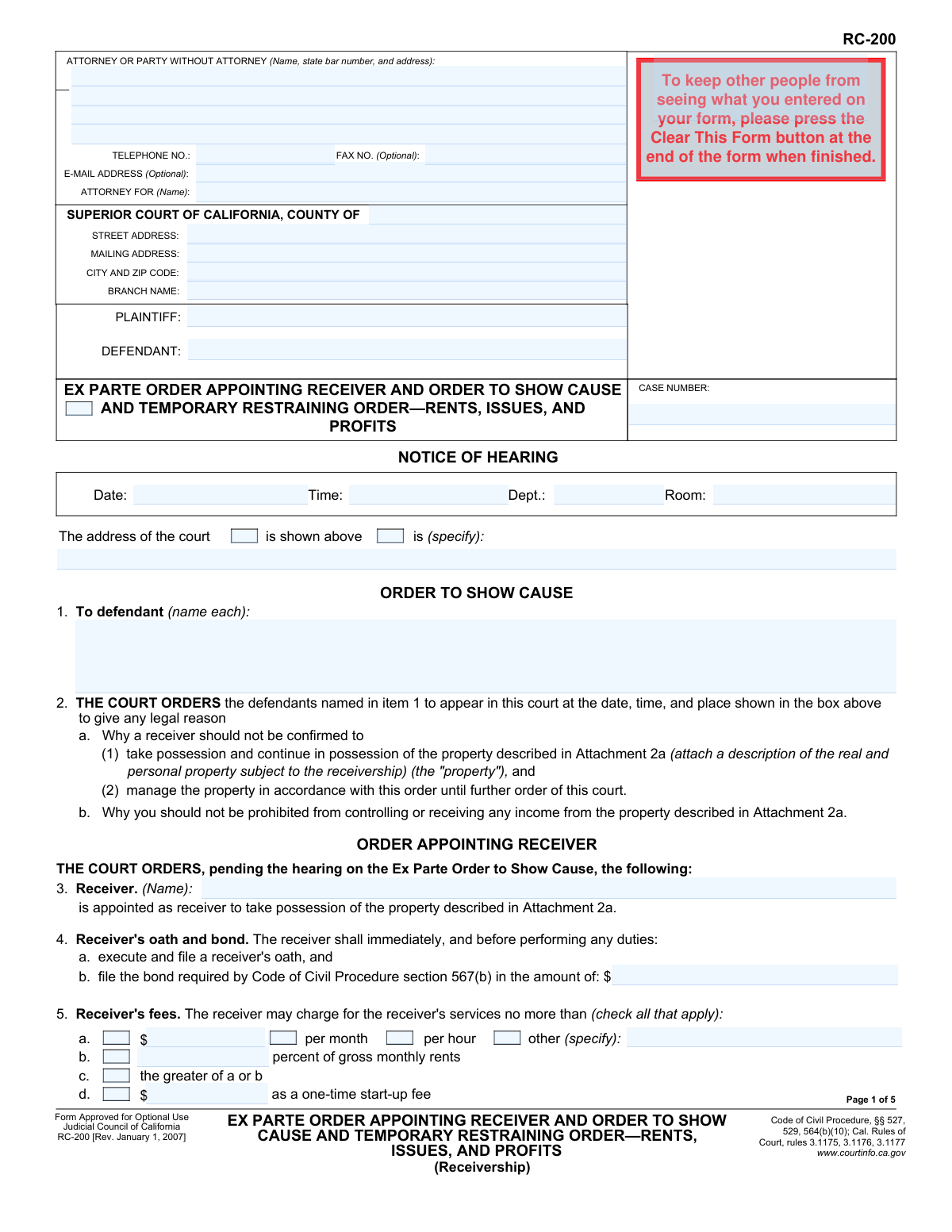
Yes! You can use AI to fill out Form RC-200, Ex Parte Order Appointing Receiver and Order to Show Cause and Temporary Restraining Order—Rents, Issues, and Profits

Form RC-200, the Ex Parte Order Appointing Receiver, is a critical legal document used in California courts to urgently appoint a neutral third party (a receiver) to manage a property and its income. This order is vital in disputes, such as foreclosures, to protect the asset from waste and ensure rents are collected while the case proceeds, and it includes an Order to Show Cause and a Temporary Restraining Order. Today, this complex legal form can be filled out quickly and accurately using AI-powered services like Instafill.ai, which can also convert non-fillable PDF versions into interactive fillable forms.
RC-200 is part of the California court forms and restraining order forms categories on Instafill.
Our AI automatically handles information lookup, data retrieval, formatting, and form filling.
It takes less than a minute to fill out RC-200 using our AI form filling.
Securely upload your data. Information is encrypted in transit and deleted immediately after the form is filled out.

Form specifications

Form name: Form RC-200, Ex Parte Order Appointing Receiver and Order to Show Cause and Temporary Restraining Order—Rents, Issues, and Profits
Number of fields: 92
Number of pages: 1
Language: English
main-image

Instafill Demo: How to fill out PDF forms in seconds with AI

How to Fill Out RC-200 Online for Free in 2026

Are you looking to fill out a RC-200 form online quickly and accurately? Instafill.ai offers the #1 AI-powered PDF filling software of 2026, allowing you to complete your RC-200 form in just 37 seconds or less.
Follow these steps to fill out your RC-200 form online using Instafill.ai:
  1. 1 Navigate to Instafill.ai and upload or select the RC-200 form.
  2. 2 Provide the court and case information, including plaintiff and defendant names, and the case number, allowing the AI to populate the appropriate fields.
  3. 3 Enter the details for the Order to Show Cause, including the hearing date, time, and location, and reference the property description attachment.
  4. 4 Specify the appointed receiver's name, the required bond amount, and the details of the receiver's fees as ordered by the court.
  5. 5 Detail the specifics of the Temporary Restraining Order, outlining the actions the defendant is prohibited from taking regarding the property and its income.
  6. 6 Review all information populated by the AI for accuracy, make any necessary corrections, and then download, print, or e-file the completed Form RC-200 as required by the court.

Our AI-powered system ensures each field is filled out correctly, reducing errors and saving you time.

Why Choose Instafill.ai for Your Fillable RC-200 Form?

Speed

Complete your RC-200 in as little as 37 seconds.

Up-to-Date

Always use the latest 2026 RC-200 form version.

Cost-effective

No need to hire expensive lawyers.

Accuracy

Our AI performs 10 compliance checks to ensure your form is error-free.

Security

Your personal information is protected with bank-level encryption.

Frequently Asked Questions About Form RC-200

This form is a court order used to appoint a neutral third party, called a receiver, on an emergency basis to manage a property and collect its income. It also includes a temporary restraining order and sets a hearing date for the defendant to respond.

The plaintiff (the party filing the lawsuit, often a lender) or their attorney prepares this form and submits it to a judge for approval to protect their interest in a property.

A receiver is an individual appointed by the court to take possession of, manage, and preserve a property during a legal dispute. Their duties include collecting rent, paying bills, maintaining the property, and providing accountings to the court and parties.

Ex parte means the order is requested by one party without advance notice to the other party, typically in an emergency situation. The form includes an 'Order to Show Cause' which sets a hearing date for the defendant to appear and contest the order.

Attachment 2a must contain a complete description of the real and personal property that the receiver is being appointed to take possession of and manage.

The receiver's fees are specified by the court in item 5 of the order. Payment can be structured as an hourly rate, a percentage of gross monthly rents, or another method approved by the judge.

The TRO, detailed in item 31, legally prohibits the defendant from interfering with the property, collecting rents, or selling the asset until the court holds a hearing.

Yes, item 8 and item 32 state that the plaintiff must file bonds as required by the Code of Civil Procedure to cover potential damages to the defendant if the order is found to be wrongfully granted.

At the hearing, the defendant has the opportunity to present legal arguments and evidence as to why the receiver's appointment should not be confirmed and the temporary orders should be dissolved.

If the defendant files for bankruptcy, the receiver must follow specific duties outlined in item 27, which may require turning the property over to the bankruptcy trustee unless the plaintiff gets an order from the bankruptcy court.

The receivership ends upon a specific event, like a foreclosure sale, or by court order. The receiver must then file a final report and account with the court to be formally discharged from their duties.

Yes, services like Instafill.ai use AI to auto-fill form fields accurately and save time, which is especially helpful for complex legal documents like this.

You can use a service like Instafill.ai to upload the form, fill it out using a simple online interface, and then download the completed PDF ready for filing.

You can use a tool like Instafill.ai, which can convert flat, non-fillable PDFs into interactive forms that you can easily complete and save online.

Compliance RC-200
Validation Checks by Instafill.ai

1
Case Number Presence and Format
This check ensures the 'CASE NUMBER' field is not empty and follows the expected format for the jurisdiction. The case number is the primary identifier for the legal proceeding, linking the order to the correct court file. Failure to provide a valid case number would render the document un-fileable and legally ineffective, causing significant delays and processing rejections.
2
Hearing Date and Time Validity
Validates that the 'Date' and 'Time' fields under 'NOTICE OF HEARING' contain a valid, future date and a proper time format. This is critical as it informs the defendant of when they must appear in court to contest the order. An invalid or past date would make the notice defective, potentially violating due process and leading to the order being voided.
3
Defendant Name Requirement
Ensures that at least one defendant is named in item 1 ('To defendant'). The order must clearly identify the parties it is directed against to be enforceable. Omitting the defendant's name would make the order ambiguous and legally powerless, as there would be no specific person or entity compelled to act.
4
Receiver Name Specification
This check verifies that a name has been entered in item 3 for the appointed receiver. The identity of the receiver is a fundamental component of the appointment order. Without a named receiver, the core purpose of the order—to appoint a specific individual to take control of the property—is unfulfilled.
5
Receiver's Bond Amount Format
Validates that the amount specified for the receiver's bond in item 4b is a positive numeric value. The bond is a financial guarantee required by law to protect the parties from potential damages caused by the receiver's actions. An invalid or missing bond amount would make the appointment defective and non-compliant with the Code of Civil Procedure.
6
Receiver's Fee Structure Completeness
This check ensures that if a receiver is appointed, at least one fee option in item 5 is selected and its corresponding value (dollar amount or percentage) is a valid number. This defines how the receiver will be compensated, which is a material term of the appointment. An incomplete or ambiguous fee structure can lead to future disputes and challenges to the receiver's payments.
7
Plaintiff's Bond Amount Format
Verifies that the amount entered for the plaintiff's bond in item 8 is a valid, positive numeric currency value. This bond is required to secure the defendant against damages if the court later determines the ex parte order was granted improperly. Failure to specify a valid bond amount can invalidate the order and the receivership.
8
Property Description Attachment Reference
This validation confirms that Attachment 2a, which describes the property subject to receivership, is referenced. The order is meaningless without a clear and unambiguous description of the property the receiver is to manage. The absence of this attachment or reference would make the scope of the receiver's authority dangerously unclear and the order unenforceable.
9
Temporary Restraining Order Bond Amount
Ensures the amount for the temporary restraining order bond in item 32 is a valid, positive numeric value. This bond is required to compensate the defendant for any harm caused by the TRO if it is later found to have been wrongfully issued. An invalid or zero amount would fail to meet statutory requirements, making the TRO portion of the order invalid.
10
Service and Briefing Schedule Chronology
This check validates that the dates entered in items 34, 35, and 36 are in the correct chronological order (service, then opposition, then reply). This sequence is essential for maintaining a fair legal process and allowing each party adequate time to respond. Incorrect ordering would disrupt the briefing schedule and violate procedural rules.
11
Briefing Schedule Precedes Hearing Date
Validates that all dates in the 'SERVICE AND BRIEFING SCHEDULE' (items 34, 35, 36) occur before the hearing date listed on page one. All filings and responses must be completed before the hearing so the judge can review them. A date set after the hearing would make the filing moot and disrupt the court's process.
12
Attachment Page Count Consistency
This check ensures the 'Number of pages attached' in item 37 is a non-negative integer. Furthermore, it cross-references this count to ensure it is greater than zero if any checkboxes indicating an attachment (e.g., in items 2a or 29) are selected. This helps prevent the filing of an incomplete document package where referenced attachments are missing.
13
Management Company Fee Logic
If a management company is named in item 6, this validation ensures that a fee structure is also specified (e.g., per month, percent of rents) and that the corresponding value is a valid number. Simply naming a company without defining its compensation terms creates ambiguity and potential for future disputes. This check ensures all necessary financial details are included.
14
Conditional 'Other Orders' Text Field
Verifies that if the checkbox 'are as follows (specify)' is selected in item 29 or 33, the adjacent text field is not empty. Selecting this option indicates the user's intent to add custom orders, and leaving the field blank would create an incomplete and confusing instruction. This check ensures that specified orders are actually specified.

Common Mistakes in Completing RC-200

Incorrect Case Number or Party Names

Entering the wrong case number or misspelling plaintiff or defendant names in the caption is a frequent error. This often happens due to typographical mistakes or referencing an incorrect source document. An incorrect case number can lead to the document being filed in the wrong case or rejected outright by the court clerk, causing critical delays for an urgent ex parte order.

Vague or Incomplete Property Description in Attachment 2a

The form requires a full description of the property subject to receivership in Attachment 2a, but filers often provide only a street address. This is insufficient; a full legal description for real property and an itemized list of personal property (e.g., bank accounts, equipment) are necessary. An ambiguous description can lead to disputes over the receiver's authority and may render the order unenforceable.

Ambiguous Receiver Fee Structure in Item 5

Item 5 offers multiple options for calculating receiver fees (per hour, percentage of rent, etc.), which can be confusing. Filers may check conflicting boxes or leave amounts blank, creating ambiguity. This forces the court to guess at the intended compensation or requires a later motion to clarify, delaying payment and creating unnecessary legal work.

Omitting Required Bond Amounts

The form requires specific dollar amounts for the Receiver's Bond (Item 4b), Plaintiff's Bond (Item 8), and the TRO Bond (Item 32). Parties often leave these fields blank, assuming the judge will fill them in. However, a proposed amount is expected, and its absence makes the order incomplete, guaranteeing rejection by the court and delaying the appointment.

Forgetting to Populate Headers/Footers on Subsequent Pages

The Plaintiff, Defendant, and Case Number fields appear in the footer of every page, but filers often only complete them on the first page. This is a common oversight on multi-page forms. While seemingly minor, it can lead to rejection by the clerk for non-compliance with court rules and causes issues if pages become separated during processing.

Failing to List All Defendants in Item 1

The order is only enforceable against the defendants specifically named in Item 1. In cases with multiple defendants, it's easy to accidentally omit one or use an incorrect name. This mistake severely limits the order's effectiveness and may require the plaintiff to file a new motion to amend it, undermining the purpose of the initial ex parte relief.

Leaving the Attachment Count Blank in Item 37

Item 37 requires the total number of attached pages, which serves as a table of contents for the court clerk. Filers often forget this final step in their rush to submit. Without this number, the clerk cannot verify the submission is complete, and if a crucial attachment is lost, there is no official record it was ever submitted.

Incomplete Attorney/Party Information

The top-left box requires complete contact details, including the State Bar number for attorneys. Self-represented parties or legal assistants may overlook fields or not have the information readily available. Incomplete information hinders communication from the court and opposing parties, potentially leading to missed notices and procedural disadvantages.

Failing to Properly Label and Attach All Required Documents

This order explicitly references attachments (e.g., 'Attachment 2a', 'Attachment 29'). A common mistake is to submit the required information in a separate declaration without labeling it as the specific attachment called for in the form. This disorganization can confuse the court and lead to the application being denied for being incomplete or unclear.

Using a Non-Fillable PDF without Proper Tools

This form is often found as a flat, non-fillable PDF, leading to manual, error-prone data entry by hand or with basic PDF editors. This results in misaligned text, formatting errors, and illegibility, which can cause the court to reject the filing. To avoid this, use a tool like Instafill.ai that can convert any non-fillable court form into an interactive, fillable version, ensuring a clean and professional submission.
Saved over 80 hours a year

“I was never sure if my IRS forms like W-9 were filled correctly. Now, I can complete the forms accurately without any external help.”

Kevin Martin Green

Your data stays secure with advanced protection from Instafill and our subprocessors

Robust compliance program

Transparent business model

You’re not the product. You always know where your data is and what it is processed for.

ISO 27001, HIPAA, and GDPR

Our subprocesses adhere to multiple compliance standards, including but not limited to ISO 27001, HIPAA, and GDPR.

Security & privacy by design

We consider security and privacy from the initial design phase of any new service or functionality. It’s not an afterthought, it’s built-in, including support for two-factor authentication (2FA) to further protect your account.

Fill out RC-200 with Instafill.ai

Worried about filling PDFs wrong? Instafill securely fills form-rc-200-ex-parte-order-appointing-receiver-and-order-to-show-cause-and-temporary-restraining-orderrents-issues-and forms, ensuring each field is accurate.

Related forms by category

California court forms Judicial Council of California Form SC-105, Request for Court Order and Answer (Small Claims), Judicial Council of California Form SC-120, Defendant’s Claim and ORDER to Go to Small Claims Court (Small Claims), Judicial Council of California Form SER-001, Request for Sheriff to Serve Court Papers, Judicial Council of California Form SER-001, Request for Sheriff to Serve Court Papers, Affidavit for Collection of Personal Property California Probate Code Section 13100, Form POS-040, Proof of Service—Civil, Declaration of Facts of Death (California Superior Court), declaration-of-marriage-for-court-proceeding-california-family-law, ADOPT-200, Adoption Request, ADOPT-200, Stepparent Adoption Request, ADOPT-210, Adoption Agreement, ADOPT-310, Contact After Adoption Agreement, Judicial Council of California Form ADOPT-200, Adoption Request, Form ADR-107, Mediation Attendance Sheet, Form ADR-110, Order Appointing Referee, Form ADR-109, Stipulation or Motion for Order Appointing Referee, Form ADR-102, Request for Trial De Novo After Judicial Arbitration, Form ADR-108, Referee's Report (Code Civ. Proc., §§ 638, 639), Form ADR-106, Petition to Confirm, Correct, or Vacate Contractual Arbitration Award, Form ADR-104, Rejection of Award and Request for Trial After Attorney-Client Fee Arbitration · + 557 more →
restraining order forms Form DV-100, Request for Domestic Violence Restraining Order, DV-100, Request for Domestic Violence Restraining Order (Domestic Violence Prevention), Judicial Council of California Form DV-110, Temporary Restraining Order (CLETS-TRO) (Domestic Violence Prevention), Form DV-116, Order on Request to Continue Court Hearing (Temporary Restraining Order) (CLETS-TRO) (Domestic Violence Prevention), Form DV-130, Restraining Order After Hearing (Order of Protection) (Domestic Violence Prevention), Form CH-110, Temporary Restraining Order (CLETS-TCH) (Civil Harassment Prevention), Form CH-120, Response to Request for Civil Harassment Restraining Orders, Form CH-130, Civil Harassment Restraining Order After Hearing (CLETS-CHO), Order on Request to Modify/Terminate Civil Harassment Restraining Order (Civil Harassment Prevention), Form CH-100, Request for Civil Harassment Restraining Orders (Civil Harassment Prevention), Form CH-620, Response to Request to Modify/Terminate Civil Harassment Restraining Order (Civil Harassment Prevention), Form CIV-025, Application and Order for Reissuance of Order to Show Cause and Temporary Restraining Order, Form CD-190, Application for Temporary Restraining Order (Claim and Delivery), Order on Request to Continue Hearing (Temporary Restraining Order) (CLETS-TCH) (Civil Harassment Prevention), Form CH-610, Notice of Hearing on Request to Modify/Terminate Civil Harassment Restraining Order (Civil Harassment Prevention), Form CH-700, Request to Renew Restraining Order (Civil Harassment Prevention), Form CH-730, Order Renewing Civil Harassment Restraining Order (CLETS), Form DV-120, Response to Request for Domestic Violence Restraining Order (Domestic Violence Prevention), Form DV-300, Request to Change or End Restraining Order (Domestic Violence Prevention), Form DV-310, Notice of Court Hearing and Temporary Order to Change or End Restraining Order (Domestic Violence Prevention) · + 52 more →