Yes! You can use AI to fill out Form RT-100, Petition for Retail Crime Restraining Order (Retail Crime Prevention)
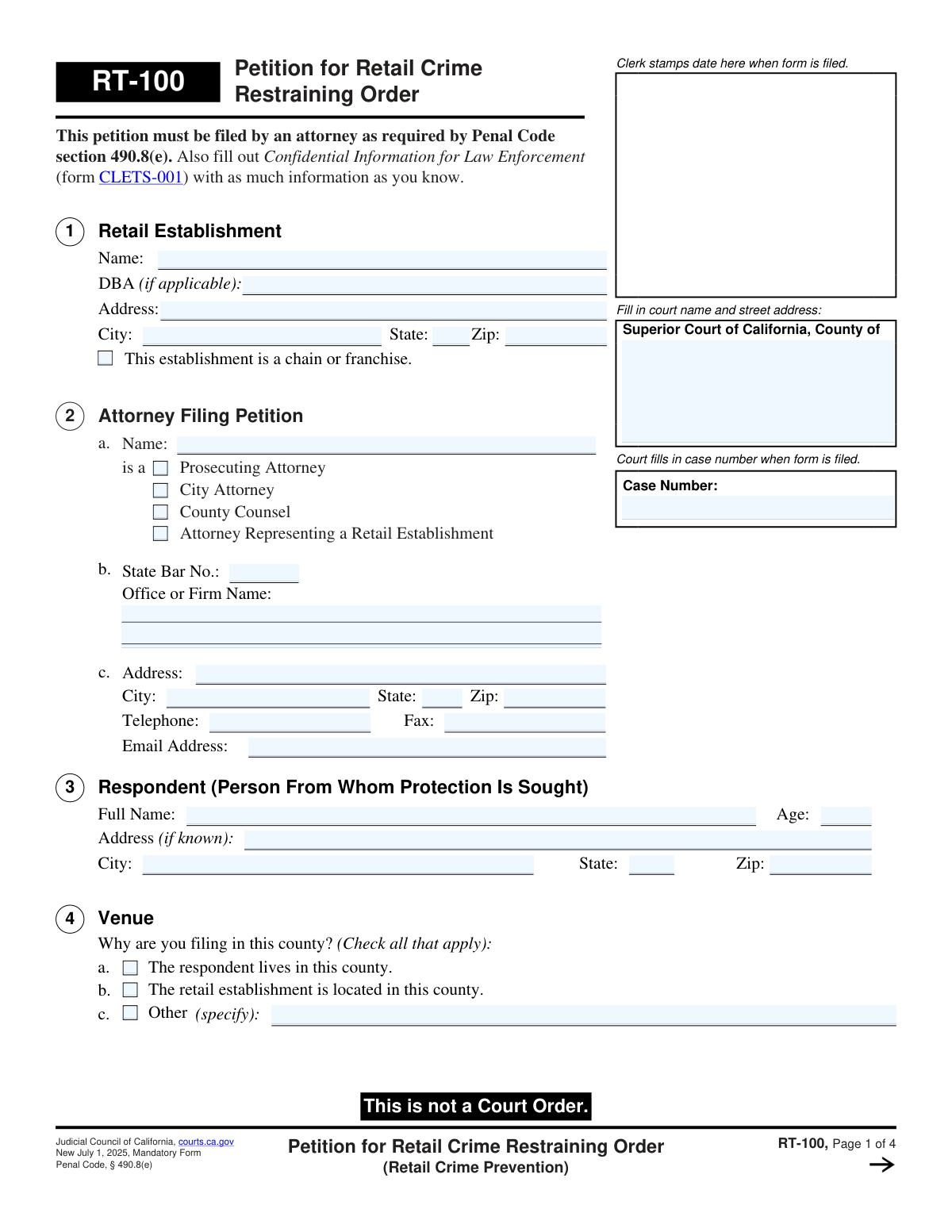
This is Form RT-100, a Petition for Retail Crime Restraining Order, used within the California court system. An attorney files this petition on behalf of a retail establishment to request a court order preventing a specific person (the respondent) from entering the store's premises due to past incidents of shoplifting, theft, or other related offenses. This legal action is crucial for businesses to prevent future losses and protect their employees. Today, this form can be filled out quickly and accurately using AI-powered services like Instafill.ai, which can also convert non-fillable PDF versions into interactive fillable forms.
Our AI automatically handles information lookup, data retrieval, formatting, and form filling.
It takes less than a minute to fill out RT-100 using our AI form filling.
Securely upload your data. Information is encrypted in transit and deleted immediately after the form is filled out.
Form specifications
| Form name: | Form RT-100, Petition for Retail Crime Restraining Order (Retail Crime Prevention) |
| Number of fields: | 64 |
| Number of pages: | 1 |
| Language: | English |
Instafill Demo: How to fill out PDF forms in seconds with AI
How to Fill Out RT-100 Online for Free in 2026
Are you looking to fill out a RT-100 form online quickly and accurately? Instafill.ai offers the #1 AI-powered PDF filling software of 2026, allowing you to complete your RT-100 form in just 37 seconds or less.
Follow these steps to fill out your RT-100 form online using Instafill.ai:
- 1 Navigate to Instafill.ai and upload or select the Petition for Retail Crime Restraining Order (Form RT-100).
- 2 Provide the details of the retail establishment and the filing attorney in the designated sections.
- 3 Enter all known information about the respondent (the person from whom protection is sought), including their name and address.
- 4 Detail the respondent's past arrests or citations related to retail crime and describe the specific conduct that led to this petition.
- 5 Explain why you believe the respondent is likely to return to the establishment and specify the exact orders you are requesting from the court.
- 6 Review all the information populated by the AI for accuracy, make any necessary edits, and then have the attorney and a representative of the retail establishment sign and date the form.
Our AI-powered system ensures each field is filled out correctly, reducing errors and saving you time.
Why Choose Instafill.ai for Your Fillable RT-100 Form?
Speed
Complete your RT-100 in as little as 37 seconds.
Up-to-Date
Always use the latest 2026 RT-100 form version.
Cost-effective
No need to hire expensive lawyers.
Accuracy
Our AI performs 10 compliance checks to ensure your form is error-free.
Security
Your personal information is protected with bank-level encryption.
Frequently Asked Questions About Form RT-100
This form is used by a retail establishment to formally request a court order that prohibits a specific individual from entering the store's premises due to past retail-related crimes.
This petition must be filed by an attorney. This can be a Prosecuting Attorney, City Attorney, County Counsel, or an attorney hired to represent the retail establishment.
No, the form explicitly states that it must be filed by an attorney as required by Penal Code section 490.8(e). A retail business must have legal representation to submit this petition.
The petition can be filed if the person has been arrested or cited for crimes like shoplifting, theft, organized retail theft, vandalism of the store, or assault or battery against a store employee.
You must provide the respondent's full name and age in Section 3. You should also provide their last known address, if you have it.
Yes, you must also complete and file the 'Confidential Information for Law Enforcement' (form CLETS-001) with as much information as you know about the respondent.
Yes, if your establishment is a chain or franchise, you can use Section 8 to ask the court to include all locations within a specified radius in the order. You will need to provide the addresses for those locations.
No, this form is only a request to the court. A judge must review the petition and grant a separate court order for the restraining order to become legally effective.
The form allows for attachments for several sections, such as Section 6 for describing conduct or Section 8 for listing additional addresses. Simply check the box indicating an attachment is used and include the extra information on a separate page.
You should file the petition in the county where the respondent lives or where the retail establishment is located. You will specify the reason for your choice of venue in Section 4.
Yes, services like Instafill.ai use AI to help you accurately auto-fill form fields. This can save significant time and help prevent errors when completing the petition.
You can use a platform like Instafill.ai to fill out the form online. Simply upload the PDF, and the service will provide an interactive version for you to complete, save, and print.
If you have a non-fillable or 'flat' PDF, you can upload it to a service like Instafill.ai. The platform can convert the document into an interactive, fillable form that you can easily complete on your computer.
This section is critical to justify the need for a restraining order. You must provide the court with specific reasons to believe there is a credible threat that the individual will return to the retail establishment.
Compliance RT-100
Validation Checks by Instafill.ai
1
Ensures Attorney Information is Complete
Validates that the attorney's name, State Bar number, and office information in Section 2 are all provided. The form explicitly states it must be filed by an attorney, making this information essential for the petition's validity. A failure would render the submission incomplete and likely cause its rejection by the court clerk.
2
Validates State Bar Number Format
Checks that the State Bar Number provided in Section 2b is a valid numerical sequence, consistent with the format used by the State Bar of California. This is crucial for verifying the attorney's credentials and authority to file the petition. An invalid format would prevent verification and lead to rejection of the form.
3
Requires Attorney Type Selection
Ensures that exactly one checkbox is selected in Section 2a to identify the attorney's role (e.g., Prosecuting Attorney, City Attorney). This information is necessary to establish the petitioner's standing and the context of the legal action. Failure to select one and only one option creates ambiguity and may halt processing.
4
Mandatory Respondent Identification
Ensures the 'Full Name' of the respondent in Section 3 is not empty. The identity of the person from whom protection is sought is the most fundamental piece of information for a restraining order. A failure to name the respondent makes the entire petition invalid and unenforceable.
5
Requires Venue Justification
Validates that at least one checkbox in Section 4 is selected to establish why the petition is filed in that specific county. If the 'Other' option is selected, the corresponding text field must be filled out. This is a jurisdictional requirement, and failure to provide a valid venue could result in the case being dismissed.
6
Verifies Presence of Alleged Crime Evidence
Validates that at least one row in the table in Section 5, detailing an arrest or citation, is completely filled out (Law Enforcement Agency, Report No., Statutory Basis). This information forms the factual basis of the petition as required by law. Without at least one documented incident, the petition lacks the necessary grounds for a restraining order.
7
Ensures Narrative for Conduct is Provided
Checks that a description of the respondent's conduct is provided in Section 6, either directly in the text box or by checking the 'Response is stated in Attachment 6' box. This narrative is critical for the court to understand the context of the arrests listed in Section 5. A missing narrative would leave the petition incomplete and unsupported.
8
Validates Franchise Order Specifics
This is a conditional check for Section 8b. If the petitioner checks the box to request the order apply to other franchise locations, it validates that both the 'miles' radius and the list of addresses for those locations are provided. Omitting these details makes the request unenforceable and ambiguous, forcing the court to deny or question this part of the order.
9
Ensures Miles Radius is a Valid Number
Validates that the 'miles' field in Section 8b contains a positive numerical value if it is filled. This is necessary to define a clear and enforceable geographic scope for the restraining order if it's extended to other franchise locations. Non-numeric or negative values would make the request invalid.
10
Attachment Count Consistency Check
Compares the number entered in Section 10 ('Number of pages attached') with the number of 'Attachment' checkboxes ticked throughout the form. If any attachment boxes are checked, the number must be greater than zero. This check prevents discrepancies between the stated attachments and the submitted documents, ensuring the court receives a complete file.
11
Validates Attorney Signature and Name
Confirms that the attorney's printed name and signature are provided on page 4. The attorney's signature certifies their role in filing the petition as required by law. A missing signature or name would invalidate the submission, as it lacks the required professional attestation.
12
Declaration Signature and Name Match
Validates that the 'Name of retail establishment' under the declaration on page 4 matches the establishment name provided in Section 1. This confirms that the person signing on behalf of the petitioner is representing the correct entity. A mismatch could indicate an error or an unauthorized filing.
13
Validates ZIP Code Format
Ensures all ZIP code fields on the form (for the establishment, attorney, and respondent) contain a valid 5-digit or 9-digit (ZIP+4) US postal code format. Correctly formatted ZIP codes are essential for mail delivery and for accurately identifying locations for jurisdictional and enforcement purposes. An invalid format can cause mail to be returned and create ambiguity.
14
Retail Establishment Address Completeness
Validates that the full address (Street, City, State, Zip) for the retail establishment in Section 1 is provided. This information defines the primary location to be protected by the restraining order. An incomplete address would make the order ambiguous and potentially unenforceable.
Common Mistakes in Completing RT-100
A primary mistake is a non-attorney, such as a store manager, attempting to file this petition. The form explicitly states on page 1 that it 'must be filed by an attorney as required by Penal Code section 490.8(e).' Any submission by a non-attorney will be immediately rejected by the court clerk, wasting time and effort and delaying protection for the business.
Filers often enter a generic court name like 'LA Court' instead of the full, proper name, 'Superior Court of California, County of Los Angeles,' and may omit the correct street address. This can lead to the petition being misrouted, delayed, or rejected at the filing window. It is crucial to verify the exact name and address of the specific court where you are filing.
In Section 1, attorneys may incorrectly list only the store's common name (DBA) without its legal entity name, or vice versa. An order issued against an incorrect or incomplete entity name may be difficult or impossible to enforce. Both the legal name and the DBA (if applicable) should be clearly and accurately provided to ensure the restraining order is legally sound.
Section 3 asks for the respondent's full name, age, and address. A common error is providing a partial name or leaving the address blank even when it's known, making it impossible for law enforcement to serve the order. Even if the exact address is unknown, providing a last known address, age, and a detailed physical description on the accompanying CLETS-001 form is vital for identification and enforcement.
In Section 4, the filer must check a box to justify why the petition is being filed in that specific county's court. Attorneys sometimes overlook this section or fail to provide a valid reason, such as the respondent's residence or the location of the retail establishment. Failure to establish proper venue can be grounds for the case to be dismissed.
Section 5 requires listing the law enforcement agency, report number, and statutory basis for each incident. Petitions are often weakened by missing report numbers or incorrect penal code citations. This lack of specific, verifiable data makes it difficult for the judge to see a pattern of conduct, reducing the likelihood of the order being granted.
In Sections 6 and 7, filers must describe the respondent's actions and why they are likely to return. A frequent mistake is using vague language like 'respondent is a threat' instead of providing a detailed, factual account of events, including dates, times, specific actions, and witness information. The court requires concrete facts, not opinions, to issue a restraining order.
The form provides checkboxes to indicate that additional information is included in an attachment (e.g., Attachment 5, 6, 7). Filers may check the box but forget to include the actual attachment, or they might include an attachment without checking the corresponding box on the form. This can lead to the court overlooking critical information, and it's also important to correctly tally the total number of pages in Section 10.
When requesting the order to apply to other franchise or chain locations in Section 8b, attorneys often fail to fill in all the required information. They might forget to specify the mileage radius or neglect to list the full addresses of the other establishments. An incomplete request will result in the order only protecting the single location listed in Section 1.
A petition can be invalidated by simple signature errors. The form requires two separate dated signatures under penalty of perjury: one for the attorney and one for the retail establishment's representative. Common mistakes include missing one of the signatures, forgetting to date them, or having the attorney sign in both places. An unsigned or improperly signed petition will be rejected by the court.
Saved over 80 hours a year
“I was never sure if my IRS forms like W-9 were filled correctly. Now, I can complete the forms accurately without any external help.”
Kevin Martin Green
Your data stays secure with advanced protection from Instafill and our subprocessors

Robust compliance program
Transparent business model
You’re not the product. You always know where your data is and what it is processed for.
ISO 27001, HIPAA, and GDPR
Our subprocesses adhere to multiple compliance standards, including but not limited to ISO 27001, HIPAA, and GDPR.
Security & privacy by design
We consider security and privacy from the initial design phase of any new service or functionality. It’s not an afterthought, it’s built-in, including support for two-factor authentication (2FA) to further protect your account.
Fill out RT-100 with Instafill.ai
Worried about filling PDFs wrong? Instafill securely fills form-rt-100-petition-for-retail-crime-restraining-order-retail-crime-prevention forms, ensuring each field is accurate.