Yes! You can use AI to fill out Form SV-130, Postsecondary School Violence Restraining Order After Hearing (CLETS-SVO)

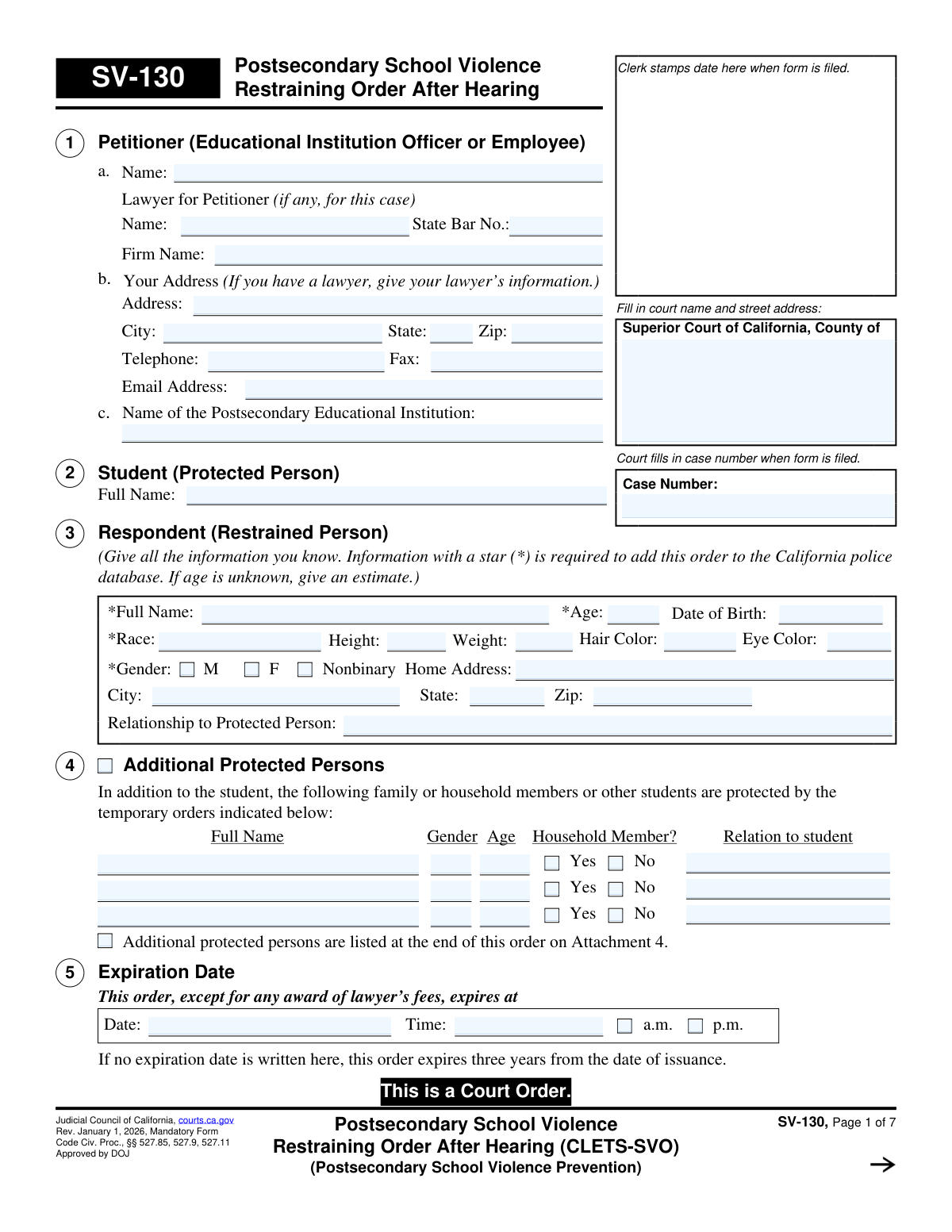
This is Form SV-130, the Postsecondary School Violence Restraining Order After Hearing, from the Judicial Council of California. It is a legally binding court order that outlines the specific prohibitions and restrictions placed on a person (the respondent) to protect a student after a court hearing. The order includes personal conduct rules, stay-away provisions, and firearm restrictions. Today, this form can be filled out quickly and accurately using AI-powered services like Instafill.ai, which can also convert non-fillable PDF versions into interactive fillable forms.
SV-130 is part of the California court forms and restraining order forms categories on Instafill.
Our AI automatically handles information lookup, data retrieval, formatting, and form filling.
It takes less than a minute to fill out SV-130 using our AI form filling.
Securely upload your data. Information is encrypted in transit and deleted immediately after the form is filled out.

Form specifications

Form name: Form SV-130, Postsecondary School Violence Restraining Order After Hearing (CLETS-SVO)
Number of fields: 197
Number of pages: 1
Language: English
main-image

Instafill Demo: How to fill out PDF forms in seconds with AI

How to Fill Out SV-130 Online for Free in 2026

Are you looking to fill out a SV-130 form online quickly and accurately? Instafill.ai offers the #1 AI-powered PDF filling software of 2026, allowing you to complete your SV-130 form in just 37 seconds or less.
Follow these steps to fill out your SV-130 form online using Instafill.ai:
  1. 1 Navigate to Instafill.ai, and upload or select the Postsecondary School Violence Restraining Order After Hearing (Form SV-130).
  2. 2 Use the AI assistant to accurately input the court name, address, and case number in the designated fields.
  3. 3 Enter the full details for the petitioner (educational institution), the protected student, and the restrained person, including required identifying information.
  4. 4 Document the hearing details, including the date, attendees, and the specific personal conduct and stay-away orders checked by the judicial officer.
  5. 5 Specify the court's orders regarding firearms, ammunition, body armor, and any associated compliance review hearings.
  6. 6 List any court-ordered costs to be paid and any other specific orders made by the judge.
  7. 7 Review all entered information for completeness and accuracy before the judicial officer signs and dates the order, then save the final document.

Our AI-powered system ensures each field is filled out correctly, reducing errors and saving you time.

Why Choose Instafill.ai for Your Fillable SV-130 Form?

Speed

Complete your SV-130 in as little as 37 seconds.

Up-to-Date

Always use the latest 2026 SV-130 form version.

Cost-effective

No need to hire expensive lawyers.

Accuracy

Our AI performs 10 compliance checks to ensure your form is error-free.

Security

Your personal information is protected with bank-level encryption.

Frequently Asked Questions About Form SV-130

The SV-130 form is a court order, issued after a hearing, to protect a postsecondary school student from violence, threats, or harassment. It legally documents the restrictions placed upon the restrained person.

The petitioner is an officer or employee of the postsecondary educational institution who is filing for the restraining order on behalf of the student being protected. The court clerk and judge also complete sections of the form after the hearing.

The order's expiration date is written in Section 5. If no specific date is entered by the court, the restraining order automatically expires three years from the date it was issued.

To ensure the order can be entered into the California police database (CLETS), you must provide the restrained person's full name, race, and gender. Providing other details like date of birth and physical description is also highly recommended.

Yes, Section 4 allows for additional people to be protected. This can include the student's family, household members, or other students who are also at risk.

Violating this court order is a criminal offense. The restrained person can be arrested, charged with a crime, and may face jail time of up to one year and/or a fine of up to $1,000.

This order prohibits the restrained person from owning, possessing, or attempting to buy any firearms, firearm parts, or ammunition. They must turn in or sell any prohibited items they have and provide a receipt to the court as proof of compliance.

If the restrained person attended the court hearing, no further service is needed. If they were absent, a copy of the order must be formally served on them, either by mail or in person, as specified in Section 17.

CLETS is the California Law Enforcement Telecommunications System. This order is entered into the CLETS database so that law enforcement officers across the state can verify its existence and enforce it.

If you have a non-fillable or 'flat' PDF, you can use an online service like Instafill.ai. It can convert the document into an interactive, fillable form that you can easily complete on your computer.

Yes, services like Instafill.ai use AI to help you complete forms like the SV-130. These tools can auto-fill your information accurately, which saves time and helps prevent common errors.

To complete this form online, you can upload the PDF to a platform like Instafill.ai. The service will make the document fillable, allowing you to type in your information, check boxes, and prepare it for submission.

Even if the protected person invites or consents to contact, the restraining order remains in full effect and must be enforced by law enforcement. Only a new court order from a judge can change the terms.

Personal Conduct Orders (Section 7) prohibit specific behaviors like harassment, stalking, and any form of contact. Stay-Away Orders (Section 8) require the restrained person to maintain a specific physical distance from the protected people and places.

Compliance SV-130
Validation Checks by Instafill.ai

1
Respondent CLETS Data Completeness
This check verifies that all fields marked with a star (*) in Section 3 for the Respondent (Restrained Person) are filled. These fields, including Full Name, Race, and Gender, are required for entering the restraining order into the California Law Enforcement Telecommunications System (CLETS). Failure to provide this information will prevent the order from being registered in the statewide police database, making it unenforceable by law enforcement who rely on this system.
2
Respondent Age and Date of Birth Consistency
This validation ensures that the 'Age' and 'Date of Birth' provided for the Respondent in Section 3 are logically consistent. The age calculated from the Date of Birth should match the age entered, within a reasonable tolerance of one year. This cross-reference prevents data entry errors and ensures the identifying information is accurate for legal and enforcement purposes. If they do not match, the form will be flagged for manual review to correct the discrepancy.
3
Order Expiration Date Validity
This check validates that the 'Expiration Date' in Section 5 is a future date and occurs after the 'Hearing Date' specified in Section 6. A restraining order cannot expire in the past or before it was officially ordered at the hearing. This is critical for defining the legal duration of the order's protections. An invalid date would render the order's term ambiguous and unenforceable.
4
Hearing Date Logical Check
This validation ensures the 'Hearing Date' in Section 6a is a valid date that is not in the future. A hearing must have already occurred for an 'Order After Hearing' to be issued. This check prevents clerical errors, such as entering a typo or a future court date. If the date is invalid, the form cannot be processed as it lacks a valid record of the judicial proceeding.
5
Continued Hearing Date Requirement
This check verifies that if the 'The hearing is continued' checkbox (Section 6c) is selected, then a future date and time for the continued hearing are provided. It is logically inconsistent to indicate a continuance without specifying when the parties must return to court. This ensures all parties are properly notified of their next required appearance, and failure to provide this date would make the continuance order incomplete and non-actionable.
6
Stay-Away Order Distance Specification
This validation ensures that if any location checkbox is selected in the 'Stay-Away Orders' (Section 8a), the 'yards' field is filled with a positive numerical value. The order is meaningless without a specified distance that the respondent must maintain. This check guarantees that the stay-away provision is clear, specific, and enforceable by law enforcement. If a location is checked but the distance is missing, the form submission will be rejected.
7
Lawyer State Bar Number Requirement
This check validates that if a 'Lawyer for Petitioner' name is entered in Section 1, the corresponding 'State Bar No.' field is also filled. The State Bar Number is the unique identifier for a licensed attorney in California and is essential for verifying their credentials and standing with the Bar. Submitting a lawyer's name without their bar number is an incomplete and unverified entry, which could cause processing delays or rejection.
8
Exclusive CLETS Entry Method Selection
This validation ensures that exactly one of the three options (16a, 16b, or 16c) is selected for entering the order into the CARPOS/CLETS system. Selecting zero or more than one option creates ambiguity about who is responsible for this critical data entry task. This check prevents confusion and ensures there is a clear, designated path for getting the order into the law enforcement database. An invalid selection would halt the process until the responsible party is clarified.
9
Conditional CLETS Agency Information
This check verifies that if option 16c is selected, indicating the petitioner's lawyer will deliver the order, then the 'Name of Law Enforcement Agency' and its 'Address' must be provided. Without this information, the petitioner or their lawyer would not know where to deliver the order for entry into CLETS. This rule ensures that the action prescribed in 16c is actually possible to complete, preventing the order from failing to be registered with law enforcement.
10
Service of Order Logical Selection
This validation enforces the selection logic in Section 17, 'Service of Order on Respondent'. It ensures that either 17a (respondent attended hearing) or 17b (respondent did not attend) is selected, but not both. Furthermore, if 17b is selected, it validates that one of its sub-options (1 or 2) is also checked to specify the circumstances of service. This logic is crucial for establishing whether the respondent has been legally notified of the order, which is a prerequisite for enforcement.
11
Firearms Compliance Hearing Date Validity
This check ensures that if a 'Court Hearing to Review Firearms...Compliance' is scheduled in Section 13, the specified date is a valid date in the future. A review hearing cannot be scheduled for a date that has already passed. This validation is critical for ensuring the respondent is given proper notice of a future legal obligation to appear in court. An invalid date would make the order for the hearing defective.
12
Case Number Consistency Across Pages
This validation verifies that the 'Case Number' field is populated and is identical on every page of the form where it appears (Pages 1, 2, 3, 4, 5, 6, and 7). The case number is the primary identifier that links all pages of this legal document together as a single order. Any inconsistency could lead to pages being misfiled or the document being considered invalid, jeopardizing the integrity of the court record.
13
Petitioner and Institution Name Completeness
This check ensures that the Petitioner's Name (Section 1a) and the Name of the Postsecondary Educational Institution (Section 1c) are both provided. The petitioner is the individual filing on behalf of the institution, and both entities are central parties to the legal action. Missing either name would make the order fundamentally incomplete and legally deficient, as it would not be clear who sought the order or on whose behalf it was granted.
14
Additional Protected Person Row Integrity
This validation ensures that if a 'Full Name' is entered for an 'Additional Protected Person' in any row of Section 4, then the 'Relation to student' field in that same row is also completed. Simply listing a name is insufficient; the relationship is required to establish their connection to the case and justify their inclusion for protection under the order. This check prevents incomplete entries and ensures the record is clear about who is being protected and why.

Common Mistakes in Completing SV-130

Omitting Required Respondent Details for Law Enforcement

Section 3 requires the respondent's full name, race, and gender to enter the order into the California police database (CLETS). People often leave these starred (*) fields blank because they are unsure of the information. This failure prevents or delays law enforcement from being able to identify the restrained person and enforce the order, putting the protected person at risk. Always fill in all known information, providing an estimate for age if the exact date of birth is unknown.

Using Vague or Inaccurate Physical Descriptions

In Section 3, fields like height, weight, hair color, and eye color are crucial for positive identification by law enforcement. Submitters may guess, use outdated information, or write generic terms like 'average' or 'brown.' This ambiguity can lead to misidentification or an officer's inability to confirm the respondent's identity during an encounter. It is vital to provide the most accurate and specific descriptions possible to ensure the order is effective.

Incorrectly Entering the Petitioner's Address

Section 1b instructs the petitioner to provide their lawyer’s address if they are represented, but petitioners often mistakenly enter their personal home address or the main school address. This can lead to improper service of future legal documents and potentially expose the petitioner's private information. The address listed should be the official address for legal correspondence, which is typically the attorney's office or a designated institutional office.

Failing to Include All Individuals Needing Protection

Section 4 allows for the protection of the student's family, household members, or other students, but petitioners sometimes forget to list everyone who has been affected or is at risk. This oversight means the final order will not legally protect these additional individuals, leaving them vulnerable to the respondent's actions. Before submitting, carefully review the situation and list the full name of every person who requires the order's protection.

Omitting the Case Number on Subsequent Pages

The Case Number field appears at the top of every page, but filers frequently fill it in on the first page and forget to carry it over to all subsequent pages. If the pages of this multi-page order become separated, the lack of a case number can cause significant clerical issues and confusion, potentially invalidating parts of the order. Ensure the case number is written or typed on every single page before filing.

Writing Vague or Unenforceable 'Other' Orders

Sections 7a(7) and 15 allow for custom orders, but people often write requests that are too broad, ambiguous, or not legally permissible, such as 'stop all contact.' An unenforceable order is useless and will be rejected by the judge. Any 'other' order must be specific, concise, and describe a clear, observable action, like 'Do not post about the protected person on any social media platform.'

Incomplete Selection of Stay-Away Locations

Section 8a requires checking all locations from which the respondent must stay away, such as the student's home, job, or vehicle. It is common for a petitioner to only check the school and the student themselves, forgetting other places where the student could be vulnerable. This limits the scope of the restraining order, as police can only enforce the specific locations listed. Carefully consider all relevant places and check every applicable box.

Providing Incorrect Law Enforcement Agency Details

If the petitioner is responsible for delivering the order (Section 16c), they must list the correct law enforcement agency and its address for entry into the CLETS database. Petitioners may list the wrong jurisdiction (e.g., city police instead of the county sheriff) or provide an incomplete address. This error can severely delay the order's entry into the statewide system, meaning officers in the field will not be aware of it and cannot enforce it.

Forgetting or Mislabelling Required Attachments

The form frequently directs the user to provide additional information on attachments, such as for additional protected persons in Section 4. A common mistake is failing to include these attachments or not labeling them clearly with the case name, case number, and corresponding form section. This can result in the court disregarding the extra information, weakening the order's scope or preventing the recovery of costs.

Attempting to Fill a Non-Fillable PDF by Hand

Often, legal forms are distributed as 'flat' or non-fillable PDFs, forcing users to print them and fill them out by hand. This frequently leads to illegible handwriting, which can make critical information like names and addresses unreadable and the order unenforceable. To avoid this, use a tool like Instafill.ai, which can convert any PDF into a smart, fillable form, ensuring all entries are clear, legible, and properly formatted.

Using Inconsistent or Incorrect Date/Time Formats

The form requires numerous dates and times, such as the expiration date (Section 5) and hearing dates (Section 6). Users may enter dates in non-standard formats (e.g., DD-MM-YY) or forget to specify a.m. or p.m. for times. These inconsistencies can create legal ambiguity about when the order is in effect or when parties must appear in court. Always use the standard MM/DD/YYYY format and clearly mark a.m. or p.m.; AI-powered form filling tools like Instafill.ai can automatically format this data correctly.
Saved over 80 hours a year

“I was never sure if my IRS forms like W-9 were filled correctly. Now, I can complete the forms accurately without any external help.”

Kevin Martin Green

Your data stays secure with advanced protection from Instafill and our subprocessors

Robust compliance program

Transparent business model

You’re not the product. You always know where your data is and what it is processed for.

ISO 27001, HIPAA, and GDPR

Our subprocesses adhere to multiple compliance standards, including but not limited to ISO 27001, HIPAA, and GDPR.

Security & privacy by design

We consider security and privacy from the initial design phase of any new service or functionality. It’s not an afterthought, it’s built-in, including support for two-factor authentication (2FA) to further protect your account.

Fill out SV-130 with Instafill.ai

Worried about filling PDFs wrong? Instafill securely fills form-sv-130-postsecondary-school-violence-restraining-order-after-hearing-clets-svo forms, ensuring each field is accurate.

Related forms by category

California court forms Judicial Council of California Form SC-105, Request for Court Order and Answer (Small Claims), Judicial Council of California Form SC-120, Defendant’s Claim and ORDER to Go to Small Claims Court (Small Claims), Judicial Council of California Form SER-001, Request for Sheriff to Serve Court Papers, Judicial Council of California Form SER-001, Request for Sheriff to Serve Court Papers, Affidavit for Collection of Personal Property California Probate Code Section 13100, Form POS-040, Proof of Service—Civil, Declaration of Facts of Death (California Superior Court), declaration-of-marriage-for-court-proceeding-california-family-law, ADOPT-200, Adoption Request, ADOPT-200, Stepparent Adoption Request, ADOPT-210, Adoption Agreement, ADOPT-310, Contact After Adoption Agreement, Judicial Council of California Form ADOPT-200, Adoption Request, Form ADR-107, Mediation Attendance Sheet, Form ADR-110, Order Appointing Referee, Form ADR-109, Stipulation or Motion for Order Appointing Referee, Form ADR-102, Request for Trial De Novo After Judicial Arbitration, Form ADR-108, Referee's Report (Code Civ. Proc., §§ 638, 639), Form ADR-106, Petition to Confirm, Correct, or Vacate Contractual Arbitration Award, Form ADR-104, Rejection of Award and Request for Trial After Attorney-Client Fee Arbitration · + 557 more →
restraining order forms Form DV-100, Request for Domestic Violence Restraining Order, DV-100, Request for Domestic Violence Restraining Order (Domestic Violence Prevention), Judicial Council of California Form DV-110, Temporary Restraining Order (CLETS-TRO) (Domestic Violence Prevention), Form DV-116, Order on Request to Continue Court Hearing (Temporary Restraining Order) (CLETS-TRO) (Domestic Violence Prevention), Form DV-130, Restraining Order After Hearing (Order of Protection) (Domestic Violence Prevention), Form CH-110, Temporary Restraining Order (CLETS-TCH) (Civil Harassment Prevention), Form CH-120, Response to Request for Civil Harassment Restraining Orders, Form CH-130, Civil Harassment Restraining Order After Hearing (CLETS-CHO), Order on Request to Modify/Terminate Civil Harassment Restraining Order (Civil Harassment Prevention), Form CH-100, Request for Civil Harassment Restraining Orders (Civil Harassment Prevention), Form CH-620, Response to Request to Modify/Terminate Civil Harassment Restraining Order (Civil Harassment Prevention), Form CIV-025, Application and Order for Reissuance of Order to Show Cause and Temporary Restraining Order, Form CD-190, Application for Temporary Restraining Order (Claim and Delivery), Order on Request to Continue Hearing (Temporary Restraining Order) (CLETS-TCH) (Civil Harassment Prevention), Form CH-610, Notice of Hearing on Request to Modify/Terminate Civil Harassment Restraining Order (Civil Harassment Prevention), Form CH-700, Request to Renew Restraining Order (Civil Harassment Prevention), Form CH-730, Order Renewing Civil Harassment Restraining Order (CLETS), Form DV-120, Response to Request for Domestic Violence Restraining Order (Domestic Violence Prevention), Form DV-300, Request to Change or End Restraining Order (Domestic Violence Prevention), Form DV-310, Notice of Court Hearing and Temporary Order to Change or End Restraining Order (Domestic Violence Prevention) · + 52 more →