
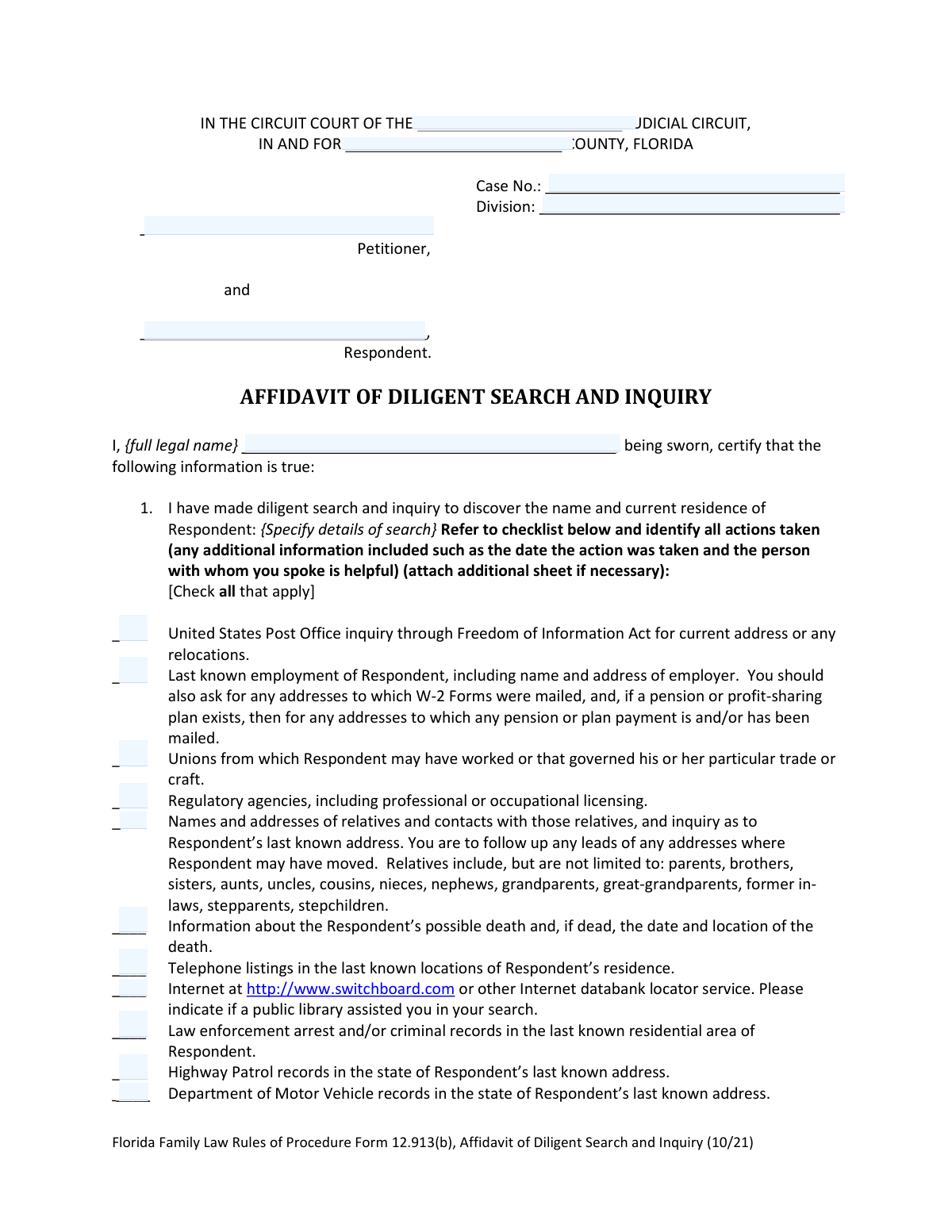
Yes! You can use AI to fill out Florida Family Law Rules of Procedure Form 12.913(b), Affidavit of Diligent Search and Inquiry
Don't type 65 fields by hand. Tell our AI about yourself, or upload a document you already have, and it fills every field in seconds. You check it, then download, print or sign.
The AI does the filling. You just check it.
No typing into boxes, nothing to install.
What this form asks for
The AI fills all of it, from your answers or your documents.
The AI checks your answers before you download
14 checks built for this form, so a wrong date or a missing answer is caught before anyone else sees it.
Ensures that the 'County', 'Circuit #', 'Case No.', 'Division', 'Petitioner', and 'Respondent' fields are all populated. These fields are essential for correctly identifying and filing the document with the appropriate court and case. A failure in this validation would prevent the form from being associated with the correct legal proceeding.
Validates that the 'full legal name' of the person signing the affidavit (the Petitioner) is provided. This field cannot be left blank as it identifies the individual swearing to the facts stated in the document. An empty field would invalidate the affidavit, as the identity of the affiant would be unknown.
Checks that at least one checkbox under section 1, detailing the diligent search actions, has been selected. The entire purpose of this affidavit is to prove a diligent search was conducted. If no actions are checked, the form fails to meet its primary legal requirement and should be rejected for incompleteness.
Verifies that if the 'Other: {explain}' checkbox in section 1 is checked, the corresponding text field for the explanation is not empty. This ensures that any non-standard search methods are properly documented for the court's review. A checked box with no explanation provides no useful information and makes the claim of an 'other' search unsubstantiated.
Confirms that in section 2, either the 'known' or 'unknown' option for the Respondent's age is selected, but not both. If 'known' is selected, the associated age field must be populated. This prevents contradictory or incomplete data entry regarding a key piece of identifying information for the Respondent.
If the Respondent's age is marked as 'known', this check ensures the entered value is a plausible integer (e.g., between 1 and 120). This validation prevents data entry errors such as text, negative numbers, or unrealistic ages. It maintains the integrity of the data provided to the court.
And 8 more checks
- Mutually Exclusive Residence Status Selection
- Mandatory Last Known Address
- Date of Last Known Address Validity
- Petitioner Signature Date Requirement
- Petitioner Contact Information Completeness
- Petitioner E-mail Format Validation
- Conditional Nonlawyer Section Integrity
- Telephone Number Format Consistency
Let AI fill out your Form 12.913(b)
No typing. Every field filled in seconds, checked, ready to sign.
How to Fill Out Form 12.913(b) Online for Free in 2026
What the AI walks you through.
- Navigate to Instafill.ai and upload or select the Florida Affidavit of Diligent Search and Inquiry, Form 12.913(b).
- Provide the court and case information, including the circuit, county, case number, and the names of the petitioner and respondent.
- Detail your diligent search efforts by checking all applicable boxes from the provided checklist and adding specific details for each action taken to locate the respondent.
- Indicate whether the respondent's age is known and specify their last known residence status by selecting the appropriate option.
- Enter the respondent's last known address and employment information, including the date this information was last known to be accurate.
- Carefully review all entered information for accuracy, then date and e-sign the affidavit under penalties of perjury.
- Download the completed, signed affidavit, ready for filing with the clerk of the circuit court.
Common Mistakes in Completing Form 12.913(b)
The ones the AI is built to catch.
Providing Insufficient Search Details
Stating the Last Known Address is 'Unknown'
Failing to Follow Up on Leads
Improper Execution or Notarization
Providing Contradictory Information
Omitting Required Dates
Forgetting to Sign and Date the Affidavit
Ignoring the 'Nonlawyer' Assistance Section
Using Informal or Incomplete Names
Leaving Case Information Blank
Frequently Asked Questions About Form 12.913(b)
Is it really free for 7 days?
Can I fill other forms too?
How do I cancel?
How does the AI fill out Form 12.913(b)?
What happens to my information?
How complex is Form 12.913(b) to fill out?
What is the purpose of the Affidavit of Diligent Search and Inquiry form?
Who needs to fill out this form?
Do I have to check every single box on the diligent search checklist?
The form says a 'last known address cannot be unknown.' What does this mean?
What other forms do I need to file with this affidavit?
What do I do after I fill out and sign this form?
The form mentions e-filing. Am I required to file this form electronically?
How do I fill out Section 3 about the Respondent's current residence?
What happens after I successfully file this affidavit?
Can an AI tool help me fill out this form?
How can I fill out the Affidavit of Diligent Search and Inquiry online?
What should I do if the PDF version of this form I found is not fillable?
What if a nonlawyer helps me complete this form?
Get your Form 12.913(b) filled out by AI
$0 today. Cancel before Oct 30 and you pay nothing.
Other forms like this one
family law forms: Form 12.902(b), Family Law Financial Affidavit (Short Form), Florida Supreme Court Approved Family Law Form 12.901(b)(3), Petition for Dissolution of Marriage with No Dependent or Minor Child(ren) or Property (02/18), Form FL-170, Declaration for Default or Uncontested Dissolution or Legal Separation (Family Law), Form FL-100, Petition—Marriage/Domestic Partnership (Family Law), declaration-of-marriage-for-court-proceeding-california-family-law, Florida Supreme Court Approved Family Law Form 12.902(d), Uniform Child Custody Jurisdiction and Enforcement Act (UCCJEA) Affidavit, Florida Family Law Rules of Procedure Form 12.910(a), Summons: Personal Service on an Individual, Florida Supreme Court Approved Family Law Form 12.941(a), Petition for Enforcement of Out-of-State Custody Decree and for Order to Pick Up Minor Child(ren), Florida Supreme Court Approved Family Law Form 12.970(a), Petition for Temporary Custody by Extended Family, Form FL-110, Summons (Family Law), Form FL-120, Response—Marriage/Domestic Partnership (Family Law), ADOPT-200, Adoption Request, ADOPT-200, Stepparent Adoption Request, ADOPT-210, Adoption Agreement, ADOPT-310, Contact After Adoption Agreement, Adoption Assistance Program Nonrecurring Adoption Expense Agreement and Claim, Adoption Request (Stepparent), Adoption and Safe Families Act (ASFA) Survey, Florida Family Law Rules of Procedure Form 12.900(b), Notice of and Consent to Limited Appearance, Florida Family Law Rules of Procedure Form 12.900(d), Termination of Limited Appearance
family court forms: Form 12.995(c), Safety-Focused Parenting Plan, Florida Supreme Court Approved Family Law Form 12.901(b)(3), Petition for Dissolution of Marriage with No Dependent or Minor Child(ren) or Property (02/18), Form N161, Appellant’s notice (All appeals except small claims track appeals and appeals to the Family Division of the High Court), Form N161, Appellant's Notice (All appeals except small claims track appeals and appeals to the Family Division of the High Court), declaration-of-marriage-for-court-proceeding-california-family-law, Florida Supreme Court Approved Family Law Form 12.902(d), Uniform Child Custody Jurisdiction and Enforcement Act (UCCJEA) Affidavit, Florida Supreme Court Approved Family Law Form 12.941(a), Petition for Enforcement of Out-of-State Custody Decree and for Order to Pick Up Minor Child(ren), Florida Supreme Court Approved Family Law Form 12.970(a), Petition for Temporary Custody by Extended Family, Adoption Request (Stepparent), Florida Family Law Rules of Procedure Form 12.900(b), Notice of and Consent to Limited Appearance, Florida Family Law Rules of Procedure Form 12.900(d), Termination of Limited Appearance, Florida Family Law Rules of Procedure Form 12.900(e), Acknowledgment of Assistance by Attorney, Florida Family Law Rules of Procedure Form 12.900(g), Agreement Limiting Representation, Florida Family Law Rules of Procedure Form 12.900(h), Notice of Related Cases, Florida Family Law Rules of Procedure Form 12.901(a), Joint Petition for Simplified Dissolution of Marriage, Form 12.902(b), Family Law Financial Affidavit (Short Form), Florida Family Law Rules of Procedure Form 12.902(c), Family Law Financial Affidavit (Long Form), Florida Family Law Rules of Procedure Form 12.902(e), Child Support Guidelines Worksheet, Florida Supreme Court Approved Family Law Form 12.902(f)(1), Marital Settlement Agreement for Dissolution of Marriage with Dependent or Minor Child(ren), Florida Supreme Court Approved Family Law Form 12.902(f)(2), Marital Settlement Agreement for Dissolution of Marriage with Property but No Dependent or Minor Child(ren)
florida court forms: Form 12.995(c), Safety-Focused Parenting Plan, Florida Supreme Court Approved Family Law Form 12.901(b)(3), Petition for Dissolution of Marriage with No Dependent or Minor Child(ren) or Property (02/18), Florida Supreme Court Approved Family Law Form 12.902(d), Uniform Child Custody Jurisdiction and Enforcement Act (UCCJEA) Affidavit, Florida Supreme Court Approved Family Law Form 12.941(a), Petition for Enforcement of Out-of-State Custody Decree and for Order to Pick Up Minor Child(ren), Florida Supreme Court Approved Family Law Form 12.970(a), Petition for Temporary Custody by Extended Family, Florida Family Law Rules of Procedure Form 12.900(b), Notice of and Consent to Limited Appearance, Florida Family Law Rules of Procedure Form 12.900(d), Termination of Limited Appearance, Florida Family Law Rules of Procedure Form 12.900(e), Acknowledgment of Assistance by Attorney, Florida Family Law Rules of Procedure Form 12.900(a), Disclosure from Nonlawyer, Florida Family Law Rules of Procedure Form 12.910(a), Summons: Personal Service on an Individual, Form 12.902(b), Family Law Financial Affidavit (Short Form), Florida Supreme Court Approved Family Law Form 12.902(f)(1), Marital Settlement Agreement for Dissolution of Marriage with Dependent or Minor Child(ren), Florida Supreme Court Approved Family Law Form 12.903(c)(1), Answer to Petition and Counterpetition for Dissolution of Marriage with Dependent or Minor Child(ren), Florida Supreme Court Approved Family Law Form 12.902(l), Affidavit of Income for Child Support, Florida Supreme Court Approved Family Law Form 12.903(b), Answer to Petition for Dissolution of Marriage, Florida Supreme Court Approved Family Law Form 12.902(i), Affidavit of Corroborating Witness, Florida Supreme Court Approved Family Law Form 12.902(f)(2), Marital Settlement Agreement for Dissolution of Marriage with Property but No Dependent or Minor Child(ren), Florida Family Law Rules of Procedure Form 12.902(c), Family Law Financial Affidavit (Long Form), Florida Family Law Rules of Procedure Form 12.902(e), Child Support Guidelines Worksheet, Florida Family Law Rules of Procedure Form 12.900(h), Notice of Related Cases
Let AI fill out your Form 12.913(b)
Your trial starts once a card is added. You pay nothing before Oct 30.
Our AI already knows this form, all 65 fields of it. Skip the typing: tell it about yourself, or upload what you have, and it fills the whole form in seconds.
- AI fills every field on all 5 pages, checkboxes included
- No typing into boxes: answer a few questions, or upload a document you already have, an old copy of this form, a photo of a document
- The AI checks the answers; you review and change anything before you download
- Download the finished PDF, print it, or sign it online
- Encrypted, and never used to train AI
Cancel before Oct 30 and you pay nothing.
A card is needed to start the trial. Cancel in two clicks from your account.
Terms · Privacy