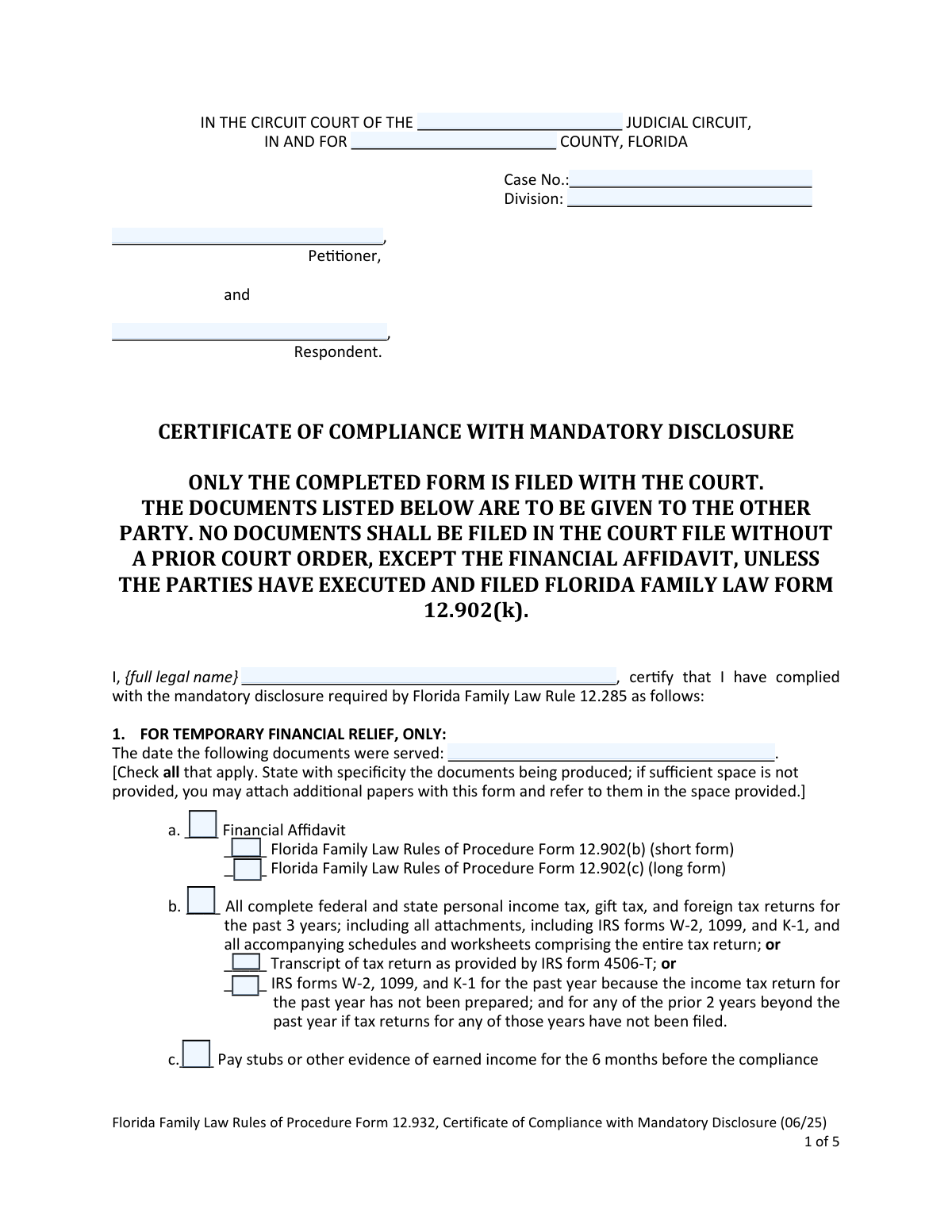
Yes! You can use AI to fill out Form 12.932, Certificate of Compliance with Mandatory Disclosure

Florida Family Law Form 12.932, Certificate of Compliance with Mandatory Disclosure, is a legal document used to inform the court and the opposing party that you have fulfilled your obligation to exchange specific financial documents as required by law. This certification is a critical step in family law proceedings, such as divorce or modification cases, ensuring both parties have the necessary information for fair negotiations and court decisions. Today, this form can be filled out quickly and accurately using AI-powered services like Instafill.ai, which can also convert non-fillable PDF versions into interactive fillable forms.
Form 12.932 is part of the family court forms, family law forms and florida court forms categories on Instafill.
Our AI automatically handles information lookup, data retrieval, formatting, and form filling.
It takes less than a minute to fill out Form 12.932 using our AI form filling.
Securely upload your data. Information is encrypted in transit and deleted immediately after the form is filled out.

Form specifications

Form name: Form 12.932, Certificate of Compliance with Mandatory Disclosure
Number of fields: 122
Number of pages: 1
Language: English
main-image

Instafill Demo: How to fill out PDF forms in seconds with AI

How to Fill Out Form 12.932 Online for Free in 2026

Are you looking to fill out a FORM 12.932 form online quickly and accurately? Instafill.ai offers the #1 AI-powered PDF filling software of 2026, allowing you to complete your FORM 12.932 form in just 37 seconds or less.
Follow these steps to fill out your FORM 12.932 form online using Instafill.ai:
  1. 1 Navigate to Instafill.ai and upload or select the Florida Form 12.932, Certificate of Compliance with Mandatory Disclosure.
  2. 2 Provide the court and case information, including the judicial circuit, county, case number, and division.
  3. 3 Enter your full legal name and identify yourself as the Petitioner or Respondent.
  4. 4 Check the boxes for all financial documents you have served on the other party, specifying details for each item as required for temporary or permanent relief.
  5. 5 Indicate the date the documents were served and certify the method of service (e-mail, mail, or hand delivery) to the other party or their attorney.
  6. 6 Review all entered information for accuracy, then electronically sign and date the certificate under penalties of perjury.
  7. 7 Download the completed form to file with the clerk of the circuit court and serve a copy to the other party as required.

Our AI-powered system ensures each field is filled out correctly, reducing errors and saving you time.

Why Choose Instafill.ai for Your Fillable Form 12.932 Form?

Speed

Complete your Form 12.932 in as little as 37 seconds.

Up-to-Date

Always use the latest 2026 Form 12.932 form version.

Cost-effective

No need to hire expensive lawyers.

Accuracy

Our AI performs 10 compliance checks to ensure your form is error-free.

Security

Your personal information is protected with bank-level encryption.

Frequently Asked Questions About Form Form 12.932

This form is used to notify the court and the other party that you have provided them with the required financial information and documents as mandated by Florida's family law rules.

Each party in a Florida family law case must fill out this form to certify they have exchanged financial documents. It applies to original and supplemental cases, but not simplified dissolutions or cases where a respondent served by publication does not answer.

The required financial documents must be served on the other party within 45 days of the respondent being served with the initial petition or supplemental petition for modification.

No, you should not file your financial documents with the court unless ordered to do so. You only file the completed Certificate of Compliance (Form 12.932) and your Financial Affidavit; the actual documents are served directly on the other party.

Section 1 lists the documents required for a temporary financial relief hearing, which are less extensive. Section 2 lists the comprehensive set of documents required for initial, supplemental, and permanent financial relief proceedings.

If your individual gross annual income is under $50,000, you should use the Family Law Financial Affidavit (Short Form) 12.902(b). If your income is $50,000 or more, you must use the Long Form 12.902(c).

You must certify which documents you have provided with specificity. If a document is not available, you should be prepared to explain why, as you are still under an obligation to comply with the disclosure rules.

You and the other party can agree to modify or waive the production of most documents. However, you cannot waive the requirement to complete and file a Financial Affidavit (Form 12.902(b) or 12.902(c)).

After you serve your initial disclosure, you have an ongoing obligation to promptly provide the other party with any new information or documents that change your financial status or make previously provided information inaccurate.

You must file the original, completed form with the clerk of the circuit court in the county where your case is filed. You must also serve a copy on the other party or their attorney.

Yes, services like Instafill.ai use AI to accurately auto-fill form fields, which can save you significant time and help prevent common errors.

You can use a service like Instafill.ai to upload the form and fill it out online. The platform's AI can assist in completing the fields accurately and efficiently.

If you have a flat, non-fillable PDF, you can use a tool like Instafill.ai. It can convert the document into an interactive, fillable form that you can complete on your computer.

You must provide documents such as tax returns for the last 3 years, pay stubs for the last 6 months, and bank, retirement, and credit card statements for the last 12-24 months, among others listed on the form.

Compliance Form 12.932
Validation Checks by Instafill.ai

1
Ensures Case Information is Complete
This check verifies that the header fields, including 'Case No.', 'Division', 'JUDICIAL CIRCUIT', and 'COUNTY', are all filled out. This information is critical for correctly identifying and filing the document within the court system. A failure would mean the document cannot be properly associated with the correct legal case, leading to rejection by the clerk.
2
Validates Certifier's Full Legal Name
This validation ensures the 'I, {full legal name}, certify' field is not empty and contains a full name rather than initials or a placeholder. The certifier's identity is fundamental to the legal validity of the document, as it establishes who is attesting to the compliance. An invalid entry would render the certification legally questionable.
3
Confirms Signature and Signature Date
This check confirms that the 'Signature of Party' field is signed and the 'Dated' field next to it is filled with a valid, non-future date. An unsigned or undated legal document is generally considered invalid and unenforceable. This validation is crucial for establishing the document's authenticity and the date the certification was made.
4
Verifies Method of Service Selection
This validation ensures that at least one of the checkboxes for the method of service ('e-mailed', 'mailed', 'hand delivered') is selected in the 'I certify that a copy of this document was...' section. The court requires proof that the other party was properly notified. Failure to indicate a service method makes the certification of service incomplete and potentially invalid.
5
Validates Service Date and Recipient
This check ensures the service date ('on {date}') is a valid, non-future date and that the recipient's name and address are filled out. Certifying service is meaningless without specifying when it occurred and who was served. If this information is missing, there is no official record of proper service on the opposing party.
6
Conditional Requirement for Document Descriptions
This validation checks that if any document checkbox in Section 1(c) or Section 2(c-r) is checked, the corresponding text field for providing specifics is not empty. The form explicitly requires the party to 'state with specificity the documents being produced.' A checked box without a description fails to meet this requirement and makes the disclosure ambiguous.
7
Ensures Financial Affidavit Form Specificity
This check validates that if the 'Financial Affidavit' checkbox is checked in either Section 1 or Section 2, one of the sub-options ('short form' or 'long form') must also be selected. Simply stating an affidavit was provided is insufficient, as the rules require specifying which version was used based on income. This prevents ambiguity about which required financial disclosure was made.
8
Ensures Tax Document Type Specificity
This validation confirms that if the main tax document checkbox (1.b or 2.b) is selected, at least one of the sub-options (tax returns, IRS transcript, or W-2/1099 forms) is also checked. This logic ensures the party clarifies exactly which form of tax documentation was provided to the other party. An incomplete selection would create uncertainty about what was actually disclosed.
9
Validates Presence of Section-Specific Service Dates
This check ensures that if any document checkbox is checked within Section 1 ('FOR TEMPORARY FINANCIAL RELIEF'), the corresponding 'date the following documents were served' field for that section is filled. The same logic is applied independently to Section 2. This is important because temporary and permanent disclosures can happen at different times, and each must be dated.
10
Verifies Completeness of Nonlawyer Assistant Information
If any field in the 'IF A NONLAWYER HELPED YOU' section is filled, this check ensures all other fields in that section are also complete, including name, address, phone number, and for whom the form was prepared. Florida court rules require specific disclosures for nonlawyer assistance. Incomplete information in this section would be a violation of those rules.
11
Logical Consistency of Party Roles
This validation ensures the names entered for 'Petitioner' and 'Respondent' at the top of the form are not identical. It also checks that the name of the certifier matches either the Petitioner or Respondent name. This prevents basic data entry errors and confirms the person filing the form is one of the primary parties to the case.
12
Validates Case Number Format
This check verifies that the 'Case No.' field follows the standard format for the jurisdiction, which typically includes a year, a case type code (e.g., 'DR' for Domestic Relations), and a unique number. An incorrectly formatted case number can lead to the document being misfiled or rejected by the court clerk. This validation helps ensure proper record-keeping.
13
Logical Date Sequencing
This validation ensures that the signature 'Dated' field is on or after the 'date' of service listed in the Certificate of Service section. A party certifies that service has already been completed, so the signature date cannot precede the service date. This check maintains the logical and legal integrity of the certification process.
14
Modification Proceeding Document Check
This check ensures that if the checkbox for item 2.p ('If a modification proceeding...') is checked, the corresponding description field is filled out. This item is only relevant in modification cases, and checking it implies there are agreements to disclose. An empty description field would contradict the assertion that such documents are being produced.

Common Mistakes in Completing Form 12.932

Filing Financial Documents with the Court

A frequent error is filing the actual financial documents (tax returns, bank statements, etc.) along with this certificate. The form's instructions, often in bold capital letters, state that only the certificate itself is filed with the court clerk. This mistake happens because people assume all evidence must be filed, leading to the public exposure of sensitive personal and financial information and potentially angering the judge for cluttering the court record. To avoid this, remember this form is a 'certificate' that you gave the documents to the other party, not the documents themselves.

Using Vague or Incomplete Document Descriptions

The form requires filers to 'state with specificity the documents being produced' in the blank lines provided. Many people simply check a box and leave the line blank, or write a generic term like 'bank statements.' This is insufficient and can lead to legal challenges from the other party claiming non-compliance. To avoid this, you must list specific details such as the financial institution, the last four digits of the account number, and the exact date range of the documents being provided (e.g., 'Chase Checking Acct x1234, statements from 01/2023-12/2023').

Incorrectly Completing Disclosure Sections 1 and 2

This form has two main sections for listing documents: Section 1 is exclusively for temporary financial relief hearings, while Section 2 is for initial, supplemental, and permanent relief. Filers often get confused and fill out the wrong section, or both sections unnecessarily. This creates confusion about what has been certified and for what purpose, potentially invalidating the certificate for the intended proceeding. Carefully read the heading of each section and only complete the one that applies to the current stage of your case.

Omitting the 'Date Served'

Both Section 1 and Section 2 begin with a critical line: 'The date the following documents were served:'. This date is the cornerstone of the certification, proving when you met your disclosure obligation. Forgetting to fill in this date makes the entire certificate defective, as it fails to establish a timeline for compliance. This can result in your filing being considered incomplete, potentially leading to motions to compel and sanctions. Always fill in this date immediately after you have sent the documents to the other party.

Selecting the Wrong Financial Affidavit Form

The form requires certifying the production of a Financial Affidavit, listing Form 12.902(b) (Short Form) and 12.902(c) (Long Form). The correct form is determined by your gross annual income (under or over $50,000). People often guess, use the wrong income calculation, or simply check the wrong box. Using the incorrect affidavit is a serious compliance failure that can delay the case and require you to redo and re-serve the correct, more detailed form.

Entering Incorrect Case Caption Information

The top of the form requires the Judicial Circuit, County, Case Number, and Division. It is very common for self-represented litigants to enter this information incorrectly, leave fields blank, or transpose numbers. This can cause the court clerk to reject the document or, worse, file it in the wrong case, meaning it will be as if you never filed it at all. To prevent this, carefully copy the information exactly as it appears on the Petition or other official court documents. AI-powered tools like Instafill.ai can help by storing case information and auto-populating it correctly on all subsequent forms.

Incomplete or Incorrect Certificate of Service

At the end of the form, the Certificate of Service section is where you swear you sent a copy to the other party. Common mistakes include forgetting to check the method of delivery (e-mail, mail, hand-delivered), omitting the date of service, or listing an incorrect or old address for the other party. An improper Certificate of Service can invalidate your filing, as there is no proof the other party was notified, potentially causing you to miss crucial deadlines. Double-check all details in this section before signing.

Forgetting to Sign and Date the Form

An unsigned or undated form is legally invalid. The signature block is a sworn statement, made under penalties of perjury, that the information is true and compliant with court rules. Forgetting this simple step will cause the court clerk to reject the filing, leading to delays and requiring you to refile. Always perform a final review of the form, specifically looking for your signature and the date, before submitting it. If the form is a non-fillable PDF, a tool like Instafill.ai can convert it to a fillable version where you can easily add a digital signature and date.

Misunderstanding the 'Continuing Duty to Disclose'

Many people believe that once they file this Certificate of Compliance, their disclosure duties are complete. However, the instructions note a 'continuing duty' to provide the other party with any new or updated financial information that arises during the case. Neglecting this ongoing obligation can lead to severe consequences, including court sanctions or having a judge make negative assumptions about your finances. To avoid this, maintain organized records and promptly forward any new documents like pay stubs or account statements to the other party.

Failing to List Virtual Currency

Section 2(j) specifically requires the disclosure of all virtual currency (cryptocurrency) statements and holdings. This is a relatively new requirement, and many people either overlook it or do not consider digital assets like Bitcoin or Ethereum to be 'financial' in the traditional sense. Failure to disclose these assets is a direct violation of the mandatory disclosure rule and can be viewed as hiding assets, which carries severe penalties. Be sure to gather and produce all relevant transaction histories and current holdings from any crypto exchanges or wallets.
Saved over 80 hours a year

“I was never sure if my IRS forms like W-9 were filled correctly. Now, I can complete the forms accurately without any external help.”

Kevin Martin Green

Your data stays secure with advanced protection from Instafill and our subprocessors

Robust compliance program

Transparent business model

You’re not the product. You always know where your data is and what it is processed for.

ISO 27001, HIPAA, and GDPR

Our subprocesses adhere to multiple compliance standards, including but not limited to ISO 27001, HIPAA, and GDPR.

Security & privacy by design

We consider security and privacy from the initial design phase of any new service or functionality. It’s not an afterthought, it’s built-in, including support for two-factor authentication (2FA) to further protect your account.

Fill out Form 12.932 with Instafill.ai

Worried about filling PDFs wrong? Instafill securely fills form-12932-certificate-of-compliance-with-mandatory-disclosure forms, ensuring each field is accurate.

Related forms by category

family court forms Form 12.995(c), Safety-Focused Parenting Plan, Florida Supreme Court Approved Family Law Form 12.901(b)(3), Petition for Dissolution of Marriage with No Dependent or Minor Child(ren) or Property (02/18), Form N161, Appellant’s notice (All appeals except small claims track appeals and appeals to the Family Division of the High Court), Form N161, Appellant's Notice (All appeals except small claims track appeals and appeals to the Family Division of the High Court), Florida Supreme Court Approved Family Law Form 12.915, Designation of Current Mailing and E-mail Address, Declaration of Marriage for Court Proceeding (California Family Law), Florida Supreme Court Approved Family Law Form 12.902(d), Uniform Child Custody Jurisdiction and Enforcement Act (UCCJEA) Affidavit, Florida Supreme Court Approved Family Law Form 12.941(a), Petition for Enforcement of Out-of-State Custody Decree and for Order to Pick Up Minor Child(ren), Florida Supreme Court Approved Family Law Form 12.970(a), Petition for Temporary Custody by Extended Family, Adoption Request (Stepparent), Florida Family Law Rules of Procedure Form 12.900(b), Notice of and Consent to Limited Appearance, Florida Family Law Rules of Procedure Form 12.900(d), Termination of Limited Appearance, Florida Family Law Rules of Procedure Form 12.900(e), Acknowledgment of Assistance by Attorney, Florida Family Law Rules of Procedure Form 12.900(g), Agreement Limiting Representation, Florida Family Law Rules of Procedure Form 12.900(h), Notice of Related Cases, Florida Family Law Rules of Procedure Form 12.901(a), Joint Petition for Simplified Dissolution of Marriage, Form 12.902(b), Family Law Financial Affidavit (Short Form), Florida Family Law Rules of Procedure Form 12.902(c), Family Law Financial Affidavit (Long Form), Florida Family Law Rules of Procedure Form 12.902(e), Child Support Guidelines Worksheet, Florida Supreme Court Approved Family Law Form 12.902(f)(1), Marital Settlement Agreement for Dissolution of Marriage with Dependent or Minor Child(ren) · + 19 more →
family law forms Form 12.902(b), Family Law Financial Affidavit (Short Form), Florida Supreme Court Approved Family Law Form 12.901(b)(3), Petition for Dissolution of Marriage with No Dependent or Minor Child(ren) or Property (02/18), Form FL-170, Declaration for Default or Uncontested Dissolution or Legal Separation (Family Law), Form FL-100, Petition—Marriage/Domestic Partnership (Family Law), Florida Supreme Court Approved Family Law Form 12.915, Designation of Current Mailing and E-mail Address, Declaration of Marriage for Court Proceeding (California Family Law), Florida Supreme Court Approved Family Law Form 12.902(d), Uniform Child Custody Jurisdiction and Enforcement Act (UCCJEA) Affidavit, Florida Family Law Rules of Procedure Form 12.910(a), Summons: Personal Service on an Individual, Florida Supreme Court Approved Family Law Form 12.941(a), Petition for Enforcement of Out-of-State Custody Decree and for Order to Pick Up Minor Child(ren), Florida Supreme Court Approved Family Law Form 12.970(a), Petition for Temporary Custody by Extended Family, Form FL-110, Summons (Family Law), Form FL-120, Response—Marriage/Domestic Partnership (Family Law), ADOPT-200, Adoption Request, ADOPT-200, Stepparent Adoption Request, ADOPT-210, Adoption Agreement, ADOPT-310, Contact After Adoption Agreement, Adoption Assistance Program Nonrecurring Adoption Expense Agreement and Claim, Adoption Request (Stepparent), Adoption and Safe Families Act (ASFA) Survey, Florida Family Law Rules of Procedure Form 12.900(b), Notice of and Consent to Limited Appearance · + 26 more →
florida court forms Form 12.995(c), Safety-Focused Parenting Plan, Florida Supreme Court Approved Family Law Form 12.901(b)(3), Petition for Dissolution of Marriage with No Dependent or Minor Child(ren) or Property (02/18), Florida Supreme Court Approved Family Law Form 12.915, Designation of Current Mailing and E-mail Address, Florida Supreme Court Approved Family Law Form 12.902(d), Uniform Child Custody Jurisdiction and Enforcement Act (UCCJEA) Affidavit, Florida Supreme Court Approved Family Law Form 12.941(a), Petition for Enforcement of Out-of-State Custody Decree and for Order to Pick Up Minor Child(ren), Florida Supreme Court Approved Family Law Form 12.970(a), Petition for Temporary Custody by Extended Family, Florida Family Law Rules of Procedure Form 12.900(b), Notice of and Consent to Limited Appearance, Florida Family Law Rules of Procedure Form 12.900(d), Termination of Limited Appearance, Florida Family Law Rules of Procedure Form 12.900(e), Acknowledgment of Assistance by Attorney, Florida Family Law Rules of Procedure Form 12.900(a), Disclosure from Nonlawyer, Florida Family Law Rules of Procedure Form 12.910(a), Summons: Personal Service on an Individual, Form 12.902(b), Family Law Financial Affidavit (Short Form), Florida Supreme Court Approved Family Law Form 12.902(f)(1), Marital Settlement Agreement for Dissolution of Marriage with Dependent or Minor Child(ren), Florida Supreme Court Approved Family Law Form 12.903(c)(1), Answer to Petition and Counterpetition for Dissolution of Marriage with Dependent or Minor Child(ren), Florida Supreme Court Approved Family Law Form 12.902(l), Affidavit of Income for Child Support, Florida Supreme Court Approved Family Law Form 12.903(b), Answer to Petition for Dissolution of Marriage, Florida Supreme Court Approved Family Law Form 12.902(i), Affidavit of Corroborating Witness, Florida Supreme Court Approved Family Law Form 12.902(f)(2), Marital Settlement Agreement for Dissolution of Marriage with Property but No Dependent or Minor Child(ren), Florida Family Law Rules of Procedure Form 12.902(c), Family Law Financial Affidavit (Long Form), Florida Family Law Rules of Procedure Form 12.902(e), Child Support Guidelines Worksheet · + 20 more →