
Yes! You can use AI to fill out Form CIV-105, Request for Entry of Default (Fair Debt Buying Practices Act)
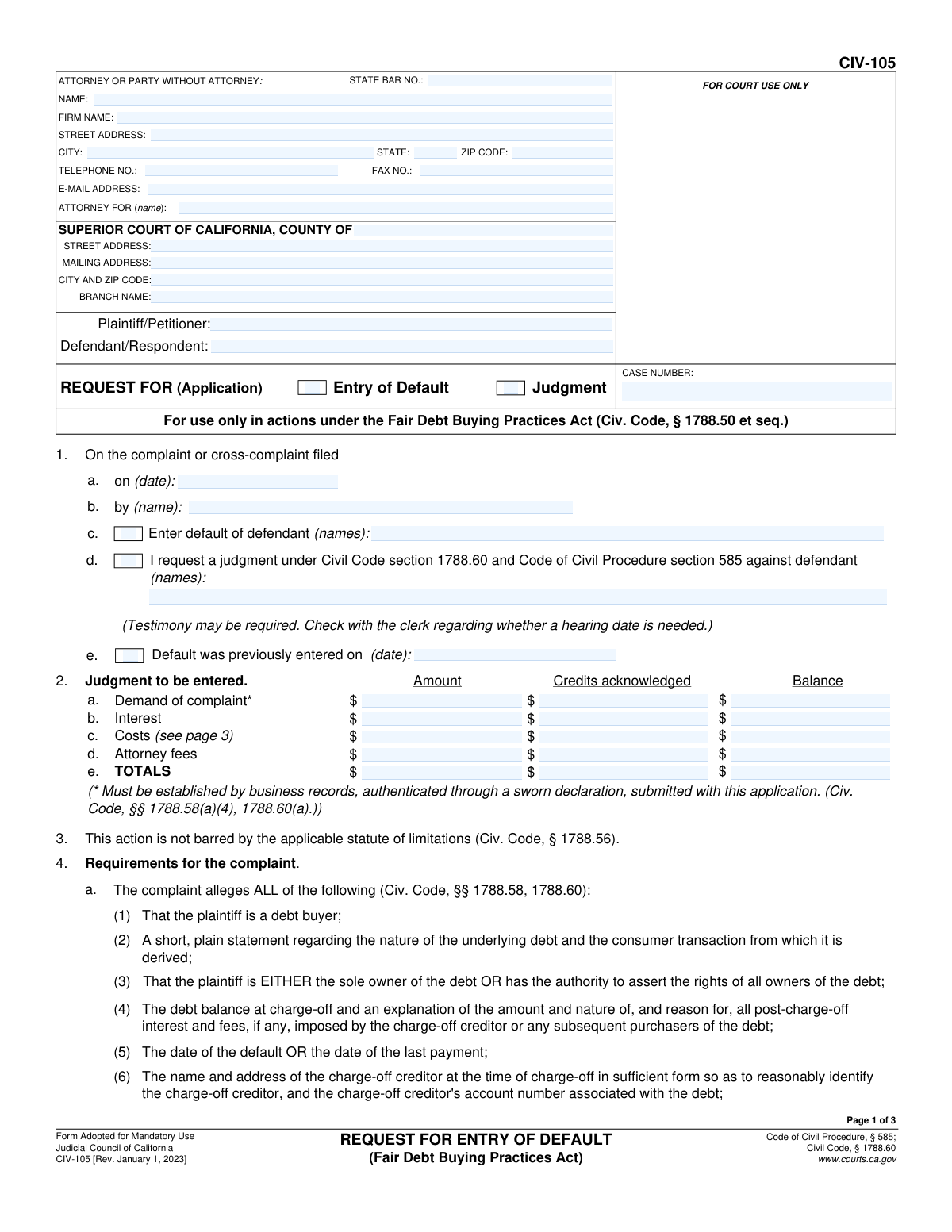
Don't type 100 fields by hand. Tell our AI about yourself, or upload a document you already have, and it fills every field in seconds. You check it, then download, print or sign.
The AI does the filling. You just check it.
No typing into boxes, nothing to install.
What this form asks for
The AI fills all of it, from your answers or your documents.
The AI checks your answers before you download
12 checks built for this form, so a wrong date or a missing answer is caught before anyone else sees it.
Validates that the 'CASE NUMBER', 'Plaintiff/Petitioner', and 'Defendant/Respondent' fields contain the exact same values on all pages of the form (pages 1, 2, and 3). This is critical to ensure the document is internally consistent and refers to a single, unambiguous case. A mismatch could lead to filing errors or rejection by the court clerk.
Verifies the arithmetic in the 'Judgment to be entered' table (Section 2). It checks that for each row (a-d), the 'Balance' column equals the 'Amount' column minus the 'Credits acknowledged' column. It also ensures the 'TOTALS' in row 'e' correctly sum the values in the columns above them.
Ensures the 'Costs' amount listed in Section 2.c is identical to the 'TOTAL' amount calculated in the 'Memorandum of costs' in Section 10.e. This cross-reference check guarantees that the judgment amount requested accurately reflects the detailed cost breakdown. Discrepancies would make the judgment request logically inconsistent and likely to be rejected.
In Section 8, 'Declaration of mailing', this check ensures that the user has selected either option 'a' (not mailed) or option 'b' (mailed), but not both. These options are mutually exclusive, and selecting both creates a logical contradiction. The form should prevent or flag this state to ensure a clear declaration is made.
If option 'b' (mailed) is checked in Section 8, this validation confirms that the mailing date in 8.b(1) and the recipient names and addresses in 8.b(2) are not empty. These details are mandatory to prove that the declaration of mailing was properly executed. Failure to provide these details would render the declaration incomplete.
This check enforces the conditional logic in Section 6. If the user selects 'did' use a legal assistant, it validates that all sub-fields (6.a through 6.f) are filled out. Conversely, if 'did not' is selected, it ensures these fields are empty to prevent ambiguity. This is important for compliance with Business and Professions Code disclosure requirements.
And 6 more checks
- Mandatory Non-Military Status Declaration
- Conditional Non-Military Specification
- Waived Costs Contradiction Check
- Section 7 Declaration Completeness
- Date Field Format and Plausibility
- State Bar Number Requirement for Attorneys
Let AI fill out your CIV-105
No typing. Every field filled in seconds, checked, ready to sign.
How to Fill Out CIV-105 Online for Free in 2026
What the AI walks you through.
- Navigate to Instafill.ai and upload the CIV-105 form or select it from their library of official documents.
- Use the AI assistant to accurately fill in the court, case, and party information, including the case number and attorney details.
- Complete Section 1 to specify the request for entry of default, including the date the complaint was filed and the defendant's name.
- Itemize the judgment amounts in Section 2, detailing the demand, interest, costs, and attorney fees, ensuring they are supported by business records.
- Fill out the required declarations, including the declaration of mailing (Section 8), declaration of nonmilitary status (Section 9), and the memorandum of costs (Section 10).
- Carefully review all entered information for accuracy, then electronically sign and date the form in the designated signature fields.
- Download the completed, signed CIV-105 form and file it with the appropriate California Superior Court along with all required supporting documentation.
Common Mistakes in Completing CIV-105
The ones the AI is built to catch.
Incorrect Calculation of Total Judgment
Failure to Attach Mandatory Supporting Documents
Improper Verification of Military Status
Missing Signatures or Dates on Declarations
Inconsistent Case Information Across Pages
Incomplete Declaration of Mailing
Falsely Certifying Complaint Requirements
Claiming Unsubstantiated or Unallowable Costs
Confusing 'Entry of Default' with 'Default Judgment'
Using an Outdated Version of the Form
Frequently Asked Questions About CIV-105
Is it really free for 7 days?
Can I fill other forms too?
How do I cancel?
How does the AI fill out CIV-105?
What happens to my information?
How complex is CIV-105 to fill out?
What is the purpose of Form CIV-105?
Who needs to fill out this form?
What is the difference between an 'Entry of Default' and a 'Default Judgment'?
What documents do I need to attach to Form CIV-105?
How do I calculate the amounts for Section 2, 'Judgment to be entered'?
Why is the checklist in Section 4, 'Requirements for the complaint,' so important?
How do I verify the defendant's military status for Section 9?
What should I do if I don't know the defendant's address for the mailing declaration in Section 8?
Where do I file the completed Form CIV-105?
Can AI tools help me fill out this form?
How can I fill out Form CIV-105 online?
My copy of the CIV-105 form is a scanned PDF and not fillable. What can I do?
What costs can I claim in Section 10, the 'Memorandum of costs'?
What does it mean that the action is 'not barred by the applicable statute of limitations' in Section 3?
Get your CIV-105 filled out by AI
$0 today. Cancel before Oct 31 and you pay nothing.
Other forms like this one
California court forms: Judicial Council of California Form SC-105, Request for Court Order and Answer (Small Claims), Judicial Council of California Form SC-120, Defendant’s Claim and ORDER to Go to Small Claims Court (Small Claims), Judicial Council of California Form SER-001, Request for Sheriff to Serve Court Papers, Judicial Council of California Form SER-001, Request for Sheriff to Serve Court Papers, Affidavit for Collection of Personal Property California Probate Code Section 13100, Form POS-040, Proof of Service—Civil, Declaration of Facts of Death (California Superior Court), declaration-of-marriage-for-court-proceeding-california-family-law, ADOPT-200, Adoption Request, ADOPT-200, Stepparent Adoption Request, ADOPT-210, Adoption Agreement, ADOPT-310, Contact After Adoption Agreement, Judicial Council of California Form ADOPT-200, Adoption Request, Form ADR-107, Mediation Attendance Sheet, Form ADR-110, Order Appointing Referee, Form ADR-109, Stipulation or Motion for Order Appointing Referee, Form ADR-102, Request for Trial De Novo After Judicial Arbitration, Form ADR-108, Referee's Report (Code Civ. Proc., §§ 638, 639), Form ADR-106, Petition to Confirm, Correct, or Vacate Contractual Arbitration Award, Form ADR-104, Rejection of Award and Request for Trial After Attorney-Client Fee Arbitration
civil court forms: Petition for Leave to Proceed In Forma Pauperis (Court of Common Pleas of Lehigh County, Pennsylvania, Civil Division), Designation of Record on Appeal (Civil) (Maricopa County Justice Courts, Arizona) (Form APP 8150-702), Certificate of Service (Civil Court Claim), Pfändungs- und Überweisungsbeschluss (Garnishment and Transfer Order) – German Civil Enforcement Court Form, AOPC 308A, Civil Complaint, Form MC 03, Answer, Civil, Form POS-040, Proof of Service—Civil, ONTARIO Form 8: Application (General), Form ATJ 601.9, Application for Waiver of Court Fees (Civil), Nevada Justice / Municipal Civil Court Cover Sheet, Form MC 01, Summons, Form MC 10, Judgment, Civil, Form MC 99, Motion and Affidavit to Set Aside Default (Civil), Form MC 281a, Civil Mediator Application, Ex Parte Motion and Order to Renew Civil Judgment, AO 88B, Subpoena to Produce Documents, Information, or Objects or to Permit Inspection of Premises in a Civil Action, Form APP-031A, Application for Extension of Time to File Brief (Civil Case), Civil Appeal Case Information Statement, Form APP-014, Appellant's Proposed Statement on Appeal (Unlimited Civil Case), form-app-015-respondents-proposed-corrections-toadditions-to-appellants-proposed-settled-statement-unlimited-civil-case
Let AI fill out your CIV-105
Your trial starts once a card is added. You pay nothing before Oct 31.
Our AI already knows this form, all 100 fields of it. Skip the typing: tell it about yourself, or upload what you have, and it fills the whole form in seconds.
- AI fills every field on all 3 pages, checkboxes included
- No typing into boxes: answer a few questions, or upload a document you already have, an old copy of this form, a photo of a document
- The AI checks the answers; you review and change anything before you download
- Download the finished PDF, print it, or sign it online
- Encrypted, and never used to train AI
Cancel before Oct 31 and you pay nothing.
A card is needed to start the trial. Cancel in two clicks from your account.
Terms · Privacy