Yes! You can use AI to fill out Form CIV-161, Order to Show Cause (Government Employee)

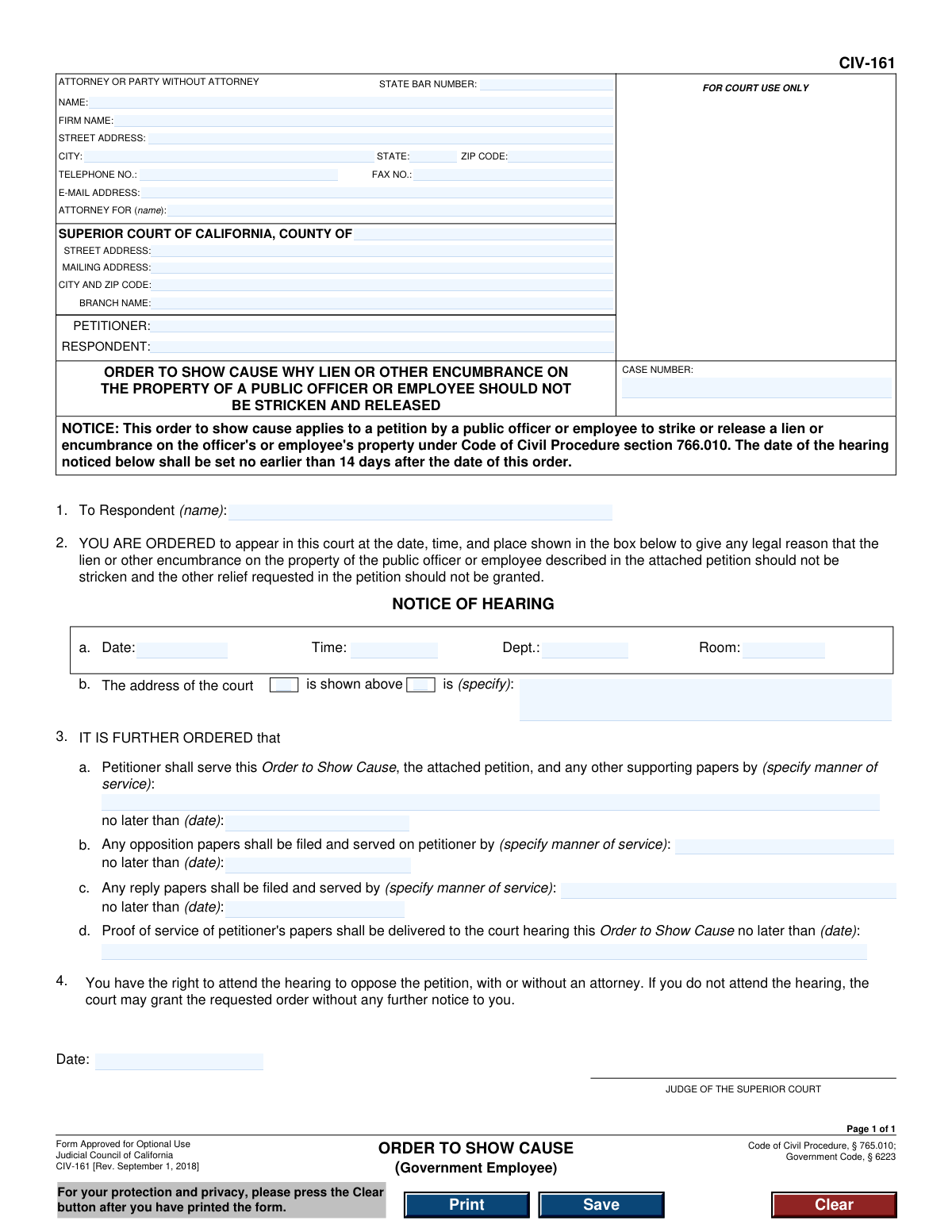
Form CIV-161 is a legal order issued by a California Superior Court in response to a petition from a public officer or employee. It commands a respondent to appear at a scheduled hearing and show cause, or provide a legal reason, why a lien or other encumbrance on the employee's property should not be stricken and released. This form is crucial for public employees seeking to clear their property of potentially invalid claims. Today, this form can be filled out quickly and accurately using AI-powered services like Instafill.ai, which can also convert non-fillable PDF versions into interactive fillable forms.
CIV-161 is part of the California court forms and civil court forms categories on Instafill.
Our AI automatically handles information lookup, data retrieval, formatting, and form filling.
It takes less than a minute to fill out CIV-161 using our AI form filling.
Securely upload your data. Information is encrypted in transit and deleted immediately after the form is filled out.

Form specifications

Form name: Form CIV-161, Order to Show Cause (Government Employee)
Number of fields: 38
Number of pages: 1
Language: English
main-image

Instafill Demo: How to fill out PDF forms in seconds with AI

How to Fill Out CIV-161 Online for Free in 2026

Are you looking to fill out a CIV-161 form online quickly and accurately? Instafill.ai offers the #1 AI-powered PDF filling software of 2026, allowing you to complete your CIV-161 form in just 37 seconds or less.
Follow these steps to fill out your CIV-161 form online using Instafill.ai:
  1. 1 Navigate to Instafill.ai and upload or select Form CIV-161, Order to Show Cause (Government Employee).
  2. 2 Enter the case information, including the court name, county, branch, and case number in the top section.
  3. 3 Provide the details for the 'Attorney or Party Without Attorney,' including name, address, state bar number, and contact information.
  4. 4 Clearly identify the names of the Petitioner and Respondent in the appropriate fields.
  5. 5 Input the name of the Respondent being ordered to appear and the specific date, time, and location of the court hearing.
  6. 6 Detail the court's further orders regarding the manner and deadlines for serving the order, filing opposition papers, and submitting replies.
  7. 7 Review the entire form for accuracy, then download the completed document to be signed by a judge and served according to the court's instructions.

Our AI-powered system ensures each field is filled out correctly, reducing errors and saving you time.

Why Choose Instafill.ai for Your Fillable CIV-161 Form?

Speed

Complete your CIV-161 in as little as 37 seconds.

Up-to-Date

Always use the latest 2026 CIV-161 form version.

Cost-effective

No need to hire expensive lawyers.

Accuracy

Our AI performs 10 compliance checks to ensure your form is error-free.

Security

Your personal information is protected with bank-level encryption.

Frequently Asked Questions About Form CIV-161

This form is a court order compelling someone to appear in court and provide a legal reason why a lien or encumbrance on a public employee's property should not be stricken and released. It is initiated by the public employee who believes the lien is improper.

The Petitioner is the public officer or employee asking the court to remove the lien from their property. The Respondent is the person or entity who placed the lien and is being ordered to appear in court.

The Petitioner or their attorney typically prepares the form with the necessary case information. However, it is an official court order that becomes legally binding only after it is signed by a Judge of the Superior Court.

This order must be served with the 'attached petition,' which is the document the public employee filed to start the legal action. The judge may also require other supporting papers to be served as well.

This section specifies the exact date, time, and location of the court hearing. The Respondent is ordered to appear at this hearing to present their case.

If the Respondent fails to appear at the scheduled hearing, the court may grant the Petitioner's request to strike the lien without any further notice to the Respondent.

The judge will specify all deadlines in Section 3 of the form. This includes the final date for the Petitioner to serve the order and the deadlines for both parties to file and serve opposition or reply papers.

According to the notice on the form, the hearing date must be set no earlier than 14 days after the date the judge signs the Order to Show Cause.

You must provide your attorney's information (or your own if self-represented), including name, address, and state bar number, as well as the specific Superior Court information and the case number.

Yes, AI-powered services like Instafill.ai can help you accurately auto-fill form fields with your case information, saving you time and helping to prevent errors.

You can upload the PDF to the Instafill.ai platform, which will make the form interactive. You can then type your information directly into the fields or use the AI to populate them from your saved data.

Services like Instafill.ai can convert flat, non-fillable PDFs into interactive forms. Simply upload the document, and the platform will make the fields fillable for you.

Compliance CIV-161
Validation Checks by Instafill.ai

1
Case Number Presence and Format
This check ensures the 'CASE NUMBER' field is not empty and conforms to the court's expected format. The case number is the primary identifier for a legal proceeding, and its absence or incorrect format would make it impossible to file or associate the document with the correct case file. If this validation fails, the system should flag the document for manual review or reject the submission.
2
State Bar Number Validation
Validates that if an attorney's name is provided, the 'STATE BAR NUMBER' field contains a valid, numeric California State Bar number. This is important for verifying the attorney's credentials and good standing with the State Bar. A missing or invalid number could indicate the person is not authorized to practice law, and the filing may be rejected.
3
Petitioner and Respondent Name Completeness
Ensures that both the 'PETITIONER' and 'RESPONDENT' fields in the case caption are filled out. These fields identify the primary parties to the action, and the document is legally incomplete without them. Failure to provide both names would result in the form being rejected as it's unclear who the legal action is between.
4
Respondent Name Consistency Check
This validation cross-references the respondent's name listed in the case caption ('RESPONDENT') with the name listed in the body of the order ('To Respondent (name):'). The names must match exactly to ensure the order is directed at the correct individual. A mismatch could lead to legal challenges regarding proper notice and render the order unenforceable.
5
Hearing Date 14-Day Minimum Notice Rule
This check verifies that the 'Date' of the hearing is set at least 14 days after the 'Date' the order is signed by the judge. This is a legal requirement specified on the form (Code of Civil Procedure § 766.010) to ensure the respondent has adequate time to prepare. An insufficient notice period would invalidate the hearing and any resulting decisions.
6
Logical Date Sequence for Deadlines
This validation ensures the dates in section 3 follow a logical chronological order: the Order Date must be on or before the Service Date (3a), which must be before the Opposition Deadline (3b), which must be before the Reply Deadline (3c). All of these dates must occur before the Hearing Date. This sequence is critical for maintaining due process and ensuring all parties have a fair opportunity to respond.
7
Proof of Service Deadline Before Hearing
Verifies that the date for delivering the 'Proof of service' (item 3d) is set for a date before the scheduled 'NOTICE OF HEARING' date. The court must have proof that the respondent was properly notified before the hearing can proceed. If this deadline is after the hearing, it defeats its purpose and the hearing may be postponed.
8
Conditional Court Address Requirement
This check ensures that if the checkbox 'is (specify):' for the court address is selected in section 2b, the corresponding text field for the address is not empty. This prevents a situation where the form indicates a specific address will be provided, but none is given, leading to confusion about the hearing location. If the box is checked and the field is empty, an error should be triggered.
9
Attorney For Party Specification
Ensures that if an attorney's name is entered in the 'ATTORNEY OR PARTY WITHOUT ATTORNEY' section, the 'ATTORNEY FOR (name):' field is also completed. This is crucial to explicitly link the attorney to the specific party they are representing (e.g., the Petitioner). Without this information, the court and opposing party would not know who the attorney represents, causing confusion.
10
Email Address Format Validation
This check validates that the value entered in the 'E-MAIL ADDRESS' field follows the standard format of an email address (e.g., '[email protected]'). Proper email formatting is essential for electronic service and communication from the court and other parties. An invalid email address could lead to missed notices and deadlines.
11
Court County Requirement
Validates that the 'COUNTY OF' field under 'SUPERIOR COURT OF CALIFORNIA' is filled in. This specifies the jurisdiction of the court handling the case. Omitting the county would make it impossible to determine which of California's 58 superior courts the document is intended for, leading to immediate rejection.
12
Hearing Date is in the Future
This validation confirms that the hearing date entered in section 2a is a date in the future relative to the date of submission. A hearing cannot be scheduled for a past date. This simple check prevents data entry errors that would make the order nonsensical and require correction.
13
ZIP Code Format
This check ensures that any ZIP code fields (for the attorney and the court) contain a valid 5-digit or 9-digit (ZIP+4) numeric format. Correct ZIP codes are essential for ensuring mail is delivered correctly by the USPS. An incorrect format could lead to returned mail and missed communications.
14
Telephone Number Format
Verifies that the 'TELEPHONE NO.' field contains a number that conforms to a standard 10-digit format, with or without common separators like parentheses, spaces, or hyphens. A valid phone number is critical for the court or opposing counsel to be able to contact the filer. An improperly formatted number could hinder communication and cause delays.

Common Mistakes in Completing CIV-161

Entering an Incorrect or Incomplete Case Number

Filers often mistype the case number or leave it blank, especially when dealing with multiple cases. Since the case number is the primary identifier for a court file, any error can cause the document to be misfiled or rejected by the court clerk. This leads to significant processing delays and can even result in missed deadlines. To avoid this, always double-check the case number against official court documents and ensure it is entered in the exact format required by the court.

Reversing Petitioner and Respondent Roles

It is a frequent error to mix up the 'Petitioner' (the party filing the request) and the 'Respondent' (the party the request is against). This happens due to a misunderstanding of legal terminology. Reversing these roles creates significant confusion in the court record, can lead to defective orders, and may require corrected documents to be refiled, wasting time and resources. Always confirm you are correctly identified as the Petitioner (the public employee seeking relief) and the other party is the Respondent.

Filing in the Wrong Court or Branch

Parties sometimes enter the wrong county, branch name, or address for the court. This mistake occurs when filers are unfamiliar with the specific venue rules for their case, assuming it's simply the closest courthouse. Filing in the wrong court location will result in an automatic rejection, forcing the filer to start the process over at the correct court and potentially jeopardizing their case if a deadline is missed. Always verify the correct court and branch from prior case documents or the court's official website.

Setting a Non-Compliant Hearing Date

The form explicitly states the hearing date must be set 'no earlier than 14 days after the date of this order,' but filers often miss this instruction. They may miscalculate the days or be unaware of the legal requirement for minimum notice. A judge will reject a proposed order with an improper hearing date, forcing the filer to resubmit the form and delaying the resolution of the matter. To prevent this, carefully calculate the date, adding a few extra days as a buffer to ensure compliance.

Failing to Specify the Manner and Dates of Service

In Section 3, filers frequently leave the fields for 'manner of service' and the corresponding deadlines blank. This often stems from not knowing the procedural rules for notifying other parties. A judge cannot sign an order without these details, as it would violate due process, so the form will be returned, halting the case. You must specify a legally valid method of service (e.g., 'Personal Service,' 'First-Class Mail') and propose reasonable deadlines for all parties.

Incomplete Information for Self-Represented Litigants

A person filing without an attorney ('in pro per') may get confused by the 'ATTORNEY OR PARTY WITHOUT ATTORNEY' section. They might leave their contact information incomplete or incorrectly fill out the 'ATTORNEY FOR' line. This can prevent the court and the opposing party from being able to send important notices, potentially leading to missed hearings or default judgments. If you are self-represented, you must enter your own full name, address, and contact details, and write your own name followed by 'Petitioner, In Pro Per' in the 'ATTORNEY FOR' field.

Failing to Attach the Required Petition

This form, CIV-161, is an 'Order to Show Cause' that sets a hearing; it is not the request itself. A common and critical error is filing this form without the separate 'Petition' document that explains the facts and legal reasons for striking the lien. The form itself refers to 'the attached petition,' and without it, the filing is incomplete and will be rejected by the court. Always ensure your detailed, written Petition is prepared and attached to this form when you file.

Using an Outdated Version of the Form

Courts periodically update their forms, and using an old version is a frequent cause for rejection. The current form is marked '[Rev. September 1, 2018],' but a filer might use a version saved on their computer or found on an unofficial website. A court clerk will often refuse to accept an outdated form, forcing a last-minute scramble to refile and risking a missed deadline. To avoid this, always download the latest version directly from the official Judicial Council of California website before filling it out.

Signing or Dating in the Judge's Signature Box

Seeing a signature and date line at the bottom of the form, a filer might mistakenly sign it themselves. This happens from a misunderstanding that the document is a proposed order for the judge to sign, not a declaration from the filer. A form signed by anyone other than the judge in the designated judicial signature area is invalid and will be immediately rejected by the clerk. The filer should prepare the entire form but leave the final date and signature line at the very bottom completely blank for the judge.

Incorrectly Identifying the Respondent in the Body of the Order

In Section 1, 'To Respondent (name):', filers may enter an incomplete or misspelled name for the party who filed the lien. This can happen due to carelessness or not having the exact legal name of the entity or individual. An error in this field can render the resulting court order unenforceable, as it is not properly directed to the correct party, and may invalidate the service of process. To prevent this, use the full, correct legal name of the respondent as it appears on the lien document or other official records. AI-powered tools like Instafill.ai can help by saving and accurately populating party information across all related legal documents.
Saved over 80 hours a year

“I was never sure if my IRS forms like W-9 were filled correctly. Now, I can complete the forms accurately without any external help.”

Kevin Martin Green

Your data stays secure with advanced protection from Instafill and our subprocessors

Robust compliance program

Transparent business model

You’re not the product. You always know where your data is and what it is processed for.

ISO 27001, HIPAA, and GDPR

Our subprocesses adhere to multiple compliance standards, including but not limited to ISO 27001, HIPAA, and GDPR.

Security & privacy by design

We consider security and privacy from the initial design phase of any new service or functionality. It’s not an afterthought, it’s built-in, including support for two-factor authentication (2FA) to further protect your account.

Fill out CIV-161 with Instafill.ai

Worried about filling PDFs wrong? Instafill securely fills form-civ-161-order-to-show-cause-government-employee forms, ensuring each field is accurate.

Related forms by category

California court forms Judicial Council of California Form SC-105, Request for Court Order and Answer (Small Claims), Judicial Council of California Form SC-120, Defendant’s Claim and ORDER to Go to Small Claims Court (Small Claims), Judicial Council of California Form SER-001, Request for Sheriff to Serve Court Papers, Judicial Council of California Form SER-001, Request for Sheriff to Serve Court Papers, Affidavit for Collection of Personal Property California Probate Code Section 13100, Form POS-040, Proof of Service—Civil, Declaration of Facts of Death (California Superior Court), declaration-of-marriage-for-court-proceeding-california-family-law, ADOPT-200, Adoption Request, ADOPT-200, Stepparent Adoption Request, ADOPT-210, Adoption Agreement, ADOPT-310, Contact After Adoption Agreement, Judicial Council of California Form ADOPT-200, Adoption Request, Form ADR-107, Mediation Attendance Sheet, Form ADR-110, Order Appointing Referee, Form ADR-109, Stipulation or Motion for Order Appointing Referee, Form ADR-102, Request for Trial De Novo After Judicial Arbitration, Form ADR-108, Referee's Report (Code Civ. Proc., §§ 638, 639), Form ADR-106, Petition to Confirm, Correct, or Vacate Contractual Arbitration Award, Form ADR-104, Rejection of Award and Request for Trial After Attorney-Client Fee Arbitration · + 126 more →
civil court forms Petition for Leave to Proceed In Forma Pauperis (Court of Common Pleas of Lehigh County, Pennsylvania, Civil Division), Designation of Record on Appeal (Civil) (Maricopa County Justice Courts, Arizona) (Form APP 8150-702), Certificate of Service (Civil Court Claim), Pfändungs- und Überweisungsbeschluss (Garnishment and Transfer Order) – German Civil Enforcement Court Form, AOPC 308A, Civil Complaint, Form MC 03, Answer, Civil, Form POS-040, Proof of Service—Civil, ONTARIO Form 8: Application (General), Form ATJ 601.9, Application for Waiver of Court Fees (Civil), Nevada Justice / Municipal Civil Court Cover Sheet, Form MC 01, Summons, Form MC 10, Judgment, Civil, Form MC 99, Motion and Affidavit to Set Aside Default (Civil), Form MC 281a, Civil Mediator Application, Ex Parte Motion and Order to Renew Civil Judgment, AO 88B, Subpoena to Produce Documents, Information, or Objects or to Permit Inspection of Premises in a Civil Action, Form APP-031A, Application for Extension of Time to File Brief (Civil Case), Civil Appeal Case Information Statement, Form APP-014, Appellant's Proposed Statement on Appeal (Unlimited Civil Case), form-app-015-respondents-proposed-corrections-toadditions-to-appellants-proposed-settled-statement-unlimited-civil-case · + 32 more →