Yes! You can use AI to fill out New Jersey Judiciary Family Part Case Information Statement (CIS)

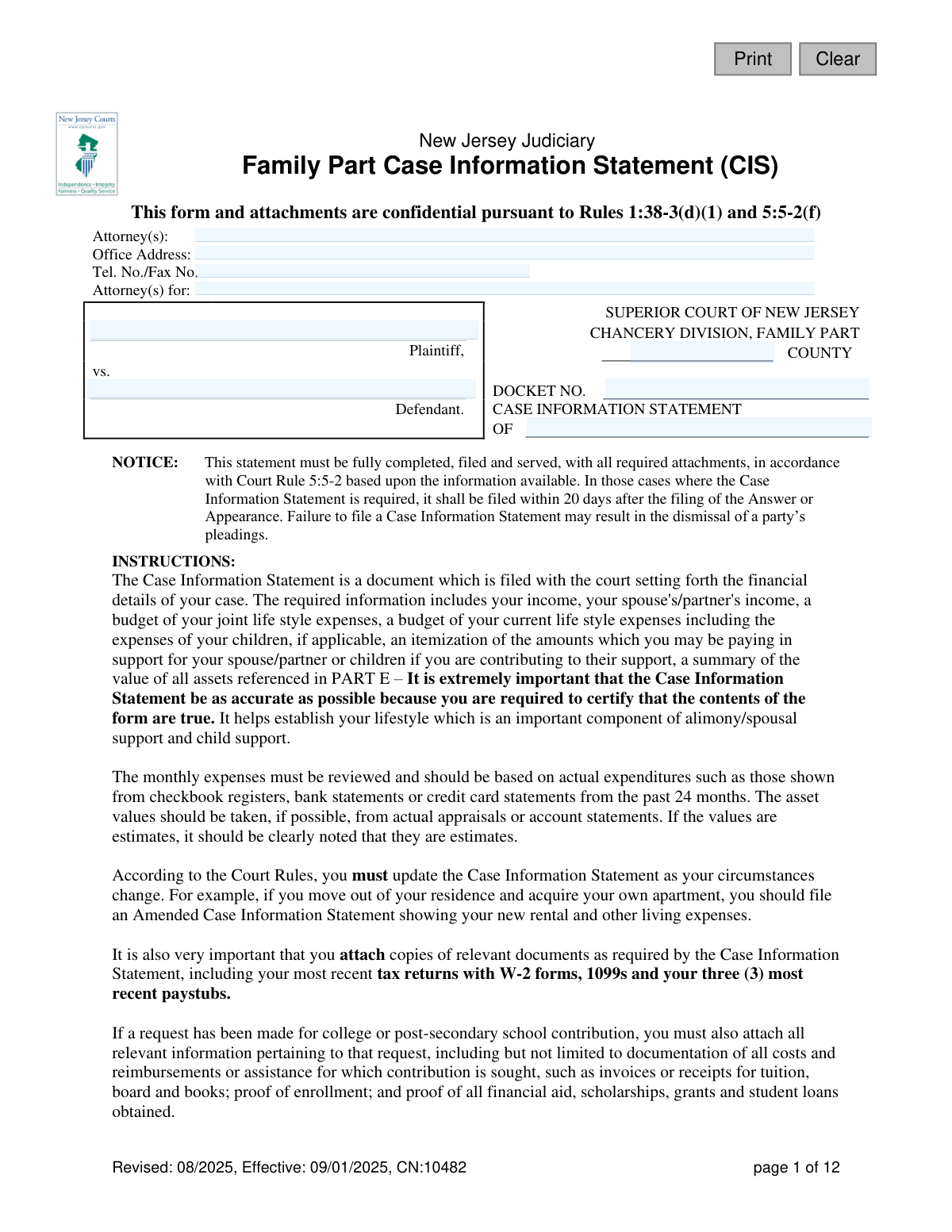
The Family Part Case Information Statement (CIS) is a mandatory document filed in the New Jersey Superior Court for family law matters, such as divorce or dissolution of a civil union. It provides the court with a complete financial overview of both parties, including income, expenses, assets, and liabilities, which is crucial for decisions regarding alimony, child support, and equitable distribution. Today, this detailed form can be filled out quickly and accurately using AI-powered services like Instafill.ai, which can also convert non-fillable PDF versions into interactive fillable forms.
Family Part CIS (CN:10482) is part of the family court forms and New Jersey forms categories on Instafill.
Our AI automatically handles information lookup, data retrieval, formatting, and form filling.
It takes less than a minute to fill out Family Part CIS (CN:10482) using our AI form filling.
Securely upload your data. Information is encrypted in transit and deleted immediately after the form is filled out.

Form specifications

Form name: New Jersey Judiciary Family Part Case Information Statement (CIS)
Number of fields: 849
Number of pages: 1
Language: English
main-image

Instafill Demo: How to fill out PDF forms in seconds with AI

How to Fill Out Family Part CIS (CN:10482) Online for Free in 2026

Are you looking to fill out a FAMILY PART CIS (CN:10482) form online quickly and accurately? Instafill.ai offers the #1 AI-powered PDF filling software of 2026, allowing you to complete your FAMILY PART CIS (CN:10482) form in just 37 seconds or less.
Follow these steps to fill out your FAMILY PART CIS (CN:10482) form online using Instafill.ai:
  1. 1 Navigate to Instafill.ai and upload the New Jersey Family Part Case Information Statement or select it from the form library.
  2. 2 Use the AI assistant to accurately fill in Part A (Case Information) and Part B (Miscellaneous Information), including party details, children's information, and employment history.
  3. 3 Complete Part C (Income Information) by providing details of your past and present income, and easily attach required documents like tax returns, W-2s, and pay stubs.
  4. 4 Detail your monthly expenses for both the joint marital lifestyle and your current lifestyle in Part D, covering shelter, transportation, and personal costs.
  5. 5 List all family assets and liabilities on the balance sheet in Part E, ensuring a complete and accurate declaration of real estate, bank accounts, vehicles, and debts.
  6. 6 Address any special problems in Part F, use the checklist in Part G to verify all required attachments are included, and then certify and electronically sign the statement.
  7. 7 Download, print, or securely share your completed and signed Family Part CIS directly from the platform for filing with the court and serving on the other party.

Our AI-powered system ensures each field is filled out correctly, reducing errors and saving you time.

Why Choose Instafill.ai for Your Fillable Family Part CIS (CN:10482) Form?

Speed

Complete your Family Part CIS (CN:10482) in as little as 37 seconds.

Up-to-Date

Always use the latest 2026 Family Part CIS (CN:10482) form version.

Cost-effective

No need to hire expensive lawyers.

Accuracy

Our AI performs 10 compliance checks to ensure your form is error-free.

Security

Your personal information is protected with bank-level encryption.

Frequently Asked Questions About Form Family Part CIS (CN:10482)

The CIS is a confidential court document that details the financial aspects of your family law case, including income, expenses, assets, and liabilities. It is crucial because it helps the court understand your financial situation and establish the lifestyle standard for determining alimony, child support, and equitable distribution.

Any party involved in a New Jersey Family Part case where financial matters like alimony, child support, or equitable distribution are in dispute must complete and file a CIS.

The Case Information Statement must be filed with the court and served on the other party within 20 days after the filing of the Answer or Appearance. Failure to file on time may lead to dismissal of your pleadings.

You must attach several documents, including your most recent federal and state tax returns with W-2s, your three most recent pay stubs, and an Affidavit of Insurance Coverage. A complete checklist of required attachments is provided in Part G of the form.

You should base your monthly expenses on actual expenditures from the past 24 months. Review your checkbook registers, bank statements, and credit card statements to ensure the figures are as accurate as possible.

The 'Joint Life Style' column should reflect the standard of living your family maintained during the marriage or civil union. The 'Current Life Style' column should reflect your own present-day expenses for yourself and any children living with you.

According to Court Rules, you are required to file an Amended Case Information Statement to update the court whenever your circumstances change, such as getting a new job or moving to a new residence.

You should complete the information for the other party 'if known.' Provide the most accurate information you have available, but you are not expected to know details that have not been shared with you.

Part E provides the court with a complete summary of all your family's assets (like real estate, bank accounts, vehicles) and liabilities (like mortgages, loans, credit card debt). This information is essential for the equitable distribution of property.

Use this section to provide a brief narrative about any complex issues in your case. Examples include challenges in valuing a family business, unique medical problems of a family member, or other special circumstances the court should be aware of.

You must attach all relevant information, including invoices for tuition and books, proof of enrollment, and documentation of all financial aid, scholarships, grants, and student loans.

Yes, you can use services like Instafill.ai, which leverage AI to accurately auto-fill form fields from your saved information, helping you complete complex forms like the CIS much faster.

To fill out the form online, you can use a service like Instafill.ai. Simply upload the CIS PDF, and the platform will make it an interactive, fillable form that you can complete and save digitally.

If you have a non-fillable or 'flat' PDF, you can use a tool like Instafill.ai. It can convert the non-fillable PDF into an interactive form that you can easily fill out on your computer.

Compliance Family Part CIS (CN:10482)
Validation Checks by Instafill.ai

1
Validates Docket Number Format
This check ensures the 'DOCKET NO.' field follows the official New Jersey court format (e.g., FM-XX-NNNNN-YY). Correct formatting is crucial for the document to be properly filed and tracked within the judiciary system. A failure in validation would prevent submission and require the user to correct the number to match the court's required structure.
2
Ensures Logical Date Sequence for Marriage and Separation
This validation confirms that the 'Date of Separation' in Part A is not earlier than the 'Date of Marriage, or entry into Civil Union or Domestic Partnership'. This check maintains the logical and chronological integrity of the case timeline. If the separation date precedes the marriage date, an error is flagged, as this represents a chronological impossibility.
3
Child's Birthdate Must Be a Valid Past Date
This check verifies that each 'Birthdate' entered for a child in Part A, Section 2 is a valid date and occurs before the current date. This prevents data entry errors such as future dates or non-existent dates (e.g., Feb 30). Accurate birthdates are essential for matters of custody, parenting time, and child support calculations.
4
Requires Explanation for 'Yes' Answers in Income Section
This validation rule applies to several questions in Part C-5, such as those asking about bonuses, supplemental compensation, or stock options. If a user answers 'Yes' to one of these questions, this check ensures the corresponding explanation text field is not left empty. This is important for providing full financial disclosure as required by the court; failure to explain a 'Yes' answer would halt submission until the required details are provided.
5
Verifies Calculation of Last Year's Net Income
This check confirms the arithmetic in Part C-1, ensuring that 'Net income' (Line 4) correctly equals 'Gross earned income' (Line 1) plus 'Unearned income' (Line 2) minus 'Total Income Taxes paid' (Line 3). This is a critical check for financial accuracy and consistency in the income statement. A discrepancy would trigger an error, forcing the user to review and correct their financial figures before filing.
6
Verifies Monthly Expense Grand Total Calculation
This validation ensures the 'Grand Totals' at the end of Part D are the correct sum of the totals from Schedule A (Shelter), Schedule B (Transportation), Schedule C (Personal), and Schedule D (Non-Recurring). This confirms the accuracy of the overall monthly expense summary, which is a key factor in determining support and alimony. If the totals do not add up, the form will be considered inaccurate and require correction.
7
Validates Asset and Liability Ownership Codes
This check ensures that the 'Title to Property' column in the Part E asset list and the 'Name of Responsible Party' column in the liability list only contain the accepted codes: 'P' (Plaintiff), 'D' (Defendant), or 'J' (Joint). Using standardized codes is essential for the court to clearly understand the ownership structure of assets and liabilities. An invalid code would result in an error, requiring the user to select one of the three valid options.
8
Verifies Total Gross Assets Calculation
This check sums the 'Value' of all individual assets listed in Part E (Real Property, Bank Accounts, Vehicles, etc.) and compares it to the 'TOTAL GROSS ASSETS' field. This ensures the summary figure accurately reflects the detailed asset list. An incorrect total would undermine the credibility of the entire financial statement and must be corrected.
9
Ensures Asset Distribution Sum is Consistent
This validation confirms that the sum of 'TOTAL SUBJECT TO EQUITABLE DISTRIBUTION' and 'TOTAL NOT SUBJECT TO EQUITABLE DISTRIBUTION' equals the 'TOTAL GROSS ASSETS' in Part E. This is a logical cross-check to ensure that all declared assets have been correctly categorized for distribution purposes. A mismatch indicates a calculation or classification error that must be resolved.
10
Verifies Total Gross Liabilities Calculation
This check sums the 'Total Owed' for all individual liabilities listed in Part E (excluding contingent liabilities) and verifies it matches the 'TOTAL GROSS LIABILITIES' field. This is crucial for an accurate representation of the party's financial obligations. If the sum does not match the total, an error is flagged to prompt the user to correct the figures.
11
Verifies Net Worth Calculation
This validation performs a critical cross-part calculation, ensuring that the 'NET WORTH' field in the liabilities section of Part E is equal to 'TOTAL GROSS ASSETS' minus 'TOTAL GROSS LIABILITIES'. Net worth is a fundamental summary of the family's financial position, and an incorrect calculation would render the balance sheet invalid. The system will flag any discrepancy for immediate correction.
12
Confirms Attachment for 'Yes' on Agreement Existence
In Part A, if the user checks 'Yes' to the question 'Does an agreement exist between parties relative to any issue?', this validation ensures that a corresponding file has been attached to the submission. The court requires a copy of any existing agreements to understand the current status of the case. Failure to attach the document when indicated would prevent submission.
13
Verifies Presence of Required Attachments
This check cross-references the checkboxes in Part G ('Required Attachments') with the actual files uploaded with the form. If a user checks a box indicating an attachment is included (e.g., tax returns, pay stubs, W-2s), the system verifies that a corresponding document is present. This is vital because the form is considered incomplete without its required supporting documentation, and submission will fail if an indicated attachment is missing.

Common Mistakes in Completing Family Part CIS (CN:10482)

Confusing 'Joint Life Style' and 'Current Life Style' Expenses

In Part D, individuals often mistakenly enter their current, post-separation expenses into both columns or fail to accurately reconstruct the 'Joint Life Style' budget from during the marriage. This happens due to a misunderstanding of the terms. An inaccurate 'Joint Life Style' budget can significantly weaken a claim for alimony or support intended to maintain that standard of living, leading to an unfair financial outcome.

Inaccurate Calculation of Average Weekly Income

When completing Part C, people often miscalculate their 'Average gross weekly income' by using a monthly average instead of the required last three pay periods, or by forgetting to include overtime or bonuses. This leads to incorrect income figures, which are the foundation for all support calculations, potentially resulting in an inequitable child support or alimony award. To avoid this, add the gross pay from the last three pay stubs and divide by three, ensuring all compensation is accounted for.

Forgetting to Attach All Required Documents

The form requires numerous attachments, as listed in Part G, including tax returns, W-2s, pay stubs, and an Affidavit of Insurance. Filers frequently forget one or more of these documents due to the complexity of the gathering process. An incomplete submission can result in the court dismissing a party's pleadings, causing significant delays and increased legal fees. Using Part G as a final checklist before filing is crucial to ensure completeness.

Omitting or Undervaluing Assets in the Balance Sheet

In Part E, it is common for filers to 'forget' to list assets like cryptocurrency, stock options, retirement accounts, or the cash surrender value of life insurance. They may also provide a low 'garage sale' value for tangible property instead of a fair market value. Since this is a sworn statement, intentional omission is perjury and can result in severe legal penalties, loss of credibility, and the court awarding a larger share of assets to the other party.

Using Incorrect Math for Monthly Expense Calculations

Part D requires monthly expenses, but many costs are incurred weekly (like groceries) or annually (like insurance). A frequent mistake is to multiply a weekly cost by four, which understates the true annual expense. This leads to an inaccurate budget that can result in an insufficient support award. To avoid this, multiply weekly costs by 4.33 or by 52 and then divide by 12; for annual bills, simply divide by 12. AI-powered form filling tools like Instafill.ai can perform these calculations automatically to ensure accuracy.

Failing to Properly Identify and Justify Exempt Assets

Many filers do not understand the legal distinction between marital property (subject to distribution) and exempt property (like inheritances or pre-marital assets kept separate). In Part E, they may fail to claim an exemption or neglect to provide the required reason. This can result in an exempt asset being unintentionally included in the marital pot for division, leading to a significant financial loss.

Reporting Income Inconsistent with Attached Tax Returns

A common red flag is when the income figures entered in Part C-1 (Last Year's Income) do not exactly match the figures on the attached tax returns and W-2s. This often happens when filers enter numbers from memory instead of copying them from the source documents. This discrepancy immediately undermines the filer's credibility and invites intense scrutiny of all their financial claims, suggesting either carelessness or an attempt to mislead.

Neglecting to Disclose Non-Traditional or Supplemental Income

Filers often focus only on their base salary and fail to report other compensation detailed in Part C, Section 5. This includes bonuses, commissions, stock options, gig economy income (e.g., Uber, DoorDash), rental income, or significant employer-paid perks. Omitting any income source is a serious misrepresentation that can lead to sanctions, retroactive support payments with interest, and irreparable damage to the filer's credibility with the court.

Double-Counting Expenses and Deductions

People frequently list an expense in two different places, such as listing a 401(k) contribution as a payroll deduction in Part C and also as a 'Savings/Investment' expense in the Part D budget. The form explicitly warns against this, but it's an easy mistake to make. This inflates the filer's stated financial needs, and when caught, it makes them appear either deceptive or careless, requiring embarrassing corrections.

Providing Vague Descriptions for Assets and Liabilities

In Part E, filers often use generic descriptions like 'Bank Account' or 'Car Loan' instead of providing the institution name, account number, and a clear description. This lack of specificity makes it impossible for the court and the other party to verify the information. It leads to formal discovery requests, which increase legal costs, delay the case, and can create suspicion that the filer is attempting to obscure details. If the form is a non-fillable PDF, tools like Instafill.ai can convert it into a fillable version, making it easier to enter complete and accurate details.
Saved over 80 hours a year

“I was never sure if my IRS forms like W-9 were filled correctly. Now, I can complete the forms accurately without any external help.”

Kevin Martin Green

Your data stays secure with advanced protection from Instafill and our subprocessors

Robust compliance program

Transparent business model

You’re not the product. You always know where your data is and what it is processed for.

ISO 27001, HIPAA, and GDPR

Our subprocesses adhere to multiple compliance standards, including but not limited to ISO 27001, HIPAA, and GDPR.

Security & privacy by design

We consider security and privacy from the initial design phase of any new service or functionality. It’s not an afterthought, it’s built-in, including support for two-factor authentication (2FA) to further protect your account.

Fill out Family Part CIS (CN:10482) with Instafill.ai

Worried about filling PDFs wrong? Instafill securely fills new-jersey-judiciary-family-part-case-information-statement-cis forms, ensuring each field is accurate.

Related forms by category

family court forms Form 12.995(c), Safety-Focused Parenting Plan, Florida Supreme Court Approved Family Law Form 12.901(b)(3), Petition for Dissolution of Marriage with No Dependent or Minor Child(ren) or Property (02/18), Form N161, Appellant’s notice (All appeals except small claims track appeals and appeals to the Family Division of the High Court), Form N161, Appellant's Notice (All appeals except small claims track appeals and appeals to the Family Division of the High Court), Florida Supreme Court Approved Family Law Form 12.915, Designation of Current Mailing and E-mail Address, declaration-of-marriage-for-court-proceeding-california-family-law, Florida Supreme Court Approved Family Law Form 12.902(d), Uniform Child Custody Jurisdiction and Enforcement Act (UCCJEA) Affidavit, Florida Supreme Court Approved Family Law Form 12.941(a), Petition for Enforcement of Out-of-State Custody Decree and for Order to Pick Up Minor Child(ren), Florida Supreme Court Approved Family Law Form 12.970(a), Petition for Temporary Custody by Extended Family, Adoption Request (Stepparent), Florida Family Law Rules of Procedure Form 12.900(b), Notice of and Consent to Limited Appearance, Florida Family Law Rules of Procedure Form 12.900(d), Termination of Limited Appearance, Florida Family Law Rules of Procedure Form 12.900(e), Acknowledgment of Assistance by Attorney, Florida Family Law Rules of Procedure Form 12.900(g), Agreement Limiting Representation, Florida Family Law Rules of Procedure Form 12.900(h), Notice of Related Cases, Florida Family Law Rules of Procedure Form 12.901(a), Joint Petition for Simplified Dissolution of Marriage, Form 12.902(b), Family Law Financial Affidavit (Short Form), Florida Family Law Rules of Procedure Form 12.902(c), Family Law Financial Affidavit (Long Form), Florida Family Law Rules of Procedure Form 12.902(e), Child Support Guidelines Worksheet, Florida Supreme Court Approved Family Law Form 12.902(f)(1), Marital Settlement Agreement for Dissolution of Marriage with Dependent or Minor Child(ren) · + 51 more →
New Jersey forms State of New Jersey Alternate Benefit Program Withdrawal Request Acknowledgement Receipt, Horizon Blue Cross Blue Shield of New Jersey Applied Behavior Analysis Supplemental Information Form, State of New Jersey Application for Employment (Form DPF-663), New Jersey Judiciary Plea Form (Plea 01), Supplemental Plea Form for Certain Sexual Offenses: Megan’s Law/Parole Supervision for Life/Community Supervision for Life (Plea 05), Financial Questionnaire to Establish Indigency, New Jersey Judiciary Resource Family Information Form, Foreclosure Case Information Statement (FCIS) - Appendix XII-B2, New Jersey Judiciary Records Request Form, Superior Court of New Jersey, Application for Appeal and Order, FL Certification of Requested Background Checks for Kinship Legal Guardianship, Certification of Caregiver as to Knowledge of Identity and/or Location of Parents, FL Order Judgment for Kinship Legal Guardianship, New Jersey Judiciary Certification of Repair and Plea of Guilty, Uniform Summary Support Order (USSO), New Jersey Judiciary Volunteer Application (CN 10293), Application to Take the New Jersey Court Interpreter Oral Examination, New Jersey Judiciary Attorney Fee Arbitration Request, Order to Show Cause with Temporary Restraints Pursuant to Rule 4:52, Tax Court of New Jersey, State Tax Complaint · + 158 more →