Fill out account application forms
with AI.
Account application forms are the fundamental documents required to establish a formal relationship with financial institutions, including banks, brokerages, and retirement plan providers. These forms are essential because they collect the necessary personal, financial, and regulatory information needed to open accounts such as IRAs, 529 college savings plans, and business investment accounts. By providing this data, you ensure compliance with federal laws and enable the proper management and protection of your assets.
By continuing, you acknowledge Instafill's Privacy Policy and agree to get occasional product update and promotional emails.
About account application forms
This category is used by a broad spectrum of people, from individuals planning for retirement to business owners managing corporate funds. For instance, a new employee might need a Fidelity 403(b) application to enroll in a workplace savings plan, while an entrepreneur might look for a Merrill Business Investor Account form to manage company capital. Tools like Instafill.ai use AI to fill these forms in under 30 seconds, handling your data accurately and securely. Whether you are rolling over an old account or opening a new margin trading profile, these documents are the first step in achieving your financial objectives.
Accurate completion is crucial for avoiding administrative delays and ensuring that beneficiary designations and investment preferences are recorded correctly. These forms provide a standardized way to communicate your instructions to the custodian, making them a vital component of any professional financial planning strategy.
Every form on this page can be completed without typing. Instafill is form filling software that reads a PDF and fills it for you — including flat and scanned documents that carry no fillable fields at all.
Forms in This Category
The forms in this category have a median Form Complexity Index of 64/100 (Complex), measured across 45 forms by field count, input difficulty, length, conditional logic and structure. See how it is calculated.
- Enterprise-grade security & data encryption
- 99%+ accuracy powered by AI
- 1,000+ forms from all industries
- Complete forms in under 60 seconds
How to Choose the Right Form
Personal Retirement Accounts (IRAs)
If you are an individual looking to save for retirement, your choice depends on the financial institution you prefer. Use the Charles Schwab IRA Account Application or the Schwab IRA Account Application for Schwab accounts. For Fidelity, choose the Fidelity Advisor IRA Application for Automatic Rollover Accounts if you are moving funds from a former employer. If you are setting up a Traditional or Roth IRA through Voya, use the Voya Investment Management Traditional, Roth, Rollover, and SEP Individual Retirement Account (IRA) Application.
Business and Entity Accounts
For organizations, trusts, or corporations, specialized entity forms are required to establish a brokerage presence:
- Corporations & Non-Profits: Use the Schwab One® Account Application for Incorporated Organizations or the Fidelity Advisor Entity New Account Application.
- Small Businesses: If you are setting up a plan for employees, look for the New Fidelity Account Application — SIMPLE IRA or the Merrill Edge® Self-Directed SIMPLE IRA Retirement Account Application.
- Trusts & Estates: Choose the Merrill Edge® Self-Directed Trust and Estate Cash Management Account (CMA Account).
Education Savings (529 Plans)
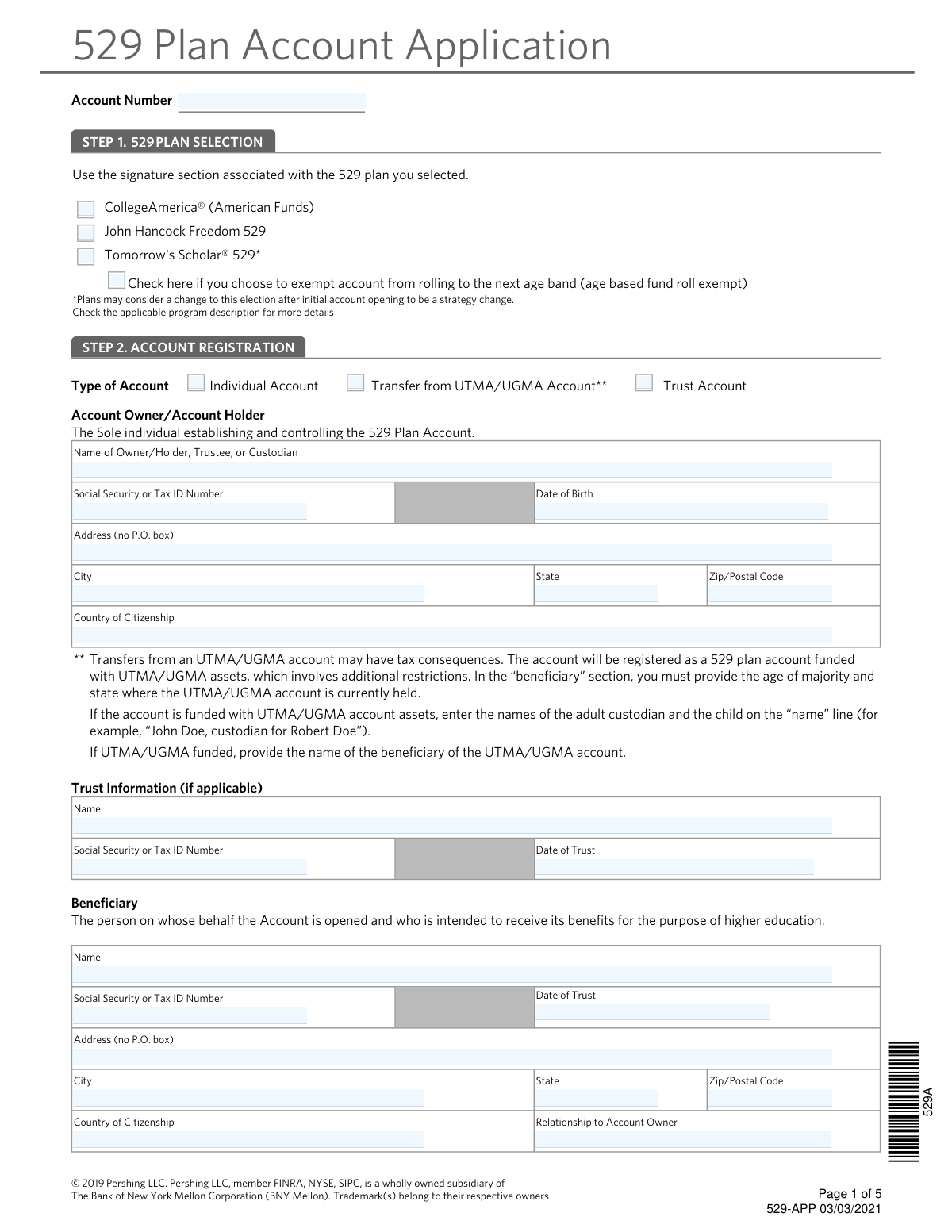
To save for higher education, select a form based on your residency or plan provider. The standard 529 Plan Account Application works for general purposes, while West Virginia residents should use the Account Application for Merrill West Virginia Residents - The Hartford SMART529. Fidelity users should look for the Fidelity Institutional CHET Advisor 529 Plan New Account Application.
Specialized Trading and Loans
If you already have an account but need to add specific features or borrow against your balance, use these targeted forms:
- Trading Features: To enable advanced trading, use the Merrill Lynch Margin Account Application and Agreement or the Merrill Lynch Option Account Application and Agreement.
- Plan Loans: If you need to borrow from a workplace retirement plan, use the Account Reduction Loan Application 401(a) Plan or the Account Reduction Loan Application 403(b) Plan depending on your specific plan type.
Tips for account application forms
One of the most common reasons for application rejection is a typo in a Social Security Number or Employer Identification Number. Always verify these digits against official documents before submitting to avoid lengthy processing delays or identity verification issues.
If you are opening an account for a trust, LLC, or corporation, keep your founding documents like Articles of Incorporation or Trust Agreements nearby. Most brokerage and entity forms require specific details from these documents, such as the date of formation and a list of all authorized signers.
For retirement accounts like IRAs and 401(k)s, failing to name a beneficiary can lead to complicated probate issues for your heirs. Ensure you provide full names and birthdates for both primary and contingent beneficiaries to ensure your assets are protected and distributed according to your wishes.
Filling out complex financial applications can be tedious, but AI-powered tools like Instafill.ai can complete these forms in under 30 seconds with high accuracy. Your sensitive data stays secure during the process, making it a reliable way to manage multiple account applications quickly.
Many brokerage forms ask you to select a 'sweep' account for uninvested cash or provide bank routing numbers for initial funding. Deciding on these financial logistics in advance prevents you from having to pause the application to look up banking details mid-way through.
While many modern forms accept digital signatures, some specific account types—particularly those involving spousal consent or trust authorizations—may still require a physical 'wet' signature or a notary seal. Review the signature page first to determine if you need to print the document or arrange for a witness.
Carefully review whether you are selecting a Roth, Traditional, or Rollover account type on your application. Choosing the wrong tax treatment can have significant long-term financial implications and may require a complex 'recharacterization' process to fix later.
Frequently Asked Questions
Account application forms are the primary documents used to establish a new financial relationship with a brokerage, bank, or investment firm. They collect essential personal data, employment history, and financial profiles required by regulators to open accounts such as IRAs, 529 plans, or standard brokerage accounts.
You should use a personal application if the account will be owned by an individual, a joint couple, or a custodian for a minor. Entity applications are specifically designed for legal structures such as LLCs, corporations, partnerships, or trusts, and usually require additional documentation like articles of incorporation or trust agreements.
Yes, you can use AI tools like Instafill.ai to complete these forms in under 30 seconds. The AI accurately extracts data from your existing documents and places it into the correct fields, ensuring that complex financial forms are filled out without manual entry errors.
While the application forms for both account types look similar, they represent different tax treatments for your retirement savings. A Traditional IRA application is typically used for pre-tax contributions, while a Roth IRA application is for after-tax contributions where qualified withdrawals are tax-free.
You should use a 529 Plan application when you intend to save specifically for future education costs, such as college tuition or K-12 expenses. These forms require you to name both an account owner and a designated beneficiary, often a child or grandchild, who will use the funds.
Manually filling out multi-page brokerage or retirement applications can take 20 to 30 minutes due to the detailed financial information required. Using an AI-powered service like Instafill.ai reduces this time to less than 30 seconds by automating the data entry process from your source files.
You will generally need your Social Security number or Taxpayer ID, a valid government-issued ID, and your current employment information. For specialized accounts like rollovers, you may also need a recent statement from your previous retirement plan or bank.
Yes, self-employed individuals and small business owners often use specialized applications such as SIMPLE IRA, SEP IRA, or Individual 401(k) forms. These accounts allow for higher contribution limits and different employer-matching rules compared to standard personal IRAs.
A non-prototype retirement account application is used when a business or trust wants to use a brokerage firm solely as an investment platform rather than using the firm's standard pre-approved plan documents. In these cases, the account holder is responsible for their own plan's legal compliance and tax reporting.
Once the form is filled and signed, it is typically submitted directly to the financial institution's new accounts department. Submission methods vary by firm and may include secure online portals, faxing to a dedicated number, or mailing the physical document to a specific processing center.
Financial institutions are required by 'Know Your Customer' (KYC) regulations to ensure that the investment products they offer are suitable for your financial situation. Information about your experience with stocks, bonds, or options helps the firm determine if you are eligible for advanced features like margin trading.
Glossary
- Form Complexity Index
- Instafill’s 0–100 measure of how much effort a form takes to complete, calculated deterministically from the form’s own structure rather than estimated. It combines the number of fillable fields (the largest factor), how difficult those fields are to complete based on their type, the number of pages that contain fields, the amount of conditional “fill-only-if” logic, and how many sections the form is divided into, then adds modifiers for tables and repeating lists, bundled instruction pages, and dense page layouts. A higher score means the form is harder to fill out by hand. The forms in this category have a median Form Complexity Index of 64/100 (Complex). See exactly how it is calculated.
- IRA (Individual Retirement Account)
- A tax-advantaged account that allows individuals to save for retirement through various investment vehicles like stocks, bonds, and mutual funds.
- Beneficiary
- A person or legal entity designated by the account owner to receive the assets in the account upon the owner's death.
- Custodian
- A financial institution, such as a bank or brokerage firm, that is legally responsible for holding and safeguarding the assets within an investment account.
- 529 Plan
- A tax-advantaged savings plan sponsored by a state or educational institution designed to encourage saving for future higher education costs.
- Rollover
- The process of moving funds from one tax-advantaged retirement plan, such as a former employer's 401(k), into a new IRA or another qualified plan without incurring taxes or penalties.
- FBO (For the Benefit Of)
- A technical designation used in account titling to show that the account is held by one party for the legal benefit of another, common in trust or retirement transfers.
- Margin
- A high-risk account feature that allows an investor to borrow money from the brokerage firm to purchase securities, using the account's existing assets as collateral.
- SIMPLE IRA
- A 'Savings Incentive Match Plan for Employees' designed for small businesses with 100 or fewer employees, allowing both employers and employees to contribute to a retirement fund.
- UTMA/UGMA
- Custodial accounts established under the Uniform Transfers/Gifts to Minors Acts that allow adults to manage assets for a minor until they reach the age of majority.