
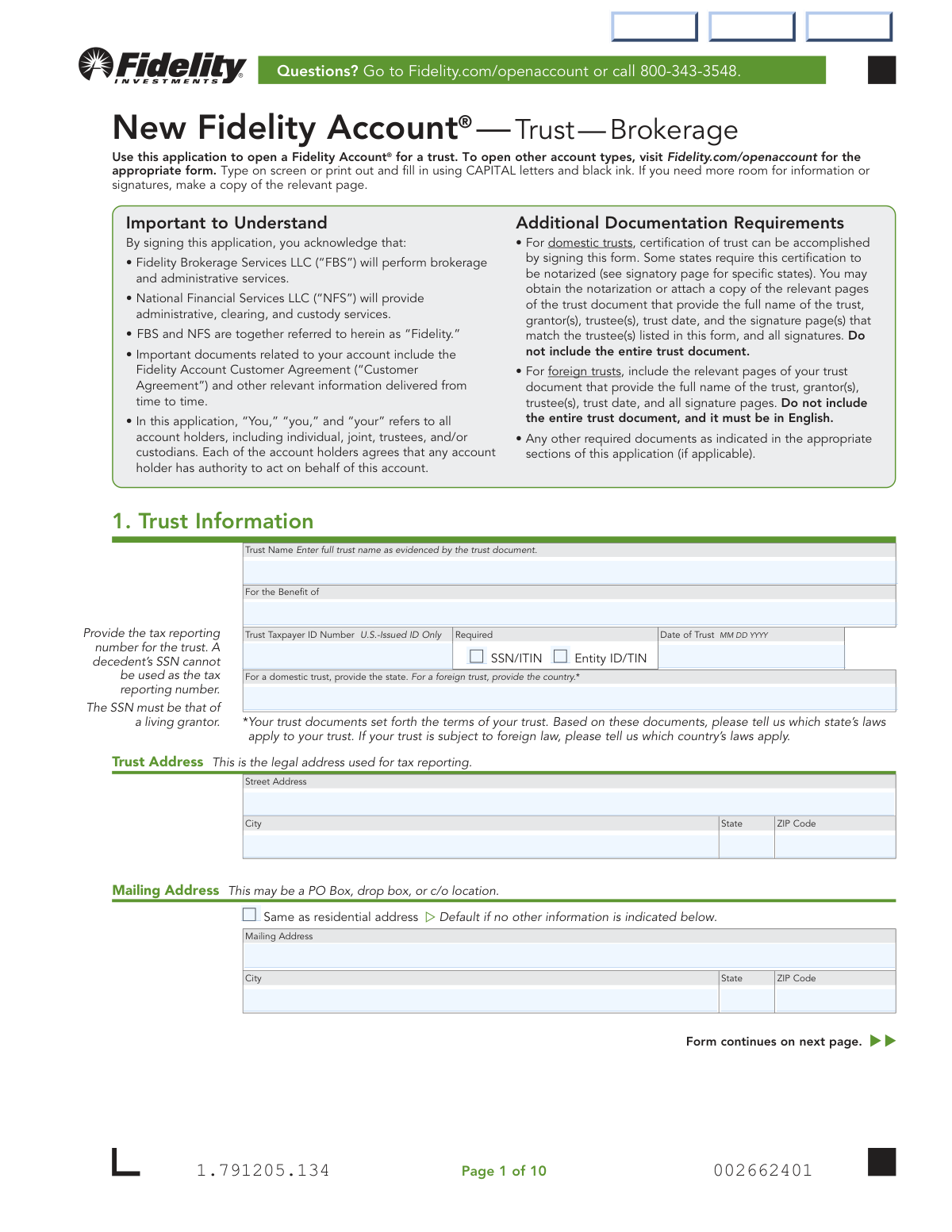
Yes! You can use AI to fill out New Fidelity Account® — Trust — Brokerage (1.791205.134)
Don't type 221 fields by hand. Tell our AI about yourself, or upload a document you already have, and it fills every field in seconds. You check it, then download, print or sign.
The AI does the filling. You just check it.
No typing into boxes, nothing to install.
What this form asks for
The AI fills all of it, from your answers or your documents.
The AI checks your answers before you download
14 checks built for this form, so a wrong date or a missing answer is caught before anyone else sees it.
This validation ensures that the Trust Taxpayer ID Number is valid and consistent with the grantor's status. It checks that a decedent's SSN is not used as the trust's tax ID. Furthermore, if an SSN/ITIN is provided, it cross-references with Section 3 to confirm it belongs to a living grantor. Failure to comply may result in tax reporting errors and rejection of the application by the IRS, requiring correction and resubmission.
This check validates that information provided for a trustee is consistent with their declared type (individual or entity). If the 'Trustee is an entity' box is checked, the 'Entity Name' field must be populated, while personal fields like 'First Name' and 'Date of Birth' must be empty. Conversely, if the box is unchecked, the personal fields are required and the 'Entity Name' field must be empty. An inconsistency here indicates a data entry error and will prevent the application from being processed until the trustee's information is clarified.
This validation is triggered when a trustee is identified as a 'Foreign citizen'. It ensures that all required fields within the foreign citizen section are completed, including Country of Citizenship, U.S. residency status, and full Government Identification details. This information is mandatory for regulatory compliance (e.g., KYC/AML). If this section is incomplete, the account cannot be opened due to regulatory risk and the application will be returned.
This check verifies that any government-issued ID provided has not expired. The 'ID Expiration Date' must be on or after the date the application is submitted. This is crucial for identity verification as per federal regulations, which require an unexpired, government-issued ID. An expired ID will cause the application to be rejected pending submission of a valid, unexpired ID document copy.
This validation enforces conditional logic based on the trustee's employment status. If 'Employed' is selected, the 'Occupation' and 'Employer' fields are mandatory. If 'Retired' or 'Not employed' is selected, the 'Source of Income' field is mandatory. This information is required by industry regulations to understand the client's financial profile. Missing this information will result in an incomplete application that cannot be processed.
When the 'DECEASED Grantor' box is checked in Section 3, this validation ensures that only the grantor's full legal name is provided. It confirms that all other personal data fields for that individual, such as Date of Birth, Taxpayer ID Number, and address, are left blank as instructed. Incorrectly providing extra information can lead to data processing errors and confusion about account roles, so the application will be flagged for correction.
And 8 more checks
- Verification of All Trustee Signatures
- Notarization Requirement Flag
- EFT Bank Routing Number Format
- Mutually Exclusive Initial Funding Selection
- Trusted Contact Uniqueness Check
- Ancillary Form Requirement Check
- Date of Trust Chronological Validity
- Primary vs. Additional Trustee Section Usage
Let AI fill out your Fidelity Trust Account Application
No typing. Every field filled in seconds, checked, ready to sign.
How to Fill Out Fidelity Trust Account Application Online for Free in 2026
What the AI walks you through.
- Navigate to Instafill.ai and upload the 'New Fidelity Account® — Trust — Brokerage' application or select it from the available templates.
- Provide the trust's information in Section 1, including the full trust name, tax ID number, and legal address.
- Enter the detailed personal and financial information for the Primary Trustee in Section 2, including citizenship, employment, and any affiliations.
- Use Section 3 to add information for any additional trustees, grantors, or other individuals with authority over the trust.
- Specify the initial funding method in Section 4 and ongoing funding options in Section 6, whether by check, transfer from another firm, or from an existing Fidelity account.
- Select desired account features in Section 7 and review the Certification of Trust in Section 8 to ensure all details are correct.
- Have all trustees digitally sign and date the application in Section 9, notarizing signatures if required by your state's laws, before securely submitting the completed form.
Common Mistakes in Completing Fidelity Trust Account Application
The ones the AI is built to catch.
Using an Incorrect Taxpayer ID Number for the Trust
Failing to Obtain Signatures from All Trustees
Overlooking State-Specific Notarization Requirements
Entering an Inaccurate or Incomplete Trust Name
Incorrectly Designating Trustee Roles and Authorities
Submitting Incorrect or Incomplete Trust Documentation
Providing Personal Information That Doesn't Match Government ID
Forgetting to Attach Required Documents for EFT Setup
Designating the Account Owner as Their Own Trusted Contact
Confusing the Sections for Primary and Additional Trustees
Frequently Asked Questions About Fidelity Trust Account Application
Is it really free for 7 days?
Can I fill other forms too?
How do I cancel?
How does the AI fill out Fidelity Trust Account Application?
What happens to my information?
How complex is Fidelity Trust Account Application to fill out?
What is the purpose of this form?
Who needs to complete and sign this application?
What documents do I need to submit for a domestic trust?
What documents are required for a foreign trust?
How do I initially fund this new trust account?
When do I need to get the trustee signatures notarized?
What is a 'Core Position'?
How do I add checkwriting to this account?
What is a Trusted Contact and is it required?
Where do I send the completed application?
Can AI tools help me fill out this form?
How can I fill out this Fidelity trust application online?
The PDF I have is not fillable. What should I do?
What do I do if there are more trustees than the form has space for?
Get your Fidelity Trust Account Application filled out by AI
$0 today. Cancel before Nov 18 and you pay nothing.
Other forms like this one
trust forms: Form 8855, Election To Treat a Qualified Revocable Trust, Private Trust (Mod(PT).2005), Form 3520 (Rev. December 2023), Annual Return To Report Transactions With Foreign Trusts and Receipt of Certain Foreign Gifts, Judicial Council of California Form DE-120, Notice of Hearing—Decedent's Estate or Trust, Judicial Council of California Form DE-120, Notice of Hearing—Decedent's Estate or Trust, Fidelity Change of Account Ownership — Mutual Fund Only Accounts (Changing to a Trust, Estate, Guardian, or Conservator Account), Fidelity Ownership Change to Trust, Fidelity Change of Account Registration — Changing to a Trust, Estate, Guardian, or Conservator Brokerage Account, Trusted Contact Authorization Form, I.B.E.W. & Electrical Industry Local 697 Money Purchase Plan and Trust Direct Rollover Request Form Due to Qualified Domestic Relations Order, Bechtel Trust & Thrift Plan Rollover Process, General Purpose Loan Application Packet, IW DC of SOV Annuity Trust, NYPD Superior Officers Council Annuity Trust Fund Plan Rollover Form, Trust Certification and Trustee Powers, Housing Agency Retirement Trust Form #190, Request to Withdraw a Rollover Account, The Housing Agency Retirement Trust 457(b) Deferred Compensation Plan Request For Distribution Form, Housing Agency Retirement Trust Transfer/Rollover Form, Qualified Retirement Plan and Trust Summary Plan Description, The Housing Agency Retirement Trust 457b Deferred Compensation Plan Change of Beneficiary Designation Form, TIAA Trust, N.A. Private Asset Management, Request for a Direct Transfer From IRA Contracts
brokerage forms: 41, Fidelity Change of Account Registration: Changing to an Individual, Joint, or Custodial Brokerage Account, Fidelity Change of Account Registration — Changing to a Trust, Estate, Guardian, or Conservator Brokerage Account, Move Assets from My Schwab Brokerage Account, Open a Schwab One® Brokerage Account, Charles Schwab PCRA Self-Directed Brokerage Account, Schwab Health Savings Brokerage Account (HSBA) to HSA Invest Choice Account Transfer Form, Intra-Brokerage Securities Transfer, Moving your Vanguard funds to a Vanguard Brokerage Account Disclosure statement, Vanguard Brokerage Account CREST Transfer Form, Moving your Vanguard funds to a Vanguard Brokerage Account Disclosure statement, TIAA Brokerage Incoming Account Transfer Form, TIAA Brokerage Joint Transfer on Death Account Agreement, TIAA Brokerage IRA Distribution Request (Form F11025), Request for a Qualified Charitable Distribution (QCD) from a Brokerage Individual Retirement Account (IRA), TIAA Brokerage Authorization To Gift Securities, Form F11014, TIAA Brokerage Power of Attorney (POA) Form, TIAA Brokerage Durable Power Of Attorney Affidavit Of Full Force And Effect, TIAA Brokerage Incoming Managed Account Transfer Form (F11319), Form F11015, TIAA Brokerage Designation of Beneficiary
Fidelity forms: Fidelity Funds Account Transfer of Assets Form, Fidelity Stock Plan Services (SPS) Transfer Request Form, How to Transfer Assets from Morgan Stanley to Fidelity Investments (Fidelity Stock Plan Services Guide), Fidelity Investments Transfer/Rollover/Exchange Form, Fidelity Investments Standing Transfer Instructions Form, Fidelity Charitable 144/145 Contribution Form, One-Time Withdrawal – IRA, Fidelity Investments, Fidelity Investments Transfer/Rollover Form, Fidelity Advisor 403(b) Distribution Request Form, Fidelity Advisor IRA Distribution Request for Automatic Rollover Accounts, Special Tax Notice: Your Rollover Options - Fidelity Investments, Fidelity Charitable Letter of Authorization, Fidelity Advisor Trading Authorization and Indemnification, Fidelity Investment-Only (Non-Prototype) Retirement Account Application, Fidelity NetBenefits Send a Document Form, Fidelity NetBenefits Auditor's Guide: An Overview of Fidelity's 2024 Plan Year Reporting Package, Fidelity NetBenefits Distribution - Recurring Payments, Fidelity Investments® Beneficiary Distribution Form, Fidelity Investments Distribution Form, Fidelity One-Time Withdrawal Form — Nonretirement
broker forms: Letter of Authorization to Broker, Form 1099-B, Proceeds From Broker Transactions, 41, Fannie Mae Residential Broker Price Opinion (BPO) (Revised 03/99), Fidelity Change of Account Registration: Changing to an Individual, Joint, or Custodial Brokerage Account, Fidelity Change of Account Registration — Changing to a Trust, Estate, Guardian, or Conservator Brokerage Account, Move Assets from My Schwab Brokerage Account, Open a Schwab One® Brokerage Account, Charles Schwab PCRA Self-Directed Brokerage Account, Schwab Health Savings Brokerage Account (HSBA) to HSA Invest Choice Account Transfer Form, Intra-Brokerage Securities Transfer, Moving your Vanguard funds to a Vanguard Brokerage Account Disclosure statement, Vanguard Brokerage Account CREST Transfer Form, Moving your Vanguard funds to a Vanguard Brokerage Account Disclosure statement, TIAA Brokerage Incoming Account Transfer Form, TIAA Brokerage Joint Transfer on Death Account Agreement, TIAA Brokerage IRA Distribution Request (Form F11025), Request for a Qualified Charitable Distribution (QCD) from a Brokerage Individual Retirement Account (IRA), Form OL 75, Auto Broker Log, TIAA Brokerage Authorization To Gift Securities
brokerage account forms: BlackRock New Account Application For Non-Retirement Accounts, Fidelity Change of Account Registration: Changing to an Individual, Joint, or Custodial Brokerage Account, Fidelity Change of Account Registration — Changing to a Trust, Estate, Guardian, or Conservator Brokerage Account, Move Assets from My Schwab Brokerage Account, Open a Schwab One® Brokerage Account, Charles Schwab PCRA Self-Directed Brokerage Account, Schwab Health Savings Brokerage Account (HSBA) to HSA Invest Choice Account Transfer Form, Moving your Vanguard funds to a Vanguard Brokerage Account Disclosure statement, Vanguard Brokerage Account CREST Transfer Form, Moving your Vanguard funds to a Vanguard Brokerage Account Disclosure statement, TIAA Brokerage Incoming Account Transfer Form, TIAA Brokerage Joint Transfer on Death Account Agreement, Request for a Qualified Charitable Distribution (QCD) from a Brokerage Individual Retirement Account (IRA), TIAA Brokerage Incoming Managed Account Transfer Form (F11319), Form F11004, TIAA Brokerage Individual Transfer on Death Account Agreement, Fidelity® Brokerage Business Account Certification, Brokerage Corestone Account Application, IRA/IRRA®/Roth IRA/SEP/SRA Divorce Transfer Instruction Form, Merrill AwardChoice® Individual Investor Account Application Form for U.S. Persons, Merrill Business Investor Account (BIA) and Working Capital Management Account (WCMA) Account Application Booklet and Agreements
trust account forms: Fidelity Trustee Certification — Adding or Removing Trustees, Fidelity Change of Account Ownership — Mutual Fund Only Accounts (Changing to a Trust, Estate, Guardian, or Conservator Account), Fidelity Change of Account Registration — Changing to a Trust, Estate, Guardian, or Conservator Brokerage Account, Housing Agency Retirement Trust Form #190, Request to Withdraw a Rollover Account, TIAA Trust, N.A. Authorization to receive client account information, Letter of Authorization to Change Account Title to a Grantor Revocable Trust, Vanguard Personal Investor – Unregulated Trust details – Account information update, Option Information — Corporate and Institutional Accounts; Sole Proprietorship Accounts; Merrill Lynch Trust Accounts, Merrill Edge Self-Directed Trust and Estate Cash Management Account (CMA Account) Account Application Booklet and Agreements, Merrill Edge® Self-Directed Trust Cash Management Account® (CMA® Account) Account Application Booklet and Agreements, Option Information — Individual, Joint and Trust Accounts, New Fidelity Account® — Trust — Brokerage (1.791205.136)
new account forms: New Account Agreement, Vanguard 403(b)(7) New Account Form, New Fidelity Account — Retirement Plan Account, New Fidelity Account® — SIMPLE IRA, Fidelity Advisor Entity New Account Application, Fidelity Institutional CHET Advisor 529 Plan New Account Application, New Fidelity Account® — Inherited IRA for a Non-Spouse Individual, New Account Agreement - Trading Direct, BlackRock New Account Application For Non-Retirement Accounts, New York Life Investments Funds Individual Retirement Account Application and NYLIFE Securities LLC Investor Profile, New Jersey Judiciary Guardianship Report EZ Accounting Form, Adult Guardianship - EZ-Accounting Form - Additional pages, New Jersey Judiciary Guardianship Report Comprehensive Accounting Form, JACS Request to Change Administrator Form (Judiciary Account Charge System), New Fidelity Account® — Trust — Brokerage (1.791205.136)
Let AI fill out your Fidelity Trust Account Application
Your trial starts once a card is added. You pay nothing before Nov 18.
Your bank declined that card, so the trial did not start and nothing was charged. Please try another card.
Our AI already knows this form, all 221 fields of it. Skip the typing: tell it about yourself, or upload what you have, and it fills the whole form in seconds.
- AI fills every field on all 17 pages, tables and checkboxes included
- No typing into boxes: answer a few questions, or upload a document you already have, an old copy of this form, a photo of a document
- The AI checks the answers; you review and change anything before you download
- Download the finished PDF, print it, or sign it online
- Encrypted, and never used to train AI
Cancel before Nov 18 and you pay nothing.
A card is needed to start the trial. We check it with a $19.99 hold that is released right away. Cancel in two clicks from your account.
Terms · Privacy