Yes! You can use AI to fill out New Jersey Judiciary Domestic Violence Contempt and Related Disorderly Persons and Petty Disorderly Persons Plea Form

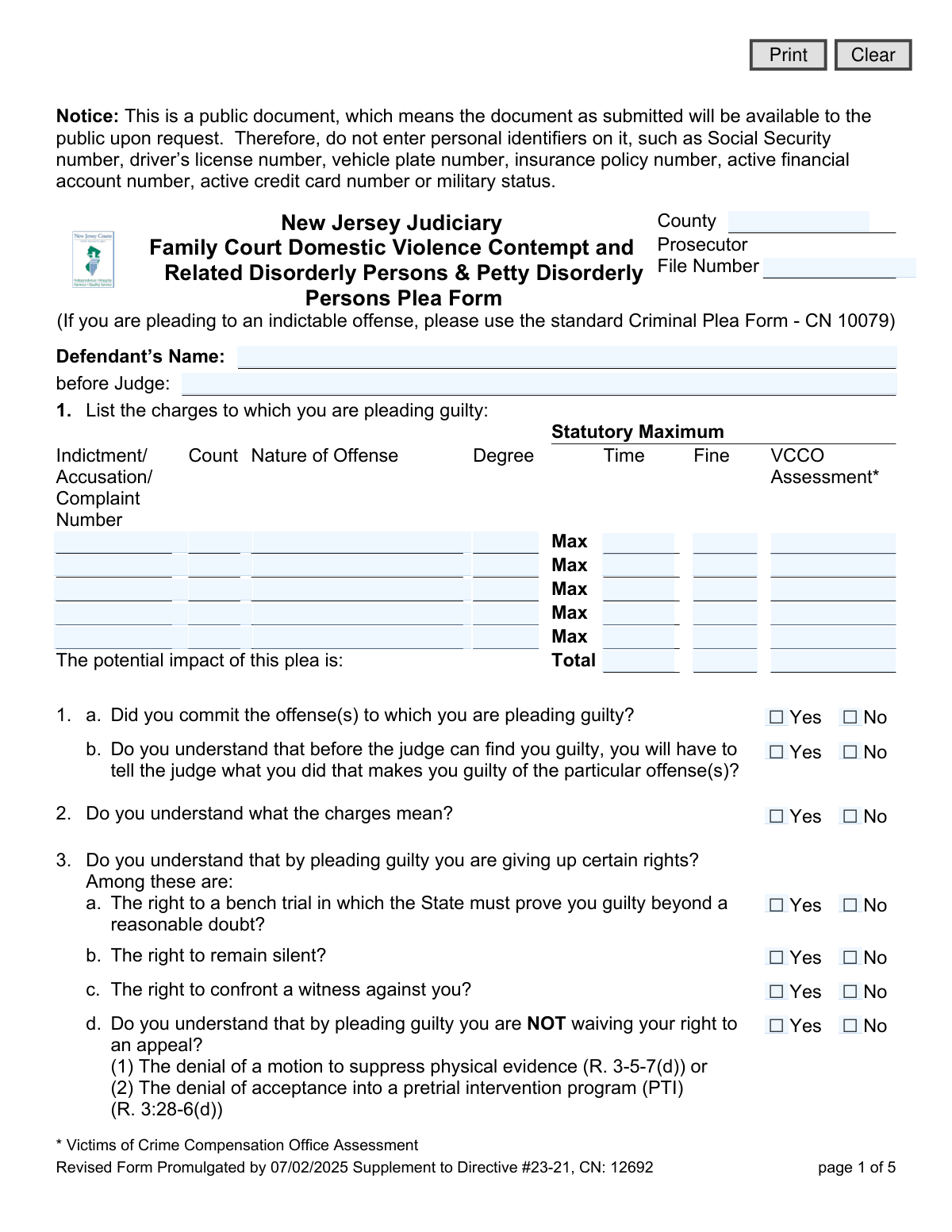
The New Jersey Domestic Violence Contempt Plea Form (CN 12692) is a critical legal document for defendants in the New Jersey Family Court system entering a guilty plea for domestic violence contempt and related offenses. By completing this form, the defendant formally acknowledges the charges, the rights they are waiving, and the potential consequences, including fines, jail time, and immigration issues. Today, this form can be filled out quickly and accurately using AI-powered services like Instafill.ai, which can also convert non-fillable PDF versions into interactive fillable forms.
CN 12692 is part of the domestic violence forms and New Jersey forms categories on Instafill.
Our AI automatically handles information lookup, data retrieval, formatting, and form filling.
It takes less than a minute to fill out CN 12692 using our AI form filling.
Securely upload your data. Information is encrypted in transit and deleted immediately after the form is filled out.

Form specifications

Form name: New Jersey Judiciary Domestic Violence Contempt and Related Disorderly Persons and Petty Disorderly Persons Plea Form
Number of fields: 150
Number of pages: 1
Language: English
main-image

Instafill Demo: How to fill out PDF forms in seconds with AI

How to Fill Out CN 12692 Online for Free in 2026

Are you looking to fill out a CN 12692 form online quickly and accurately? Instafill.ai offers the #1 AI-powered PDF filling software of 2026, allowing you to complete your CN 12692 form in just 37 seconds or less.
Follow these steps to fill out your CN 12692 form online using Instafill.ai:
  1. 1 Navigate to Instafill.ai and upload the 'Domestic Violence Contempt Plea Form' or select it from the platform's template library.
  2. 2 Enter the defendant's name, case details like the county and prosecutor file number, and the presiding judge's name in the designated fields.
  3. 3 List all charges to which you are pleading guilty, including the indictment/complaint number, nature of the offense, and degree for each.
  4. 4 Carefully proceed through the questionnaire, answering each yes/no question to confirm your understanding of the rights being waived, potential penalties, and other legal consequences of the plea.
  5. 5 Detail the specifics of the plea agreement, including any charges the prosecutor will dismiss and the recommended sentence.
  6. 6 Review the entire completed form with your defense attorney to ensure all information is accurate before you, your attorney, and the prosecutor digitally sign and date the document.
  7. 7 Download, print, or securely share the finalized plea form for submission to the court as required.

Our AI-powered system ensures each field is filled out correctly, reducing errors and saving you time.

Why Choose Instafill.ai for Your Fillable CN 12692 Form?

Speed

Complete your CN 12692 in as little as 37 seconds.

Up-to-Date

Always use the latest 2026 CN 12692 form version.

Cost-effective

No need to hire expensive lawyers.

Accuracy

Our AI performs 10 compliance checks to ensure your form is error-free.

Security

Your personal information is protected with bank-level encryption.

Frequently Asked Questions About Form CN 12692

This form is used in New Jersey Family Court when a defendant agrees to plead guilty to domestic violence contempt or related disorderly persons offenses. It officially documents that the defendant understands the charges, the rights they are giving up, and all the consequences of their guilty plea.

This form is for defendants who are pleading guilty to domestic violence contempt, disorderly persons, or petty disorderly persons offenses. It is typically completed by the defendant with the guidance of their defense attorney before being presented to a judge.

This form is only for domestic violence contempt and related disorderly persons offenses. If you are pleading guilty to a more serious indictable offense, you must use the standard Criminal Plea Form (CN 10079) instead.

This form is a public document, meaning it can be accessed by the public upon request. To protect your privacy and prevent identity theft, you must not include sensitive information like Social Security numbers, driver's license numbers, or financial account numbers.

By signing this form and pleading guilty, you are waiving several important constitutional rights. These include the right to a trial, the right to remain silent, and the right to confront witnesses against you.

Pleading guilty to an offense involving domestic violence will prohibit you from purchasing, owning, possessing, or controlling a firearm. You will also be barred from receiving a firearms purchaser identification card or a permit to purchase a handgun.

If you are not a U.S. citizen, a guilty plea can have very serious immigration consequences, including deportation, denial of naturalization, or being barred from re-entering the country. You have the right to seek advice from an attorney about these specific consequences before you plead guilty.

Pleading guilty results in several mandatory fees, including a Victims of Crime Compensation Office (VCCO) assessment of at least $50, a $100 Domestic Violence Surcharge, and a $75 Safe Neighborhood Services Fund assessment. The judge can also order you to pay fines and restitution to the victim.

No, the judge is not bound by the prosecutor's recommendation and can impose a more severe sentence. However, if the judge decides on a harsher sentence than what was agreed upon in the plea, you have the right to withdraw your guilty plea.

As stated in question 9, a person convicted of a second or subsequent offense of domestic violence contempt must serve a mandatory minimum sentence of at least 30 days in the County Jail.

Yes, services like Instafill.ai use AI to help auto-fill form fields accurately, which can save time and reduce errors. However, this is a legal document, and it should always be completed under the direct guidance of your defense attorney.

You can use a service like Instafill.ai to upload the PDF and fill it out on your computer. This allows you to type your answers directly into the fields, ensuring they are clear and legible before you print the form for signatures.

If you have a non-fillable or 'flat' PDF, tools like Instafill.ai can convert it into an interactive, fillable form. This allows you to easily complete it on your computer, save it, and print it.

Compliance CN 12692
Validation Checks by Instafill.ai

1
Ensures Core Case Information is Complete
This check verifies that the 'County', 'Prosecutor File Number', 'Defendant’s Name', and 'Judge' fields are all filled out. This information is essential for correctly identifying and docketing the plea agreement. A failure in this validation would prevent the form from being processed, as it cannot be linked to a specific case or defendant.
2
Requires at Least One Guilty Plea Charge
Validates that at least the first row of the charges table in question 1 is completed with details of an offense. A plea form is meaningless without at least one charge to which the defendant is pleading guilty. If this section is blank, the form is incomplete and cannot be accepted by the court.
3
Verifies Calculation of Total Maximum Penalties
This check ensures that the 'Total' fields for 'Max Time', 'Max Fine', and 'VCCO Assessment' are the correct sum of the values listed for each individual charge in question 1. This is a logical consistency check to prevent mathematical errors and ensure the defendant is aware of the correct total potential penalties. An incorrect total could invalidate the defendant's understanding of the plea.
4
Confirms Factual Basis for Plea
This validation ensures that the defendant has answered 'Yes' to question 1a, 'Did you commit the offense(s) to which you are pleading guilty?'. Answering 'No' indicates there is no factual basis for the plea, which is a legal requirement for acceptance by the court. A 'No' answer must halt the process and trigger a judicial inquiry.
5
Validates Understanding of Waived Rights
This check confirms that the defendant has answered 'Yes' to questions 3a, 3b, and 3c, indicating they understand they are waiving their right to a trial, their right to remain silent, and their right to confront witnesses. This is a cornerstone of a knowing and voluntary plea. A 'No' answer to any of these questions suggests the plea is not being made with full understanding and cannot be accepted.
6
Enforces Conditional Logic for Probation/Parole Status
This validation checks if question 10 ('Are you currently on probation or parole?') is answered 'Yes'. If it is, the system ensures that the follow-up question 10a (understanding the consequences for probation/parole) is also answered. This is crucial for ensuring the defendant is aware of the additional jeopardy they face, such as a parole violation, as a result of the guilty plea.
7
Enforces Conditional Logic for Immigration Advice
This check validates the response to question 18c ('Have you discussed... immigration status with your attorney?'). If the defendant answers 'No', the system requires an answer to question 18d ('Would you like the opportunity to do so?'). This ensures the defendant's right to seek legal advice on critical immigration consequences is explicitly addressed before proceeding.
8
Confirms Final Consent After Immigration Advisement
This validation ensures that question 18e ('...do you still want to plead guilty?') is answered 'Yes'. This is the final confirmation that the defendant wishes to proceed after being fully advised of the potential immigration consequences. A 'No' answer would indicate the defendant wishes to withdraw their plea and must be honored.
9
Verifies Satisfaction with Legal Counsel
This check ensures the defendant has answered 'Yes' to question 26, 'Are you satisfied with the advice you have received from your lawyer?'. This is a critical check to protect against claims of ineffective assistance of counsel. A 'No' answer would immediately bring the proceedings to a halt and require the judge to inquire further into the matter.
10
Validates Signature Date
This check verifies that the 'Date' field in the signature section is a validly formatted date and is not set in the future. The date establishes the official record of when the plea was formalized. An invalid or future date would compromise the legal integrity and timeline of the court record, causing the form to be rejected.
11
Ensures All Required Signatures are Present
This validation confirms that the signature fields for the 'Defendant', 'Defense Attorney', and 'Prosecutor' have all been completed. The signatures are legally required to attest to the accuracy of the form's contents and the agreement of all parties. A missing signature from any party invalidates the entire plea agreement.
12
Prohibits Personal Identifiers in Form Fields
Based on the notice on page 1, this check scans free-text fields (such as those in questions 14 and 22) for patterns matching prohibited personal identifiers like Social Security or driver's license numbers. This is important to protect the defendant's privacy, as the document is public. If such information is found, the user should be prompted to remove it before submission.
13
Validates Financial and Time Penalty Fields
This check ensures that all fields for 'Max Time', 'Max Fine', and 'VCCO Assessment' in the charges table contain valid data types. 'Max Time' should be a text string representing a duration (e.g., '30 days', '6 months'), while 'Max Fine' and 'VCCO' should be numeric or currency values. This prevents data entry errors and ensures the penalty calculations are based on correct information.
14
Confirms Understanding of Judge's Discretion
This validation verifies that the defendant has answered 'Yes' to question 23, confirming they understand the judge is not bound by the prosecutor's recommendations and can impose a more severe sentence. This is a critical component of a voluntary plea, ensuring the defendant is not pleading guilty based on a misunderstanding of the judge's authority. A 'No' answer would indicate a fundamental misunderstanding of the plea process.

Common Mistakes in Completing CN 12692

Including Prohibited Personal Identifiers

The form explicitly warns on page 1 that it is a public document and not to include personal identifiers like Social Security or driver's license numbers. People often overlook this warning out of habit and include sensitive data. This mistake can lead to the form's rejection by the court clerk and, more dangerously, exposes the defendant to identity theft since the submitted form is available to the public.

Incorrectly Listing Charges and Case Numbers

In Sections 1 and 13, defendants must list the specific charges they are pleading to and those being dismissed, including indictment/complaint numbers. It is common to make transposition errors, misspell the offense, or list the wrong count number. Such errors can invalidate the plea agreement, leading to confusion over which charges are resolved and potentially causing charges that were meant to be dismissed to remain active.

Incomplete or Vague Plea Term Descriptions

Sections 14 and 22 require the defendant to specify the prosecutor's recommended sentence and list any other promises made. A common mistake is to be vague or to omit verbal promises, assuming they will be honored. The court is only bound by what is written on this form; any unlisted promises are unenforceable, which can result in a significantly harsher sentence than the defendant expected.

Mishandling the Immigration Consequences Section

Section 18 is critical for non-U.S. citizens. A frequent and grave error is to rush through these questions without fully understanding that a guilty plea can lead to mandatory deportation, denial of naturalization, or exclusion from the U.S. Answering 'Yes' to question 18(e) without having sought specialized immigration law advice can have irreversible, life-altering consequences.

Underestimating Financial Penalties

Section 4 details numerous mandatory fees, assessments, and surcharges (VCCO, Safe Neighborhood Fund, Domestic Violence Surcharge, etc.). Defendants often check 'Yes' without calculating the total financial burden, which can easily amount to hundreds or thousands of dollars. This leads to surprise and financial hardship post-sentencing, and failure to pay can result in further legal action.

Failing to Preserve Appeal Rights for Pretrial Motions

Question 3(e) allows a defendant to list specific pretrial motions they wish to preserve for appeal. Many people misunderstand this and leave it blank, thereby unintentionally waiving their right to appeal important rulings, such as the denial of a motion to suppress evidence. This mistake permanently closes a potential avenue for overturning the conviction.

Using the Wrong Plea Form

The form's header clearly states it is for Domestic Violence Contempt and Disorderly Persons offenses, and that the standard Criminal Plea Form (CN 10079) must be used for indictable offenses. Using this form for an indictable charge is a fundamental error that will invalidate the entire plea. This requires the process to be restarted, causing significant delays and wasting court resources.

Providing Contradictory Answers

A person might accidentally check 'No' to question 1(a) ('Did you commit the offense?') while trying to plead guilty, or 'No' to question 26 ('Are you satisfied with your lawyer?'). Any such contradiction signals to the judge that the plea may not be knowing and voluntary. This will almost certainly lead the judge to reject the plea agreement on the spot until the contradiction is resolved.

Missing Signatures or Incorrect Dates

Forgetting to sign or date the form on page 5 is a simple but common oversight, especially under the stress of a court proceeding. An unsigned or undated form is legally invalid and will be rejected by the court. This halts the plea process and requires the form to be completed and re-submitted correctly. AI-powered tools like Instafill.ai can prevent this by flagging mandatory signature and date fields before submission.

Calculation Errors in Maximum Penalty Totals

Section 1 requires the defendant to total the statutory maximums for jail time, fines, and assessments for all charges. Simple arithmetic errors are common when adding these figures. An incorrect total makes the form inaccurate and may cause the judge to question whether the defendant truly understands the full scope of potential punishment they face by pleading guilty.

Failing to Convert the Form for Digital Use

This form is provided as a non-fillable PDF, forcing users to print it and fill it out by hand, which can lead to illegible handwriting and data entry errors. This manual process is inefficient and prone to mistakes that could cause the form to be rejected. Using a tool like Instafill.ai can convert the flat PDF into an interactive, fillable form, ensuring entries are clear, legible, and properly formatted.
Saved over 80 hours a year

“I was never sure if my IRS forms like W-9 were filled correctly. Now, I can complete the forms accurately without any external help.”

Kevin Martin Green

Your data stays secure with advanced protection from Instafill and our subprocessors

Robust compliance program

Transparent business model

You’re not the product. You always know where your data is and what it is processed for.

ISO 27001, HIPAA, and GDPR

Our subprocesses adhere to multiple compliance standards, including but not limited to ISO 27001, HIPAA, and GDPR.

Security & privacy by design

We consider security and privacy from the initial design phase of any new service or functionality. It’s not an afterthought, it’s built-in, including support for two-factor authentication (2FA) to further protect your account.

Fill out CN 12692 with Instafill.ai

Worried about filling PDFs wrong? Instafill securely fills new-jersey-judiciary-domestic-violence-contempt-and-related-disorderly-persons-and-petty-disorderly-persons-plea-form forms, ensuring each field is accurate.

Related forms by category

domestic violence forms Form DV-100, Request for Domestic Violence Restraining Order, Dakota County CDA New Admissions Informal Review Request Form (Housing Choice Voucher Program) and HUD Form 5382, Certification of Domestic Violence, Dating Violence, Sexual Assault, or Stalking, and Alternate Documentation, DV-100, Request for Domestic Violence Restraining Order (Domestic Violence Prevention), Form DV-200, Proof of Personal Service (CLETS) (Domestic Violence Prevention), Judicial Council of California Form DV-110, Temporary Restraining Order (CLETS-TRO) (Domestic Violence Prevention), Form DV-109, Notice of Court Hearing (Domestic Violence Prevention), Form DV-101, Description of Abuse (Domestic Violence Prevention), Form DV-108, Request for Orders to Prevent Child Abduction (Domestic Violence Prevention), Form DV-116, Order on Request to Continue Court Hearing (Temporary Restraining Order) (CLETS-TRO) (Domestic Violence Prevention), Form DV-130, Restraining Order After Hearing (Order of Protection) (Domestic Violence Prevention), Form DV-105, Request for Child Custody and Visitation Orders (Domestic Violence Prevention), Form DV-140, Child Custody and Visitation Order (Domestic Violence Prevention), Form DV-145, Order to Prevent Child Abduction (Domestic Violence Prevention), State of Michigan Form MC 282, Domestic Violence Screening for Referral to Mediation, MC 282a, Domestic Violence Screening, Form CR-161, Criminal Protective Order—Other Than Domestic Violence (CLETS—CPO), Form CR-162, Order to Surrender Firearms, Firearm Parts, and Ammunition in Domestic Violence Case (CLETS—CPO), Form CR-102, Domestic Violence Plea Form With Waiver of Rights—Misdemeanor (Criminal), Form CR-160, Criminal Protective Order—Domestic Violence (CLETS—CPO), Form DV-120, Response to Request for Domestic Violence Restraining Order (Domestic Violence Prevention) · + 26 more →
New Jersey forms State of New Jersey Alternate Benefit Program Withdrawal Request Acknowledgement Receipt, Horizon Blue Cross Blue Shield of New Jersey Applied Behavior Analysis Supplemental Information Form, State of New Jersey Application for Employment (Form DPF-663), New Jersey Judiciary Plea Form (Plea 01), Supplemental Plea Form for Certain Sexual Offenses: Megan’s Law/Parole Supervision for Life/Community Supervision for Life (Plea 05), Financial Questionnaire to Establish Indigency, New Jersey Judiciary Resource Family Information Form, Foreclosure Case Information Statement (FCIS) - Appendix XII-B2, New Jersey Judiciary Records Request Form, Superior Court of New Jersey, Application for Appeal and Order, FL Certification of Requested Background Checks for Kinship Legal Guardianship, Certification of Caregiver as to Knowledge of Identity and/or Location of Parents, FL Order Judgment for Kinship Legal Guardianship, New Jersey Judiciary Certification of Repair and Plea of Guilty, Uniform Summary Support Order (USSO), New Jersey Judiciary Volunteer Application (CN 10293), Application to Take the New Jersey Court Interpreter Oral Examination, New Jersey Judiciary Attorney Fee Arbitration Request, Order to Show Cause with Temporary Restraints Pursuant to Rule 4:52, Tax Court of New Jersey, State Tax Complaint · + 271 more →