Yes! You can use AI to fill out New Jersey Judiciary Domestic Violence Economic Mediation Protected Party Post-Mediation Questionnaire
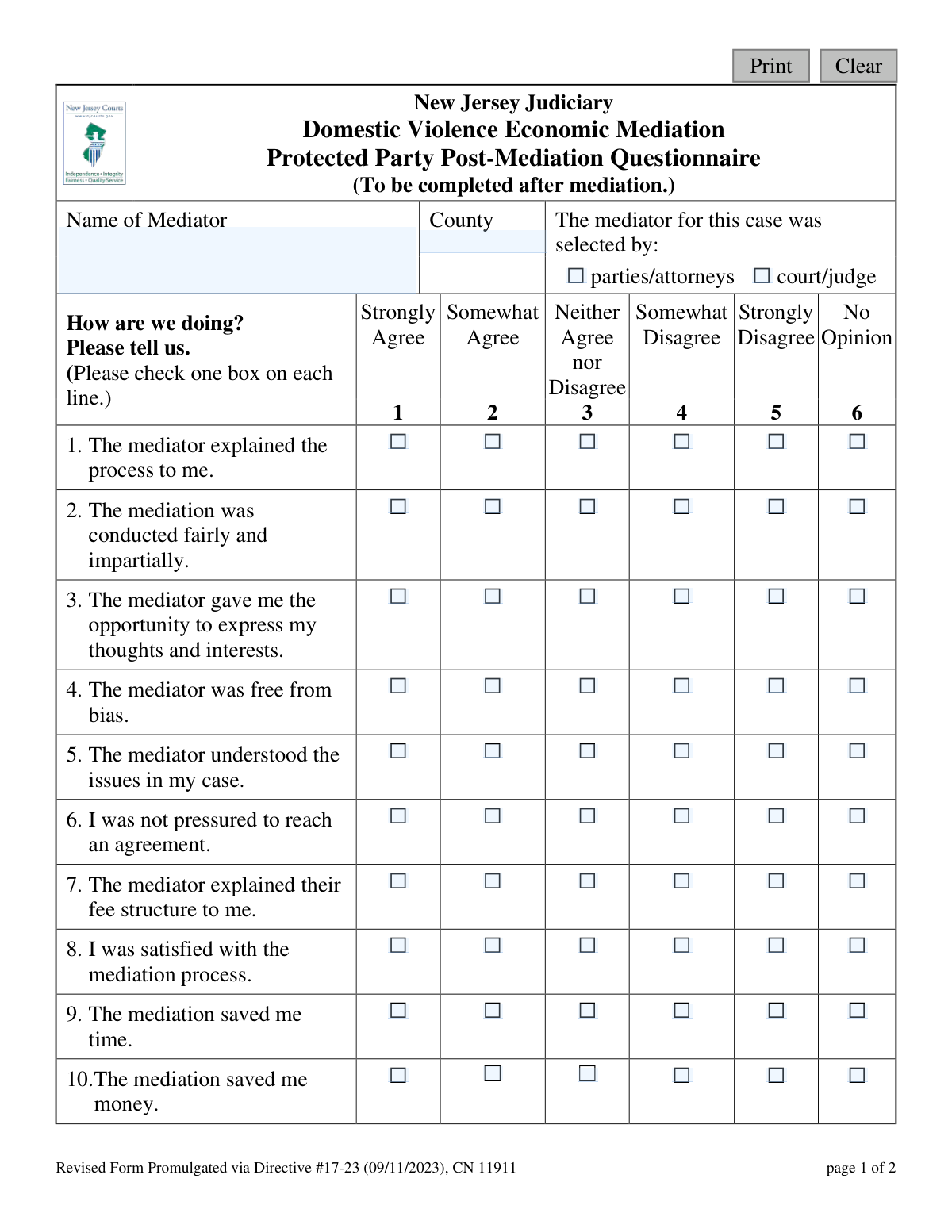
This form is a questionnaire provided by the New Jersey Judiciary for a protected party to complete after participating in Domestic Violence Economic Mediation. Its purpose is to collect feedback on the mediator's performance, the fairness of the process, and the litigant's overall experience to help improve the statewide program. Today, this form can be filled out quickly and accurately using AI-powered services like Instafill.ai, which can also convert non-fillable PDF versions into interactive fillable forms.
DVEM - CN 11911 is part of the
domestic violence forms and New Jersey forms categories on Instafill.
Our AI automatically handles information lookup, data retrieval, formatting, and form filling.
It takes less than a minute to fill out DVEM - CN 11911 using our AI form filling.
Securely upload your data. Information is encrypted in transit and deleted immediately after the form is filled out.
Form specifications
| Form name: | New Jersey Judiciary Domestic Violence Economic Mediation Protected Party Post-Mediation Questionnaire |
| Number of fields: | 102 |
| Number of pages: | 1 |
| Language: | English |
Instafill Demo: How to fill out PDF forms in seconds with AI
How to Fill Out DVEM - CN 11911 Online for Free in 2026
Are you looking to fill out a DVEM - CN 11911 form online quickly and accurately? Instafill.ai offers the #1 AI-powered PDF filling software of 2026, allowing you to complete your DVEM - CN 11911 form in just 37 seconds or less.
Follow these steps to fill out your DVEM - CN 11911 form online using Instafill.ai:
- 1 Navigate to Instafill.ai and upload or select the Protected Party Post-Mediation Questionnaire.
- 2 Enter the name of the mediator and the county where the mediation took place.
- 3 Indicate whether the mediator was selected by the parties/attorneys or by the court/judge.
- 4 Carefully answer questions 1 through 15 by checking the box that best reflects your experience, ranging from 'Strongly Agree' to 'Strongly Disagree'.
- 5 Answer the subsequent yes/no questions regarding your willingness to repeat the process and whether your case settled.
- 6 Use the provided text boxes to add any further description of your experience or suggestions for improvement.
- 7 Review all your responses for accuracy before submitting or downloading the completed questionnaire.
Our AI-powered system ensures each field is filled out correctly, reducing errors and saving you time.
Why Choose Instafill.ai for Your Fillable DVEM - CN 11911 Form?
Speed
Complete your DVEM - CN 11911 in as little as 37 seconds.
Up-to-Date
Always use the latest 2026 DVEM - CN 11911 form version.
Cost-effective
No need to hire expensive lawyers.
Accuracy
Our AI performs 10 compliance checks to ensure your form is error-free.
Security
Your personal information is protected with bank-level encryption.
Frequently Asked Questions About Form DVEM - CN 11911
This form is used by the New Jersey Judiciary to collect feedback from the 'Protected Party' after a Domestic Violence Economic Mediation session. Your responses help evaluate the mediator's performance and the overall effectiveness of the program.
This questionnaire should be completed by the individual identified as the 'Protected Party' in a domestic violence case who has just participated in economic mediation. It should be filled out after the mediation has concluded.
You will need the name of your mediator and the county where the mediation took place. The rest of the form consists of questions about your personal experience during the mediation process.
In a domestic violence case, the 'Protected Party' is the person who has been granted a restraining order for their protection. This form is specifically designed to capture your unique perspective and safety concerns during mediation.
For questions 1 through 15, review the statement and check the box that best reflects your opinion, ranging from 'Strongly Agree' to 'Strongly Disagree'. If a question is not applicable or you are unsure, you can select 'No Opinion'.
While not mandatory, providing written feedback in questions 17 and 19 is highly encouraged. This is your opportunity to share specific details or suggestions that can help improve the mediation program for others.
No, this form is for program evaluation and quality control purposes only. Your confidential feedback is used to assess the mediation process and will not impact the legal decisions in your case.
The form should be completed and submitted after your mediation session ends. The mediator or court staff will provide you with specific instructions on how and where to turn it in.
Honest feedback, whether positive or negative, is essential for the Judiciary to maintain a high-quality mediation program. Your responses are used to monitor performance and ensure mediators are fair, impartial, and follow proper procedures.
Yes, services like Instafill.ai use AI to help you accurately fill out forms. It can help populate basic information and ensure the document is completed neatly and efficiently.
You can use a service like Instafill.ai to complete the form on your computer or phone. Simply upload the PDF, and the platform will allow you to type your answers directly into the fields before printing.
If you have a non-fillable or 'flat' PDF, you can use Instafill.ai to convert it into an interactive, fillable form. This makes it easy to type your responses instead of having to print the form and fill it out by hand.
These questions address two different potential benefits of mediation. 'Saved me time' refers to avoiding lengthy court proceedings, while 'saved me money' refers to reducing legal fees and other costs associated with litigation.
Compliance DVEM - CN 11911
Validation Checks by Instafill.ai
1
Mediator Name Presence
This check ensures that the 'Name of Mediator' field is not left blank. This information is critical for associating the feedback with a specific mediator, which is essential for program evaluation and quality control. If this field is empty, the form submission will be rejected with a prompt for the user to provide the mediator's name.
2
County Selection Required
Validates that a county has been specified in the 'County' field. The county information is necessary for regional analysis, tracking program performance across different jurisdictions, and identifying geographical trends. A failure to provide the county will prevent form submission until a value is entered.
3
Mediator Selector Choice Required
Ensures that one of the two options ('parties/attorneys' or 'court/judge') for how the mediator was selected is checked. This data point helps the Judiciary understand the primary pathways for mediator assignment in domestic violence cases. The form cannot be submitted until a selection is made for this required question.
4
Likert Scale Questions Completeness
This validation verifies that for each of the 15 Likert-scale questions (from 'The mediator explained the process' to 'I knew that I was able to leave'), exactly one response has been selected. Incomplete surveys provide skewed or unusable data for program analysis. If any question is unanswered, the user will be notified to complete all feedback items before submission.
5
Safety Feedback Answer Required
Specifically confirms that question 11, 'I felt safe during the process,' has been answered. Given this is a questionnaire for a 'Protected Party' in a domestic violence case, this feedback is of paramount importance for assessing program safety. An omission here would trigger a validation error, highlighting the field as mandatory.
6
Repeat Mediation Choice Mandatory
This check ensures that question 16, 'If you had the choice to do this again would you do it?', is answered with either 'Yes' or 'No'. This question is a key indicator of overall user satisfaction and the perceived value of the mediation program. The submission will be blocked until this binary choice is made.
7
Case Settlement Status Required
Validates that question 18, 'Did your case settle?', has been answered. The settlement rate is a primary metric for measuring the effectiveness of the economic mediation program. Without this information, a key outcome cannot be determined, so the form will not be accepted until a 'Yes' or 'No' is selected.
8
Valid County Name Format
If the county field is a free-text input, this check validates the entry against a predefined list of the 21 official New Jersey counties. This ensures data consistency and prevents typos or invalid entries, which is crucial for accurate reporting and data aggregation. An invalid entry would prompt the user to correct the county name or select from a list.
9
Experience Description Character Limit
This validation imposes a maximum character limit (e.g., 2500 characters) on the open-text field for question 17, 'Is there anything else that you would like to add...'. This prevents excessively long submissions that could be difficult to process or cause database storage issues. If the limit is exceeded, the user will be asked to shorten their response.
10
Suggestions Field Character Limit
This check enforces a maximum character limit on the response to question 19, 'Do you have any other suggestions on how we can improve?'. Similar to other text fields, this maintains data integrity and manageability. A user exceeding the character count will receive an error message and be required to edit their input.
11
Input Sanitization for Text Fields
This security check scans all free-text fields ('Name of Mediator', 'describe your experience', 'suggestions') for potentially malicious input, such as HTML tags, scripts, or SQL injection patterns. This is a critical measure to protect the application and database from security vulnerabilities. If malicious patterns are detected, the submission is blocked and the input is rejected.
12
Single Selection per Question
Verifies that for every question with multiple choice options (the Likert scale, mediator selection, repeat choice, and settlement status), only one option is selected. This prevents ambiguous or invalid data that would result from a user checking multiple boxes for a single question. If more than one option is selected for any single question, an error will be displayed, requiring the user to correct their selections.
Common Mistakes in Completing DVEM - CN 11911
Users often leave the 'Name of Mediator' and 'County' fields blank, either from rushing or not having the information readily available. This is a critical error because it makes the feedback almost useless; the judiciary cannot link the questionnaire to the specific mediator or court jurisdiction being evaluated. To avoid this, keep all case-related documents handy when completing the form, as they will contain the correct names and county information.
A common data entry mistake is checking more than one box for a single numbered question (e.g., checking both 'Strongly Agree' and 'Somewhat Agree'). This usually happens on paper forms where there are no built-in constraints. This invalidates the response for that question, leading to incomplete data for analysis. To prevent this, carefully select only one box per line. Using a tool like Instafill.ai can help by converting flat PDFs into interactive forms with radio buttons that technically prevent multiple selections.
Many litigants rate the entire process based on whether they were happy with the final outcome or if the case settled. It's a natural bias, but this form is designed to evaluate the mediator's conduct and the fairness of the process itself, regardless of the result. This confusion can lead to an excellent mediator receiving a poor review simply because an agreement wasn't reached. To avoid this, try to answer questions about the process (e.g., fairness, impartiality, safety) by focusing only on the mediator's actions and the session's structure.
When faced with open-ended questions like 'Is there anything else that you would like to add?', users often write 'N/A' or something generic like 'It was fine.' This happens due to fatigue or a feeling that checkboxes are sufficient. This is a missed opportunity, as specific, detailed comments provide crucial context that quantitative data cannot. To provide useful feedback, describe specific actions or moments, such as, 'The mediator did a great job of keeping the discussion focused when it started to get off track.'
Some users feel compelled to select an 'Agree' or 'Disagree' option for every question, even when it doesn't apply to their situation. For example, if the court paid for the mediation, the question about the mediator's fee structure (Q7) is irrelevant. Choosing 'Disagree' in this case would be inaccurate. The 'No Opinion' option is the correct choice in such scenarios, and using it ensures data integrity by not forcing an inapplicable answer.
A user might state they were 'Strongly' satisfied with the process (Q8) but then answer 'No' to whether they would do it again (Q16). While this can reflect nuanced feelings, it can also signal confusion or misinterpretation of the questions. Such contradictions can cause reviewers to question the validity of the entire submission. To avoid this, read through all your answers before submitting and use the open-ended comment sections to explain any seemingly contradictory feelings.
It is easy to accidentally miss a row when filling out a long list of checkbox questions. Each question, from 'The mediator explained the process' to 'I felt safe,' is a distinct data point for the judiciary to evaluate the program's effectiveness. Skipping a question means that valuable piece of feedback is lost. The best way to avoid this is to move methodically down the list, ensuring one box in each numbered row is checked before moving to the next.
Providing an incorrect or incomplete spelling of the mediator's name is a frequent error, often because the user is guessing based on memory. This has the same negative consequence as leaving the field blank: the feedback cannot be tied to the correct individual. This prevents the judiciary from identifying patterns of excellence or areas for improvement with specific mediators. Always refer to official court documents to verify the correct spelling.
This form is specifically for the 'Protected Party' in a Domestic Violence case, and questions about safety, fear, and pressure are paramount. Some individuals may answer from a general perspective of dissatisfaction rather than focusing on how the process addressed the inherent power imbalance and safety concerns. This dilutes the purpose of the form. Before answering, it's helpful to re-read the form's title and consciously evaluate the experience through the specific lens of safety and freedom from coercion.
The question of whether the mediator was selected by the 'parties/attorneys' or the 'court/judge' is often overlooked or answered incorrectly. Users may not recall or may have been uninvolved in this part of the process. This data is important for the judiciary to track referral sources and their success rates. If you are unsure, it is better to ask your attorney or check the case file rather than guess. AI-powered tools like Instafill.ai can help by pre-filling this information if it's available in the digital case file, ensuring accuracy.
Saved over 80 hours a year
“I was never sure if my IRS forms like W-9 were filled correctly. Now, I can complete the forms accurately without any external help.”
Kevin Martin Green
Your data stays secure with advanced protection from Instafill and our subprocessors

Robust compliance program
Transparent business model
You’re not the product. You always know where your data is and what it is processed for.
ISO 27001, HIPAA, and GDPR
Our subprocesses adhere to multiple compliance standards, including but not limited to ISO 27001, HIPAA, and GDPR.
Security & privacy by design
We consider security and privacy from the initial design phase of any new service or functionality. It’s not an afterthought, it’s built-in, including support for two-factor authentication (2FA) to further protect your account.
Fill out DVEM - CN 11911 with Instafill.ai
Worried about filling PDFs wrong? Instafill securely fills new-jersey-judiciary-domestic-violence-economic-mediation-protected-party-post-mediation-questionnaire forms, ensuring each field is accurate.