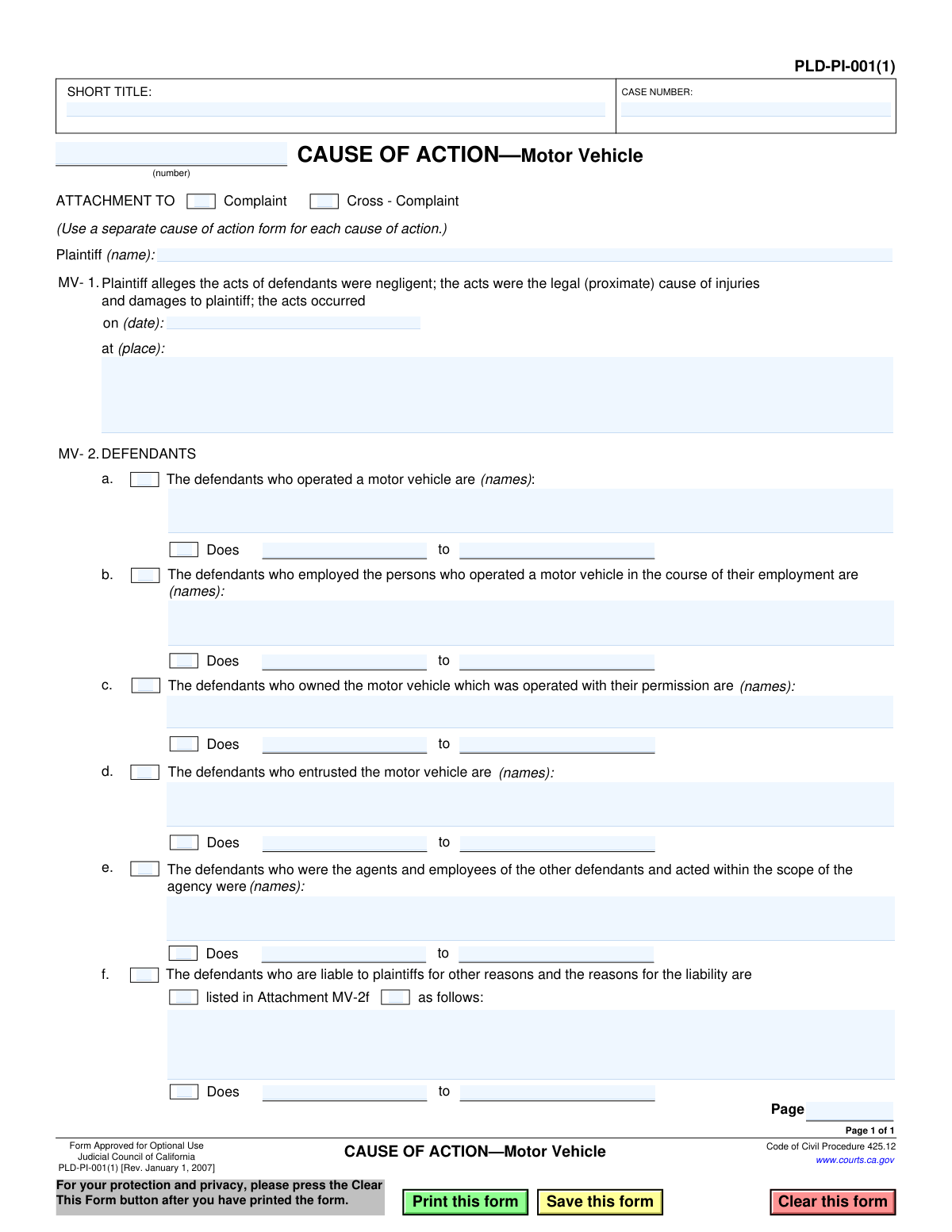
Yes! You can use AI to fill out Form PLD-PI-001(1), Cause of Action—Motor Vehicle

Form PLD-PI-001(1) is a legal document used in California Superior Courts as an attachment to a complaint or cross-complaint in a personal injury case. Its purpose is to formally state the cause of action, or the legal grounds for the lawsuit, specifically when the injury results from a motor vehicle incident. The form identifies the defendants and the specific reasons for their alleged liability, such as being the driver, owner, or employer of the driver. Today, this form can be filled out quickly and accurately using AI-powered services like Instafill.ai, which can also convert non-fillable PDF versions into interactive fillable forms.
PLD-PI-001(1) is part of the California court forms and motor vehicle forms categories on Instafill.
Our AI automatically handles information lookup, data retrieval, formatting, and form filling.
It takes less than a minute to fill out PLD-PI-001(1) using our AI form filling.
Securely upload your data. Information is encrypted in transit and deleted immediately after the form is filled out.

Form specifications

Form name: Form PLD-PI-001(1), Cause of Action—Motor Vehicle
Number of fields: 45
Number of pages: 1
Language: English
main-image

Instafill Demo: How to fill out PDF forms in seconds with AI

How to Fill Out PLD-PI-001(1) Online for Free in 2026

Are you looking to fill out a PLD-PI-001(1) form online quickly and accurately? Instafill.ai offers the #1 AI-powered PDF filling software of 2026, allowing you to complete your PLD-PI-001(1) form in just 37 seconds or less.
Follow these steps to fill out your PLD-PI-001(1) form online using Instafill.ai:
  1. 1 Navigate to Instafill.ai and upload or select Form PLD-PI-001(1).
  2. 2 Enter the case information, including the Short Title and Case Number, at the top of the form.
  3. 3 Specify that the form is an attachment to either a Complaint or Cross-Complaint and name the plaintiff.
  4. 4 In section MV-1, provide the date and location of the motor vehicle incident.
  5. 5 In section MV-2, identify all defendants by name and check the boxes corresponding to their alleged roles (e.g., driver, owner, employer).
  6. 6 Review all the information you've entered for accuracy and completeness before finalizing the document.
  7. 7 Download the completed form to be attached to your primary legal filing with the court.

Our AI-powered system ensures each field is filled out correctly, reducing errors and saving you time.

Why Choose Instafill.ai for Your Fillable PLD-PI-001(1) Form?

Speed

Complete your PLD-PI-001(1) in as little as 37 seconds.

Up-to-Date

Always use the latest 2026 PLD-PI-001(1) form version.

Cost-effective

No need to hire expensive lawyers.

Accuracy

Our AI performs 10 compliance checks to ensure your form is error-free.

Security

Your personal information is protected with bank-level encryption.

Frequently Asked Questions About Form PLD-PI-001(1)

This form is a legal document used in California courts to specify the reasons (causes of action) for suing one or more parties due to a motor vehicle accident. It is an attachment to a main Complaint or Cross-Complaint, detailing who is being sued and why.

The plaintiff (the person initiating the lawsuit) or their attorney must complete this form when filing a personal injury case related to a motor vehicle incident.

Check 'Complaint' if you are the original party starting the lawsuit. Check 'Cross-Complaint' if you are a defendant who is now suing the plaintiff or bringing another party into the existing lawsuit.

In section MV-1, you must enter the exact date and the specific location (such as the street address or intersection) where the motor vehicle accident occurred.

This section identifies the defendants based on their role: 'operator' is the driver, 'owner' is the legal owner of the car, and 'employer' is the company the driver worked for if the accident happened on the job.

'Doe' defendants are placeholders for responsible parties whose names you do not know at the time of filing. Including them allows you to add them to the lawsuit later once their identity is discovered, without violating the statute of limitations.

Yes, you can name multiple defendants on a single form by listing their names in the appropriate categories under section MV-2.

This form cannot be filed by itself. It must be attached to a primary court document, such as a Complaint (Form PLD-PI-001) or Cross-Complaint, and filed together as a single package.

Use this section for less common liability claims, such as suing a mechanic for faulty repairs that caused the crash or a government entity for a dangerous road condition. You must briefly describe the reason and attach a separate page labeled 'Attachment MV-2f'.

No, you can list multiple defendants on one form. You only need a separate Cause of Action form if you are alleging a different legal theory, for example, 'General Negligence' in addition to 'Motor Vehicle'.

Yes, services like Instafill.ai use AI to accurately auto-fill form fields, which saves time and helps prevent errors. This is particularly helpful for entering case information consistently across multiple legal documents.

To use Instafill.ai, you upload the PDF of the form to their platform. The AI will identify all the fillable fields, allowing you to enter your information once and have it populated correctly throughout the document.

If you have a non-fillable or 'flat' PDF, you can use a service like Instafill.ai. Their platform can convert the static document into an interactive, fillable form that you can easily complete and save online.

Compliance PLD-PI-001(1)
Validation Checks by Instafill.ai

1
Short Title Presence
Ensures the 'SHORT TITLE' field is populated. This field is essential for identifying the case in all subsequent court filings and correspondence. If this field is left empty, the document may be rejected by the court clerk as it cannot be associated with a specific case.
2
Case Number Presence
Verifies that the 'CASE NUMBER' field is not empty. The case number is the unique identifier assigned by the court, and its absence makes it impossible to file the document correctly. Failure to provide the case number will result in filing rejection.
3
Exclusive Attachment Type Selection
Checks that exactly one of the 'Complaint' or 'Cross-Complaint' checkboxes is selected. This form serves as an attachment, and its legal context depends on whether it's part of an initial complaint or a cross-complaint. Selecting none or both would create ambiguity, leading to procedural defects.
4
Plaintiff Name Completeness
Validates that the 'Plaintiff (name)' field is filled out. The identity of the plaintiff is a fundamental component of any legal action. Without this information, the cause of action has no legal standing, and the form is incomplete.
5
Incident Date Validity
Ensures the 'on (date)' field in section MV-1 contains a valid date and that the date is not in the future. The date of the incident is a critical fact for establishing the timeline and determining issues like the statute of limitations. An invalid or future date would render the claim nonsensical.
6
Incident Place Completeness
Verifies that the 'at (place)' field in section MV-1 is populated. The location of the incident is crucial for establishing court jurisdiction and is a key factual element of the case. Leaving this field blank makes the allegation incomplete and may be grounds for dismissal.
7
Minimum Defendant Identification
Checks that at least one defendant is identified in section MV-2, either by name or by checking a 'Does' box for placeholder defendants. A lawsuit cannot proceed without at least one defendant being named or designated. This validation prevents the submission of a form that fails to identify an opposing party.
8
Conditional Defendant Name Entry
For each defendant category in MV-2 (a-e), this check ensures that if a name is provided, the corresponding 'Does' checkbox is not also checked for the same entry, or vice-versa. This prevents contradictory information where a specific defendant is named but also categorized as an unknown 'Doe' defendant in the same line item.
9
Doe Number Range Logic
Validates that for any 'Does' checkbox that is checked in section MV-2, the corresponding 'to' number is greater than or equal to the 'from' number. This ensures the range of placeholder 'Doe' defendants is logical (e.g., 'Does 1 to 10' is valid, but 'Does 10 to 1' is not). An illogical range would cause confusion and require correction.
10
MV-2f Attachment Reference Check
If the checkbox in section MV-2f is checked, this validation triggers a notification or warning to the user. It confirms that the user understands that a separate document, 'Attachment MV-2f,' explaining the reasons for liability must be created and attached to the filing. This prevents an incomplete filing where the referenced attachment is missing.
11
Plaintiff-Defendant Name Conflict
Compares the plaintiff's name against all named defendants in section MV-2. If a match is found, a warning is issued. While there are rare exceptions, a person generally cannot sue themselves, and such an entry is almost always a data entry error that needs to be corrected.
12
At Least One Defendant Category Selected
Verifies that at least one of the subsections in MV-2 (a through f) has been completed with either a name or a 'Does' designation. This ensures the plaintiff has alleged a specific legal theory of liability against at least one category of defendant, which is a necessary component of the cause of action.

Common Mistakes in Completing PLD-PI-001(1)

Inconsistent 'Short Title' or 'Case Number'

This form is an attachment to a primary complaint, and filers often forget to copy the 'Short Title' and 'Case Number' exactly as they appear on the main document. This happens due to oversight or rushing. Any mismatch can lead to the court clerk rejecting the filing or misfiling the document, causing significant delays and requiring a corrected submission.

Providing a Vague Incident Location

In section MV-1, people often write a general location like 'Main Street' instead of a precise one like 'the intersection of Main Street and Oak Avenue, Anytown, CA'. This ambiguity can weaken the case by making facts harder to prove and may even create jurisdictional questions. Always use the specific location as documented in the police report or other official records.

Incorrect or Improperly Formatted Incident Date

Entering the wrong date or using a non-standard format (e.g., 'last Tuesday') in section MV-1 is a critical error. This mistake, often due to not referencing official reports, can be used by the defense to challenge the entire claim and may impact the statute of limitations. Always verify the date from a police report and use a clear MM/DD/YYYY format to avoid any ambiguity.

Confusing Defendant Liability Categories

In section MV-2, filers frequently miscategorize defendants, such as listing a person as only the 'operator' when they were also the 'owner'. This stems from a misunderstanding of legal liabilities like vicarious liability or negligent entrustment. Failing to name a party in all relevant categories can limit your ability to recover damages, while incorrectly naming parties can lead to parts of your complaint being dismissed.

Improperly Using 'Doe' Defendant Fields

The 'Does' fields are a legal provision for naming unknown defendants who may be identified later, but people often misunderstand them. Common mistakes include leaving them blank, which forfeits the right to add defendants later, or trying to name a known person in these fields. This can prevent adding a liable party after the statute of limitations has expired, so it's crucial to use sequential placeholders (e.g., 'Does 1 to 10') as advised by legal procedure.

Forgetting to Include 'Attachment MV-2f'

A frequent clerical error is checking the box in section MV-2f to indicate that other liable parties are listed in an attachment, but then failing to actually draft and include the document named 'Attachment MV-2f'. This renders the claim for 'other reasons' completely unsupported and subject to immediate dismissal. If you check this box, you must attach a separate page that clearly explains the basis for liability for the specified defendants.

Failing to Number the Cause of Action

Many people overlook the '(number)' field next to 'CAUSE OF ACTION—Motor Vehicle'. A complaint can have multiple causes of action, and each must be numbered sequentially for clarity and proper reference in future court proceedings. Forgetting to number it creates disorganization and may lead to the court requiring an amended filing, causing unnecessary delays.

Submitting an Illegible, Handwritten Form

When a fillable version of a form is not available, people resort to handwriting, which is often illegible. Poorly written names, dates, and addresses can lead to critical data entry errors by the court clerk, potentially invalidating the filing or causing notices to be sent to the wrong address. To prevent this, it's best to type the information. AI-powered tools like Instafill.ai can convert non-fillable PDFs into fillable versions, ensuring all entries are clear and legible.

Confusing Vehicle 'Owner' with 'Entruster'

In section MV-2, filers often incorrectly use the 'owner' (subsection c) and 'entrusted' (subsection d) categories interchangeably. Ownership simply denotes who holds the title, while 'negligent entrustment' is a specific claim that the owner knew the driver was incompetent or reckless. Pleading negligent entrustment without facts to support it can lead to a motion to strike from the defense, weakening your overall position.

Not Specifying 'Complaint' or 'Cross-Complaint'

The form requires the filer to check a box indicating if it is an attachment to a 'Complaint' or a 'Cross-Complaint'. Overlooking this simple step creates ambiguity about the document's legal context. This can confuse the court and opposing counsel, potentially requiring clarification or refiling to ensure the pleadings are clear. Always ensure the correct box is checked to match the primary legal document.
Saved over 80 hours a year

“I was never sure if my IRS forms like W-9 were filled correctly. Now, I can complete the forms accurately without any external help.”

Kevin Martin Green

Your data stays secure with advanced protection from Instafill and our subprocessors

Robust compliance program

Transparent business model

You’re not the product. You always know where your data is and what it is processed for.

ISO 27001, HIPAA, and GDPR

Our subprocesses adhere to multiple compliance standards, including but not limited to ISO 27001, HIPAA, and GDPR.

Security & privacy by design

We consider security and privacy from the initial design phase of any new service or functionality. It’s not an afterthought, it’s built-in, including support for two-factor authentication (2FA) to further protect your account.

Fill out PLD-PI-001(1) with Instafill.ai

Worried about filling PDFs wrong? Instafill securely fills form-pld-pi-0011-cause-of-actionmotor-vehicle forms, ensuring each field is accurate.

Related forms by category

California court forms Judicial Council of California Form SC-105, Request for Court Order and Answer (Small Claims), Judicial Council of California Form SC-120, Defendant’s Claim and ORDER to Go to Small Claims Court (Small Claims), Judicial Council of California Form SER-001, Request for Sheriff to Serve Court Papers, Judicial Council of California Form SER-001, Request for Sheriff to Serve Court Papers, Affidavit for Collection of Personal Property California Probate Code Section 13100, Form POS-040, Proof of Service—Civil, Declaration of Facts of Death (California Superior Court), declaration-of-marriage-for-court-proceeding-california-family-law, ADOPT-200, Adoption Request, ADOPT-200, Stepparent Adoption Request, ADOPT-210, Adoption Agreement, ADOPT-310, Contact After Adoption Agreement, Judicial Council of California Form ADOPT-200, Adoption Request, Form ADR-107, Mediation Attendance Sheet, Form ADR-110, Order Appointing Referee, Form ADR-109, Stipulation or Motion for Order Appointing Referee, Form ADR-102, Request for Trial De Novo After Judicial Arbitration, Form ADR-108, Referee's Report (Code Civ. Proc., §§ 638, 639), Form ADR-106, Petition to Confirm, Correct, or Vacate Contractual Arbitration Award, Form ADR-104, Rejection of Award and Request for Trial After Attorney-Client Fee Arbitration · + 503 more →
motor vehicle forms Colorado Form DR 0026, Tax Statement for Leased Motor Vehicle, Form 8910, Alternative Motor Vehicle Credit, State of Florida Department of Highway Safety and Motor Vehicles (FLHSMV) Form HSMV 82993, Separate Odometer Disclosure Statement and Acknowledgment, DL 142, Request for Cancellation or Surrender of a Driver License or Identification Card (State of California Department of Motor Vehicles), California Department of Motor Vehicles (DMV) Form REG 135, Bill of Sale, Letter of Authorization - County of Kauai Department of Finance, Division of Motor Vehicles & Licensing, Form 735-501, Vehicle Bill of Sale, Form DR 0024, Standard Sales Tax Receipt for Vehicle Sales, Form DR 2020SP, Exception Processing Application, Form MV-82TON, Application for Title, Form REG 343, Application for Title or Registration, Form VR-005, Application for Certificate of Title, Georgia Department of Revenue Form T-7, Bill of Sale, Form MV-104, Report of Motor Vehicle Accident, Form DTF-802, Statement of Transaction – Sale or Gift of Motor Vehicle, Trailer, All-Terrain Vehicle (ATV), Vessel (Boat), or Snowmobile, Form HSMV 82050, Notice of Sale and/or Bill of Sale for a Motor Vehicle, Mobile Home, Off-Highway Vehicle or Vessel, Power of Attorney for a Motor Vehicle, Mobile Home, or Vessel, Emancipated Minor's Application to California Department of Motor Vehicles