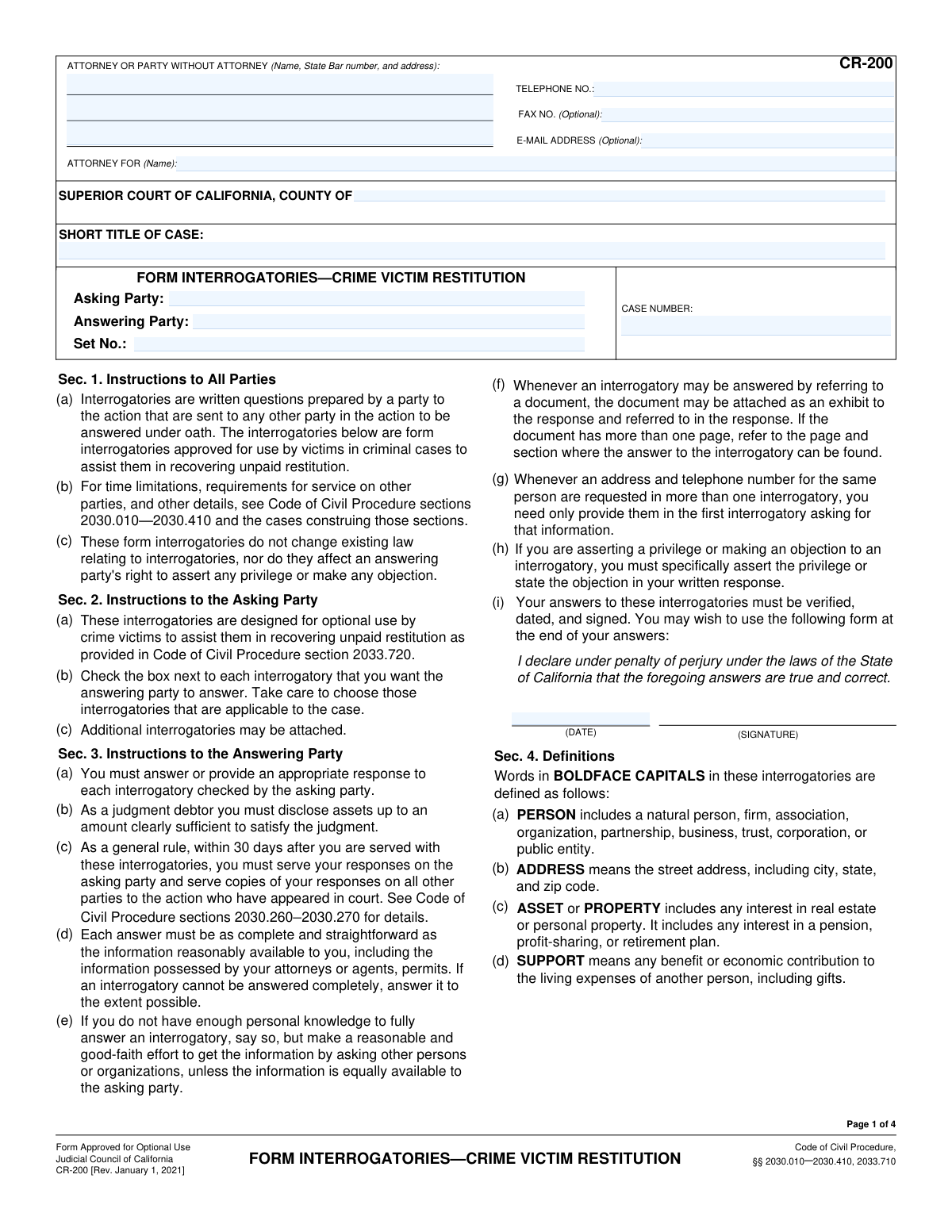
Yes! You can use AI to fill out Judicial Council of California Form CR-200, Form Interrogatories—Crime Victim Restitution

Form CR-200, Form Interrogatories—Crime Victim Restitution, is a legal document used in California by crime victims (Asking Party) to send written questions to a defendant (Answering Party) who owes them court-ordered restitution. Its purpose is to discover the defendant's assets, income, and financial status to help the victim enforce the judgment and collect the money they are owed. Today, this form can be filled out quickly and accurately using AI-powered services like Instafill.ai, which can also convert non-fillable PDF versions into interactive fillable forms.
CR-200 is part of the California court forms, California judicial forms and Judicial Council forms categories on Instafill.
Our AI automatically handles information lookup, data retrieval, formatting, and form filling.
It takes less than a minute to fill out CR-200 using our AI form filling.
Securely upload your data. Information is encrypted in transit and deleted immediately after the form is filled out.

Form specifications

Form name: Judicial Council of California Form CR-200, Form Interrogatories—Crime Victim Restitution
Number of fields: 52
Number of pages: 1
Language: English
main-image

Instafill Demo: How to fill out PDF forms in seconds with AI

How to Fill Out CR-200 Online for Free in 2026

Are you looking to fill out a CR-200 form online quickly and accurately? Instafill.ai offers the #1 AI-powered PDF filling software of 2026, allowing you to complete your CR-200 form in just 37 seconds or less.
Follow these steps to fill out your CR-200 form online using Instafill.ai:
  1. 1 Navigate to Instafill.ai and upload your CR-200 PDF or search for 'Form Interrogatories—Crime Victim Restitution' in the form library.
  2. 2 Provide the court, case, and party information in the header section, including your name, the answering party's name, and the case number.
  3. 3 Proceed to Section 5, 'Interrogatories,' and use the tool to check the boxes next to each question you want the answering party to answer.
  4. 4 Carefully review all the information you've entered and the questions you have selected to ensure they are accurate and applicable to your case.
  5. 5 Download the completed form, which is now ready for you to serve on the answering party as per the legal requirements.
  6. 6 Once you receive the answers, you can use the information to take further legal action to collect the restitution owed to you.

Our AI-powered system ensures each field is filled out correctly, reducing errors and saving you time.

Why Choose Instafill.ai for Your Fillable CR-200 Form?

Speed

Complete your CR-200 in as little as 37 seconds.

Up-to-Date

Always use the latest 2026 CR-200 form version.

Cost-effective

No need to hire expensive lawyers.

Accuracy

Our AI performs 10 compliance checks to ensure your form is error-free.

Security

Your personal information is protected with bank-level encryption.

Frequently Asked Questions About Form CR-200

This form allows a crime victim (the Asking Party) to formally question the person who owes them restitution (the Answering Party) about their finances. The goal is to discover assets and income that can be used to collect the unpaid restitution ordered by the court.

The crime victim, or their attorney, initiates the process by checking the boxes next to the questions they want answered. The person who owes restitution must then provide complete, written answers to all the checked questions under oath.

As a general rule, you must serve your written responses on the asking party within 30 days after you receive the form. It is crucial to comply with this deadline as outlined in the Code of Civil Procedure.

No, you only need to answer the specific interrogatories that the Asking Party has marked with a check. For those questions, you must provide a complete and straightforward answer to the best of your ability.

You will need to provide detailed information about your finances, including your employment history, current income, bank accounts, property, vehicles, and other assets. You may need to gather documents like pay stubs, bank statements, and tax returns to answer accurately.

If you don't have personal knowledge to answer, you must say so but also make a reasonable, good-faith effort to find the information. You cannot simply ignore a question because the answer isn't immediately available.

Verifying your answers means you must sign a statement at the end of your responses, under penalty of perjury, declaring that your answers are true and correct. Providing false information can have serious legal consequences.

Yes, you have the right to assert a legal privilege or make an objection to an interrogatory. If you do, you must specifically state the privilege or objection in your written response instead of providing an answer.

The crime victim will use the information you provided to enforce the restitution judgment. This could involve actions like garnishing your wages, levying your bank accounts, or placing a lien on your property.

Yes, services like Instafill.ai use AI to help you accurately fill out forms. These tools can auto-fill your personal information, saving you time and helping to prevent common errors.

Simply upload the PDF of Form CR-200 to the Instafill.ai platform. The tool will make the document interactive, allowing you to type your answers directly into the fields and then download or print the completed form.

You can use a service like Instafill.ai to convert a flat, non-fillable PDF into an interactive form. This allows you to easily type in your information without needing to print the form and fill it out by hand.

As defined in Section 4, this is a broad term that includes any interest in real estate or personal property. This covers everything from your home and car to your bank accounts, retirement plans, and valuable personal belongings.

Yes, several questions, such as 8.2 and 9.1, specifically ask about assets and accounts owned by your spouse. You are required to provide this information as it may be relevant to determining community property and your ability to pay.

Compliance CR-200
Validation Checks by Instafill.ai

1
Social Security Number Format
This check verifies that the Social Security Number provided in section 2.6 is entered in the standard XXX-XX-XXXX format. Proper formatting is essential for database matching and identity verification processes used in asset searches. A failure in this validation would prevent the system from accepting the number and require the user to correct the entry before submission.
2
Date of Birth Logical Validity
This validation ensures the date of birth entered in section 2.2 is a valid calendar date and is in the past. It prevents the entry of future dates or impossible dates (e.g., February 30). This check is crucial for identity verification and for calculating the answering party's age, which can be relevant in legal contexts. An invalid date would trigger an error message.
3
Gross vs. Net Pay Consistency
This check ensures that the Gross Pay amount listed in section 4.1(e) is greater than or equal to the Net Pay amount in section 4.1(f). It is a logical impossibility for net pay (after deductions) to be more than gross pay (before deductions). This validation prevents simple data entry errors and ensures the financial information provided is plausible.
4
Case Number Format Validation
This check validates that the 'CASE NUMBER' field conforms to the specific format used by the Superior Court of California. Each county may have a slightly different but consistent structure for case numbers. Correct formatting is critical for ensuring the document is filed correctly and associated with the proper legal case in the court's system.
5
Residential History Continuity
This validation examines the residence addresses and dates provided for the last five years under section 2.3. It checks that the date ranges are contiguous and do not contain significant unexplained gaps or overlaps. A complete and logical timeline of residence is important for asset tracing and verifying the answering party's history.
6
Conditional Requirement for Spousal Information
This check enforces a conditional rule based on the answer to 'Are you married?' in section 2.7. If the answer is affirmative, the system requires that the spouse's full name, date of marriage, and current address be filled out. This is important because spousal assets can be relevant to satisfying a judgment, and incomplete information would hinder the collection process.
7
Vehicle Year Plausibility
This validation ensures that the vehicle 'year' provided in section 9.5(a) is a realistic four-digit number. The check would flag years that are in the future or unreasonably old (e.g., before 1900), as these are likely data entry mistakes. Accurate vehicle information is necessary for valuation and identification of assets.
8
Last Bank Deposit Date Check
This check verifies that the 'date you last made a deposit' in section 8.1(d) is not a future date. The date must be on or before the current date of form submission. This simple logical check prevents nonsensical data entry and ensures the information about banking activity is chronologically correct.
9
Bankruptcy Filing Year Validity
This validation ensures the 'year' of bankruptcy filing entered in section 2.8(c) is a valid four-digit year and is not in the future. This information is used to assess the answering party's financial history and potential discharge of other debts. An invalid year would make this historical data unreliable.
10
Real Estate Acquisition Date Logic
This check validates that the 'date acquired' for any real estate in section 9.1(b) is a valid date in the past. The acquisition date cannot be after the date the form is being completed. This ensures the timeline of property ownership is logical and accurate for asset evaluation.
11
Phone Number Format
This validation ensures that all telephone and fax number fields (e.g., in the header and section 1.1) adhere to a standard U.S. format, such as (XXX) XXX-XXXX or XXX-XXX-XXXX. Consistent formatting is crucial for data integrity and for ensuring the contact information is usable. If the format is incorrect, the system should prompt the user for correction.
12
Judgment Payment Consistency Check
This check validates the data in section 12.1 regarding other judgments. If an amount has been paid (12.1(f)), the 'amount still due' (12.1(g)) must be less than the original 'amount of the judgment' (12.1(d)). This arithmetic validation ensures the financial data provided about other liabilities is internally consistent and logical.

Common Mistakes in Completing CR-200

Missing or Incorrect Case Information

Respondents often leave the header section blank or enter the wrong Case Number, Court, or Party Names. This typically happens due to carelessness or not having the official court documents readily available when filling out the form. An incorrect header can lead to the document being rejected by the court clerk or misfiled, causing significant delays in the legal process. To avoid this, always cross-reference the information with the original court summons or a recent court filing.

Failure to Sign and Date the Verification

A critical and frequent error is forgetting to sign and date the declaration under penalty of perjury, as required by Section 3(i). People may complete the detailed questions and overlook this final step. An unverified response is legally invalid and can be treated by the court as if no response was submitted at all, potentially leading to sanctions or a default judgment. Always double-check the last page for the signature and date fields before submission.

Providing Incomplete or Vague Answers

Many interrogatories, like 2.3(d) or 4.1, have multiple sub-parts requiring specific details (e.g., name, address, AND phone number). Respondents often provide a partial answer, such as a name without an address, or use vague terms like 'various' or 'personal funds.' This renders the answer non-responsive, allowing the asking party to file a motion to compel, which increases legal costs and delays resolution. To prevent this, carefully read and answer every part of each question separately.

Underreporting Income and Financial Support

Respondents frequently underreport their financial status by only listing their primary job's net pay, omitting overtime, cash-based side jobs, or gig economy work (Question 3.1). A similar mistake is failing to disclose financial help from family or friends (Question 6.1), not realizing the form's broad definition of 'SUPPORT' includes gifts and contributions to living expenses. Since the form is signed under penalty of perjury, these omissions can have severe legal consequences. It is crucial to review all income sources and financial assistance received.

Omitting Spouse's Assets and Information

Several questions (e.g., 8.2, 9.1, 9.2, 9.5) explicitly ask for information about a spouse's assets, accounts, and property. Respondents may mistakenly believe their spouse's finances are irrelevant or private, and therefore fail to disclose them. In a community property state like California, spousal assets can be subject to collection, and failing to disclose them can be considered fraudulent concealment. Carefully read each question to see if it includes 'or your spouse' and provide the requested information completely.

Confusing Gross Pay with Net Pay

Question 4.1(e) and 4.1(f) specifically ask for both 'gross pay' (before taxes and deductions) and 'net pay' (take-home pay). A common data entry error is to provide only the net pay amount for both fields or to confuse the two. This provides an inaccurate picture of the respondent's true earning capacity, which is crucial for determining ability to pay restitution. To avoid this, refer to a recent pay stub, which will clearly itemize both gross and net earnings.

Incomplete Disclosure of Bank Accounts and Property

When answering questions about assets (Sections 8.0 and 9.0), people often forget to list all of their accounts, such as online-only banks, PayPal/Venmo balances, or credit union accounts. Similarly, they may fail to list personal property like jewelry, collections, or electronics as requested in 9.9, either by oversight or by undervaluing them. This incomplete disclosure hinders asset discovery and can lead to further legal action to compel a full accounting.

Failing to Answer All 'Checked' Interrogatories

The 'Asking Party' checks boxes next to the questions they want answered. The 'Answering Party' sometimes misses one or more of these checked questions, especially if they are spread across multiple pages. This results in an incomplete response, forcing the victim's attorney to send deficiency letters or file motions with the court. To prevent this, the respondent should first go through the entire document and highlight or circle every question that has been checked before beginning to write their answers.

Omitting Past Names and Addresses

Question 2.1 asks for every name used in the past, and Question 2.3 requires five years of residence history. Respondents may forget or intentionally omit this information, such as a maiden name or a previous address where they lived for a short time. This is a mistake because assets can be held under former names, and past addresses are used in asset searches, making this information vital for collection efforts. It is important to be thorough and list all previous names and addresses as requested.

Incorrectly Documenting Employment History

Questions 4.0 and 5.0 require precise details about current and past employment, including employer names, addresses, and dates of employment. People often rely on memory and provide inaccurate dates or incomplete addresses. This makes it difficult for the victim to verify employment or serve a wage garnishment order, which is a primary method of collecting restitution. Using old tax forms (W-2s) or a resume to confirm these details is the best way to ensure accuracy. AI-powered form-filling tools like Instafill.ai can also help by automatically validating and formatting addresses to prevent errors.
Saved over 80 hours a year

“I was never sure if my IRS forms like W-9 were filled correctly. Now, I can complete the forms accurately without any external help.”

Kevin Martin Green

Your data stays secure with advanced protection from Instafill and our subprocessors

Robust compliance program

Transparent business model

You’re not the product. You always know where your data is and what it is processed for.

ISO 27001, HIPAA, and GDPR

Our subprocesses adhere to multiple compliance standards, including but not limited to ISO 27001, HIPAA, and GDPR.

Security & privacy by design

We consider security and privacy from the initial design phase of any new service or functionality. It’s not an afterthought, it’s built-in, including support for two-factor authentication (2FA) to further protect your account.

Fill out CR-200 with Instafill.ai

Worried about filling PDFs wrong? Instafill securely fills judicial-council-of-california-form-cr-200-form-interrogatoriescrime-victim-restitution forms, ensuring each field is accurate.

Related forms by category

California court forms Judicial Council of California Form SC-105, Request for Court Order and Answer (Small Claims), Judicial Council of California Form SC-120, Defendant’s Claim and ORDER to Go to Small Claims Court (Small Claims), Judicial Council of California Form SER-001, Request for Sheriff to Serve Court Papers, Judicial Council of California Form SER-001, Request for Sheriff to Serve Court Papers, Affidavit for Collection of Personal Property California Probate Code Section 13100, Form POS-040, Proof of Service—Civil, Declaration of Facts of Death (California Superior Court), declaration-of-marriage-for-court-proceeding-california-family-law, ADOPT-200, Adoption Request, ADOPT-200, Stepparent Adoption Request, ADOPT-210, Adoption Agreement, ADOPT-310, Contact After Adoption Agreement, Judicial Council of California Form ADOPT-200, Adoption Request, Form ADR-107, Mediation Attendance Sheet, Form ADR-110, Order Appointing Referee, Form ADR-109, Stipulation or Motion for Order Appointing Referee, Form ADR-102, Request for Trial De Novo After Judicial Arbitration, Form ADR-108, Referee's Report (Code Civ. Proc., §§ 638, 639), Form ADR-106, Petition to Confirm, Correct, or Vacate Contractual Arbitration Award, Form ADR-104, Rejection of Award and Request for Trial After Attorney-Client Fee Arbitration · + 128 more →
California judicial forms Judicial Council of California Form FL-300, Request for Order, Judicial Council of California Form FL-150, Income and Expense Declaration, Judicial Council of California Form DE-111, Petition for Probate (Probate—Decedents Estates), Judicial Council of California Form SC-104, Proof of Service (Small Claims), Judicial Council of California Form SC-105, Request for Court Order and Answer (Small Claims), Judicial Council of California Form DE-111, Petition for Probate (Probate—Decedents Estates), Judicial Council of California Form SC-104, Proof of Service (Small Claims), Judicial Council of California Form SC-108, Request to Correct or Cancel Judgment and Answer (Small Claims), Judicial Council of California Form SC-120, Defendant’s Claim and ORDER to Go to Small Claims Court (Small Claims), Civil Case Cover Sheet (Judicial Council of California Form CM-010), Civil Case Cover Sheet (Judicial Council of California Form CM-010), Judicial Council of California Form TR-205, Request for Trial by Written Declaration (Trial by Written Declaration—Traffic), Judicial Council of California Form DE-120, Notice of Hearing—Decedent's Estate or Trust, Inventory and Appraisal Attachment (Judicial Council of California Form DE-161, GC-041), CLETS-001, Confidential Information for Law Enforcement (Judicial Council of California), Judicial Council of California Form SER-001, Request for Sheriff to Serve Court Papers, Judicial Council of California Form UD-105, Answer—Unlawful Detainer, CLETS-001, Confidential Information for Law Enforcement (Judicial Council of California), Judicial Council of California Form ADOPT-210, Adoption Agreement, Judicial Council of California Form DE-120, Notice of Hearing—Decedent's Estate or Trust · + 23 more →
Judicial Council forms Judicial Council of California Form FL-300, Request for Order, Judicial Council of California Form FL-150, Income and Expense Declaration, Judicial Council of California Form DE-111, Petition for Probate (Probate—Decedents Estates), Judicial Council of California Form SC-104, Proof of Service (Small Claims), Judicial Council of California Form SC-105, Request for Court Order and Answer (Small Claims), Judicial Council of California Form DE-111, Petition for Probate (Probate—Decedents Estates), Judicial Council of California Form SC-104, Proof of Service (Small Claims), Judicial Council of California Form SC-108, Request to Correct or Cancel Judgment and Answer (Small Claims), Judicial Council of California Form SC-120, Defendant’s Claim and ORDER to Go to Small Claims Court (Small Claims), Civil Case Cover Sheet (Judicial Council of California Form CM-010), Civil Case Cover Sheet (Judicial Council of California Form CM-010), Judicial Council of California Form TR-205, Request for Trial by Written Declaration (Trial by Written Declaration—Traffic), Judicial Council of California Form DE-120, Notice of Hearing—Decedent's Estate or Trust, Inventory and Appraisal Attachment (Judicial Council of California Form DE-161, GC-041), CLETS-001, Confidential Information for Law Enforcement (Judicial Council of California), Judicial Council of California Form SER-001, Request for Sheriff to Serve Court Papers, Judicial Council of California Form UD-105, Answer—Unlawful Detainer, CLETS-001, Confidential Information for Law Enforcement (Judicial Council of California), Judicial Council of California Form ADOPT-210, Adoption Agreement, Judicial Council of California Form DE-120, Notice of Hearing—Decedent's Estate or Trust · + 25 more →