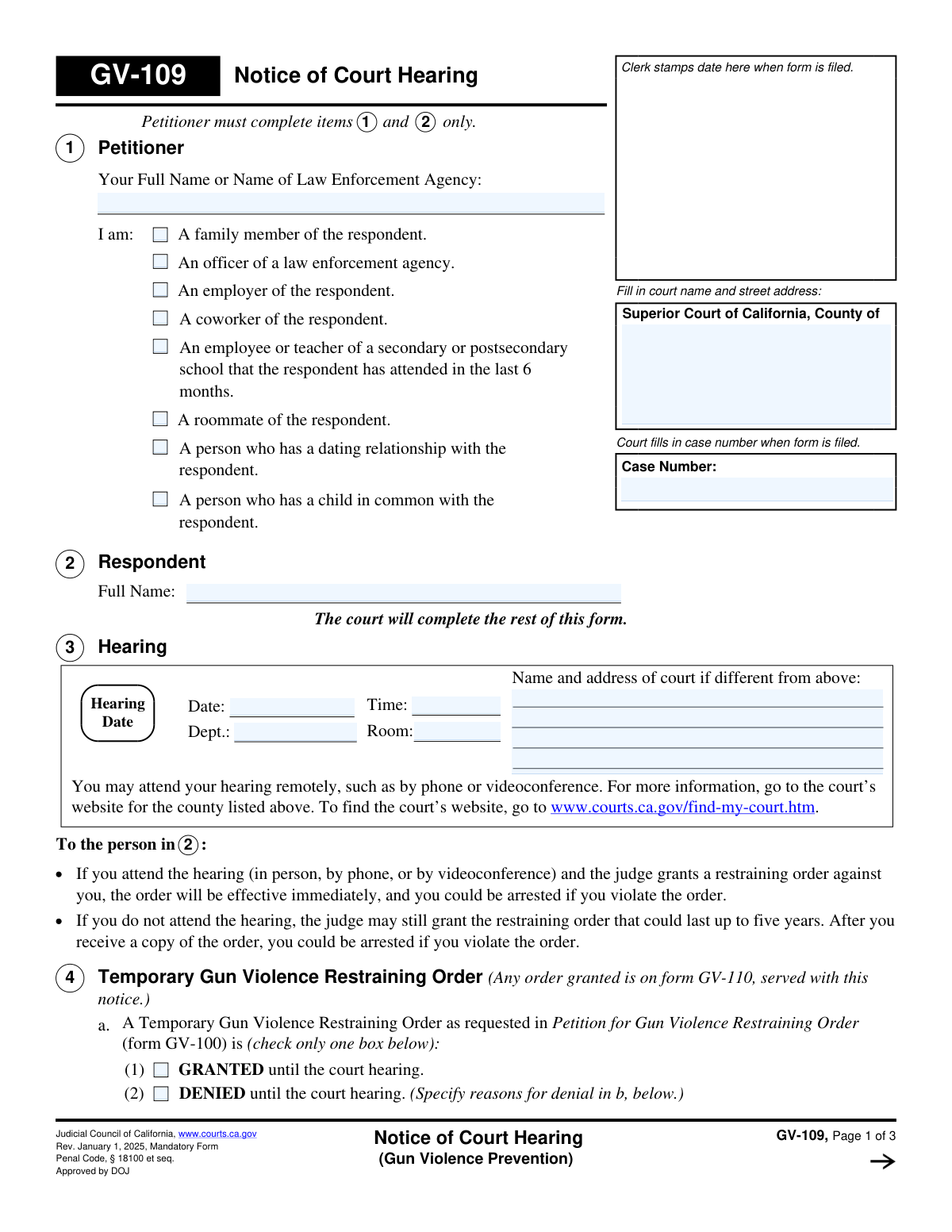
Yes! You can use AI to fill out Judicial Council of California Form GV-109, Notice of Court Hearing (Gun Violence Prevention)
Form GV-109 is a mandatory legal notice issued by the Superior Court of California in gun violence prevention cases. Its primary purpose is to inform an individual (the respondent) that a petition for a Gun Violence Restraining Order has been filed against them and to provide the date, time, and location of the court hearing. This form is critical for ensuring due process, as it officially notifies the respondent of the proceedings and gives them an opportunity to respond. Today, this form can be filled out quickly and accurately using AI-powered services like Instafill.ai, which can also convert non-fillable PDF versions into interactive fillable forms.
GV-109 is part of the
California court forms, California judicial forms and Judicial Council forms categories on Instafill.
Our AI automatically handles information lookup, data retrieval, formatting, and form filling.
It takes less than a minute to fill out GV-109 using our AI form filling.
Securely upload your data. Information is encrypted in transit and deleted immediately after the form is filled out.
Form specifications
| Form name: | Judicial Council of California Form GV-109, Notice of Court Hearing (Gun Violence Prevention) |
| Number of fields: | 53 |
| Number of pages: | 1 |
| Language: | English |
Instafill Demo: How to fill out PDF forms in seconds with AI
How to Fill Out GV-109 Online for Free in 2026
Are you looking to fill out a GV-109 form online quickly and accurately? Instafill.ai offers the #1 AI-powered PDF filling software of 2026, allowing you to complete your GV-109 form in just 37 seconds or less.
Follow these steps to fill out your GV-109 form online using Instafill.ai:
- 1 Navigate to Instafill.ai and upload or select Form GV-109, Notice of Court Hearing.
- 2 Use the AI-guided interface to enter the petitioner's full name or the name of the law enforcement agency in Section 1.
- 3 In Section 1, check the box that correctly identifies the petitioner's relationship to the respondent.
- 4 Move to Section 2 and accurately input the full name of the respondent.
- 5 Review the information you entered in Sections 1 and 2 for completeness and accuracy, as the rest of the form is completed by the court.
- 6 Download, save, or print the partially completed form, ready for filing with the court clerk.
Our AI-powered system ensures each field is filled out correctly, reducing errors and saving you time.
Why Choose Instafill.ai for Your Fillable GV-109 Form?
Speed
Complete your GV-109 in as little as 37 seconds.
Up-to-Date
Always use the latest 2026 GV-109 form version.
Cost-effective
No need to hire expensive lawyers.
Accuracy
Our AI performs 10 compliance checks to ensure your form is error-free.
Security
Your personal information is protected with bank-level encryption.
Frequently Asked Questions About Form GV-109
This form is used by the court to officially notify a person (the respondent) that a petition for a Gun Violence Restraining Order has been filed against them and to provide the date, time, and location of the court hearing.
The petitioner, who is the person requesting the restraining order, must complete only sections 1 and 2. The rest of the form is completed by the court.
You only need to provide your full name, check the box describing your relationship to the respondent in section 1, and provide the respondent's full name in section 2.
This means the judge has denied the request for a Temporary Restraining Order, so no order is in effect before the hearing. However, the court hearing will still take place as scheduled to decide if a final order should be granted.
If you do not attend the hearing, the judge can still grant the restraining order against you, which can last for up to five years. You will be legally required to follow the order once you receive a copy of it.
A law enforcement officer or a person over 18 who is not involved in the case must personally give (serve) the respondent a copy of this form and other required documents at least five days before the hearing.
If you need more time to serve the respondent, you can ask the court to reschedule the hearing by filing form GV-115, 'Request to Continue Court Hearing for Gun Violence Restraining Order'.
You can file a 'Response to Petition for Gun Violence Restraining Order' (form GV-120) and must attend the hearing to tell the judge why you disagree with the request. You may also bring witnesses and other evidence.
If you do not wish to oppose the petition, you can complete and file form GV-125, 'Consent to Gun Violence Restraining Order and Surrender of Firearms'.
The respondent must also be served with the Petition (GV-100), a blank Response form (GV-120), and other informational documents. If a temporary order was granted, a copy of that order (GV-110) must also be included.
Yes, services like Instafill.ai use AI to accurately auto-fill form fields, which can save you time and help prevent errors when completing your portion of the form.
You can use a service like Instafill.ai to complete your sections of the form online. Simply upload the document, and the tool will guide you through filling out the required fields for the petitioner.
If you have a non-fillable or 'flat' PDF, you can use a tool like Instafill.ai. It can convert the document into an interactive, fillable form that you can easily complete and save online.
You can request an interpreter or other disability accommodations by contacting the clerk's office at least five days before your hearing. You may need to submit form MC-410, 'Disability Accommodation Request'.
Compliance GV-109
Validation Checks by Instafill.ai
1
Petitioner Name Required
This check verifies that the 'Your Full Name or Name of Law Enforcement Agency' field in section 1 is not empty. This field is mandatory for identifying the party initiating the petition. A failure would render the form legally incomplete and prevent the court from knowing who filed the request.
2
Respondent Name Required
This check ensures that the 'Full Name' field for the Respondent in section 2 is populated. Identifying the respondent is the primary purpose of this section and is critical for the court to issue any orders against the correct individual. If this field is empty, the notice is invalid and cannot be processed.
3
Petitioner Relationship Specified
Validates that at least one checkbox is selected in section 1 to describe the petitioner's relationship to the respondent. This information is legally required to establish the petitioner's standing to file for a Gun Violence Restraining Order. Failure to select a relationship may lead to the petition being rejected for lack of standing.
4
Case Number Consistency Across Pages
This validation confirms that the 'Case Number' field is identical on page 1, page 2, and page 3. Maintaining a consistent case number is crucial for document integrity and ensures all pages are correctly associated with a single court case. A mismatch could lead to misfiling or the rejection of non-matching pages.
5
Valid Future Hearing Date
This check ensures the 'Date' field in section 3 contains a valid, correctly formatted date that is in the future. The hearing date must be in the future to provide notice to the respondent. An invalid or past date would make the notice nonsensical and legally deficient, requiring correction by the court clerk.
6
Valid Hearing Time Format
Verifies that the 'Time' field in section 3 is in a recognized time format (e.g., HH:MM AM/PM). A clear and unambiguous time is essential for all parties to know when to appear for the hearing. An improperly formatted time could cause confusion and lead to parties missing the court date.
7
Exclusive TRO Decision Check
This validation ensures that in section 4a, only one of the two checkboxes, 'GRANTED' or 'DENIED', is selected. The court's decision on the Temporary Restraining Order must be unambiguous. Selecting both or neither would create a logical contradiction, making the order unenforceable until corrected.
8
Denial Reason Required on TRO Denial
This is a conditional check that verifies if the 'DENIED' box is checked in section 4a, then a reason for denial must be indicated in section 4b. The law requires the court to specify its reasoning for a denial. Failure to provide a reason would make the court's decision incomplete and subject to appeal or review.
9
Explanation for 'Other' Denial Reason
If the 'Other' checkbox is selected as the reason for denial in section 4b(2), this check ensures the corresponding text field is populated. This provides necessary clarification for the specific reasons behind the court's decision. An empty field would make the denial reason vague and legally insufficient.
10
Logical Service of Temporary Order Form
This check validates that if the Temporary Gun Violence Restraining Order is 'GRANTED' in section 4a, then the checkbox for form 'GV-110' in section 5b must also be checked. It is legally required to serve the respondent with the temporary order if one was granted. Failure to indicate service of this form would be a critical procedural error.
11
Specification for 'Other' Served Documents
This validation ensures that if the 'Other' checkbox is checked in section 5f, the corresponding text field specifying the document is filled out. This is necessary to maintain a complete and accurate record of all documents served on the respondent. An empty specification field creates an incomplete record of service.
12
Clerk Certification Date Validity
Verifies that the date in the Clerk's Certificate section is a valid date and is on or after the form's filing date. This date certifies when the copy was made and confirmed as true. An invalid or future date would call the authenticity and timing of the certification into question.
Common Mistakes in Completing GV-109
The form explicitly states, 'Petitioner must complete items 1 and 2 only' and 'The court will complete the rest of this form.' Petitioners often mistakenly fill out sections 3 (Hearing details) or 4 (Temporary Order status), assuming they need to complete the entire document. This leads to the form being rejected by the court clerk, causing delays and requiring the petitioner to start over. To avoid this, carefully read all instructions and only enter information in the fields specifically designated for the petitioner.
In the top section, petitioners must 'Fill in court name and street address.' A common error is using an abbreviation (e.g., 'LA Court') or providing a partial address. This can result in the petition being filed in the wrong jurisdiction or courthouse, leading to significant processing delays or outright dismissal of the case. Always use the full, official name, such as 'Superior Court of California, County of [County Name],' and the complete street address to ensure proper filing.
Items 1 and 2 require the 'Full Name' of the petitioner and respondent. People frequently use informal names, nicknames, or initials instead of the complete legal name. This creates ambiguity and can invalidate the legal proceeding, especially for the respondent, as it can be grounds for a challenge to the service of the notice. Always use the full legal name as it appears on government-issued identification to ensure the parties are correctly identified.
In Item 1, the petitioner must check a box to identify their relationship to the respondent (e.g., family member, coworker). Forgetting to select a relationship is a critical error because this information establishes the petitioner's legal standing to file for a Gun Violence Restraining Order. Without this information, the court cannot verify eligibility, and the petition will be deemed incomplete and likely rejected, halting the process before it begins.
When the petitioner is a law enforcement officer, the form requires the 'Name of Law Enforcement Agency.' A common mistake is for the officer to enter their own name instead of the agency's official name (e.g., 'Officer John Smith' instead of 'Los Angeles Police Department'). This can cause confusion about who the legal petitioner is—the individual or the agency—potentially affecting the case's standing. The full, formal name of the agency must be used.
This form is often available as a non-fillable PDF, requiring users to print and fill it out by hand. Illegible handwriting for names, addresses, or other details is a frequent problem. This can lead to court clerks misinterpreting the information, resulting in data entry errors in the court's system, failed service attempts on the respondent, and returned mail. To prevent this, it is best to use a tool like Instafill.ai, which can convert flat PDFs into digitally fillable forms, ensuring all entries are clear and legible.
Petitioners sometimes mistakenly believe this 'Notice of Court Hearing' (GV-109) is the first step to initiate a restraining order. However, this form is filed with or after the 'Petition for Gun Violence Restraining Order' (GV-100). Filing form GV-109 alone is incorrect, as there is no underlying petition for the court to schedule a hearing for. This fundamental misunderstanding results in an automatic rejection by the clerk and lost time.
When filling out legal documents, precision is key. A common mistake is using unofficial abbreviations for court names, agency names, or street addresses (e.g., 'CA' for California, 'St.' for Street, or 'LAPD' for Los Angeles Police Department). While convenient, these can create ambiguity and may not meet the court's formal requirements, potentially causing the document to be returned for correction. Always write out full names and words unless an official abbreviation is specified.
In Item 1, a petitioner might technically fit into multiple categories (e.g., being both a 'roommate' and having a 'dating relationship'). However, the form's design with checkboxes implies a single selection that best represents the primary basis for the petition. Selecting multiple boxes can create ambiguity for the court regarding the petitioner's standing. It is best to choose the single, strongest legal relationship that applies to the situation.
The instructions on pages 2 and 3 reference a package of documents that must be served, including the GV-100 (Petition) and GV-120 (blank Response). A petitioner might incorrectly assume that filing just the GV-109 is sufficient. The court clerk will not accept an incomplete filing package. It is crucial to prepare and file the GV-100 Petition alongside the GV-109 to ensure the case is opened correctly and a hearing is scheduled.
Saved over 80 hours a year
“I was never sure if my IRS forms like W-9 were filled correctly. Now, I can complete the forms accurately without any external help.”
Kevin Martin Green
Your data stays secure with advanced protection from Instafill and our subprocessors

Robust compliance program
Transparent business model
You’re not the product. You always know where your data is and what it is processed for.
ISO 27001, HIPAA, and GDPR
Our subprocesses adhere to multiple compliance standards, including but not limited to ISO 27001, HIPAA, and GDPR.
Security & privacy by design
We consider security and privacy from the initial design phase of any new service or functionality. It’s not an afterthought, it’s built-in, including support for two-factor authentication (2FA) to further protect your account.
Fill out GV-109 with Instafill.ai
Worried about filling PDFs wrong? Instafill securely fills judicial-council-of-california-form-gv-109-notice-of-court-hearing-gun-violence-prevention forms, ensuring each field is accurate.