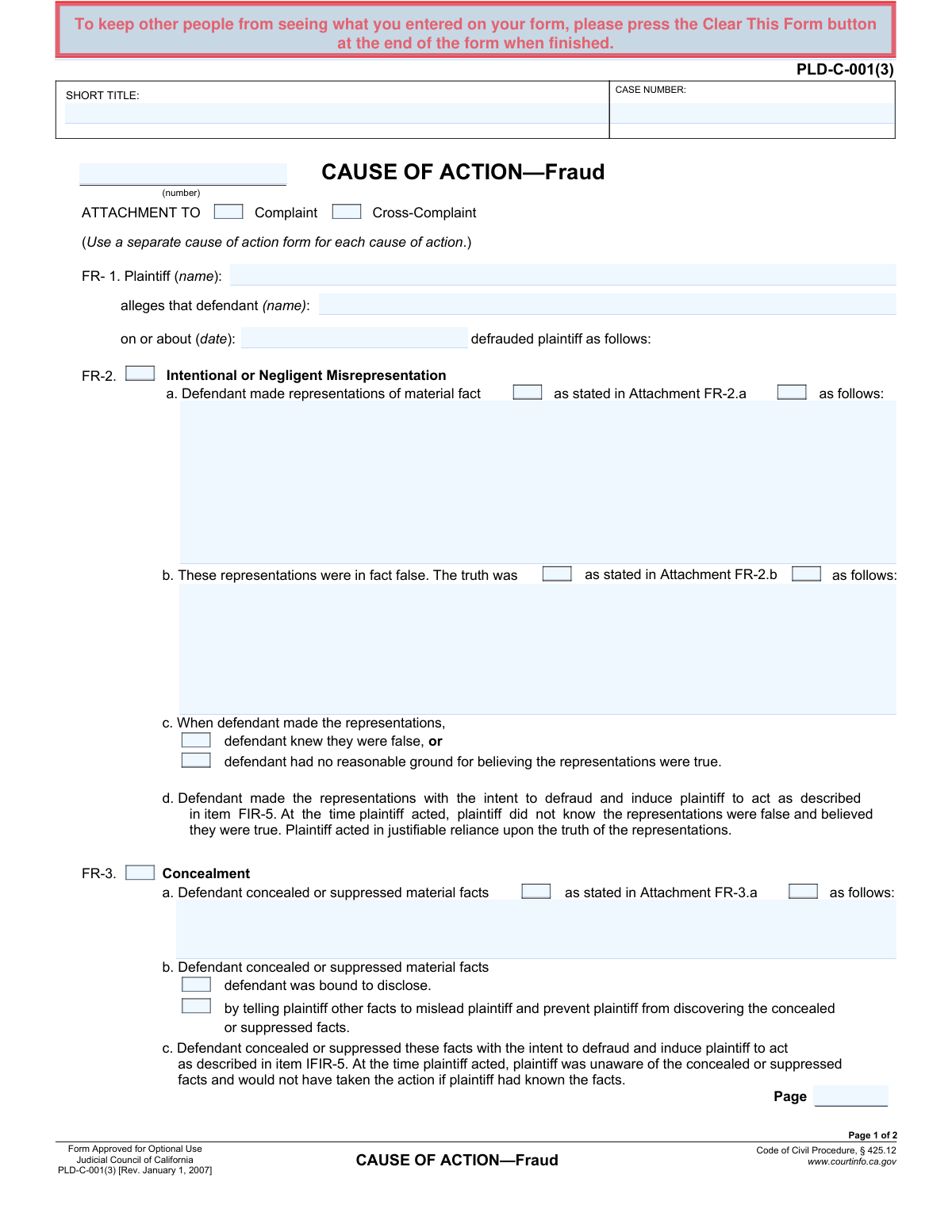
Yes! You can use AI to fill out Judicial Council of California Form PLD-C-001(3), Cause of Action—Fraud
Form PLD-C-001(3), Cause of Action—Fraud, is a mandatory attachment for civil lawsuits in California where a party is alleging fraud. It provides a structured format to detail the specific elements of the claim, such as intentional misrepresentation, concealment, or a promise made without the intent to perform. Properly completing this form is crucial for establishing a valid legal claim for fraud in court. Today, this form can be filled out quickly and accurately using AI-powered services like Instafill.ai, which can also convert non-fillable PDF versions into interactive fillable forms.
PLD-C-001(3) is part of the
California court forms, California judicial forms and Judicial Council forms categories on Instafill.
Our AI automatically handles information lookup, data retrieval, formatting, and form filling.
It takes less than a minute to fill out PLD-C-001(3) using our AI form filling.
Securely upload your data. Information is encrypted in transit and deleted immediately after the form is filled out.
Form specifications
| Form name: | Judicial Council of California Form PLD-C-001(3), Cause of Action—Fraud |
| Number of fields: | 45 |
| Number of pages: | 1 |
| Language: | English |
Instafill Demo: How to fill out PDF forms in seconds with AI
How to Fill Out PLD-C-001(3) Online for Free in 2026
Are you looking to fill out a PLD-C-001(3) form online quickly and accurately? Instafill.ai offers the #1 AI-powered PDF filling software of 2026, allowing you to complete your PLD-C-001(3) form in just 37 seconds or less.
Follow these steps to fill out your PLD-C-001(3) form online using Instafill.ai:
- 1 Navigate to Instafill.ai and upload the PLD-C-001(3) form or select it from the template library.
- 2 Enter the case number, short title, and identify whether the form is an attachment to a Complaint or Cross-Complaint at the top.
- 3 In section FR-1, identify the plaintiff and the defendant involved in the fraud claim.
- 4 Choose the basis for the fraud claim in sections FR-2, FR-3, or FR-4, providing detailed facts about the misrepresentation, concealment, or false promise.
- 5 In section FR-5, describe how you were induced to act in justifiable reliance on the defendant's conduct.
- 6 Detail the financial or other damages you suffered as a result of your reliance in section FR-6.
- 7 Review the entire form with the AI assistant to ensure all required information is complete and accurate, then download the finished document for filing with the court.
Our AI-powered system ensures each field is filled out correctly, reducing errors and saving you time.
Why Choose Instafill.ai for Your Fillable PLD-C-001(3) Form?
Speed
Complete your PLD-C-001(3) in as little as 37 seconds.
Up-to-Date
Always use the latest 2026 PLD-C-001(3) form version.
Cost-effective
No need to hire expensive lawyers.
Accuracy
Our AI performs 10 compliance checks to ensure your form is error-free.
Security
Your personal information is protected with bank-level encryption.
Frequently Asked Questions About Form PLD-C-001(3)
This is a legal form used in California courts to formally allege that a defendant committed fraud. It is not a standalone lawsuit but an attachment to a Complaint or Cross-Complaint that details the specific fraudulent acts.
The plaintiff (the person or entity filing the lawsuit) or their attorney must complete this form. It is used to provide the court with the specific facts that form the basis of the fraud claim.
Misrepresentation involves making a false statement of fact, while Concealment is about hiding or suppressing material facts. A False Promise (Promise Without Intent to Perform) occurs when the defendant makes a promise they never intended to keep.
Yes, you can and should select all boxes that apply to your case. For each type of fraud you allege, you must provide the specific facts and details in the corresponding section.
In these sections, you must provide a clear and concise statement of the facts. This includes what the defendant said or did, when it happened, and how it was fraudulent.
Justifiable reliance means you had a reasonable basis for believing the defendant's statements or promises and that you took a specific action because of that belief. You must describe the action you were induced to take.
In this section, you must specify the harm you suffered because of the fraud. This is typically the financial loss you incurred, but can also include other damages directly caused by your reliance on the defendant's conduct.
The form allows you to use attachments for longer explanations. Simply check the box that says 'as stated in Attachment FR-[number]' and provide the full details on a separate, clearly labeled page.
This form must be filed with the court as part of a complete Complaint or Cross-Complaint package. You must follow your local court's specific rules for filing, which may include electronic filing or in-person submission.
You can name multiple defendants on one form if they were all involved in the same fraudulent act. However, if you have different causes of action (e.g., fraud and breach of contract), you must use a separate 'Cause of Action' form for each one.
Yes, services like Instafill.ai use AI to auto-fill form fields accurately and save time. While AI can assist with data entry, it cannot provide legal advice, so consulting an attorney for the substance of your claims is recommended.
Upload the PLD-C-001(3) PDF to the Instafill.ai platform. The AI will make the form fillable online, allowing you to easily enter your case information, check the appropriate boxes, and type your detailed explanations.
If you have a non-fillable or 'flat' PDF, you can upload it to Instafill.ai. The service's AI technology can convert the document into an interactive, fillable form that you can complete and sign digitally.
Compliance PLD-C-001(3)
Validation Checks by Instafill.ai
1
Case Number Format and Presence
This check ensures that the 'CASE NUMBER' field is not empty and conforms to the standard format required by the court. The case number is a unique identifier for the legal proceeding, and its accuracy is critical for filing and tracking the document. A missing or incorrectly formatted number will lead to rejection by the court clerk.
2
Short Title Completeness
Validates that the 'SHORT TITLE' field contains text. This field provides a brief, human-readable identifier for the case, used in various court documents and calendars. An empty short title can cause confusion and processing delays.
3
Attachment Type Selection
Ensures that exactly one of the 'Complaint' or 'Cross-Complaint' checkboxes is selected. This form must be an attachment to one of these primary legal documents. Failing to select one, or selecting both, creates ambiguity about the document's legal context and will require correction.
4
Plaintiff Name Required
Verifies that the 'Plaintiff (name)' field (FR-1) is filled out. The plaintiff is the party initiating the claim, and their identity is a fundamental requirement for any legal action. The form is invalid without identifying who is making the allegation.
5
Defendant Name Required
Verifies that the 'defendant (name)' field (FR-1) is filled out. The defendant is the party being accused of fraud, and they must be clearly identified for the case to proceed. A missing defendant name makes the cause of action legally insufficient.
6
Date of Fraud Format
Checks that the 'on or about (date)' field contains a valid date, preferably in a standard format like MM/DD/YYYY. This date establishes the timeline for the alleged fraud, which is crucial for statutes of limitations and presenting a clear factual basis. An invalid or ambiguous date weakens the claim.
7
At Least One Cause of Action Selected
Validates that at least one of the main checkboxes for FR-2 (Misrepresentation), FR-3 (Concealment), or FR-4 (Promise Without Intent) is selected. The purpose of the form is to allege a specific type of fraud. If no cause of action is chosen, the form has no legal substance and fails its primary purpose.
8
Misrepresentation Details Provided (FR-2)
If 'Intentional or Negligent Misrepresentation' (FR-2) is checked, this validates that details are provided for both the representation (FR-2.a) and the truth (FR-2.b). For each, the user must select either 'as follows' and fill in the text, or check 'as stated in Attachment'. This ensures the claim is substantiated with specific facts as required by law.
9
Defendant's State of Mind Selection (FR-2.c)
If FR-2 is checked, this ensures at least one of the checkboxes in section FR-2.c ('defendant knew they were false' or 'defendant had no reasonable ground for believing...') is selected. This element, known as 'scienter', is a critical legal requirement for a misrepresentation claim. Failure to allege the defendant's state of mind makes the claim legally deficient.
10
Concealment Details Provided (FR-3)
If 'Concealment' (FR-3) is checked, this validates that the material facts allegedly concealed are described, either in the 'as follows' text box or in an attachment (FR-3.a). A general allegation of concealment is insufficient; the plaintiff must specify what was hidden. This check enforces that requirement.
11
Promise Details Provided (FR-4)
If 'Promise Without Intent to Perform' (FR-4) is checked, this validates that the specific promise is described in the 'as follows' text box or in an attachment (FR-4.a). The claim is based on a specific promise, which must be clearly identified for the defendant to respond and for the court to evaluate.
12
Justifiable Reliance Details (FR-5)
Ensures that section FR-5, which describes how the plaintiff acted in reliance on the defendant's conduct, is completed. Justifiable reliance is a core element of any fraud claim, linking the defendant's wrongdoing to the plaintiff's actions. An omission here is a fatal flaw in the legal argument.
13
Damages Specification (FR-6)
Validates that section FR-6, describing the damages suffered by the plaintiff, is completed. A plaintiff must state how they were harmed and what they lost as a result of the fraud. Without a statement of damages, the court has no basis to award a remedy.
14
Conditional Text Field Completeness
For any section where an 'as follows' checkbox is selected (e.g., FR-2.a, FR-3.a, FR-5), this check ensures the corresponding text field is not empty. This prevents a submission where the user indicates they will provide details on the form but then fails to do so, leaving the allegation unsupported.
Common Mistakes in Completing PLD-C-001(3)
People often forget to fill in the 'CASE NUMBER' and 'SHORT TITLE' at the top of the form, or they enter them incorrectly. This happens when filers are in a hurry or don't have the official case information readily available. An incorrect filing can be rejected by the court clerk, causing significant delays and requiring the document to be resubmitted.
In sections like FR-2.a, filers often write a long, narrative-style story instead of a concise statement of the material fact that was misrepresented. This fails to clearly articulate the specific legal elements of fraud, which can weaken the claim and lead to it being challenged or dismissed. To avoid this, break down the events into distinct, provable statements of fact for each required element.
A frequent error is trying to cram complex facts into the small text boxes provided, making the form unreadable and the allegations incomplete. The form includes checkboxes like 'as stated in Attachment FR-2.a' for a reason. For any detailed explanation, it is crucial to check the box, create a separate document clearly labeled with the corresponding attachment number, and describe the facts in full detail there.
Section FR-5 requires the plaintiff to describe the specific action they were induced to take, but many filers just state they 'relied on the promise.' This is insufficient, as it fails to plead a critical element of fraud. You must specify the resulting action, such as 'signed the contract dated [Date],' 'paid the sum of $10,000,' or 'transferred ownership of the property,' to create a valid legal claim.
In section FR-6, filers often vaguely state they 'suffered financial loss' without providing specific amounts or a clear calculation of the harm. Courts require damages to be pleaded with specificity. Failing to list the exact amount of money lost or the value of property not received can weaken the claim and complicate recovery efforts.
A key element of fraud is the defendant's intent, as required in sections like FR-2.c ('defendant knew they were false'). People often focus on the false statement but forget to explicitly allege the defendant's knowledge or intent. This is a fatal flaw in a fraud claim, as it fails to establish the required 'scienter' and can be grounds for immediate dismissal of the cause of action.
In section FR-1, filers may misspell the names of the plaintiff or defendant, or fail to use their full legal names (e.g., using a nickname or omitting 'Inc.' for a corporation). This can create significant legal problems, including issues with serving the complaint and enforcing a potential judgment. Always use the full, correct legal names for all individuals and entities, which can be validated using public records.
The form requires the filer to check a box indicating if it is an attachment to a 'Complaint' or 'Cross-Complaint.' A Complaint initiates a lawsuit, while a Cross-Complaint is filed by a defendant. Selecting the wrong option mischaracterizes the legal action, causing procedural confusion and delays that may require filing an amended pleading to correct.
Section FR-2.b requires the filer to state 'The truth was...' after listing the defendant's false representations, but this step is often missed. Simply stating that a representation was false is not enough; you must provide the corresponding true facts. Clearly contrasting the lie with the truth is essential for demonstrating the misrepresentation element to the court.
This form is often distributed as a flat, non-fillable PDF, leading to messy, handwritten submissions that are difficult to read and may be rejected. This also increases the likelihood of data entry errors and omissions. To avoid this, AI-powered tools like Instafill.ai can convert the non-fillable PDF into an interactive, fillable form, ensuring a clean, professional, and accurately completed document.
Saved over 80 hours a year
“I was never sure if my IRS forms like W-9 were filled correctly. Now, I can complete the forms accurately without any external help.”
Kevin Martin Green
Your data stays secure with advanced protection from Instafill and our subprocessors

Robust compliance program
Transparent business model
You’re not the product. You always know where your data is and what it is processed for.
ISO 27001, HIPAA, and GDPR
Our subprocesses adhere to multiple compliance standards, including but not limited to ISO 27001, HIPAA, and GDPR.
Security & privacy by design
We consider security and privacy from the initial design phase of any new service or functionality. It’s not an afterthought, it’s built-in, including support for two-factor authentication (2FA) to further protect your account.
Fill out PLD-C-001(3) with Instafill.ai
Worried about filling PDFs wrong? Instafill securely fills judicial-council-of-california-form-pld-c-0013-cause-of-actionfraud forms, ensuring each field is accurate.