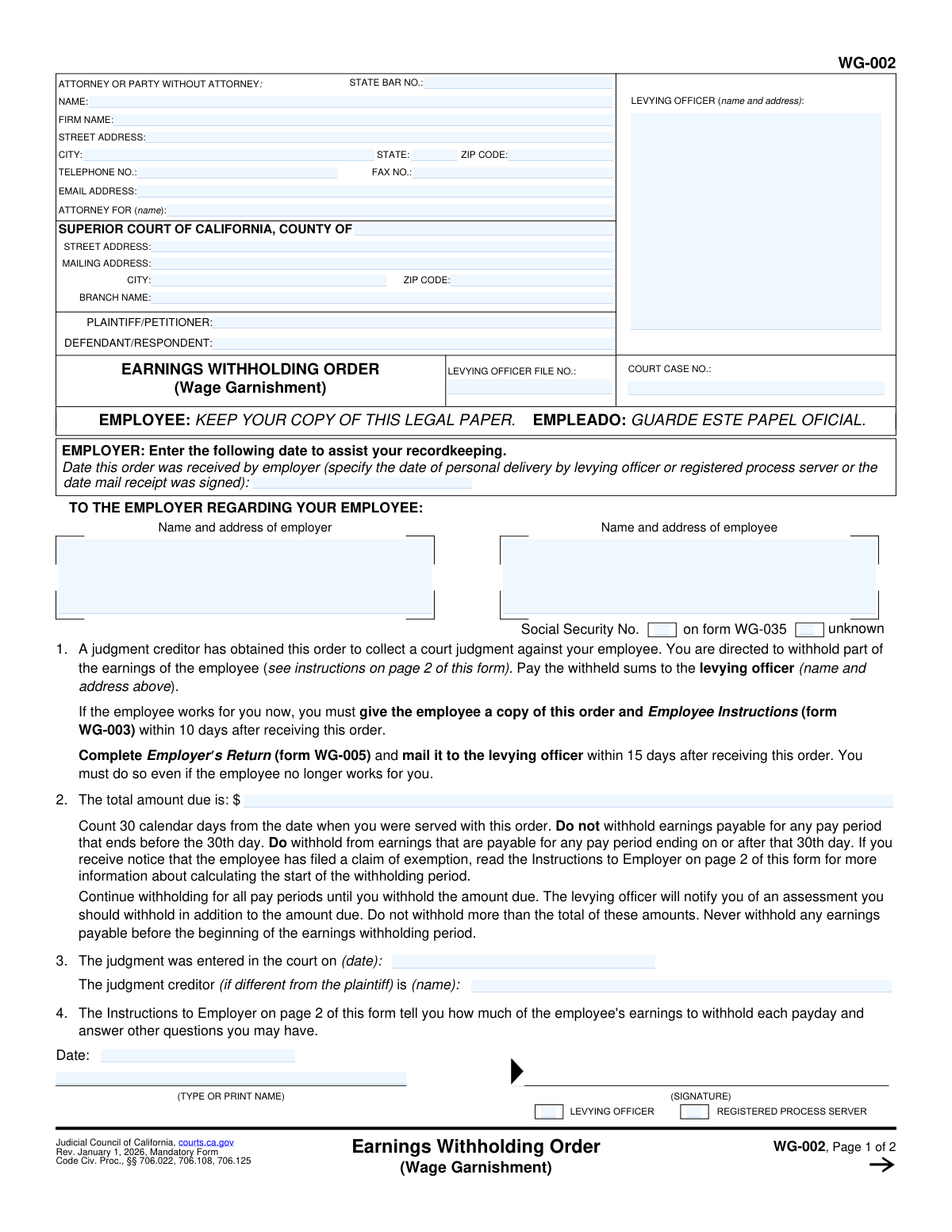
Yes! You can use AI to fill out Judicial Council of California Form WG-002, Earnings Withholding Order (Wage Garnishment)

The Earnings Withholding Order (WG-002) is a legal form issued by the Judicial Council of California that directs an employer to withhold a portion of an employee's earnings to pay a court-ordered debt. This wage garnishment order is served by a levying officer and provides detailed instructions to the employer on how to calculate and remit the withheld funds. Today, this form can be filled out quickly and accurately using AI-powered services like Instafill.ai, which can also convert non-fillable PDF versions into interactive fillable forms.
WG-002 is part of the California court forms, California judicial forms and Judicial Council forms categories on Instafill.
Our AI automatically handles information lookup, data retrieval, formatting, and form filling.
It takes less than a minute to fill out WG-002 using our AI form filling.
Securely upload your data. Information is encrypted in transit and deleted immediately after the form is filled out.

Form specifications

Form name: Judicial Council of California Form WG-002, Earnings Withholding Order (Wage Garnishment)
Number of fields: 37
Number of pages: 1
Language: English
main-image

Instafill Demo: How to fill out PDF forms in seconds with AI

How to Fill Out WG-002 Online for Free in 2026

Are you looking to fill out a WG-002 form online quickly and accurately? Instafill.ai offers the #1 AI-powered PDF filling software of 2026, allowing you to complete your WG-002 form in just 37 seconds or less.
Follow these steps to fill out your WG-002 form online using Instafill.ai:
  1. 1 Navigate to Instafill.ai and upload or select the Form WG-002, Earnings Withholding Order.
  2. 2 Use the AI assistant to input the levying officer's information, court case number, and attorney details.
  3. 3 Enter the full details of the court, including county and branch name, as well as the plaintiff/petitioner and defendant/respondent information.
  4. 4 Provide the name and address of the employer and the employee whose wages are to be garnished.
  5. 5 Specify the total amount due on the judgment, the date the judgment was entered, and the name of the judgment creditor if different from the plaintiff.
  6. 6 Review all the information auto-filled and entered by the AI for complete accuracy, ensuring all names, addresses, and monetary amounts are correct.
  7. 7 Finalize the form, which can then be dated and signed by the levying officer or registered process server before being served to the employer.

Our AI-powered system ensures each field is filled out correctly, reducing errors and saving you time.

Why Choose Instafill.ai for Your Fillable WG-002 Form?

Speed

Complete your WG-002 in as little as 37 seconds.

Up-to-Date

Always use the latest 2026 WG-002 form version.

Cost-effective

No need to hire expensive lawyers.

Accuracy

Our AI performs 10 compliance checks to ensure your form is error-free.

Security

Your personal information is protected with bank-level encryption.

Frequently Asked Questions About Form WG-002

This is a legal court order, also known as a wage garnishment, sent to an employer. It directs you to withhold a portion of an employee's earnings to pay off a court judgment against them.

Within 10 days, you must give your employee a copy of this order and the Employee Instructions (form WG-003). You must also complete and mail the Employer's Return (form WG-005) to the levying officer within 15 days.

You should not withhold earnings for any pay period that ends before the 30th day after you receive this order. Begin withholding from earnings payable for any pay period ending on or after that 30th day.

You are still required to complete the Employer's Return (form WG-005) and mail it to the levying officer within 15 days. On the return, you will indicate that the person is no longer your employee.

First, determine the employee's 'disposable earnings' by subtracting legally required deductions from their gross pay. The form provides a multi-step calculation based on disposable earnings and the applicable minimum wage to find the correct withholding amount.

You must continue withholding earnings for all pay periods until the total amount due on the order is fully paid. The levying officer will notify you of any additional assessments and will send a written notice when the withholding should stop.

The withheld amounts must be paid to the levying officer, whose name and address are on the front of the form. Payments for a given month must be sent by the 15th day of the next month.

No, it is illegal to fire an employee because of an Earnings Withholding Order for the payment of a single debt. Violating this law can lead to civil damages and criminal prosecution.

The form instructs you to review the Employer's Return (form WG-005) for instructions on how to handle multiple orders. Certain orders, like those for child support, may have a higher priority.

Yes, it is illegal to postpone or advance the payment of earnings to prevent the order from taking effect. The employee's pay period must not be changed for this purpose.

Yes, services like Instafill.ai use AI to help you accurately fill out related forms, such as the Employer's Return (WG-005). This can save time and help prevent errors by auto-filling case numbers, names, and addresses.

Simply upload the necessary form, like the Employer's Return, to the Instafill.ai platform. The service will make the document fillable online, allowing you to type in the required information, save it, and print it for mailing.

You can use a tool like Instafill.ai, which is designed to convert non-fillable PDFs into interactive, fillable forms. This allows you to easily complete the document on your computer before printing.

Compliance WG-002
Validation Checks by Instafill.ai

1
Court Case Number Format and Presence
Ensures the 'COURT CASE NO.' field is not empty and follows a plausible format for a case number. This number is the primary identifier for the legal action, and its absence or incorrect format would make it impossible to file, track, or reference the order correctly. If this validation fails, the form cannot be processed as it cannot be linked to a specific court proceeding.
2
State Bar Number Format
Validates that the 'STATE BAR NO.' is a numeric value, typically 6 digits for California. This ensures the attorney can be uniquely identified and verified with the state bar association. An invalid number could indicate a data entry error or an unauthorized person filing the form, leading to rejection.
3
Total Amount Due is a Valid Positive Currency
Checks that the 'total amount due' is a positive numerical value greater than zero, formatted as currency. This amount is the basis for the entire wage garnishment, so it must be a clear and valid monetary figure. A zero, negative, or non-numeric value would render the order nonsensical and legally unenforceable.
4
Judgment Date is a Valid Past Date
Verifies that the 'judgment was entered in the court on (date)' is a valid calendar date that occurs on or before the current date. A judgment cannot be entered in the future. This validation prevents logical impossibilities and ensures the order is based on a pre-existing, valid judgment.
5
Signature Date Consistency
Ensures the signature date is a valid date that is on or after the 'Judgment Date'. An earnings withholding order cannot be signed and issued before the underlying court judgment exists. This check maintains the logical and legal sequence of events required for a valid order.
6
Exclusive Selection for Signatory Type
Validates that only one of the checkboxes for 'LEVYING OFFICER' or 'REGISTERED PROCESS SERVER' is selected. The form must be signed by one or the other, but not both. This check prevents ambiguity about who is officially issuing the order, which is critical for establishing its authority.
7
Exclusive Selection for Social Security Number Status
Checks that only one of the two options regarding the employee's Social Security Number ('on form WG-035' or 'unknown') is selected. It is logically impossible for the SSN to be both known (on another form) and unknown simultaneously. This ensures clarity for the employer who needs to identify the correct employee.
8
Required Party Names
Ensures that both the 'PLAINTIFF/PETITIONER' and 'DEFENDANT/RESPONDENT' fields are filled out. A legal action requires at least two opposing parties. Missing one of these names makes the order incomplete and legally deficient, as it's unclear who is suing whom.
9
Required Employee and Employer Information
Validates that the 'Name and address of employer' and 'Name and address of employee' fields are both completed. The order is directed at a specific employer to garnish a specific employee's wages. Without this information, the order is completely non-actionable and cannot be served or executed.
10
Attorney Email Address Format
Validates that the value entered in the 'EMAIL ADDRESS' field for the attorney follows the standard '[email protected]' format. This is important for ensuring reliable electronic communication regarding the case. An invalid email format would lead to bounced notifications and communication failures.
11
ZIP Code Format Validation
Checks that all ZIP code fields (for the attorney and the court) contain a valid 5-digit or 9-digit (ZIP+4) numeric format. Correct ZIP codes are essential for ensuring legal notices and other mail are delivered to the correct physical location. An invalid format could result in misdirected mail and significant delays.
12
Telephone Number Format
Verifies that the 'TELEPHONE NO.' field is in a recognizable U.S. phone number format (e.g., XXX-XXX-XXXX or (XXX) XXX-XXXX). A valid phone number is crucial for allowing parties to contact the attorney or party filing the form. Failure to provide a valid number can impede communication and slow down the legal process.
13
Completeness of Levying Officer Information
Ensures that the 'LEVYING OFFICER (name and address)' field is fully completed. The employer is instructed to pay withheld sums to the levying officer, so their name and address are critical for payment processing. An incomplete field would prevent the employer from complying with the order.
14
Employer Received Date Logic
Validates that the 'Date this order was received by employer' is a valid date and is on or after the levying officer's signature date. The employer cannot receive the order before it has been signed and issued. This check ensures the timeline for withholding is calculated from a logical starting point.

Common Mistakes in Completing WG-002

Confusing Court Case and Levying Officer File Numbers

Filers often transpose or incorrectly enter the 'COURT CASE NO.' and the 'LEVYING OFFICER FILE NO.'. This happens because both are prominent identifiers at the top of the form. This error can cause payments to be misapplied or the order to be rejected by the levying officer, significantly delaying the collection process. To avoid this, carefully verify that the court case number matches the judgment and the levying officer file number is the one assigned by the sheriff or marshal's office.

Failing to Record the Date the Order Was Received

Employers are required to enter the specific date they received the order, as this date starts the 30-day clock for the withholding period. This is a common oversight that leads to starting the garnishment too early or too late, resulting in non-compliance and incorrect payroll calculations. To prevent this, the employer must immediately record the date of personal delivery or the date the mail receipt was signed upon receipt.

Miscalculating the Employee's 'Disposable Earnings'

Employers frequently miscalculate 'disposable earnings' by confusing it with gross pay or take-home pay. They may incorrectly subtract voluntary deductions like 401(k) contributions or health insurance, which are not legally required deductions. This error leads to incorrect withholding amounts and potential liability for the employer. Always calculate disposable earnings by subtracting only legally mandated deductions like taxes, social security, and state disability insurance.

Using an Incorrect Minimum Wage for Withholding Calculation

The withholding calculation depends on the applicable minimum wage, which may be a local (city or county) rate that is higher than the state's. Employers often default to the state minimum wage without checking local ordinances, leading to incorrect and insufficient garnishment amounts. This constitutes non-compliance and can create liability. Always verify and use the current minimum wage for the specific location where the employee physically works.

Providing Incomplete Plaintiff or Defendant Information

Filers may use abbreviations, nicknames, or misspell the legal names of the 'PLAINTIFF/PETITIONER' or 'DEFENDANT/RESPONDENT'. This occurs when not referring directly to the official court judgment. An exact name match is crucial for legal validity, and any discrepancy can give the employer a valid reason to reject the order, causing significant delays. Always copy the names precisely as they appear on the final judgment.

Entering an Incorrect 'Total Amount Due'

The 'Total amount due' is often miscalculated or transcribed incorrectly from the judgment. A common mistake is to improperly add post-judgment interest or costs, which are calculated and added later by the levying officer. This error can lead to over- or under-withholding and potential legal challenges. Ensure this field reflects only the principal judgment amount as stated in the court order.

Mishandling the Employee's Social Security Number

The form directs that the employee's Social Security Number be provided on a separate, confidential form (WG-035). However, filers or employers sometimes mistakenly write the SSN directly on the WG-002 form. This action can lead to a privacy breach and may cause the form to be rejected for not following procedure. To avoid this, always use the designated WG-035 form for this sensitive information.

Neglecting to Submit the Employer's Return (WG-005)

The form instructs the employer to complete and mail the 'Employer's Return (form WG-005)' to the levying officer within 15 days. Many employers overlook this step, especially if the individual no longer works for them. Failure to submit this form can result in penalties and leaves the creditor and levying officer unaware of the employee's status, halting the process.

Omitting or Providing Incomplete Levying Officer/Court Details

The party filling out the form may fail to provide the full name and address for both the 'LEVYING OFFICER' and the specific 'SUPERIOR COURT' branch. This happens when the filer is unfamiliar with the county's procedures or rushes through the form. Missing information prevents the employer from knowing where to send payments and communications, rendering the order unenforceable until corrected. AI-powered form filling tools like Instafill.ai can help prevent this by auto-populating correct court and officer details.

Illegible or Incomplete Attorney/Party Information

When filled by hand, the attorney or self-represented party's contact information is often illegible, or key fields like the State Bar Number are left blank. This makes it difficult for the court or employer to make contact if questions arise, delaying the entire process. Using a fillable PDF ensures all information is clear and complete. If the form is a non-fillable PDF, tools like Instafill.ai can convert it into an interactive, fillable version to ensure legibility.
Saved over 80 hours a year

“I was never sure if my IRS forms like W-9 were filled correctly. Now, I can complete the forms accurately without any external help.”

Kevin Martin Green

Your data stays secure with advanced protection from Instafill and our subprocessors

Robust compliance program

Transparent business model

You’re not the product. You always know where your data is and what it is processed for.

ISO 27001, HIPAA, and GDPR

Our subprocesses adhere to multiple compliance standards, including but not limited to ISO 27001, HIPAA, and GDPR.

Security & privacy by design

We consider security and privacy from the initial design phase of any new service or functionality. It’s not an afterthought, it’s built-in, including support for two-factor authentication (2FA) to further protect your account.

Fill out WG-002 with Instafill.ai

Worried about filling PDFs wrong? Instafill securely fills judicial-council-of-california-form-wg-002-earnings-withholding-order-wage-garnishment forms, ensuring each field is accurate.

Related forms by category

California court forms Judicial Council of California Form SC-105, Request for Court Order and Answer (Small Claims), Judicial Council of California Form SC-120, Defendant’s Claim and ORDER to Go to Small Claims Court (Small Claims), Judicial Council of California Form SER-001, Request for Sheriff to Serve Court Papers, Judicial Council of California Form SER-001, Request for Sheriff to Serve Court Papers, Affidavit for Collection of Personal Property California Probate Code Section 13100, Form POS-040, Proof of Service—Civil, Declaration of Facts of Death (California Superior Court), declaration-of-marriage-for-court-proceeding-california-family-law, ADOPT-200, Adoption Request, ADOPT-200, Stepparent Adoption Request, ADOPT-210, Adoption Agreement, ADOPT-310, Contact After Adoption Agreement, Judicial Council of California Form ADOPT-200, Adoption Request, Form ADR-107, Mediation Attendance Sheet, Form ADR-110, Order Appointing Referee, Form ADR-109, Stipulation or Motion for Order Appointing Referee, Form ADR-102, Request for Trial De Novo After Judicial Arbitration, Form ADR-108, Referee's Report (Code Civ. Proc., §§ 638, 639), Form ADR-106, Petition to Confirm, Correct, or Vacate Contractual Arbitration Award, Form ADR-104, Rejection of Award and Request for Trial After Attorney-Client Fee Arbitration · + 557 more →
California judicial forms Judicial Council of California Form FL-300, Request for Order, Judicial Council of California Form FL-150, Income and Expense Declaration, Judicial Council of California Form DE-111, Petition for Probate (Probate—Decedents Estates), Judicial Council of California Form SC-104, Proof of Service (Small Claims), Judicial Council of California Form SC-105, Request for Court Order and Answer (Small Claims), Judicial Council of California Form DE-111, Petition for Probate (Probate—Decedents Estates), Judicial Council of California Form SC-104, Proof of Service (Small Claims), Judicial Council of California Form SC-108, Request to Correct or Cancel Judgment and Answer (Small Claims), Judicial Council of California Form SC-120, Defendant’s Claim and ORDER to Go to Small Claims Court (Small Claims), Civil Case Cover Sheet (Judicial Council of California Form CM-010), Civil Case Cover Sheet (Judicial Council of California Form CM-010), Judicial Council of California Form TR-205, Request for Trial by Written Declaration (Trial by Written Declaration—Traffic), Judicial Council of California Form DE-120, Notice of Hearing—Decedent's Estate or Trust, Inventory and Appraisal Attachment (Judicial Council of California Form DE-161, GC-041), CLETS-001, Confidential Information for Law Enforcement (Judicial Council of California), Judicial Council of California Form SER-001, Request for Sheriff to Serve Court Papers, Judicial Council of California Form UD-105, Answer—Unlawful Detainer, CLETS-001, Confidential Information for Law Enforcement (Judicial Council of California), Judicial Council of California Form ADOPT-210, Adoption Agreement, Judicial Council of California Form DE-120, Notice of Hearing—Decedent's Estate or Trust · + 63 more →
Judicial Council forms Judicial Council of California Form FL-300, Request for Order, Judicial Council of California Form FL-150, Income and Expense Declaration, Judicial Council of California Form DE-111, Petition for Probate (Probate—Decedents Estates), Judicial Council of California Form SC-104, Proof of Service (Small Claims), Judicial Council of California Form SC-105, Request for Court Order and Answer (Small Claims), Judicial Council of California Form DE-111, Petition for Probate (Probate—Decedents Estates), Judicial Council of California Form SC-104, Proof of Service (Small Claims), Judicial Council of California Form SC-108, Request to Correct or Cancel Judgment and Answer (Small Claims), Judicial Council of California Form SC-120, Defendant’s Claim and ORDER to Go to Small Claims Court (Small Claims), Civil Case Cover Sheet (Judicial Council of California Form CM-010), Civil Case Cover Sheet (Judicial Council of California Form CM-010), Judicial Council of California Form TR-205, Request for Trial by Written Declaration (Trial by Written Declaration—Traffic), Judicial Council of California Form DE-120, Notice of Hearing—Decedent's Estate or Trust, Inventory and Appraisal Attachment (Judicial Council of California Form DE-161, GC-041), CLETS-001, Confidential Information for Law Enforcement (Judicial Council of California), Judicial Council of California Form SER-001, Request for Sheriff to Serve Court Papers, Judicial Council of California Form UD-105, Answer—Unlawful Detainer, CLETS-001, Confidential Information for Law Enforcement (Judicial Council of California), Judicial Council of California Form ADOPT-210, Adoption Agreement, Judicial Council of California Form DE-120, Notice of Hearing—Decedent's Estate or Trust · + 64 more →