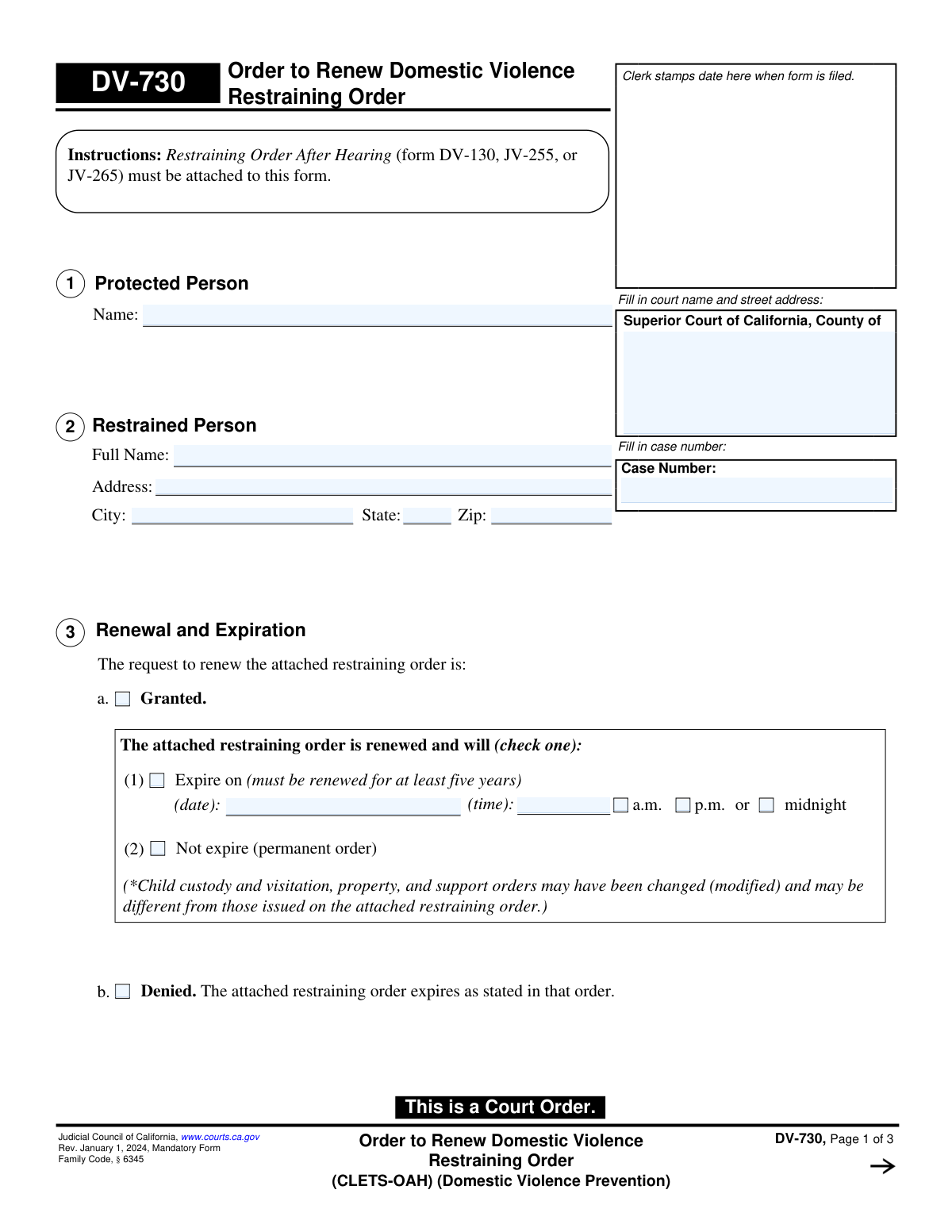
Yes! You can use AI to fill out Form DV-730, Order to Renew Domestic Violence Restraining Order (Domestic Violence Prevention)
Form DV-730, the Order to Renew Domestic Violence Restraining Order, is a mandatory California Judicial Council form. It is completed by a judge to officially grant or deny a request to extend an existing restraining order (such as Form DV-130), making the protection either permanent or valid for at least five more years. This order is critical for ensuring continued legal protection for victims of domestic violence. Today, this form can be filled out quickly and accurately using AI-powered services like Instafill.ai, which can also convert non-fillable PDF versions into interactive fillable forms.
DV-730 is part of the
California court forms, domestic violence forms and restraining order forms categories on Instafill.
Our AI automatically handles information lookup, data retrieval, formatting, and form filling.
It takes less than a minute to fill out DV-730 using our AI form filling.
Securely upload your data. Information is encrypted in transit and deleted immediately after the form is filled out.
Form specifications
| Form name: | Form DV-730, Order to Renew Domestic Violence Restraining Order (Domestic Violence Prevention) |
| Number of fields: | 62 |
| Number of pages: | 1 |
| Language: | English |
Instafill Demo: How to fill out PDF forms in seconds with AI
How to Fill Out DV-730 Online for Free in 2026
Are you looking to fill out a DV-730 form online quickly and accurately? Instafill.ai offers the #1 AI-powered PDF filling software of 2026, allowing you to complete your DV-730 form in just 37 seconds or less.
Follow these steps to fill out your DV-730 form online using Instafill.ai:
- 1 Navigate to Instafill.ai and upload or select Form DV-730.
- 2 Enter the Superior Court information and the specific case number at the top of the form.
- 3 Clearly identify the names of the protected person (Item 1) and the restrained person (Item 2), including the restrained person's address.
- 4 The judge will complete Item 3 to indicate if the renewal is granted or denied, and specify the new expiration date or if the order is permanent.
- 5 The judge will document the hearing details, including who was present, in Item 4.
- 6 If applicable, the judge will specify any lawyer's fees and costs to be paid in Item 5.
- 7 The judge will complete the service requirements in Item 6 before signing the order, which is then filed by the court clerk.
Our AI-powered system ensures each field is filled out correctly, reducing errors and saving you time.
Why Choose Instafill.ai for Your Fillable DV-730 Form?
Speed
Complete your DV-730 in as little as 37 seconds.
Up-to-Date
Always use the latest 2026 DV-730 form version.
Cost-effective
No need to hire expensive lawyers.
Accuracy
Our AI performs 10 compliance checks to ensure your form is error-free.
Security
Your personal information is protected with bank-level encryption.
Frequently Asked Questions About Form DV-730
Form DV-730 is the official court order issued by a judge that either grants or denies a request to renew an existing Domestic Violence Restraining Order. It is not a request form, but the final decision from the court.
A judge or judicial officer completes and signs this form after a hearing to make their decision official. The protected and restrained persons provide their information for the case, but the order itself is issued by the court.
If the 'Granted' box is checked, the judge has approved the extension of your restraining order. The form will then specify the new expiration date or state that the order is permanent.
According to the form, a renewed restraining order must be granted for at least five years. The judge also has the option to make the order permanent, meaning it will never expire.
If the 'Denied' box is checked, the judge did not approve the extension. The original restraining order will expire on the date stated in that initial order (Form DV-130).
A copy of the original Restraining Order After Hearing (form DV-130, JV-255, or JV-265) must be attached to this renewal order. This is a mandatory requirement for the order to be complete.
The restrained person is notified through a process called 'service.' If they attended the hearing, no further proof of service may be needed; otherwise, they must be formally served a copy as directed by the judge in Section 6.
No, the sheriff or marshal will serve this order for free. You must complete a 'Request for Sheriff to Serve Court Papers' (Form SER-001) and give it to the sheriff's office with a copy of this order.
After the judge signs the order, the court clerk files it and provides certified copies. You must then ensure a copy is served on the restrained person if required, and you should keep a certified copy with you at all times.
This is a legal statement confirming the order meets the requirements of the federal Violence Against Women Act (VAWA). This ensures the restraining order is enforceable in all 50 states, U.S. territories, and tribal lands.
Yes, services like Instafill.ai use AI to help you accurately auto-fill your information onto the form, saving time and reducing errors. You would then print the prepared form for filing and the judge's signature.
You can use a service like Instafill.ai to upload the form and fill it out in an interactive online format. This allows you to easily type your information into the correct fields before printing the completed document for the court.
If you have a flat, non-fillable PDF, you can use a tool like Instafill.ai to convert it into an interactive form. This makes it easy to type your information directly onto the document, ensuring it is neat and legible for the court.
Compliance DV-730
Validation Checks by Instafill.ai
1
Ensures Case Number Consistency Across Pages
This check verifies that the Case Number entered on page 1, page 2, and page 3 are identical. A consistent case number is critical for ensuring all pages of the order are correctly associated and filed under the same legal case. A mismatch could lead to the order being rejected or improperly filed, rendering it unenforceable.
2
Mutually Exclusive Renewal Decision
Validates that in Section 3, either 'Granted' (3a) or 'Denied' (3b) is selected, but not both. This ensures there is a clear and unambiguous decision on the renewal request. If neither or both are selected, the order is legally ambiguous and cannot be processed.
3
Conditional Expiration Choice for Granted Renewals
This check ensures that if the renewal request is 'Granted' (3a), one of the two sub-options ('Expire on' or 'Not expire') is selected, but not both. This is crucial for defining the duration of the renewed order. Failure to select one of these options leaves the order's term undefined, making it invalid.
4
Validates Minimum Five-Year Renewal Period
As stated on the form, this validation confirms that if an expiration date is set in Section 3a(1), it is at least five years from the date of the order. This enforces the legal requirement specified in Family Code § 6345. An order with a shorter duration would be legally non-compliant and could be challenged or rejected.
5
Requires Lawyer Name if Presence is Indicated
This check verifies that if a checkbox indicating a lawyer's presence at the hearing is marked in Section 4, the corresponding name field for that lawyer is filled. This is important for creating an accurate record of legal representation at the hearing. An incomplete record could cause confusion or issues in future legal proceedings.
6
Mutually Exclusive Service Method Selection
Validates that in Section 6, either option 'a' (No other proof of service is needed) or 'b' (The person in 1 must have person in 2 served) is selected, but not both. This ensures a clear directive on how the order was or will be served. Ambiguity in service instructions can invalidate the order's enforcement against the restrained person.
7
Ensures Service Details for Unserved Party
This check confirms that if Section 6b is selected (indicating the restrained person was not present and must be served), at least one method of service is checked in the sub-options. Furthermore, if 'Other' (6b2) is selected, the associated text field must be completed. This is critical for ensuring the restrained person receives legal notice, which is a requirement for due process.
8
Verifies Presence of Protected and Restrained Person Names
This validation ensures that the full name of the Protected Person (Section 1) and the Restrained Person (Section 2) are provided. These names are the most fundamental pieces of information on the order, identifying the parties involved. An order without this information is completely invalid and has no legal effect.
9
Validates Completeness of Restrained Person's Address
This check ensures that the full address for the Restrained Person in Section 2, including street, city, state, and ZIP code, is complete. A complete and accurate address is essential for law enforcement to serve the order and to enter it into the California Law Enforcement Telecommunications System (CLETS). An incomplete address can prevent the order from being enforced.
10
Ensures Hearing Date and Time are Recorded
This validation confirms that the date and time of the hearing are filled out in Section 4. This information establishes the legal context and timing of the court's decision to grant or deny the renewal. Missing this information can call the order's procedural validity into question.
11
Validates Expiration Date and Time Specification
If the order is set to expire on a specific date (Section 3a1), this check ensures the date is in a valid format (e.g., MM/DD/YYYY) and that a time (including a.m./p.m. or midnight) is selected. Precision in the expiration date and time is legally required to determine exactly when the order ceases to be in effect. Any ambiguity could lead to disputes or improper enforcement.
12
Validates Lawyer's Fee Amount is a Valid Number
This check verifies that any amount entered for lawyer's fees and costs in Section 5 is a valid positive number. This ensures that any financial obligations are clearly and correctly stated. Non-numeric or improperly formatted values would make the fee award unenforceable.
13
Validates Judge's Signature Date
This check ensures that the date next to the Judge's signature on page 3 is present and represents a valid date that is not in the future. This date is crucial as it typically signifies when the order was officially made by the court. An order without a valid signature date may be considered incomplete and not yet in effect.
14
Validates Attached Pages Count
This check ensures the 'Number of pages attached' in Section 8a is a valid non-negative integer. This provides a clear record of the document's composition for the court clerk and all parties. An incorrect or non-numeric value could lead to confusion about whether the filed document is complete.
Common Mistakes in Completing DV-730
The form's primary instruction is to attach the existing Restraining Order After Hearing (form DV-130, JV-255, or JV-265). Many filers overlook this, submitting the renewal request by itself. This mistake guarantees rejection by the court clerk, as the renewal order has no legal context without the original order it is meant to extend, causing significant delays.
The case number must be entered identically on all three pages and must exactly match the number on the original court file. A single typo can cause the document to be misfiled or rejected, halting the renewal process. To prevent this, meticulously copy the case number from a previous official court document. AI-powered tools like Instafill.ai can also prevent this by auto-populating the correct case number across all pages, ensuring perfect consistency.
In Section 3, the form explicitly states that a renewal must be for 'at least five years' or be made permanent. A common error is entering a shorter duration, such as one or two years, which is legally invalid and will be corrected or rejected by the judge. To avoid this, either check the box for a permanent order or enter an expiration date that is a minimum of five years in the future.
The case number field appears at the top of pages 1, 2, and 3, but people often forget to fill it in after the first page. If the pages become separated during court processing, they cannot be correctly associated with the case file, rendering the filing incomplete. This simple oversight can cause major administrative delays. Using an AI form-filler like Instafill.ai eliminates this risk by automatically carrying over repeated information to all required fields.
Section 6 is legally critical, as it determines if the restrained person needs to be formally served with the renewed order. Filers may incorrectly check box 6a (stating the person was present when they were not), which could invalidate the order's enforcement. This section must be filled out based on a careful reading of the instructions and an accurate recollection of who attended the hearing.
The full legal names of the Protected Person (Section 1) and Restrained Person (Section 2) must be spelled exactly as they appear on the original restraining order. Using nicknames, initials, or making spelling errors creates ambiguity that can hinder law enforcement's ability to verify and enforce the order. Always reference the original court documents to ensure names are copied perfectly.
In Sections 3 (Expiration) and 4 (Hearing), the form requires a date, a time, and a corresponding 'a.m.', 'p.m.', or 'midnight' checkbox selection. A frequent mistake is writing the time but failing to check one of the boxes, creating an ambiguous and unenforceable term. This ambiguity requires correction and can lead to disputes, so always ensure every part of the date and time entry is complete.
This form is marked as 'Rev. January 1, 2024, Mandatory Form,' meaning courts will only accept this version or newer ones. Using an old version of a mandatory form is a common reason for immediate rejection by the court clerk, forcing you to redo the entire submission. Services like Instafill.ai help avoid this by maintaining a library of current official forms, and if a form is a non-fillable PDF, the tool can convert it to an interactive version.
Section 8a asks for the 'Number of pages attached to this three-page form.' Filers often forget to count the pages of the original order and any other attachments and write the total in this box. Leaving this blank can cause the clerk to question if the submission is complete, leading to processing delays while they manually verify the contents of the packet.
Saved over 80 hours a year
“I was never sure if my IRS forms like W-9 were filled correctly. Now, I can complete the forms accurately without any external help.”
Kevin Martin Green
Your data stays secure with advanced protection from Instafill and our subprocessors

Robust compliance program
Transparent business model
You’re not the product. You always know where your data is and what it is processed for.
ISO 27001, HIPAA, and GDPR
Our subprocesses adhere to multiple compliance standards, including but not limited to ISO 27001, HIPAA, and GDPR.
Security & privacy by design
We consider security and privacy from the initial design phase of any new service or functionality. It’s not an afterthought, it’s built-in, including support for two-factor authentication (2FA) to further protect your account.
Fill out DV-730 with Instafill.ai
Worried about filling PDFs wrong? Instafill securely fills form-dv-730-order-to-renew-domestic-violence-restraining-order-domestic-violence-prevention forms, ensuring each field is accurate.