Yes! You can use AI to fill out Form JV-296, De Facto Parent Statement

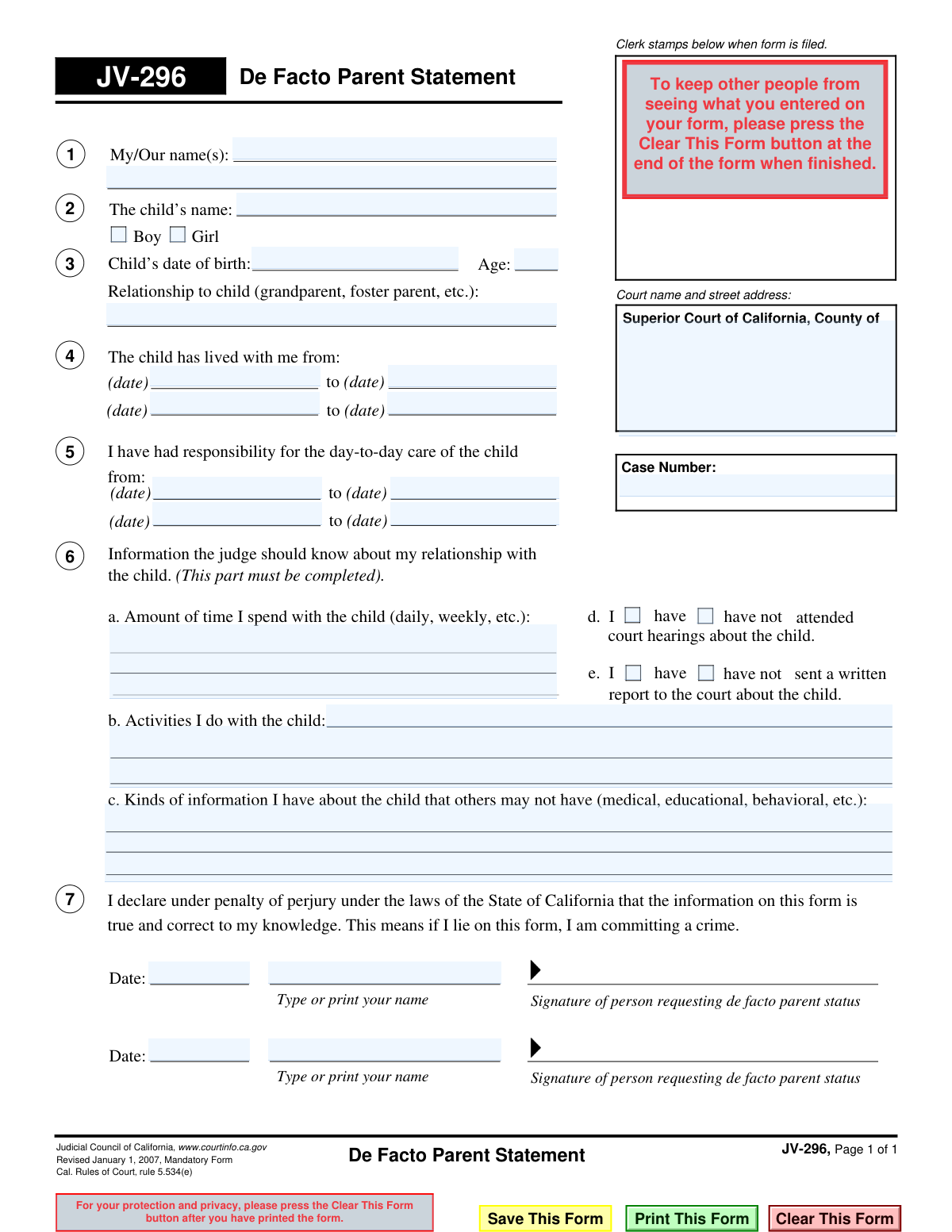
Form JV-296, the De Facto Parent Statement, is a legal document submitted to the Superior Court of California by an individual who has been fulfilling a parental role for a child in a dependency case. It provides the court with detailed information about the relationship and care provided, which is crucial for the court to grant 'de facto parent' status, allowing the person to participate in court hearings. Today, this form can be filled out quickly and accurately using AI-powered services like Instafill.ai, which can also convert non-fillable PDF versions into interactive fillable forms.
JV-296 is part of the California court forms and California state forms categories on Instafill.
Our AI automatically handles information lookup, data retrieval, formatting, and form filling.
It takes less than a minute to fill out JV-296 using our AI form filling.
Securely upload your data. Information is encrypted in transit and deleted immediately after the form is filled out.

Form specifications

Form name: Form JV-296, De Facto Parent Statement
Number of fields: 35
Number of pages: 1
Language: English
main-image

Instafill Demo: How to fill out PDF forms in seconds with AI

How to Fill Out JV-296 Online for Free in 2026

Are you looking to fill out a JV-296 form online quickly and accurately? Instafill.ai offers the #1 AI-powered PDF filling software of 2026, allowing you to complete your JV-296 form in just 37 seconds or less.
Follow these steps to fill out your JV-296 form online using Instafill.ai:
  1. 1 Navigate to Instafill.ai and upload or select the JV-296 De Facto Parent Statement form.
  2. 2 Provide your personal details, including your full name and your relationship to the child.
  3. 3 Enter the child's information, such as their name, date of birth, and age.
  4. 4 Detail the timeline of your relationship, specifying the dates the child has lived with you and you have been responsible for their day-to-day care.
  5. 5 Use the AI assistant to help you describe your relationship with the child, including time spent, activities, and unique knowledge you have about their well-being.
  6. 6 Indicate whether you have previously attended court hearings or submitted reports regarding the child.
  7. 7 Review all the information for accuracy, then sign and date the form under penalty of perjury before filing it with the court.

Our AI-powered system ensures each field is filled out correctly, reducing errors and saving you time.

Why Choose Instafill.ai for Your Fillable JV-296 Form?

Speed

Complete your JV-296 in as little as 37 seconds.

Up-to-Date

Always use the latest 2026 JV-296 form version.

Cost-effective

No need to hire expensive lawyers.

Accuracy

Our AI performs 10 compliance checks to ensure your form is error-free.

Security

Your personal information is protected with bank-level encryption.

Frequently Asked Questions About Form JV-296

This form is used to ask a California court to legally recognize you as a 'de facto parent' for a child in the dependency system. This status allows you to participate in court hearings and present information to the judge.

You should fill out this form if you have been the primary caregiver for a child, fulfilling a day-to-day parental role, and want to be formally involved in their juvenile court case. This often includes foster parents, grandparents, or other relatives.

A de facto parent is someone the court recognizes as having a parent-like relationship with a child based on providing daily care and forming a close bond. This status allows you to attend hearings, present information, and be represented by a lawyer in the child's case.

Be specific about your daily involvement, such as helping with homework, taking them to doctor's appointments, and unique activities you share. Also, mention any special knowledge you have about the child's health, education, or emotional needs.

Yes, you must include the case number for the child's dependency case. If you do not know it, you may need to contact the court clerk or the child's social worker to obtain it.

You must file the completed and signed form with the clerk of the Superior Court in the county where the child's dependency case is being heard.

After you file the form, the judge will review your statement and may hold a hearing to decide whether to grant you de facto parent status. Other parties in the case will have an opportunity to respond to your request.

Yes, you can still apply. The form asks you to check whether you have or have not attended hearings, but a 'have not' answer does not automatically disqualify you from being granted de facto parent status.

Provide the most accurate dates you can recall. If you are unsure, you can write 'approximately' before the date, but it is best to find records that can help you confirm the exact time frame.

This is a legal statement confirming that all the information you have provided on the form is true and correct to the best of your knowledge. Intentionally providing false information is a crime and can have serious legal consequences.

Yes, services like Instafill.ai use AI to help you accurately auto-fill form fields, which can save you time and reduce errors. This is especially helpful for repetitive information like names and case numbers.

You can use a service like Instafill.ai to fill out the form online. Simply upload the JV-296 PDF, and the platform will allow you to type your information directly into the fields before printing for submission.

If you have a non-fillable or 'flat' PDF, you can use a tool like Instafill.ai. It can convert the document into an interactive, fillable form so you can easily type your answers instead of writing by hand.

Compliance JV-296
Validation Checks by Instafill.ai

1
Child's Name Presence
Validates that the field for the child's name is not empty. The child's name is a fundamental piece of information required to identify the subject of the de facto parent statement. If this field is left blank, the form is ambiguous and cannot be correctly associated with a specific case or individual, leading to rejection.
2
Petitioner's Name Presence
Ensures the 'My/Our name(s)' field is filled out. This identifies the person or persons filing the statement and seeking de facto parent status. Without this information, the court cannot know who is making the declaration, making the form legally invalid and causing it to be rejected.
3
Child's Date of Birth Validity
This check verifies that the 'Child’s date of birth' is a valid date and that the date is in the past. An invalid date format would cause data processing errors, and a future date of birth is logically impossible for a child who exists. Failure to provide a valid, past date will prevent the form from being processed and require correction.
4
Age and Date of Birth Consistency
This validation compares the entered 'Age' with the age calculated from the 'Child’s date of birth'. This cross-field check ensures data accuracy and consistency. A mismatch could indicate a typo in either the age or the date of birth, which could have legal implications and will require the user to review and correct the conflicting information.
5
Exclusive Gender Selection
Verifies that only one option, either 'Boy' or 'Girl', is selected. This is a simple data integrity check to ensure the input is unambiguous. If both or neither are selected, it creates an invalid state, and the user should be prompted to make a single, definitive choice.
6
Relationship to Child Completeness
This validation ensures the 'Relationship to child' field is filled out. This information provides essential context for the judge regarding the petitioner's connection to the child (e.g., grandparent, foster parent, family friend). Leaving this field blank omits critical information and will result in the form being flagged as incomplete.
7
Valid 'Lived With' Date Chronology
Validates that in the 'The child has lived with me' section, the 'from' date occurs before the 'to' date. This ensures the date range is logical and represents a valid period of time. An inverted or illogical date range would be nonsensical and must be corrected before the form can be accepted.
8
Mandatory Information Section Completion
Checks that the narrative fields 'a', 'b', and 'c' under 'Information the judge should know' are not empty, as the form explicitly states 'This part must be completed'. This information is the core evidence for the de facto parent claim. If these fields are left blank, the statement lacks the necessary substance for a judge to make a determination, and the submission will be considered incomplete.
9
Mandatory Selection for Court Hearing Attendance
Ensures that one of the two options, 'have' or 'have not,' is selected for the statement 'I...attended court hearings about the child.' This is a required piece of information to understand the petitioner's prior involvement in the case. Failing to select an option leaves the statement incomplete and requires the user to make a choice.
10
Mandatory Selection for Written Report Submission
Verifies that the user has selected either 'have' or 'have not' for the statement 'I...sent a written report to the court about the child.' This provides the court with a complete picture of the petitioner's past actions. An unselected state makes the form incomplete and will prompt the user for a response.
11
Declaration Date Completeness
This check ensures that the 'Date' field in the declaration section is filled out. The date of the declaration is legally significant as it establishes when the sworn statement was made under penalty of perjury. An undated declaration is legally incomplete and will be rejected by the court clerk.
12
Printed Name in Declaration
Validates that the 'Type or print your name' field accompanying the signature is not blank. This field clearly identifies the signatory, linking the signature to a specific individual. Its absence can create ambiguity about who signed the document, potentially invalidating the declaration and requiring resubmission.
13
Case Number Format
This check validates the 'Case Number' against the expected format for the Superior Court of California. A correctly formatted case number is critical for ensuring the document is filed in the correct case docket. An incorrect format can lead to misfiling, delays, or the document being rejected by the court clerk's office.
14
Residency and Care Dates are in the Past
Verifies that all dates entered for when the child lived with the petitioner or when the petitioner had responsibility for care are not in the future. Claims about residency and care must be based on past events. Entering a future date is a logical impossibility for a statement of fact and would cause the form to be rejected until corrected.

Common Mistakes in Completing JV-296

Incomplete Court and Case Information

Applicants often forget to fill in the full court name, address, and case number at the top of the form. This happens when they are focused on the personal statements and overlook administrative details. An incomplete header can lead to the form being rejected by the clerk or misfiled, causing significant delays in the legal process.

Using Nicknames Instead of Legal Names

People sometimes list the child's nickname or a shortened version of their name instead of the full legal name as it appears on official documents. This can cause confusion and processing delays, as the court needs to match the form to the correct case file using the exact legal name. Always use the child's complete legal name to ensure clarity and proper record-keeping.

Inconsistent Age and Date of Birth

A common error is entering an age for the child that does not correctly correspond to their date of birth. This usually happens due to a simple miscalculation, especially if the form is filled out long before it's filed. This inconsistency can raise questions about the applicant's attention to detail and the accuracy of the information provided.

Vague or Ambiguous Timeframes

The sections asking for dates the child lived with the applicant and when the applicant had day-to-day care are often filled out with imprecise dates or have unexplained gaps. This can weaken the claim of a consistent, parent-like relationship. It's crucial to provide exact dates (mm/dd/yyyy) and use all available fields if care was provided during non-consecutive periods.

Leaving Critical Narrative Sections Blank

The form explicitly states that Section 7, 'Information the judge should know,' must be completed, yet it is frequently left partially or entirely blank. Applicants may feel intimidated or unsure what to write, but this is the most critical part of the statement. Leaving it empty will almost certainly result in the request being denied, as it fails to provide the necessary evidence of a parental relationship.

Providing Generic Instead of Specific Details

In the narrative sections, applicants often provide vague answers like 'I spend a lot of time with the child' or 'we do fun activities.' These general statements lack impact and fail to demonstrate a parental role. The judge needs concrete examples, such as 'I help with homework nightly, attend all parent-teacher conferences, and manage their weekly therapy appointments,' to understand the depth of the relationship.

Overlooking Checkbox Questions

The simple 'have/have not' checkbox questions regarding court hearings and written reports (7d and 7e) are easy to miss. Failing to check one of the boxes for each question results in an incomplete form. This oversight can be interpreted as carelessness and may require the form to be amended and refiled, causing delays.

Forgetting to Sign and Date the Form

An unsigned or undated form is legally invalid and will be immediately rejected by the court clerk. This mistake often happens when people are in a hurry or are focused on the content and forget the final, crucial step. The signature confirms that the information is true under penalty of perjury, so its absence nullifies the entire document.

Illegible Handwriting on Printed Forms

When filling out a printed PDF by hand, illegible writing can make the form impossible for the court clerk and judge to process. Names, dates, and case numbers that are unreadable can lead to rejection of the filing or misinterpretation of critical facts. Since this form is a non-fillable PDF, using a tool like Instafill.ai to convert it into a fillable version ensures all text is perfectly legible and professional.

Confusing 'Living With' vs. 'Day-to-Day Care'

Applicants may mistakenly enter the same date ranges for Section 5 ('The child has lived with me') and Section 6 ('I have had responsibility for the day-to-day care'). While these periods can overlap, they are not always identical; one could have responsibility for care without the child living in the home full-time. Failing to distinguish between these can misrepresent the actual circumstances of the relationship to the court.
Saved over 80 hours a year

“I was never sure if my IRS forms like W-9 were filled correctly. Now, I can complete the forms accurately without any external help.”

Kevin Martin Green

Your data stays secure with advanced protection from Instafill and our subprocessors

Robust compliance program

Transparent business model

You’re not the product. You always know where your data is and what it is processed for.

ISO 27001, HIPAA, and GDPR

Our subprocesses adhere to multiple compliance standards, including but not limited to ISO 27001, HIPAA, and GDPR.

Security & privacy by design

We consider security and privacy from the initial design phase of any new service or functionality. It’s not an afterthought, it’s built-in, including support for two-factor authentication (2FA) to further protect your account.

Fill out JV-296 with Instafill.ai

Worried about filling PDFs wrong? Instafill securely fills form-jv-296-de-facto-parent-statement forms, ensuring each field is accurate.

Related forms by category

California court forms Judicial Council of California Form SC-105, Request for Court Order and Answer (Small Claims), Judicial Council of California Form SC-120, Defendant’s Claim and ORDER to Go to Small Claims Court (Small Claims), Judicial Council of California Form SER-001, Request for Sheriff to Serve Court Papers, Judicial Council of California Form SER-001, Request for Sheriff to Serve Court Papers, Affidavit for Collection of Personal Property California Probate Code Section 13100, Form POS-040, Proof of Service—Civil, Declaration of Facts of Death (California Superior Court), declaration-of-marriage-for-court-proceeding-california-family-law, ADOPT-200, Adoption Request, ADOPT-200, Stepparent Adoption Request, ADOPT-210, Adoption Agreement, ADOPT-310, Contact After Adoption Agreement, Judicial Council of California Form ADOPT-200, Adoption Request, Form ADR-107, Mediation Attendance Sheet, Form ADR-110, Order Appointing Referee, Form ADR-109, Stipulation or Motion for Order Appointing Referee, Form ADR-102, Request for Trial De Novo After Judicial Arbitration, Form ADR-108, Referee's Report (Code Civ. Proc., §§ 638, 639), Form ADR-106, Petition to Confirm, Correct, or Vacate Contractual Arbitration Award, Form ADR-104, Rejection of Award and Request for Trial After Attorney-Client Fee Arbitration · + 557 more →
California state forms Judicial Council of California Form DE-111, Petition for Probate (Probate—Decedents Estates), Judicial Council of California Form DE-111, Petition for Probate (Probate—Decedents Estates), DS 1891, Applicant/Vendor Disclosure Statement (State of California Department of Developmental Services), DL 142, Request for Cancellation or Surrender of a Driver License or Identification Card (State of California Department of Motor Vehicles), Judicial Council of California Form DE-120, Notice of Hearing—Decedent's Estate or Trust, Judicial Council of California Form DE-120, Notice of Hearing—Decedent's Estate or Trust, Murrieta Police Department Citizen Complaint Form (California Penal Code § 148.6 Advisory Statement), California Department of Social Services, Sworn Statement, State of California Department of Transportation California Civil Rights Laws Certification, State of California Department of Transportation Darfur Contracting Act Certification, Form DOT ADM-0077, State of California Department of Transportation, Contract Requirements, State of California Department of Transportation Subcontractor List, State of California Department of Transportation, Certified DVBE Summary, Bidder Declaration GSPD-05-105, State of California Level of Care Rate Determination Protocol Matrix, State of California Accessible Form, State of California Form SOC 321, Request for Order and Consent - Paramedical Services, State of California Darfur Contracting Act Certification, State of California Department of Veterans Affairs COMMERCIALLY USEFUL FUNCTION (CUF) CERTIFICATION FORM, Form ADR-100, Statement of Agreement or Nonagreement · + 47 more →