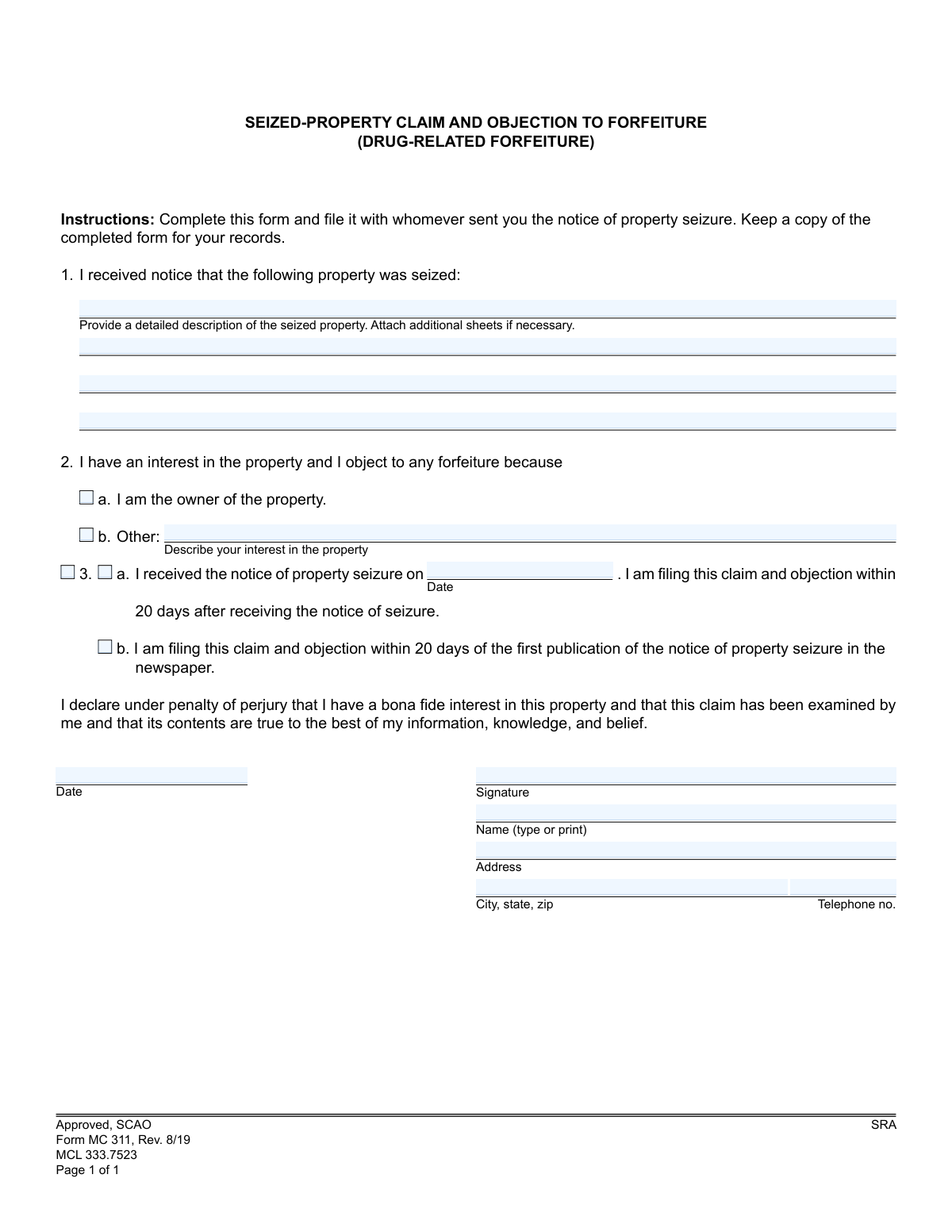
Yes! You can use AI to fill out Form MC 311, Seized-Property Claim and Objection to Forfeiture (Drug-Related Forfeiture)
Form MC 311 is a legal document used to assert an ownership or other interest in property seized by law enforcement in a drug-related case. Filing this claim is a critical step to formally object to the government's attempt to take permanent ownership of the property through forfeiture. It is essential to file this form within strict deadlines to protect your rights. Today, this form can be filled out quickly and accurately using AI-powered services like Instafill.ai, which can also convert non-fillable PDF versions into interactive fillable forms.
Our AI automatically handles information lookup, data retrieval, formatting, and form filling.
It takes less than a minute to fill out MC 311 using our AI form filling.
Securely upload your data. Information is encrypted in transit and deleted immediately after the form is filled out.
Form specifications
| Form name: | Form MC 311, Seized-Property Claim and Objection to Forfeiture (Drug-Related Forfeiture) |
| Number of fields: | 17 |
| Number of pages: | 1 |
| Language: | English |
More forms in Court claim forms
Instafill Demo: How to fill out PDF forms in seconds with AI
How to Fill Out MC 311 Online for Free in 2026
Are you looking to fill out a MC 311 form online quickly and accurately? Instafill.ai offers the #1 AI-powered PDF filling software of 2026, allowing you to complete your MC 311 form in just 37 seconds or less.
Follow these steps to fill out your MC 311 form online using Instafill.ai:
- 1 Navigate to Instafill.ai and upload or select the MC 311 form.
- 2 Provide a detailed description of the seized property in the designated fields.
- 3 Specify your interest in the property by checking 'owner' or describing your 'other' interest.
- 4 Enter the date you received the notice of seizure and confirm the filing deadline.
- 5 Carefully review all the information you have entered for accuracy and completeness.
- 6 Electronically sign and date the declaration under penalty of perjury, then provide your full name and contact information.
- 7 Download the completed form to file with the agency that sent the seizure notice and save a copy for your personal records.
Our AI-powered system ensures each field is filled out correctly, reducing errors and saving you time.
Why Choose Instafill.ai for Your Fillable MC 311 Form?
Speed
Complete your MC 311 in as little as 37 seconds.
Up-to-Date
Always use the latest 2026 MC 311 form version.
Cost-effective
No need to hire expensive lawyers.
Accuracy
Our AI performs 10 compliance checks to ensure your form is error-free.
Security
Your personal information is protected with bank-level encryption.
Frequently Asked Questions About Form MC 311
This form is used to officially state your ownership or legal interest in property that was seized in a drug-related case and to formally object to the government's attempt to take permanent ownership of it.
You should fill out this form if you have a legitimate interest in the seized property, such as being the owner or a lienholder, and you want to challenge the forfeiture.
You must file this form within 20 days of receiving the notice of seizure or within 20 days of the first date the notice was published in a newspaper. Missing this deadline is critical and may prevent you from getting your property back.
The form must be filed with the agency or office that sent you the notice of property seizure. Be sure to keep a completed copy for your personal records.
You should be as specific as possible, including any serial numbers, make, model, account numbers, or other unique identifying features to clearly identify the property you are claiming.
This refers to any legal claim to the property other than being the sole owner, such as being a co-owner, a lienholder (like a bank that issued a car loan), or having another financial stake.
Filing this claim typically stops the administrative forfeiture process and moves the case to a court. A judge will then decide whether the government can legally keep the property.
While you can file the form yourself, forfeiture law is very complex. It is highly recommended that you consult with an attorney to ensure your rights are fully protected.
Yes, services like Instafill.ai use AI to accurately auto-fill form fields, which can save you time and help prevent common errors.
You can use a platform like Instafill.ai to upload the form, fill it out on your computer, and then download the completed PDF for printing and submission.
Services like Instafill.ai can convert non-fillable PDFs into interactive, fillable forms. This allows you to easily type your information directly into the fields.
By signing the form, you are making a legal declaration that the information you provided is true to the best of your knowledge. Providing false information can have serious legal consequences.
You should list every item you are claiming in Section 1. If you run out of space on the form, you can attach additional sheets with the detailed descriptions.
Compliance MC 311
Validation Checks by Instafill.ai
1
Ensures Property Description is Provided
This validation checks that the 'detailed description of the seized property' field is not empty. This information is the primary subject of the claim and is absolutely essential for processing. A form submitted without a description of the property being claimed is invalid and cannot be acted upon.
2
Validates Selection of Interest in Property
This check ensures that the claimant has selected at least one option under section 2, either 'a. I am the owner' or 'b. Other'. This declaration is fundamental to establishing the claimant's legal standing to make a claim. If neither option is selected, the basis for the claim is unknown and the form must be rejected for incompleteness.
3
Conditional Requirement for 'Other' Interest Description
This validation rule is triggered if the claimant selects '2.b. Other'. It verifies that the corresponding text field, 'Describe your interest in the property,' is filled out. It is crucial for the reviewing authority to understand the specific nature of the 'other' interest for legal review, and an empty description makes the claim ambiguous.
4
Ensures Exclusive Filing Basis Selection
This check verifies that the claimant has selected exactly one option under section 3, either 'a' (based on personal notice) or 'b' (based on public notice). The 20-day filing deadline is calculated from a single, specific event. Selecting both or neither creates ambiguity about the deadline calculation, so the form must be returned for clarification.
5
Conditional Requirement for Notice of Seizure Date
This validation ensures that if the claimant checks box '3.a', the 'Date' field for when they received the notice of seizure is filled in. This date is the starting point for the 20-day filing window. Without this date, it is impossible to verify the timeliness of the claim based on personal notice.
6
Validates Format of Notice of Seizure Date
This check ensures the date provided in section '3.a' is a valid, parseable date (e.g., MM/DD/YYYY). Correct date formatting is essential for data integrity and allows for the accurate, automated calculation of the filing deadline. An invalid format would require manual intervention and could delay processing.
7
Logical Check: Notice Date vs. Signature Date
This validation compares the 'notice of property seizure' date from section 3.a with the signature 'Date' at the bottom of the form. The notice date must be on or before the signature date. A signature date that precedes the notice date is a logical impossibility and indicates a data entry error that must be corrected.
8
Validates Signature Date Presence and Format
This check ensures the 'Date' field in the declaration section is filled out and is in a valid date format. This date is legally significant as it marks when the claimant attested to the form's contents under penalty of perjury. An absent or malformed date can challenge the validity of the entire submission.
9
Ensures Claimant's Printed Name is Provided
This validation verifies that the 'Name (type or print)' field is not empty. The claimant's full name is a fundamental piece of identifying information required for all official correspondence and legal proceedings. A form submitted without a name is anonymous and cannot be processed.
10
Validates Completeness of Claimant's Address
This check ensures that the 'Address' and 'City, state, zip' fields are filled out. A complete mailing address is legally required to send future notices, court documents, and other official correspondence related to the forfeiture case. An incomplete address will halt the process and could cause the claimant to miss critical deadlines.
11
Validates ZIP Code Format
This validation checks that the ZIP code provided in the 'City, state, zip' field follows a valid US format, such as 5 digits or ZIP+4 (e.g., 12345 or 12345-6789). This ensures mailability and proper routing of legal documents. An invalid ZIP code can cause significant delays or non-delivery of important correspondence.
12
Validates Telephone Number Format
This check verifies that the 'Telephone no.' field, if filled, contains a valid 10-digit phone number format. While not always legally essential, a valid phone number is crucial for informal communication and clarification by the processing agency. This check helps ensure the provided contact information is usable and reduces data entry errors.
13
Verifies Presence of Signature
This validation confirms that the 'Signature' field has been signed by the claimant. A signature is a critical legal requirement that indicates the claimant has read the declaration and attests to the truthfulness of the contents under penalty of perjury. An unsigned form is legally invalid and will be rejected immediately.
14
Preliminary Check for Filing Deadline Compliance
This validation performs a preliminary check on the timeliness of the claim by comparing the 'notice date' (from 3.a) against the form's signature date. It flags claims where the signature date is more than 20 days after the notice date. While the final determination is a legal one, this check can quickly identify claims that are clearly outside the filing window.
Common Mistakes in Completing MC 311
Claimants often provide a generic description like 'my car' or 'cash' instead of specific, identifiable details. This happens due to haste or not understanding the level of detail required. An ambiguous description can lead to the agency being unable to match the claim to the specific seized asset, causing significant delays or outright rejection of the claim. To avoid this, provide all identifying details from the seizure notice, such as vehicle VINs, serial numbers on electronics, or specific currency amounts and denominations.
This is one of the most critical and common errors, often resulting from procrastination or miscalculation. The law is unforgiving about this deadline; filing even one day late will likely result in the claim being barred, allowing the government to forfeit the property without further contest. To prevent this, you must file the claim immediately upon receiving the notice and calendar the 20-day deadline, counting weekends and holidays.
In the stress of the situation, people frequently forget to sign and date the form before submitting it. An unsigned claim is legally invalid and will be rejected, as the signature is part of the declaration under penalty of perjury. This mistake can be fatal to the claim if the error isn't corrected before the 20-day deadline expires. Always perform a final review of the entire form, paying special attention to the signature and date fields at the bottom.
Many people check 'I am the owner' when their interest is more complex, or they check 'Other' without providing a sufficient explanation. For example, a lienholder, a co-owner, or someone who loaned money for the property has a specific interest that must be clearly described. An improperly defined interest can weaken the claim or cause it to be dismissed for lack of standing. Be precise about your legal or financial relationship to the property.
Simple typos or using an old address can have severe consequences. The seizing agency and courts will use this information to send crucial legal documents, including hearing dates and further notices. If you don't receive these notices because of bad contact information, you could miss a critical deadline or hearing, potentially resulting in a default judgment against you and the loss of your property. Double-check your address, phone number, and name for accuracy.
The form instructions state to file it 'with whomever sent you the notice of property seizure,' but people often get confused and send it to a courthouse or a different law enforcement agency. This mistake can cause the claim to be lost or significantly delayed. By the time the error is discovered, the 20-day filing deadline with the correct agency may have already passed. Carefully read the seizure notice you received, as it will contain the correct name and address for filing.
The form presents two options for the timeliness of the claim (Section 3a and 3b), one based on personal receipt of notice and the other on public newspaper notice. Claimants may get confused and check the wrong box or fail to enter the correct date they received the notice. This can lead to the agency challenging the timeliness of the claim. You must accurately identify how you were notified and enter the correct corresponding date to establish that you are within the 20-day window.
After rushing to send the form, many people forget the instruction to 'keep a copy for your records.' Without a copy, you have no proof of what you submitted or when you submitted it, which can be a major problem if the agency claims it was never received or was filled out incorrectly. Always make a photocopy or digital scan of the completed, signed form before you file it, and retain proof of mailing or delivery.
When filling out a form by hand, especially under stress, handwriting can become messy and difficult to read. If an official cannot decipher your property description, name, or address, they may treat the field as incomplete, leading to processing delays or rejection. To avoid this, print clearly in block letters. Better yet, use a tool like Instafill.ai, which can convert a non-fillable PDF like this one into a fillable version, ensuring all your entries are typed and perfectly legible.
This form has multiple date fields, and it's easy to enter information in the wrong place. For example, a person might put the date they are signing the form in the 'notice of property seizure' date field. This can create confusion and may be used to argue that the claim is untimely. AI-powered tools like Instafill.ai can help prevent this by guiding users and automatically validating that dates are entered in the correct format and logical place.
Saved over 80 hours a year
“I was never sure if my IRS forms like W-9 were filled correctly. Now, I can complete the forms accurately without any external help.”
Kevin Martin Green
Your data stays secure with advanced protection from Instafill and our subprocessors

Robust compliance program
Transparent business model
You’re not the product. You always know where your data is and what it is processed for.
ISO 27001, HIPAA, and GDPR
Our subprocesses adhere to multiple compliance standards, including but not limited to ISO 27001, HIPAA, and GDPR.
Security & privacy by design
We consider security and privacy from the initial design phase of any new service or functionality. It’s not an afterthought, it’s built-in, including support for two-factor authentication (2FA) to further protect your account.
Fill out MC 311 with Instafill.ai
Worried about filling PDFs wrong? Instafill securely fills form-mc-311-seized-property-claim-and-objection-to-forfeiture-drug-related-forfeiture forms, ensuring each field is accurate.