Yes! You can use AI to fill out Request for Investigation of Unemployment Insurance Fraud

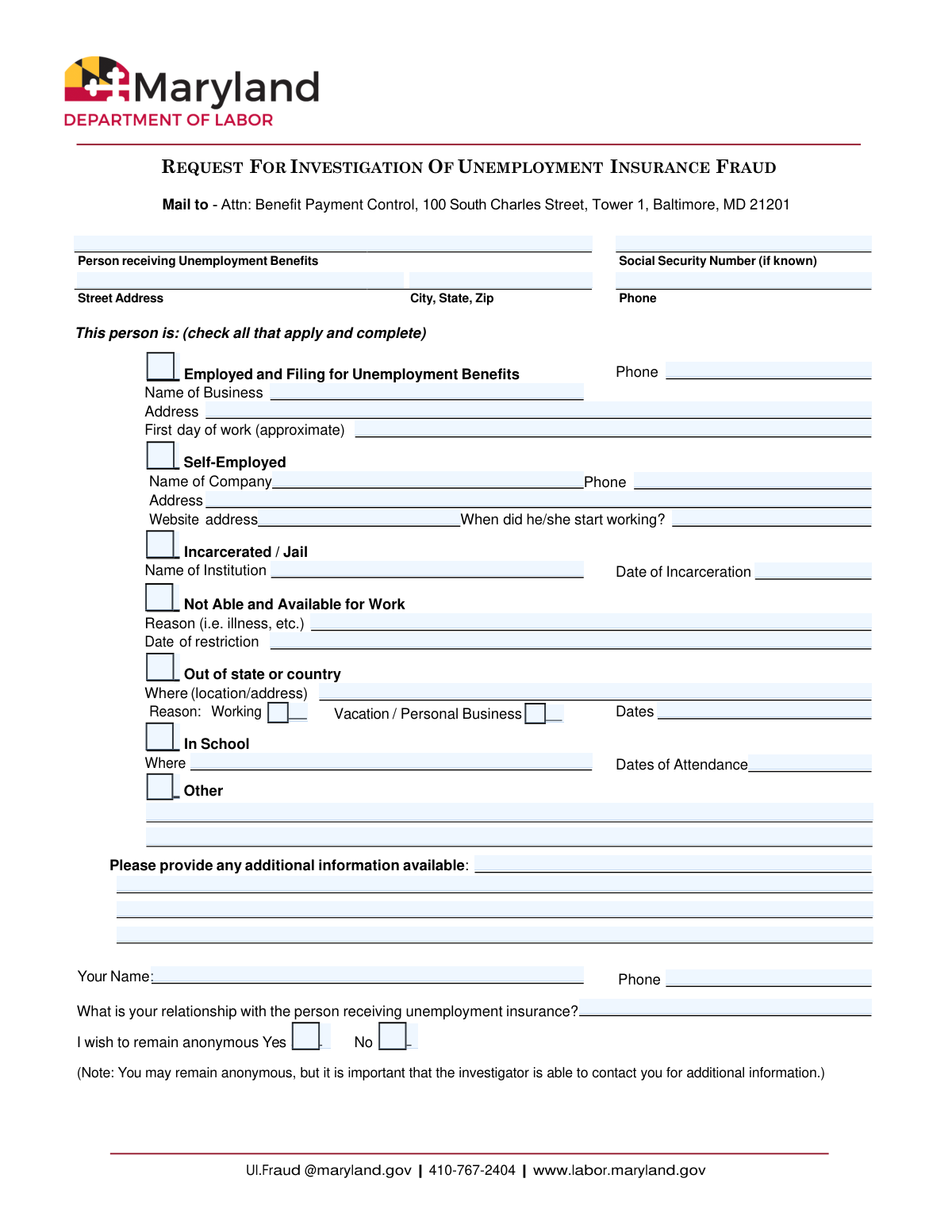
This form is used by the Maryland Department of Labor to investigate potential cases of unemployment insurance (UI) fraud. Individuals can use it to report someone they suspect is improperly receiving benefits, for reasons such as working while collecting, being incarcerated, or being otherwise ineligible. Reporting fraud helps maintain the integrity of the state's unemployment system. Today, this form can be filled out quickly and accurately using AI-powered services like Instafill.ai, which can also convert non-fillable PDF versions into interactive fillable forms.
Maryland UI Fraud Investigation Request is part of the employment forms, insurance forms and insurance request forms categories on Instafill.
Our AI automatically handles information lookup, data retrieval, formatting, and form filling.
It takes less than a minute to fill out Maryland UI Fraud Investigation Request using our AI form filling.
Securely upload your data. Information is encrypted in transit and deleted immediately after the form is filled out.

Form specifications

Form name: Request for Investigation of Unemployment Insurance Fraud
Number of fields: 42
Number of pages: 1
Filled form examples: Form Maryland UI Fraud Investigation Request Examples
Language: English
main-image

Instafill Demo: How to fill out PDF forms in seconds with AI

How to Fill Out Maryland UI Fraud Investigation Request Online for Free in 2026

Are you looking to fill out a MARYLAND UI FRAUD INVESTIGATION REQUEST form online quickly and accurately? Instafill.ai offers the #1 AI-powered PDF filling software of 2026, allowing you to complete your MARYLAND UI FRAUD INVESTIGATION REQUEST form in just 37 seconds or less.
Follow these steps to fill out your MARYLAND UI FRAUD INVESTIGATION REQUEST form online using Instafill.ai:
  1. 1 Navigate to Instafill.ai and upload or select the Maryland Request for Investigation of Unemployment Insurance Fraud form.
  2. 2 Provide the personal details of the individual suspected of fraud, including their name, address, and Social Security Number if available.
  3. 3 Check the box that corresponds to the reason for your suspicion (e.g., 'Employed and Filing', 'Incarcerated', 'Out of state') and fill in the required details for that section.
  4. 4 Enter any additional information or specific details about the suspected fraudulent activity in the designated fields.
  5. 5 Provide your name and contact information, or select the option to remain anonymous, though providing contact details can help the investigation.
  6. 6 Review all the information populated by the AI to ensure it is accurate and complete.
  7. 7 Submit the completed form to the Maryland Department of Labor's Benefit Payment Control unit via mail as indicated on the form.

Our AI-powered system ensures each field is filled out correctly, reducing errors and saving you time.

Why Choose Instafill.ai for Your Fillable Maryland UI Fraud Investigation Request Form?

Speed

Complete your Maryland UI Fraud Investigation Request in as little as 37 seconds.

Up-to-Date

Always use the latest 2026 Maryland UI Fraud Investigation Request form version.

Cost-effective

No need to hire expensive lawyers.

Accuracy

Our AI performs 10 compliance checks to ensure your form is error-free.

Security

Your personal information is protected with bank-level encryption.

Frequently Asked Questions About Form Maryland UI Fraud Investigation Request

This form is used to report an individual you suspect is fraudulently receiving Unemployment Insurance (UI) benefits in Maryland. Submitting this form initiates an official investigation by the Maryland Department of Labor.

Anyone who has information and believes an individual is improperly or illegally collecting unemployment benefits should fill out this form. This can include employers, co-workers, acquaintances, or any concerned citizen.

No, the Social Security Number is only required 'if known.' You should provide as much identifying information as you can, but you can still submit the report without the SSN.

Yes, you can choose to remain anonymous by checking the 'Yes' box on the form. However, providing your contact information is helpful as an investigator may need to contact you for additional details.

You can mail the completed form to the Benefit Payment Control unit at 100 South Charles Street, Tower 1, Baltimore, MD 21201. Alternatively, you can email it to [email protected].

You should fill out the form to the best of your ability with the information you have. Even partial information can be enough to start an investigation, so provide as many accurate details as possible.

Check the box for 'Employed and Filing for Unemployment Benefits' and provide as many details as you can. This includes the name and address of the business and the person's approximate first day of work.

After submission, the Maryland Department of Labor's Benefit Payment Control unit will review the information and conduct an investigation if warranted. Due to confidentiality laws, you will not be notified of the investigation's outcome.

Yes, services like Instafill.ai use AI to help you accurately auto-fill form fields, which can save you time and reduce errors. This is especially useful for ensuring all required information is entered correctly.

You can use a service like Instafill.ai to complete the form digitally. Simply upload the PDF to their platform, and their AI will help you fill in the fields interactively before you print it for mailing or save it for emailing.

If you have a non-fillable or 'flat' PDF, you can upload it to a platform like Instafill.ai. Their technology can convert it into an interactive, fillable form that you can complete on your computer.

The form includes specific sections for various scenarios, including being incarcerated, out of the country, in school, or not able and available for work. Check all boxes that apply and provide the requested details for each situation.

Describe your connection to the individual, for example, 'co-worker,' 'employer,' 'neighbor,' or 'family member.' If you don't know them personally, you can state 'concerned citizen.'

Compliance Maryland UI Fraud Investigation Request
Validation Checks by Instafill.ai

1
Validates Social Security Number Format
This check ensures that if a Social Security Number is entered, it conforms to the standard 9-digit format, either as XXXXXXXXX or XXX-XX-XXXX. Correct formatting is crucial for accurately identifying the individual in government databases and avoiding processing errors. A failed validation would prompt the user to correct the entry before submission.
2
Ensures Claimant Name is Provided
This validation verifies that the 'Claimant Name' field is not left blank. The claimant's full name is the primary identifier for initiating an investigation, and its absence would make the submission unusable. If this field is empty, the form cannot be submitted, and the user will be notified that the name is a required field.
3
Requires at Least One Fraud Reason
This check confirms that the user has selected at least one of the primary checkboxes indicating the type of alleged fraud (e.g., 'Employed and Filing', 'Incarcerated', 'Self-Employed'). A submission without a specified reason lacks the necessary context for an investigation to begin. The system will prevent submission and display an error if no reason is checked.
4
Validates Conditional Fields for 'Employed and Filing'
If the 'Employed and Filing for Unemployment Benefits' box is checked, this validation ensures that the 'Name of Business' and 'First day of work' fields are filled out. This information is essential for investigators to verify the claimant's employment status. Failure to provide these details will result in a prompt asking the user to complete the required employment information.
5
Validates Conditional Fields for 'Incarcerated'
When the 'Incarcerated / Jail' box is checked, this rule verifies that the 'Name of Institution' and 'Date of Incarceration' fields are completed. These details are critical for cross-referencing correctional facility records to confirm the claimant's status. If these fields are empty, the form will prompt the user to provide the necessary incarceration details.
6
Prohibits Future Dates in Date Fields
This validation rule checks all date fields (e.g., 'First day of work', 'Date of Incarceration', 'Work Restriction Date') to ensure the entered dates are not in the future. Fraud investigations are based on past or current events, so a future date is logically invalid and likely a user error. If a future date is entered, an error message will appear, requiring the user to enter a date that is today or in the past.
7
Enforces Reporter Contact Info if Not Anonymous
This check ensures that if the user selects 'I wish to remain anonymous: No', the 'Reporter Name' and 'Reporter Phone Number' fields must be filled. Providing contact information is vital for investigators who may need to ask follow-up questions to substantiate the claim. If the user opts out of anonymity but leaves contact fields blank, they will be prompted to provide their name and phone number.
8
Validates Reporter Phone Number Format
This rule verifies that the 'Reporter Phone Number', if provided, is in a valid format (e.g., 10 digits, with or without common separators like parentheses or hyphens). A correctly formatted number is essential for ensuring investigators can successfully contact the reporter. An invalid format would trigger an error message asking the user to correct the phone number.
9
Validates Claimant's ZIP Code Format
This check ensures the 'Zip' code field for the claimant's address contains a valid 5-digit or 9-digit (XXXXX-XXXX) numeric format. A valid ZIP code is necessary for mail correspondence and for accurately locating the individual. An incorrectly formatted ZIP code will trigger a validation error, prompting the user for correction.
10
Ensures Reason is Selected for 'Out of state or country'
If the 'Out of state or country' checkbox is selected, this validation confirms that a reason ('Working' or 'Vacation / Personal Business') is also checked. This context is crucial for determining if the claimant violated availability requirements. The form will not proceed without this detail, prompting the user to select a reason for the travel.
11
Validates Conditional Fields for 'Self-Employed'
When the 'Self-Employed' box is checked, this rule verifies that the 'Self-Employed Company Name' and 'Self-Employed Start Date' fields are completed. This information is fundamental for investigators to begin verifying the self-employment activity. If these fields are left blank, the system will prompt the user to provide the required details about the self-employment.
12
Ensures Anonymity Choice is Mutually Exclusive
This validation ensures that a user can only select either 'Yes' or 'No' for the 'I wish to remain anonymous' option, but not both. This prevents contradictory data input and ensures the user's intent is clear. If both options are somehow selected, the system would flag an error and require the user to make a single choice.
13
Validates Website URL Format
This check verifies that the 'Self-Employed Website Address' field, if filled, contains a valid URL format (e.g., starts with 'http://', 'https://', or 'www.'). A valid URL allows investigators to easily look up the business online as part of their research. An invalid format would result in an error message requesting the user to enter a proper web address.
14
Requires Details for 'Other' Fraud Reason
If the 'Other' checkbox is selected, this validation ensures the 'Other Situation Details' text area is not empty. The 'Other' category is useless without a description of the unique situation being reported. If the checkbox is ticked but the description is missing, the user will be prompted to provide the necessary details.

Common Mistakes in Completing Maryland UI Fraud Investigation Request

Incomplete or Vague Claimant Identification

Reporters often provide a partial name (e.g., a nickname) or an old address for the person in question. While the Social Security Number is optional, omitting it when it could be found significantly hinders the investigation. These omissions or inaccuracies force investigators to spend extra time verifying the subject's identity, potentially delaying or halting the case. To avoid this, provide the full legal name, current known address, and SSN if at all possible.

Missing Details for Checked Fraud Categories

A frequent error is checking a box like 'Employed and Filing for Unemployment Benefits' but then failing to fill out the corresponding details like the employer's name, address, and the start date. This leaves investigators with an allegation but no actionable information to follow up on. Always ensure that for every box you check, you provide all the requested supporting information in the subsequent fields to build a strong report. AI-powered form fillers like Instafill.ai can help by highlighting these required conditional fields.

Conflicting Anonymity Preference

Users often get confused by the anonymity section, either checking 'Yes' to remain anonymous while also providing their name and phone number, or checking 'No' and then failing to provide contact details. This contradiction creates ambiguity for the investigator who may need to seek clarification. Decide on your preference beforehand: if you wish to be contacted, check 'No' and provide your details; otherwise, check 'Yes' and leave your personal information blank.

Using Imprecise Dates or Timeframes

Instead of providing a specific date (even an approximate one), people often write vague entries like 'last spring' or 'a few months ago' for fields like 'First day of work' or 'Date of Incarceration'. This lack of specificity makes it difficult for investigators to cross-reference records and establish a clear timeline of the fraudulent activity. Always provide a specific month, day, and year (e.g., 'Approx. 05/15/2023') to make the report as effective as possible.

Providing Unverifiable Employer Information

When reporting someone for working while collecting benefits, users may enter generic information like 'a construction company' or 'a restaurant downtown'. This information is not verifiable and gives the investigator no starting point. To avoid this, try to find the exact legal name of the business and its physical address, which are critical for issuing subpoenas or conducting site visits.

Ignoring the 'Additional Information' Section

Reporters may have crucial context or details that don't fit into the form's structured fields but fail to include them in the 'Additional Information' area. This section is vital for explaining nuances, such as how the person is being paid (e.g., 'cash under the table'), their work schedule, or other observations that strengthen the case. Use this space to provide a narrative that connects the dots for the investigator.

Incorrectly Categorizing Employment Type

A person might be doing gig work (like driving for a rideshare app) or cash jobs, but the reporter incorrectly lists them under the standard 'Employed' section. This can lead investigators down the wrong path when searching for payroll records. It is better to use the 'Self-Employed' section or describe the situation in detail under the 'Other' category to accurately reflect the nature of the work.

Failing to Check Any Fraud Category Box

Some reporters skip the checkboxes entirely and only write a narrative in the 'Additional Information' section. This forces the investigator to interpret the report and categorize the fraud type, which can lead to misclassification or delays. It is essential to check the primary box (e.g., 'Employed', 'Incarcerated') that best describes the fraudulent activity to ensure the case is routed and processed correctly from the start.

Illegible Handwriting on Printed Forms

Since this form is often a non-fillable PDF, people print it and fill it out by hand, which can result in illegible handwriting for names, addresses, and numbers. If an investigator cannot read the information, the report may be discarded as unusable. To prevent this, it's best to use a tool like Instafill.ai that can convert a non-fillable PDF into a fillable one, allowing you to type your responses clearly and ensure all information is perfectly legible.
Saved over 80 hours a year

“I was never sure if my IRS forms like W-9 were filled correctly. Now, I can complete the forms accurately without any external help.”

Kevin Martin Green

Your data stays secure with advanced protection from Instafill and our subprocessors

Robust compliance program

Transparent business model

You’re not the product. You always know where your data is and what it is processed for.

ISO 27001, HIPAA, and GDPR

Our subprocesses adhere to multiple compliance standards, including but not limited to ISO 27001, HIPAA, and GDPR.

Security & privacy by design

We consider security and privacy from the initial design phase of any new service or functionality. It’s not an afterthought, it’s built-in, including support for two-factor authentication (2FA) to further protect your account.

Fill out Maryland UI Fraud Investigation Request with Instafill.ai

Worried about filling PDFs wrong? Instafill securely fills request-for-investigation-of-unemployment-insurance-fraud forms, ensuring each field is accurate.