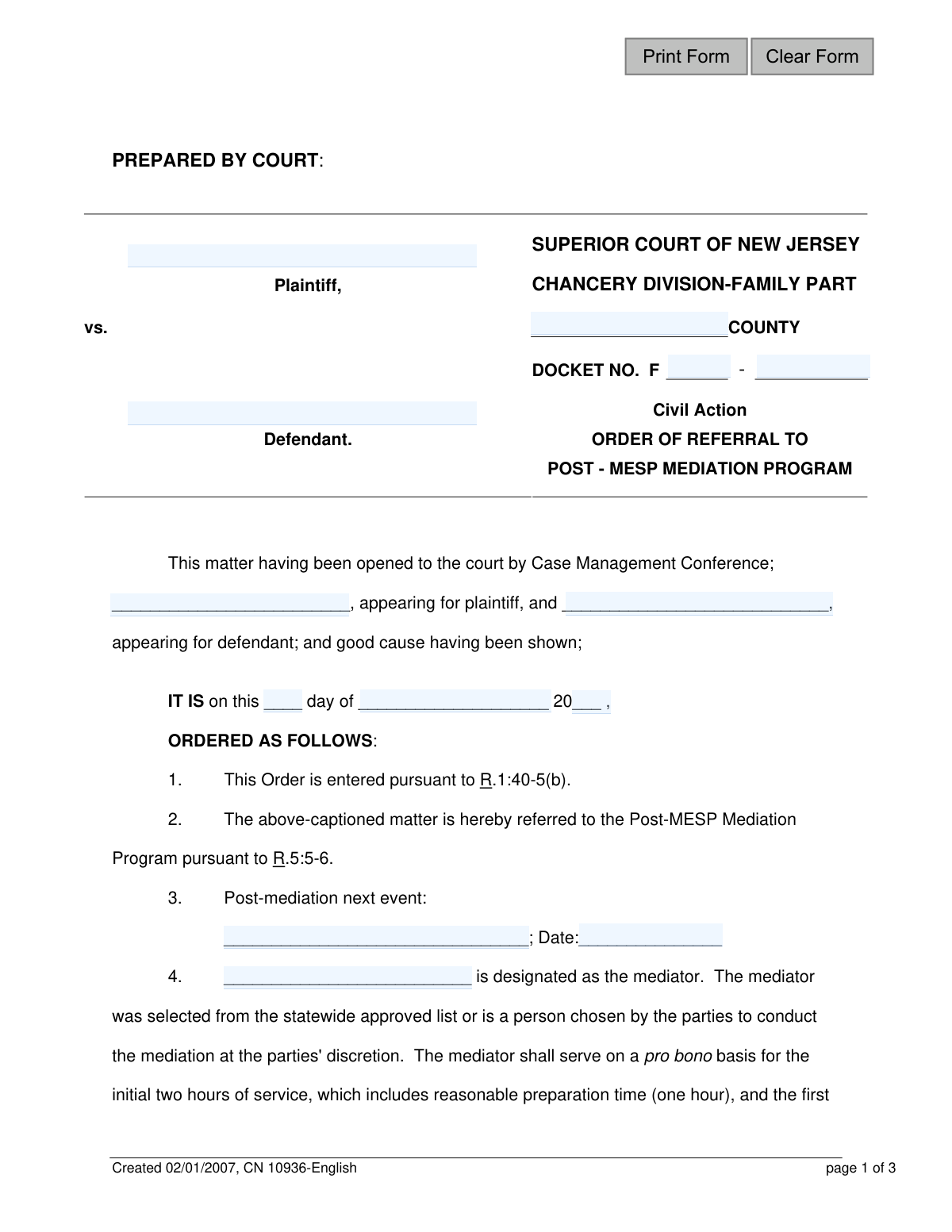
Yes! You can use AI to fill out Superior Court of New Jersey, Order of Referral to Post-MESP Mediation Program

The Order of Referral to Post-MESP Mediation Program is a legal document issued by a judge in the New Jersey Superior Court, Chancery Division-Family Part. It formally refers a civil action, typically a divorce or family law matter, to mediation after the initial Matrimonial Early Settlement Panel (MESP) process has not fully resolved all issues. The order outlines the terms of the mediation, including the designated mediator, fee arrangements, and confidentiality requirements. Today, this form can be filled out quickly and accurately using AI-powered services like Instafill.ai, which can also convert non-fillable PDF versions into interactive fillable forms.
CN 10936 is part of the New Jersey forms and superior court forms categories on Instafill.
Our AI automatically handles information lookup, data retrieval, formatting, and form filling.
It takes less than a minute to fill out CN 10936 using our AI form filling.
Securely upload your data. Information is encrypted in transit and deleted immediately after the form is filled out.

Form specifications

Form name: Superior Court of New Jersey, Order of Referral to Post-MESP Mediation Program
Number of fields: 27
Number of pages: 1
Language: English
main-image

Instafill Demo: How to fill out PDF forms in seconds with AI

How to Fill Out CN 10936 Online for Free in 2026

Are you looking to fill out a CN 10936 form online quickly and accurately? Instafill.ai offers the #1 AI-powered PDF filling software of 2026, allowing you to complete your CN 10936 form in just 37 seconds or less.
Follow these steps to fill out your CN 10936 form online using Instafill.ai:
  1. 1 Navigate to Instafill.ai and upload or select the Order of Referral to Post-MESP Mediation Program form.
  2. 2 Use the AI assistant to input the case caption details, including the Plaintiff and Defendant names, County, and Docket Number.
  3. 3 Provide the names of the attorneys appearing for the plaintiff and defendant.
  4. 4 Enter the name and contact information of the designated mediator selected from the approved list or chosen by the parties.
  5. 5 Specify the fee arrangement, including the percentage of the mediator's fee to be paid by the plaintiff and defendant after the initial pro bono period.
  6. 6 Input the date of the order and details for the post-mediation next event and date.
  7. 7 Review all the information auto-populated by the AI for accuracy, then download the completed order ready for the judge's signature and filing.

Our AI-powered system ensures each field is filled out correctly, reducing errors and saving you time.

Why Choose Instafill.ai for Your Fillable CN 10936 Form?

Speed

Complete your CN 10936 in as little as 37 seconds.

Up-to-Date

Always use the latest 2026 CN 10936 form version.

Cost-effective

No need to hire expensive lawyers.

Accuracy

Our AI performs 10 compliance checks to ensure your form is error-free.

Security

Your personal information is protected with bank-level encryption.

Frequently Asked Questions About Form CN 10936

This is a court order from a New Jersey Superior Court judge that requires parties in a family law case to attend mediation. It is issued when a case has not been fully resolved during the Matrimonial Early Settlement Panel (MESP) and aims to settle remaining issues.

No, this form is an official court order prepared and signed by a judge. You will receive a completed copy that contains the details of your mediation, including the assigned mediator and the date of your first session.

The initial two hours of the mediator's service, which includes preparation and the first session, are pro bono (free). After that, you and the other party must pay the mediator's standard hourly rate, split according to the percentages specified in the order.

You are required by the court to attend the initial session. However, the order specifies that either party has the right to opt out of the mediation process after the first two hours are completed.

Before your first session, you must provide the mediator with your Case Information Statement and ESP Statement. You are also required to cooperate by providing other relevant documents like tax returns and appraisal reports as requested.

If you do not fully settle your case, the mediator will inform the court which issues are resolved and which remain open. Your case will then proceed to the next scheduled court event, such as a trial.

Yes, the order states that all mediation proceedings are confidential and cannot be used as evidence in court. No official verbatim record or transcript of the sessions will be made.

The attendance of attorneys is decided by agreement between the parties and the mediator. However, the court requires all litigants and their attorneys (if applicable) to participate in the process in good faith.

The mediator's name, address, and telephone number are listed directly on the order you receive from the court. The date and time of your first session will also be specified on the form.

MESP stands for Matrimonial Early Settlement Panel, an earlier mandatory step in New Jersey divorce cases. This 'Post-MESP' mediation is ordered because your case did not fully settle at that initial stage.

Upon termination of the mediation, the mediator reports the outcome to the court. If the case is settled, the process concludes; if not, the case moves to the 'post-mediation next event' date listed on your order.

While you don't fill out this specific order, AI can help with related documents you must prepare, like the Case Information Statement. Services like Instafill.ai use AI to auto-fill forms accurately, saving you time and effort.

Simply upload your document, such as a Case Information Statement, to the Instafill.ai platform. The service's AI will identify the fields, allowing you to fill them out online quickly and easily.

If you have a non-fillable or 'flat' PDF, you can use a tool like Instafill.ai. It can convert the document into an interactive, fillable form so you can type your information directly into the fields.

Compliance CN 10936
Validation Checks by Instafill.ai

1
Ensures Docket Number is Complete
This check verifies that the numeric components of the Docket Number (fields 'DocketType1' and 'DocketType2') are filled in. The Docket Number is a critical unique identifier for the case within the court system. Failure to provide a complete number will result in a rejection, as the order cannot be correctly filed or tracked.
2
Validates Plaintiff and Defendant Names are Provided
This validation ensures that the 'PlaName' (Plaintiff) and 'DefName' (Defendant) fields are not empty. These names are fundamental to the legal order, identifying the parties involved in the dispute. An order without the primary parties named is legally deficient and cannot be processed.
3
Verifies Order Date is a Valid Calendar Date
This check confirms that the combination of the 'day of', 'Month', and 'Yr' fields constitutes a real date (e.g., not 'February 30'). This is important for establishing the legal effective date of the court order. An invalid date would make the order's timing ambiguous and legally challengeable.
4
Validates Mediator Fee Percentages Sum to 100
This validation checks that the values in 'PlaFee' and 'DefFee' are numeric and that their sum equals 100. This ensures the financial responsibility for the mediator's services is fully and clearly allocated between the plaintiff and defendant. If the sum is not 100, it creates financial ambiguity and the form will be considered incomplete.
5
Ensures Mediator Fee Fields are Numeric
This check verifies that the 'PlaFee' and 'DefFee' fields contain only numeric characters. These fields represent a percentage of the cost, so non-numeric entries are invalid. This prevents data entry errors and ensures the fee allocation is mathematically clear and enforceable.
6
Confirms Chronological Consistency of Dates
This validation ensures that the 'FirstMedDt' (First Mediation Date) and 'PostMedDt' (Post-mediation next event Date) are on or after the main Order Date. A mediation session cannot be scheduled before the court officially orders it. This logical check prevents nonsensical or impossible timelines from being entered.
7
Requires Mediator Name and Telephone Number
This check ensures that the mediator's name ('MedName' or 'MedInfo1') and 'Telephone Number' are provided. This contact information is essential for the parties and their attorneys to schedule and coordinate the mediation sessions. Without this information, the order is impractical and fails its primary purpose of facilitating mediation.
8
Validates Mediator Telephone Number Format
This check verifies that the 'Telephone Number' field adheres to a standard US phone number format (e.g., XXX-XXX-XXXX or (XXX) XXX-XXXX). Proper formatting ensures data consistency and usability, making it easy for parties to contact the mediator without confusion. An improperly formatted number could lead to communication failures.
9
Ensures Court County is Specified
This validation confirms that the 'County' field is not left blank. The county is a required part of the court's name (e.g., 'Superior Court of New Jersey, Ocean County'), and is essential for jurisdiction and proper filing. An order without a county is incomplete and cannot be routed to the correct courthouse.
10
Validates Payment Term is a Positive Integer
This check ensures that the 'Days' field, which specifies the deadline for paying outstanding mediation bills, is a positive whole number. A zero, negative, or non-numeric value is illogical for a payment deadline. This validation ensures the payment terms are clear and enforceable.
11
Requires Judge's Signature/Name
This validation verifies that the 'SigJudge' field is completed. A judge's signature or typed name is what gives a court order its legal authority. An unsigned order is not valid or enforceable, so this field is mandatory for the form to be accepted.
12
Ensures Post-Mediation Event is Described if Dated
This check ensures that if a date is entered in the 'PostMedDt' field, the corresponding 'PostMedEvent' description field is also filled out. A date without a description of the event is meaningless and provides no direction to the parties. This ensures the court's instructions for the next steps are clear.
13
Verifies Mediator Name Consistency
This check compares the mediator's name in the main body of the order ('MedName') with the name in the contact information section ('MedInfo1'). The names should match to avoid confusion about who the designated mediator is. Inconsistency could lead to contacting the wrong person or challenges to the process.

Common Mistakes in Completing CN 10936

Incorrect Docket Number Format

Users often enter the docket number without the required 'F' prefix or misplace the hyphen, leading to filing errors. This happens due to oversight or unfamiliarity with court-specific formatting. An incorrect docket number can cause the order to be rejected by the clerk's office or misfiled, delaying the mediation process. Always double-check the docket number against other official case documents to ensure it matches the required 'F - [number]' format.

Invalid Fee Percentage Allocation

A frequent error is entering percentages for the plaintiff and defendant's share of the mediator's fee that do not add up to 100%. This mistake occurs when parties miscalculate or fail to confirm the agreed-upon split. An invalid allocation makes the order unenforceable regarding payment and will require correction, delaying the official referral. To avoid this, confirm the split and ensure the two numbers entered explicitly sum to 100% before submitting the form.

Incomplete Mediator Contact Information

Filers sometimes provide only the mediator's name, omitting the full address and telephone number. This oversight hinders the ability of the court and the parties to communicate with the mediator, potentially delaying the scheduling of the first session. It is crucial to fill out this section completely with the mediator's full name, street address, city, state, zip code, and phone number. Using a tool like Instafill.ai can help by saving and auto-populating contact information for frequently used mediators, ensuring accuracy and completeness.

Vague or Missing Post-Mediation Event

The fields for the 'Post-mediation next event' and its date are often left blank or filled with ambiguous terms like 'Follow-up'. This information is critical for the court's calendar and case management. Leaving it incomplete can result in scheduling conflicts or require an additional case management conference to clarify the next steps. Ensure a specific, official event (e.g., 'Case Management Conference', 'Trial Date') and a precise date are entered as directed by the court.

Omitting the Payment Deadline for Mediator Fees

The clause 'Any outstanding bills shall be paid within ___ days of receipt' requires a number to be filled in, but it is frequently overlooked. This omission creates ambiguity regarding payment deadlines for the mediator's services after the initial pro bono period. This can lead to disputes over late payments and strain the relationship with the mediator. Parties must agree on a specific number of days and enter it clearly to create a binding and unambiguous payment term.

Forgetting to Provide Required Supporting Documents

The form explicitly instructs filers to provide the mediator with the parties' Case Information Statements (CIS) and ESP Statements prior to the first session. Forgetting this step is a common procedural mistake that forces the mediator to start the session without critical financial information. This wastes valuable mediation time and can lead to the rescheduling of the session. To prevent this, create a checklist and ensure all required documents are sent to the mediator well in advance of the scheduled date.

Illegible Handwritten Entries

When this form is presented as a non-fillable PDF, parties often fill it out by hand, leading to illegible entries for names, dates, and numbers. Poor handwriting can cause data entry errors by court staff, leading to incorrect records or communication sent to the wrong address. This can be avoided by typing the information. AI-powered tools like Instafill.ai can convert flat, non-fillable PDFs into interactive, fillable forms, allowing you to type directly and ensure every entry is clear and legible.

Incomplete Party or Attorney Information

The fields for plaintiff, defendant, and their respective attorneys are sometimes left blank or filled with incomplete names. This often happens when a party is self-represented and is unsure what to write. An incomplete caption can lead to rejection of the filing, as all parties must be clearly identified. Always use full legal names, and if a party is self-represented, clearly state 'Pro Se' or 'Self-Represented' in the corresponding attorney field.

Ambiguous Mediator Designation

In section 4, the line for designating the mediator is sometimes filled with just a first name or an incorrectly spelled name. This ambiguity can cause confusion about which mediator has been officially appointed, especially if there are multiple mediators with similar names on the approved list. This can delay the start of mediation as the court or parties must seek clarification. Always enter the mediator's full, correctly spelled name to ensure the designation is clear and official.

Incorrect Date on the Order

Users may incorrectly fill out the date the order is signed, entering the current date instead of the date of the hearing or conference when the order was made. This can create confusion in the case timeline and conflict with court records. The date should reflect the day the judge officially enters the order. To avoid this, carefully transcribe the date as provided by the court during the case event. Using form-filling tools can help standardize date formats and reduce manual entry errors.
Saved over 80 hours a year

“I was never sure if my IRS forms like W-9 were filled correctly. Now, I can complete the forms accurately without any external help.”

Kevin Martin Green

Your data stays secure with advanced protection from Instafill and our subprocessors

Robust compliance program

Transparent business model

You’re not the product. You always know where your data is and what it is processed for.

ISO 27001, HIPAA, and GDPR

Our subprocesses adhere to multiple compliance standards, including but not limited to ISO 27001, HIPAA, and GDPR.

Security & privacy by design

We consider security and privacy from the initial design phase of any new service or functionality. It’s not an afterthought, it’s built-in, including support for two-factor authentication (2FA) to further protect your account.

Fill out CN 10936 with Instafill.ai

Worried about filling PDFs wrong? Instafill securely fills superior-court-of-new-jersey-order-of-referral-to-post-mesp-mediation-program forms, ensuring each field is accurate.

Related forms by category

New Jersey forms State of New Jersey Alternate Benefit Program Withdrawal Request Acknowledgement Receipt, Horizon Blue Cross Blue Shield of New Jersey Applied Behavior Analysis Supplemental Information Form, State of New Jersey Application for Employment (Form DPF-663), New Jersey Judiciary Plea Form (Plea 01), Supplemental Plea Form for Certain Sexual Offenses: Megan’s Law/Parole Supervision for Life/Community Supervision for Life (Plea 05), Financial Questionnaire to Establish Indigency, New Jersey Judiciary Resource Family Information Form, Foreclosure Case Information Statement (FCIS) - Appendix XII-B2, New Jersey Judiciary Records Request Form, Superior Court of New Jersey, Application for Appeal and Order, FL Certification of Requested Background Checks for Kinship Legal Guardianship, Certification of Caregiver as to Knowledge of Identity and/or Location of Parents, FL Order Judgment for Kinship Legal Guardianship, New Jersey Judiciary Certification of Repair and Plea of Guilty, Uniform Summary Support Order (USSO), New Jersey Judiciary Volunteer Application (CN 10293), Application to Take the New Jersey Court Interpreter Oral Examination, New Jersey Judiciary Attorney Fee Arbitration Request, Order to Show Cause with Temporary Restraints Pursuant to Rule 4:52, Tax Court of New Jersey, State Tax Complaint · + 158 more →
superior court forms FW-003, Order on Court Fee Waiver (Superior Court), FW-003, Order on Court Fee Waiver (Superior Court), Form FW-003, Order on Court Fee Waiver (Superior Court), Declaration of Facts of Death (California Superior Court), Form FW-003-GC, Order on Court Fee Waiver (Superior Court) (Ward or Conservatee), Superior Court of Chatham County, Georgia, Hearing Request Form, Form FW-006, Request for Hearing About Court Fee Waiver Order (Superior Court), Form FW-002, Request to Waive Additional Court Fees (Superior Court), Form FW-008, Order on Court Fee Waiver After Hearing (Superior Court), Form FW-002-GC, Request to Waive Additional Court Fees (Superior Court) (Ward or Conservatee), Form REC-001(N), Notice of Intent to Destroy Superior Court Records; Offer to Transfer Possession, Form REC-001(R), Request for Transfer or Extension of Time for Retention of Superior Court Records, Notice of Hearing on Request for Transfer or Extension of Time for Retention of Superior Court Records; Court Order; Release and Receipt of Superior Court Records, Form REC-002(R), Release and Receipt of Superior Court Records, Superior Court of New Jersey, Application for Appeal and Order, Superior Court of New Jersey Dissolution (FM) Case Management Order, New Jersey Judiciary – Superior Court, Appellate Division Application for Permission to File Emergent Motion, New Jersey Judiciary Superior Court - Appellate Division Civil Case Information Statement, New Jersey Judiciary Superior Court - Appellate Division Criminal Case Information Statement, New Jersey Judiciary Superior Court - Appellate Division Notice of Appeal (CN: 10502) · + 23 more →