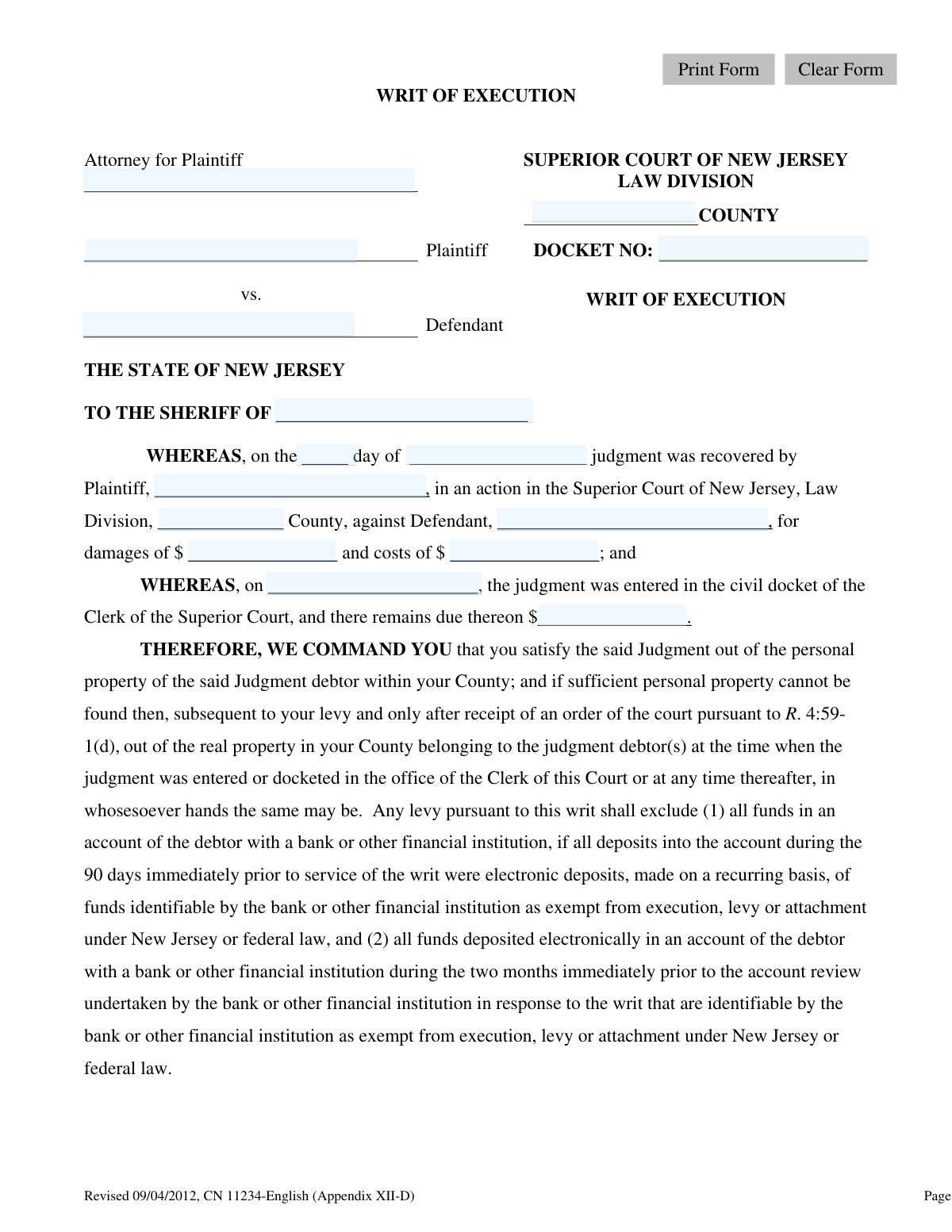
Yes! You can use AI to fill out Superior Court of New Jersey, Writ of Execution - Appendix XII-D
A Writ of Execution, specifically Appendix XII-D in New Jersey, is a legal document issued by the Superior Court after a plaintiff wins a monetary judgment. It commands the county sheriff to seize and sell the defendant's personal or real property to satisfy the debt owed to the plaintiff. This writ is a crucial step in the enforcement of a court-ordered financial judgment. Today, this form can be filled out quickly and accurately using AI-powered services like Instafill.ai, which can also convert non-fillable PDF versions into interactive fillable forms.
Our AI automatically handles information lookup, data retrieval, formatting, and form filling.
It takes less than a minute to fill out Appendix XII-D using our AI form filling.
Securely upload your data. Information is encrypted in transit and deleted immediately after the form is filled out.
Form specifications
| Form name: | Superior Court of New Jersey, Writ of Execution - Appendix XII-D |
| Number of fields: | 34 |
| Number of pages: | 1 |
| Language: | English |
Instafill Demo: How to fill out PDF forms in seconds with AI
How to Fill Out Appendix XII-D Online for Free in 2026
Are you looking to fill out a APPENDIX XII-D form online quickly and accurately? Instafill.ai offers the #1 AI-powered PDF filling software of 2026, allowing you to complete your APPENDIX XII-D form in just 37 seconds or less.
Follow these steps to fill out your APPENDIX XII-D form online using Instafill.ai:
- 1 Navigate to Instafill.ai and upload or select the New Jersey Writ of Execution (Appendix XII-D) form.
- 2 Provide the case information, including the Superior Court County, Docket Number, and the full names of the Plaintiff and Defendant.
- 3 Enter the details of the original judgment, such as the date it was recovered, the damage amount, and associated costs.
- 4 Input the total amount that remains due on the judgment and specify the name of the plaintiff's attorney who will receive the collected funds.
- 5 Use the AI tool to accurately calculate and populate the Endorsement section, including the judgment amount, additional costs, interest, credits, and sheriff's fees to determine the total.
- 6 Review all auto-filled information, including court details, dates, and monetary figures, to ensure complete accuracy before finalizing the document.
- 7 Download the completed Writ of Execution, have it signed by the appropriate parties, and file it with the Clerk of the Superior Court for issuance to the sheriff.
Our AI-powered system ensures each field is filled out correctly, reducing errors and saving you time.
Why Choose Instafill.ai for Your Fillable Appendix XII-D Form?
Speed
Complete your Appendix XII-D in as little as 37 seconds.
Up-to-Date
Always use the latest 2026 Appendix XII-D form version.
Cost-effective
No need to hire expensive lawyers.
Accuracy
Our AI performs 10 compliance checks to ensure your form is error-free.
Security
Your personal information is protected with bank-level encryption.
Frequently Asked Questions About Form Appendix XII-D
A Writ of Execution is a court order directing the County Sheriff to seize and sell a debtor's property to satisfy a monetary judgment. It is used by a plaintiff who has won a lawsuit to collect the money they are owed.
The plaintiff who won the judgment (the judgment creditor) or their attorney prepares this form. It is then submitted to the court to be officially issued by the Court Clerk.
You will need the court docket number, the names of the plaintiff and defendant, the date of the judgment, and the original judgment amount for damages and costs. You must also calculate the current amount due, including any post-judgment interest.
Yes, the form requires you to attach a statement showing how you calculated the post-judgment interest. This calculation must account for any partial payments the defendant has already made.
The completed writ is first filed with the Clerk of the Superior Court to be officially issued. Once issued, it is delivered to the Sheriff of the county where the debtor's assets are located.
You must calculate post-judgment interest as simple interest, according to New Jersey Court Rule 4:42-11. Remember to attach a separate document showing your calculation method.
Yes, but the writ exempts certain funds, such as recurring electronic deposits of benefits like Social Security. The bank is required to review the account for these exemptions before turning over any money.
If personal property is insufficient, the Sheriff can seize and sell the debtor's real property. However, this requires the plaintiff to first obtain a separate court order authorizing the sale of real estate.
The Sheriff must return the execution and a report of their actions to the Clerk of the Superior Court within twenty-four months from the date the writ was issued.
Yes, services like Instafill.ai use AI to auto-fill form fields accurately and save time. This can help reduce errors when entering repetitive information like case details, names, and addresses.
You can use a service like Instafill.ai to complete the form digitally. Simply upload the PDF, and the platform will allow you to type your information directly into the fields before printing or saving the document.
If you have a non-fillable or 'flat' PDF, you can use Instafill.ai to make it interactive. The service can convert the document into a fillable form, allowing you to easily type in your information online.
The 'Judgment Amount' is the original award from the court. The 'TOTAL' is the current amount owed, which includes the judgment amount plus any additional costs and interest, minus any credits or payments already made.
The Clerk of the Superior Court signs the writ, and the document is witnessed by a Judge of the Superior Court. This signature officially commands the Sheriff to act.
Compliance Appendix XII-D
Validation Checks by Instafill.ai
1
Validates Docket Number Format
This check ensures the 'docketNo' field conforms to the New Jersey court system's standard format, typically 'CTY-L-NNNNNN-YY'. Proper formatting is critical for the document to be correctly filed, indexed, and tracked by the court clerk. An incorrectly formatted docket number can lead to processing delays or outright rejection of the writ.
2
Verifies Chronological Order of Dates
This validation confirms the logical sequence of dates on the form. The 'Judgment Entered Date' ('jdgmtEnterDt') must be on or after the 'Judgment Recovered Date' ('jdgmtDtDay'/'jdgmtDtMoYr'), and the 'Writ Order Date' ('orderDtDay'/'orderDtMo'/'orderDtYr') must be on or after the 'Judgment Entered Date'. This is crucial for establishing a valid legal timeline, and any inconsistencies would render the writ legally defective.
3
Validates Endorsement Total Calculation
This check verifies the mathematical accuracy of the 'TOTAL' field in the Endorsement section. The system must confirm that 'totals' correctly equals ('judgment amount' + 'addl costs' + 'interest' + 'sheriffs fees' + 'sheriffs commissions') - 'credits'. An accurate total is essential for the Sheriff to know the exact amount to collect, and errors could lead to legal disputes over the collected funds.
4
Ensures Consistent County Name Usage
This validation ensures the county name is identical across the 'countyCaps', 'County', and 'ctySheriffName' fields. Consistency is vital for directing the writ to the correct county's Superior Court and Sheriff's office for execution. Mismatched county names could cause the writ to be sent to the wrong jurisdiction, making it unenforceable and causing significant delays.
5
Validates Consistency of Judgment Amounts
This check ensures the 'judgment amount' in the endorsement section accurately reflects the sum of the initial 'amount' (damages) and 'costs' from the main body of the writ. This cross-field validation maintains internal consistency and ensures the base amount for collection is correctly stated in the financial summary. A discrepancy could cause confusion and challenges to the writ's validity.
6
Validates Remaining Judgment Amount Logic
This check ensures the 'remains due thereon' amount ('jdgmtEnterAmt') is a positive value that is less than or equal to the total original judgment (damages + costs). This confirms that any prior payments are correctly accounted for and the amount sought is logical. An amount greater than the original judgment or a negative value would be invalid and lead to rejection.
7
Ensures All Monetary Fields are Numeric
This validation verifies that all fields representing dollar values (e.g., 'amount', 'costs', 'interest', 'credits') contain only valid numeric characters and a decimal point. This prevents data entry errors, such as entering text, which would corrupt financial calculations and make the writ's financial directives unenforceable. The system should enforce a standard currency format for these fields.
8
Confirms Consistent Plaintiff's Attorney Name
This check verifies that the attorney's name is identical across all fields where it appears ('plaAttyName', 'AttyAction', 'PlaAttyName'). This consistency is important for clarity and ensures there is no ambiguity regarding who is authorized to act on the plaintiff's behalf in this action. Inconsistencies could raise questions during the execution process by the Sheriff's office.
9
Key Party and Authority Information Completeness
This validation ensures that essential identifying fields, such as 'plaNameFull' (Plaintiff), 'defNameFull' (Defendant), 'judgeNameFull', and 'clerk', are not left blank. These names are fundamental to the writ's legal authority and purpose, identifying the parties involved and the court officials authorizing the action. An omission of any of these names would render the writ incomplete and invalid.
10
Validates Signature Date is Not in the Future
This check ensures the attorney's signature date ('sigDt'/'sigDtYr') is not set to a future date. The signature date attests to when the document was finalized and signed, and it must be the current date or a date in the past. A future date is illogical and would call into question the authenticity and timing of the document's execution.
11
Validates County Against Predefined List
This check validates the entered county name against an official list of New Jersey's 21 counties. This prevents misspellings or the entry of non-existent counties in fields like 'countyCaps' and 'County'. Using a standardized list ensures the writ is directed to a valid legal and administrative jurisdiction, preventing it from being lost or rejected.
12
Ensures All Date Fields are Valid Calendar Dates
This validation confirms that all date-related fields combine to form a real, valid calendar date (e.g., no 'February 30'). This applies to the judgment date, entry date, and order date. This basic data integrity check prevents data entry errors that could make the document's timeline ambiguous or legally void.
Common Mistakes in Completing Appendix XII-D
Filers often miscalculate the interest due by using compound interest instead of the required simple interest, or by failing to properly account for partial payments as required by R. 4:42-11. This leads to an incorrect total amount on the writ, which can cause the court clerk to reject the filing or lead to legal challenges from the debtor. To avoid this, meticulously calculate simple interest and clearly show how credits for partial payments were applied. AI-powered tools like Instafill.ai can help automate these complex calculations to ensure accuracy.
The form explicitly states that the method for calculating interest must be attached, as required by R. 4:59-1. Many filers overlook this requirement and submit the writ without the necessary supporting documentation. This is a common reason for immediate rejection by the court clerk, delaying the entire execution process. Always prepare a separate sheet detailing the interest calculation, including the principal, interest rate, time period, and any credits applied, and attach it to the submission.
The 'Endorsement' section requires a careful breakdown of all amounts, but people often make simple arithmetic errors when calculating the 'TOTAL'. Another frequent mistake is misinterpreting the 'Judgment Amount' field, failing to include pre-judgment costs and statutory attorney's fees as defined in the footnote. These errors result in an inaccurate final demand and will lead to the writ being returned for correction, halting enforcement efforts.
This form requires the county to be listed in multiple places, including for the court division and the Sheriff's office. Filers may enter the wrong county for execution, or enter inconsistent information across the fields. This can cause the writ to be sent to a Sheriff who has no jurisdiction over the debtor's assets, resulting in significant delays and the need to re-issue the writ. Double-check that the county where the judgment was entered and the county where assets are located are correctly and consistently identified.
The form asks for two distinct dates: the date the judgment was 'recovered' and the date it was 'entered' in the civil docket. People often confuse these two dates or use the same date for both. This is a critical error because the date of entry is used to establish priority and calculate post-judgment interest, so a mistake can invalidate the amounts claimed. Refer to the official court record to find the precise date for each event.
The full legal names of the Plaintiff and Defendant must be written exactly as they appear on the original judgment. Filers may use abbreviations, nicknames, or introduce typos, which can create ambiguity and give the Sheriff grounds to refuse execution. An incorrect name may also allow the debtor to challenge the writ's validity. To prevent this, carefully transcribe the names verbatim from the final judgment order.
The 'Credits' field in the Endorsement section is frequently left blank, even when the debtor has made partial payments on the judgment. This overstates the amount due, making the writ legally inaccurate and vulnerable to being voided. It is crucial to maintain a precise accounting of all funds received post-judgment and to declare them in the 'Credits' field to ensure the final amount is correct.
The docket number must be entered with the correct prefix (e.g., 'L' for Law Division), numbers, and year, exactly as it appears on court documents. Data entry errors, such as transposing numbers or omitting the prefix, will prevent the clerk from linking the writ to the correct case file. This results in an automatic rejection and requires the filer to correct and resubmit the form. AI form-filling tools like Instafill.ai can help prevent these errors by validating data formats as you type.
The 'WITNESS' clause requires the name of a Superior Court Judge, and the final line requires the name of the Clerk of the Superior Court. Filers often leave these fields blank because they are unsure of who to name. An incomplete writ is invalid and will be rejected by the court. Before filing, you must identify the current Assignment Judge for the vicinage and the statewide Clerk of the Superior Court to properly complete the form.
Saved over 80 hours a year
“I was never sure if my IRS forms like W-9 were filled correctly. Now, I can complete the forms accurately without any external help.”
Kevin Martin Green
Your data stays secure with advanced protection from Instafill and our subprocessors

Robust compliance program
Transparent business model
You’re not the product. You always know where your data is and what it is processed for.
ISO 27001, HIPAA, and GDPR
Our subprocesses adhere to multiple compliance standards, including but not limited to ISO 27001, HIPAA, and GDPR.
Security & privacy by design
We consider security and privacy from the initial design phase of any new service or functionality. It’s not an afterthought, it’s built-in, including support for two-factor authentication (2FA) to further protect your account.
Fill out Appendix XII-D with Instafill.ai
Worried about filling PDFs wrong? Instafill securely fills superior-court-of-new-jersey-writ-of-execution-appendix-xii-d forms, ensuring each field is accurate.