
Yes! You can use AI to fill out Form FL-305, Temporary Emergency (Ex Parte) Orders (Rev. January 1, 2026)
Don't type 130 fields by hand. Tell our AI about yourself, or upload a document you already have, and it fills every field in seconds. You check it, then download, print or sign.
The AI does the filling. You just check it.
No typing into boxes, nothing to install.
What this form asks for
The AI fills all of it, from your answers or your documents.
The AI checks your answers before you download
13 checks built for this form, so a wrong date or a missing answer is caught before anyone else sees it.
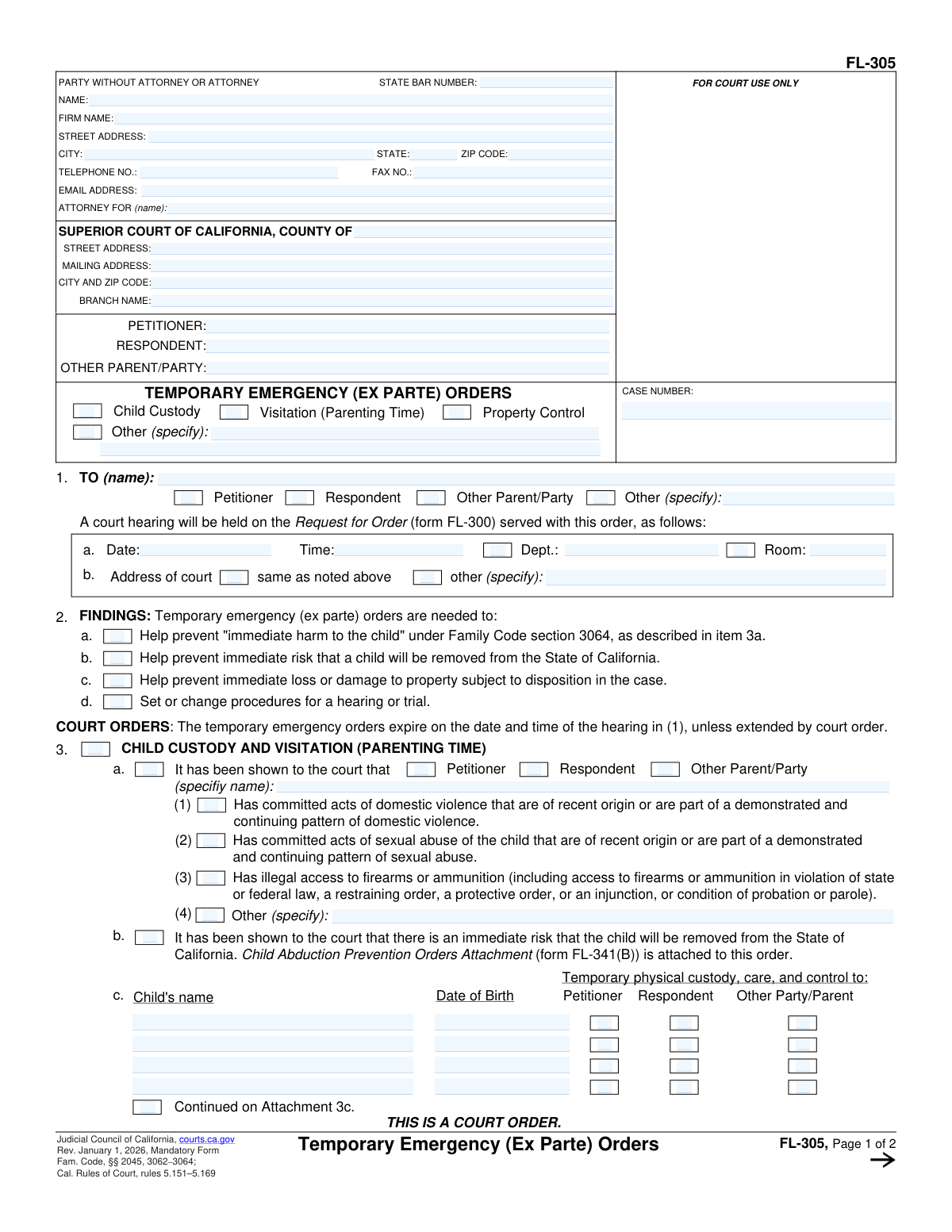
This check verifies that the 'CASE NUMBER' field is populated and is identical on both page 1 and page 2 of the form. The case number is the primary identifier for the legal proceeding, and any inconsistency can lead to filing errors, delays, or the document being rejected by the court clerk. This ensures the order is correctly associated with its case file.
Validates that the names for 'PETITIONER', 'RESPONDENT', and 'OTHER PARENT/PARTY' are consistent across the headers of both pages. Inconsistent party names can create legal ambiguity regarding who the order applies to and who is bound by its terms. This check prevents confusion and ensures the order is legally precise.
Ensures the 'Date' field in section 1a is a valid, future date. An emergency order is typically set for a hearing in the near future, so the date cannot be in the past. An invalid or past date would make the notice of hearing defective and the order unenforceable, requiring correction and re-issuance.
This check confirms that if the 'other' checkbox is selected in section 1b for the court address, the corresponding text field specifying the new address is not empty. Failing to provide the address makes the notice of hearing incomplete, preventing parties from knowing where to appear. This is critical for due process and to avoid having the hearing postponed.
Verifies that at least one checkbox is selected in section 2 ('FINDINGS'). The court must state the legal basis for issuing an emergency order, such as preventing harm to a child or damage to property. An order without a stated finding lacks a legal foundation and would be deemed invalid and unenforceable.
If any finding is checked in section 3a (e.g., domestic violence, child abuse), this validates that a name is specified and a party role (Petitioner, Respondent, etc.) is selected. The order must be clear about who is alleged to have committed the acts. Failure to identify the person makes the finding vague and legally deficient.
And 7 more checks
- Complete Child Information and Custody Award
- Conditional Specification of Travel Restriction Counties
- Conditional Specification of 'Other' Habitual Residence
- Completeness of Property Control Section
- Complete and Valid Payment Information
- Valid Judicial Officer Signature Date
- State Bar Number Format
Let AI fill out your FL-305
No typing. Every field filled in seconds, checked, ready to sign.
How to Fill Out FL-305 Online for Free in 2026
What the AI walks you through.
- Navigate to Instafill.ai and upload or select the FL-305 form.
- Use the AI tool to populate the header with court information, party names (Petitioner, Respondent), and the case number.
- Enter the scheduled court hearing details, including date, time, and location, in Section 1.
- Indicate the court's findings in Section 2 by checking the appropriate boxes for why the emergency orders are necessary.
- Detail the specific orders for child custody and visitation in Section 3, specifying custody arrangements and any travel restrictions.
- If applicable, complete Section 4 to outline property control orders, including temporary use of assets and payment responsibilities.
- Review all entered information for accuracy before saving or printing the completed order for the judicial officer's signature.
Common Mistakes in Completing FL-305
The ones the AI is built to catch.
Incomplete or Incorrect Case Header Information
Forgetting to Complete the Header on Page 2
Vague Justification for Emergency Orders
Omitting or Providing Incorrect Child Information
Proposing Unenforceable Visitation Schedules
Ambiguous Property Descriptions
Incomplete Debt Payment Instructions
Failing to Use Required Attachments
Confusing Petitioner and Respondent Roles
Illegible Handwriting or Formatting Errors
Frequently Asked Questions About FL-305
Is it really free for 7 days?
Can I fill other forms too?
How do I cancel?
How does the AI fill out FL-305?
What happens to my information?
How complex is FL-305 to fill out?
What is Form FL-305, Temporary Emergency (Ex Parte) Orders?
Who fills out this form?
Why is this called an 'emergency' or 'ex parte' order?
How long do the orders on Form FL-305 last?
I've been served with this form. What should I do?
What is needed to get a temporary emergency order for child custody?
What does the 'Property Control' section (Item 4) do?
Where do I find the date and time for my court hearing?
What happens if I violate a Temporary Emergency Order?
What is the difference between Form FL-305 and Form FL-300?
Can an AI tool help me with Form FL-305?
How can I use Instafill.ai to fill out my court forms online?
What should I do if the PDF form I need to fill out is not interactive?
Get your FL-305 filled out by AI
$0 today. Cancel before Nov 1 and you pay nothing.
Other forms like this one
California court forms: Judicial Council of California Form SC-105, Request for Court Order and Answer (Small Claims), Judicial Council of California Form SC-120, Defendant’s Claim and ORDER to Go to Small Claims Court (Small Claims), Judicial Council of California Form SER-001, Request for Sheriff to Serve Court Papers, Judicial Council of California Form SER-001, Request for Sheriff to Serve Court Papers, Affidavit for Collection of Personal Property California Probate Code Section 13100, Form POS-040, Proof of Service—Civil, Declaration of Facts of Death (California Superior Court), declaration-of-marriage-for-court-proceeding-california-family-law, ADOPT-200, Adoption Request, ADOPT-200, Stepparent Adoption Request, ADOPT-210, Adoption Agreement, ADOPT-310, Contact After Adoption Agreement, Judicial Council of California Form ADOPT-200, Adoption Request, Form ADR-107, Mediation Attendance Sheet, Form ADR-110, Order Appointing Referee, Form ADR-109, Stipulation or Motion for Order Appointing Referee, Form ADR-102, Request for Trial De Novo After Judicial Arbitration, Form ADR-108, Referee's Report (Code Civ. Proc., §§ 638, 639), Form ADR-106, Petition to Confirm, Correct, or Vacate Contractual Arbitration Award, Form ADR-104, Rejection of Award and Request for Trial After Attorney-Client Fee Arbitration
family law forms: Form 12.902(b), Family Law Financial Affidavit (Short Form), Florida Supreme Court Approved Family Law Form 12.901(b)(3), Petition for Dissolution of Marriage with No Dependent or Minor Child(ren) or Property (02/18), Form FL-170, Declaration for Default or Uncontested Dissolution or Legal Separation (Family Law), Form FL-100, Petition—Marriage/Domestic Partnership (Family Law), declaration-of-marriage-for-court-proceeding-california-family-law, Florida Supreme Court Approved Family Law Form 12.902(d), Uniform Child Custody Jurisdiction and Enforcement Act (UCCJEA) Affidavit, Florida Family Law Rules of Procedure Form 12.910(a), Summons: Personal Service on an Individual, Florida Supreme Court Approved Family Law Form 12.941(a), Petition for Enforcement of Out-of-State Custody Decree and for Order to Pick Up Minor Child(ren), Florida Supreme Court Approved Family Law Form 12.970(a), Petition for Temporary Custody by Extended Family, Form FL-110, Summons (Family Law), Form FL-120, Response—Marriage/Domestic Partnership (Family Law), ADOPT-200, Adoption Request, ADOPT-200, Stepparent Adoption Request, ADOPT-210, Adoption Agreement, ADOPT-310, Contact After Adoption Agreement, Adoption Assistance Program Nonrecurring Adoption Expense Agreement and Claim, Adoption Request (Stepparent), Adoption and Safe Families Act (ASFA) Survey, Florida Family Law Rules of Procedure Form 12.900(b), Notice of and Consent to Limited Appearance, Florida Family Law Rules of Procedure Form 12.900(d), Termination of Limited Appearance
family court forms: Form 12.995(c), Safety-Focused Parenting Plan, Florida Supreme Court Approved Family Law Form 12.901(b)(3), Petition for Dissolution of Marriage with No Dependent or Minor Child(ren) or Property (02/18), Form N161, Appellant’s notice (All appeals except small claims track appeals and appeals to the Family Division of the High Court), Form N161, Appellant's Notice (All appeals except small claims track appeals and appeals to the Family Division of the High Court), declaration-of-marriage-for-court-proceeding-california-family-law, Florida Supreme Court Approved Family Law Form 12.902(d), Uniform Child Custody Jurisdiction and Enforcement Act (UCCJEA) Affidavit, Florida Supreme Court Approved Family Law Form 12.941(a), Petition for Enforcement of Out-of-State Custody Decree and for Order to Pick Up Minor Child(ren), Florida Supreme Court Approved Family Law Form 12.970(a), Petition for Temporary Custody by Extended Family, Adoption Request (Stepparent), Florida Family Law Rules of Procedure Form 12.900(b), Notice of and Consent to Limited Appearance, Florida Family Law Rules of Procedure Form 12.900(d), Termination of Limited Appearance, Florida Family Law Rules of Procedure Form 12.900(e), Acknowledgment of Assistance by Attorney, Florida Family Law Rules of Procedure Form 12.900(g), Agreement Limiting Representation, Florida Family Law Rules of Procedure Form 12.900(h), Notice of Related Cases, Florida Family Law Rules of Procedure Form 12.901(a), Joint Petition for Simplified Dissolution of Marriage, Form 12.902(b), Family Law Financial Affidavit (Short Form), Florida Family Law Rules of Procedure Form 12.902(c), Family Law Financial Affidavit (Long Form), Florida Family Law Rules of Procedure Form 12.902(e), Child Support Guidelines Worksheet, Florida Supreme Court Approved Family Law Form 12.902(f)(1), Marital Settlement Agreement for Dissolution of Marriage with Dependent or Minor Child(ren), Florida Supreme Court Approved Family Law Form 12.902(f)(2), Marital Settlement Agreement for Dissolution of Marriage with Property but No Dependent or Minor Child(ren)
Let AI fill out your FL-305
Your trial starts once a card is added. You pay nothing before Nov 1.
Our AI already knows this form, all 130 fields of it. Skip the typing: tell it about yourself, or upload what you have, and it fills the whole form in seconds.
- AI fills every field on both pages, checkboxes included
- No typing into boxes: answer a few questions, or upload a document you already have, an old copy of this form, a photo of a document
- The AI checks the answers; you review and change anything before you download
- Download the finished PDF, print it, or sign it online
- Encrypted, and never used to train AI
Cancel before Nov 1 and you pay nothing.
A card is needed to start the trial. Cancel in two clicks from your account.
Terms · Privacy