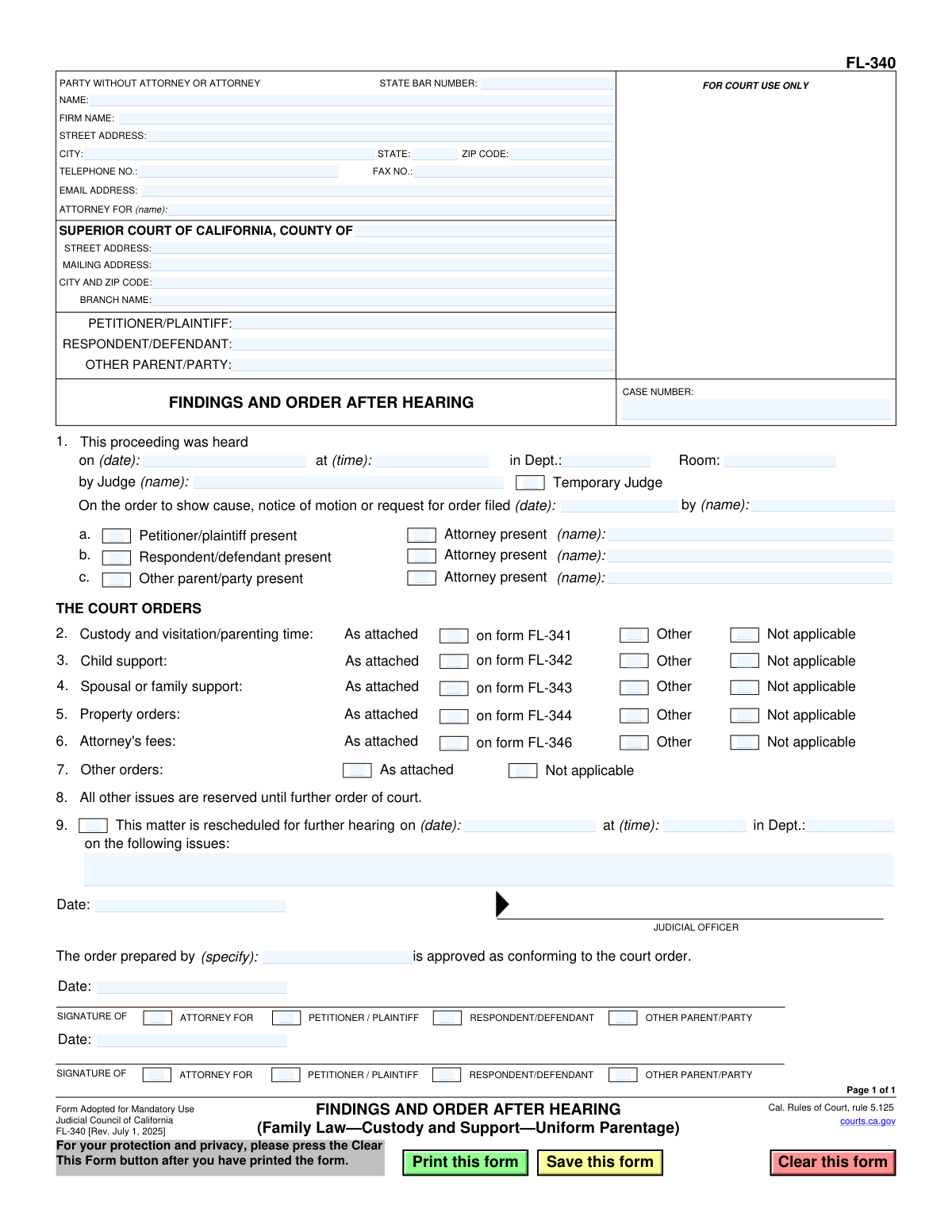
Yes! You can use AI to fill out Form FL-340, Findings and Order After Hearing (Family Law—Custody and Support—Uniform Parentage)
Form FL-340, Findings and Order After Hearing, is a critical legal document used in California Superior Courts to officially record a judge's rulings following a hearing in a family law case, including matters of custody, support, and property division. This form serves as the official court order, making the decisions legally enforceable for all parties involved. Today, this form can be filled out quickly and accurately using AI-powered services like Instafill.ai, which can also convert non-fillable PDF versions into interactive fillable forms.
FL-340 is part of the
California court forms, family court forms and family law forms categories on Instafill.
Our AI automatically handles information lookup, data retrieval, formatting, and form filling.
It takes less than a minute to fill out FL-340 using our AI form filling.
Securely upload your data. Information is encrypted in transit and deleted immediately after the form is filled out.
Form specifications
| Form name: | Form FL-340, Findings and Order After Hearing (Family Law—Custody and Support—Uniform Parentage) |
| Number of fields: | 76 |
| Number of pages: | 1 |
| Language: | English |
Instafill Demo: How to fill out PDF forms in seconds with AI
How to Fill Out FL-340 Online for Free in 2026
Are you looking to fill out a FL-340 form online quickly and accurately? Instafill.ai offers the #1 AI-powered PDF filling software of 2026, allowing you to complete your FL-340 form in just 37 seconds or less.
Follow these steps to fill out your FL-340 form online using Instafill.ai:
- 1 Navigate to Instafill.ai and upload or select Form FL-340.
- 2 Use the AI assistant to input attorney/party information, court details, and the case number in the header section.
- 3 Enter the specific details of the hearing, including the date, time, department, and the judge's name.
- 4 Indicate which parties and attorneys were present at the hearing by checking the appropriate boxes.
- 5 Mark the checkboxes corresponding to the court's orders for custody (FL-341), child support (FL-342), spousal support (FL-343), property (FL-344), and attorney's fees (FL-346), noting whether the details are attached on those specific forms.
- 6 Fill in any other specific orders or note if the matter is rescheduled for a future hearing date.
- 7 Review the entire completed form for accuracy, then download it to be signed by the judicial officer and attorneys before filing with the court.
Our AI-powered system ensures each field is filled out correctly, reducing errors and saving you time.
Why Choose Instafill.ai for Your Fillable FL-340 Form?
Speed
Complete your FL-340 in as little as 37 seconds.
Up-to-Date
Always use the latest 2026 FL-340 form version.
Cost-effective
No need to hire expensive lawyers.
Accuracy
Our AI performs 10 compliance checks to ensure your form is error-free.
Security
Your personal information is protected with bank-level encryption.
Frequently Asked Questions About Form FL-340
Form FL-340 is a legal document used in California family law cases to summarize and formalize the judge's decisions made during a court hearing. It serves as the official written record of the court's orders on issues like custody, support, and property.
Typically, the judge will instruct one of the attorneys or a self-represented party to prepare this form to reflect the verbal orders made in court. The form is then submitted to the judge for review and a final signature to make it an official order.
No, this form is completed *after* a hearing to document the judge's rulings. Before a hearing, you would typically file a form like a Request for Order (FL-300) to ask the court to make decisions.
Those are mandatory attachment forms that provide the specific details for each order. For example, if the judge makes custody orders, Form FL-341 (Child Custody and Visitation Order Attachment) must be completed and attached to this FL-340 summary form.
For each topic the judge ruled on (e.g., Child Support), you must check the box indicating that an order was made. You will then check if the detailed order is on an attached form (like FL-342) or if it's written elsewhere on the form.
The Judicial Officer (the judge) must sign the form to make it a legally binding order. Attorneys or parties may also be required to sign it to confirm that the written document accurately reflects the orders made in court.
This is a standard legal clause that means any issues not specifically addressed in this order can be brought before the court for a decision at a future date. It keeps those topics open for later consideration.
If a future hearing was scheduled, you must fill out section 9 with the new date, time, department, and the specific issues that will be discussed at that hearing.
If the form does not accurately reflect the judge's verbal orders, you should immediately notify your attorney or, if you are self-represented, the other party's attorney or the court clerk. If you disagree with the judge's actual decision, you should seek legal advice about your options, such as filing for reconsideration or an appeal.
Yes, services like Instafill.ai use AI to help you accurately populate form fields with your case information, party details, and court data. This can save time and reduce the chance of making clerical errors.
You can upload the form to the Instafill.ai platform, which will make the document interactive. You can then easily click and type to enter the hearing details and check the appropriate boxes as ordered by the court.
If you have a non-fillable or 'flat' PDF, you can use a service like Instafill.ai. Its technology can convert the static document into an interactive, fillable form that you can complete online, save, and print.
Compliance FL-340
Validation Checks by Instafill.ai
1
Mandatory Case Number
This check ensures that the 'CASE NUMBER' field is not empty. The case number is a unique identifier for the legal proceeding in the court system. Without it, the form cannot be correctly filed or associated with the proper case, leading to processing failure and delays.
2
Hearing Date Presence and Format
Validates that the hearing date in section 1, 'on (date)', is provided and is in a valid date format (e.g., MM/DD/YYYY). This date is fundamental to the order's context, establishing when the findings were made. An invalid or missing date would render the order legally questionable.
3
Logical Hearing Reschedule Date
This check ensures that the 'rescheduled for further hearing on (date)' in section 9 is chronologically after the initial hearing date in section 1. A hearing cannot be rescheduled to a date before it originally took place. This validation prevents logical impossibilities and data entry errors.
4
Attorney Presence Name Consistency
Verifies that if an 'Attorney present' checkbox is checked for any party in section 1, the corresponding attorney name field is filled out. This is crucial for creating an accurate court record of who was present at the hearing. A failure would mean the record is incomplete and potentially inaccurate.
5
Mandatory Party Identification
Ensures that at least the 'PETITIONER/PLAINTIFF' or 'RESPONDENT/DEFENDANT' field is populated. A legal case must have defined parties. Submitting a form without identifying the primary parties would make it impossible to process as it lacks fundamental context.
6
Exclusive Order Selection
For each order type in sections 2 through 7, this check confirms that only one option ('As attached', 'Other', or 'Not applicable') is selected. Selecting multiple options for a single order type creates ambiguity and contradiction. This validation ensures the court's order is clear and unequivocal.
7
Email Address Format
Validates that the value entered in the 'EMAIL ADDRESS' field follows the standard format for an email address (e.g., [email protected]). This is important for ensuring that electronic communications and service of documents are sent to a valid destination. An invalid format would lead to communication failures.
8
State Bar Number Format
This check verifies that the 'STATE BAR NUMBER' field contains only numeric characters. State Bar numbers are unique numerical identifiers for licensed attorneys. This validation helps ensure the attorney listed is properly identified and is a legitimate, registered legal professional.
9
Judicial Officer Signature Date Requirement
Ensures the 'Date' field next to the 'JUDICIAL OFFICER' signature line is filled. An order is not legally effective until it is signed and dated by the presiding judicial officer. A missing date would invalidate the entire order.
10
Motion Filing Date Logic
This validation confirms that the 'order...filed (date)' in section 1 is on or before the 'This proceeding was heard on (date)'. A hearing is held in response to a filed motion, so the filing date cannot be after the hearing date. This prevents clerical and logical errors in the court record.
11
Attorney Information Completeness
If an attorney's name is provided in the header, this check ensures that the 'STATE BAR NUMBER' and 'ATTORNEY FOR (name)' fields are also completed. This is necessary for the complete and unambiguous identification of the legal counsel and the party they represent. Incomplete information can cause confusion and filing rejections.
12
ZIP Code Format Validation
Verifies that the 'ZIP CODE' field in the attorney/party address block is a valid 5-digit or 9-digit (ZIP+4) format. Correct formatting is essential for the successful delivery of physical mail and official notices. An incorrect format could lead to returned mail and missed deadlines.
13
Mandatory Court County
This check ensures the 'COUNTY OF' field is filled out under 'SUPERIOR COURT OF CALIFORNIA'. This specifies the legal jurisdiction for the case, which is a critical piece of information for filing and enforcement. A blank county field would make it impossible to determine which court has authority.
14
Judge Name Presence
Validates that the 'Judge (name)' field in section 1 is not empty. It is essential for the legal record to identify the specific judicial officer who presided over the hearing and issued the order. A missing name creates ambiguity about the order's authority.
Common Mistakes in Completing FL-340
Self-represented parties often get confused by the header section, which asks for attorney information. They may leave it blank or enter their details incorrectly, leading to rejection or communication issues. If you are representing yourself (pro per), you must fill in your own name, address, and contact information, and then write your name again after the 'ATTORNEY FOR (name):' prompt.
The case number is the single most important identifier for your filing. A simple typo, transposed digit, or leaving it blank will cause the document to be rejected or misfiled, leading to major delays and potentially voiding the order. Always double-check the case number against a previous court notice or filing to ensure it is 100% accurate.
In sections 2-7, filers must check a box indicating how an order is specified, often by attaching another form (e.g., FL-341 for custody). A frequent and serious error is checking a box for an attachment but failing to include the corresponding form. This makes the order incomplete and unenforceable, requiring correction and refiling. Always verify that every form checked as 'attached' is included in your submission packet.
Section 1 requires checking boxes to create a record of who was present at the hearing. People often rush and forget to complete this section, or they incorrectly mark an attorney as present for a self-represented party. This creates an inaccurate legal record of the proceeding and can cause the form to be returned by the clerk. Carefully review your notes from the hearing to correctly document all attendees.
This form has fields for the hearing that just occurred (Section 1) and a potential future hearing (Section 9). A common error is to enter the future hearing date in Section 1, which misrepresents the court record about when the findings were made. Carefully read each section to ensure you are entering the date for the hearing that these findings are based upon in Section 1, and only use Section 9 if the judge explicitly set a new date.
The names for the Petitioner, Respondent, and any other party must be spelled exactly the same way across all court documents. Using nicknames, initials, or creating minor spelling variations can cause the court's electronic filing system to reject the document or create duplicate, confusing case entries. To avoid this, copy the names precisely from the initial Petition or another official court document in the case file.
Near the bottom of the form, a line reads 'The order prepared by (specify):'. It is mandatory to state who drafted the document, whether it was an attorney or a self-represented party. Overlooking this field is a common reason for the court clerk to reject the form, delaying the finalization of the court's orders until it is corrected and resubmitted.
Filers often enter the main county courthouse address instead of the specific branch where the case is being heard (e.g., 'Family Law Courthouse, West District'). This can cause the document to be sent to the wrong location, delaying filing until it is rerouted. Always verify the exact branch name and address from your official court notices. AI-powered form filling tools like Instafill.ai can help prevent this by saving and correctly auto-filling specific court information.
When using the 'Other' checkbox in sections 2-7, parties sometimes write in orders that are ambiguous, subjective, or not legally enforceable. For example, 'Parties will be reasonable' is not a clear, actionable order. Any custom order must be specific, measurable, and directive to be of any value and to be enforceable by the court later on.
The signature lines for attorneys or self-represented parties have checkboxes to specify whether the signatory is the Petitioner, Respondent, or Other Party. Many people sign the form but forget to check the corresponding box. This small omission creates ambiguity and can cause the clerk to reject the filing until the simple but necessary correction is made.
When this form is found as a non-fillable PDF, people often print it and fill it out by hand, leading to illegible entries. Poor handwriting can cause the court clerk to make data entry errors or reject the form entirely. To ensure clarity, it is best to use the official fillable version or a service like Instafill.ai, which can convert flat PDFs into fillable forms that can be typed into, ensuring a clean and legible submission.
Saved over 80 hours a year
“I was never sure if my IRS forms like W-9 were filled correctly. Now, I can complete the forms accurately without any external help.”
Kevin Martin Green
Your data stays secure with advanced protection from Instafill and our subprocessors

Robust compliance program
Transparent business model
You’re not the product. You always know where your data is and what it is processed for.
ISO 27001, HIPAA, and GDPR
Our subprocesses adhere to multiple compliance standards, including but not limited to ISO 27001, HIPAA, and GDPR.
Security & privacy by design
We consider security and privacy from the initial design phase of any new service or functionality. It’s not an afterthought, it’s built-in, including support for two-factor authentication (2FA) to further protect your account.
Fill out FL-340 with Instafill.ai
Worried about filling PDFs wrong? Instafill securely fills form-fl-340-findings-and-order-after-hearing-family-lawcustody-and-supportuniform-parentage forms, ensuring each field is accurate.