Yes! You can use AI to fill out Form FL-341(D), Additional Provisions—Physical Custody Attachment
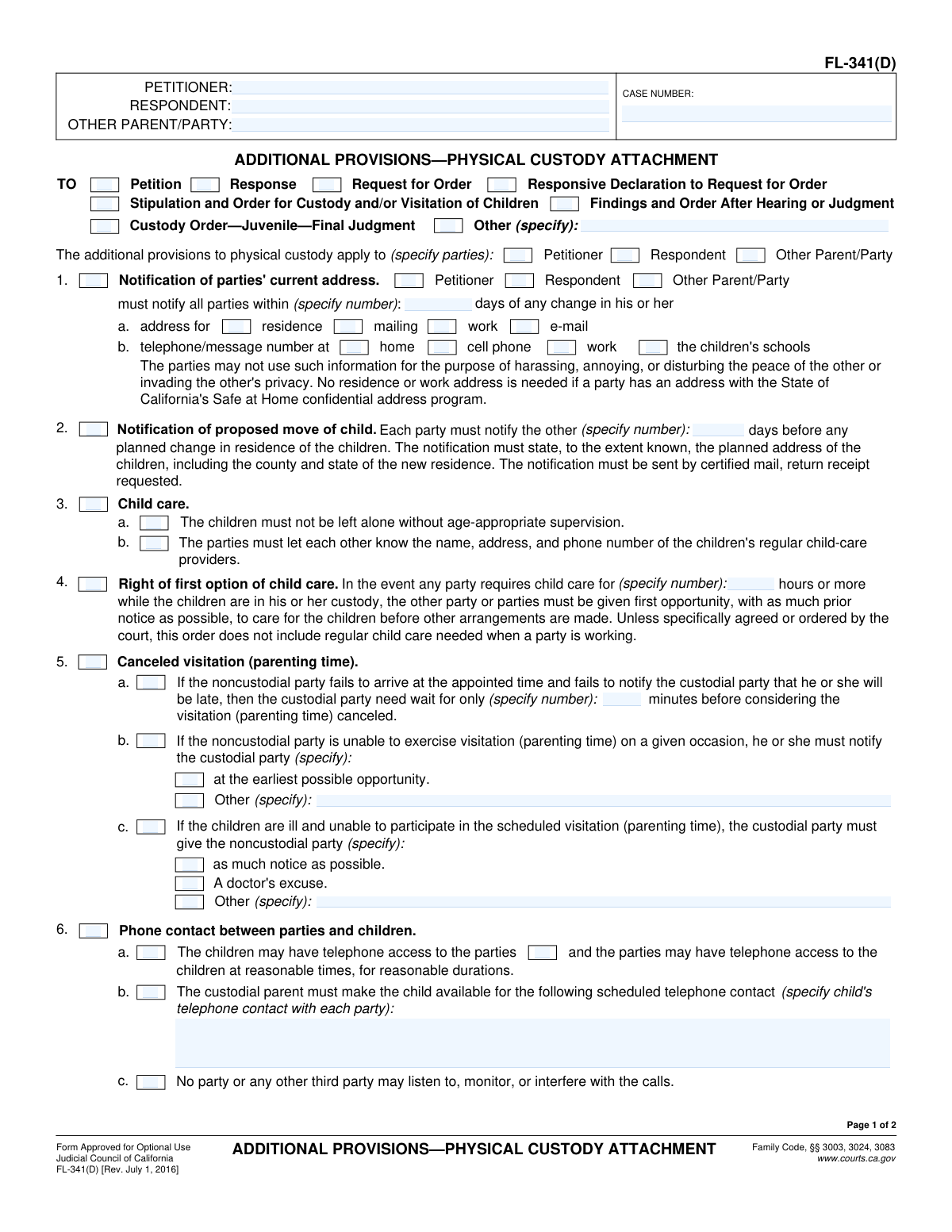
Form FL-341(D), the Additional Provisions—Physical Custody Attachment, is a legal document used in California family law to supplement a custody and visitation order. It allows parents or the court to define specific rules regarding visitation logistics, communication protocols, child care, and parental conduct to prevent future disputes. Today, this form can be filled out quickly and accurately using AI-powered services like Instafill.ai, which can also convert non-fillable PDF versions into interactive fillable forms.
FL-341(D) is part of the
California court forms, family court forms and family law forms categories on Instafill.
Our AI automatically handles information lookup, data retrieval, formatting, and form filling.
It takes less than a minute to fill out FL-341(D) using our AI form filling.
Securely upload your data. Information is encrypted in transit and deleted immediately after the form is filled out.
Form specifications
| Form name: | Form FL-341(D), Additional Provisions—Physical Custody Attachment |
| Number of fields: | 85 |
| Number of pages: | 1 |
| Language: | English |
Instafill Demo: How to fill out PDF forms in seconds with AI
How to Fill Out FL-341(D) Online for Free in 2026
Are you looking to fill out a FL-341(D) form online quickly and accurately? Instafill.ai offers the #1 AI-powered PDF filling software of 2026, allowing you to complete your FL-341(D) form in just 37 seconds or less.
Follow these steps to fill out your FL-341(D) form online using Instafill.ai:
- 1 Navigate to Instafill.ai and upload the FL-341(D) form or select it from their template library.
- 2 Enter the case information at the top of the form, including the names of the Petitioner, Respondent, Other Parent/Party, and the Case Number.
- 3 Indicate which primary court document this attachment relates to by checking the appropriate box (e.g., Petition, Request for Order, Judgment).
- 4 Go through each provision from 1 to 17, checking the boxes for the rules that will apply to your custody arrangement.
- 5 Use the AI-powered fields to fill in specific details required by the selected provisions, such as time limits, names, or custom agreements in the 'Other' sections.
- 6 Carefully review all the selected provisions and entered information to ensure they accurately reflect the court's order or the parties' agreement.
- 7 Download the completed form, sign it if required, and file it with the court as an attachment to your primary custody order.
Our AI-powered system ensures each field is filled out correctly, reducing errors and saving you time.
Why Choose Instafill.ai for Your Fillable FL-341(D) Form?
Speed
Complete your FL-341(D) in as little as 37 seconds.
Up-to-Date
Always use the latest 2026 FL-341(D) form version.
Cost-effective
No need to hire expensive lawyers.
Accuracy
Our AI performs 10 compliance checks to ensure your form is error-free.
Security
Your personal information is protected with bank-level encryption.
Frequently Asked Questions About Form FL-341(D)
This form, FL-341(D), is a California court attachment used to add specific, detailed rules to a physical custody and visitation order. It helps clarify expectations for co-parenting on topics like communication, travel, and child care.
This form is completed by parents or parties involved in a custody case. It can be attached to various court documents, such as a petition, a response, or a final judgment, to formalize agreed-upon or court-ordered parenting rules.
You will need your court case number, the full names of the petitioner, respondent, and any other parties, and the specific details you want to define, such as the number of days for notice or minutes to wait for a late parent.
This provision means that if a parent needs child care for a specified number of hours, they must first offer the other parent the opportunity to care for the children before making other arrangements.
Section 5 allows you to specify a grace period, in minutes, that the custodial party must wait for the noncustodial party. If the noncustodial party doesn't arrive or call within that time, the visitation can be considered canceled.
The form requires a parent to provide a specific number of days' notice to the other party before a planned change in the children's residence. This notification must be sent via certified mail and include the new address, if known.
No, section 1 states that a residence or work address is not required if a party is enrolled in the State of California's 'Safe at Home' confidential address program.
Yes, sections 7, 8, and 11 prohibit parents from making negative comments about each other, discussing court proceedings, or using the children as messengers.
A log book is a notebook that travels with the children between homes. Parents use it to record factual, businesslike notes about the children's health, education, and welfare to ensure consistent care.
Yes, section 16 states that terms can be changed by a written agreement signed by both parties. However, for the change to be an enforceable court order, it must be filed with the court.
This section allows you to specify that a parent may not consume alcohol, narcotics, or restricted drugs within a certain number of hours before or during their parenting time.
Yes, services like Instafill.ai use AI to help you accurately auto-fill form fields from your documents, which saves time and helps prevent common errors.
You can use a service like Instafill.ai to fill out the form online. Simply upload the PDF, and the platform's AI will help you complete the necessary fields quickly and accurately.
If you have a non-fillable or 'flat' PDF, you can use a tool like Instafill.ai. It can convert the document into an interactive, fillable form that you can easily complete on your computer.
Compliance FL-341(D)
Validation Checks by Instafill.ai
1
Case Information Consistency
Validates that the Case Number, Petitioner, and Respondent names are identical on both page 1 and page 2. This is crucial for ensuring the document is internally consistent and legally sound, as it's a multi-page attachment to a single case. If the information does not match, the form submission should be flagged for manual review to prevent filing errors.
2
Attachment Context Required
Ensures that at least one checkbox is selected at the top of the form to specify the context of the attachment (e.g., 'Petition', 'Response', 'Request for Order'). This information is vital for the court to understand how this document fits into the larger legal proceeding. A failure to select an option would make the document's purpose ambiguous and should prevent submission.
3
Applicable Party Specification
Checks that at least one party (Petitioner, Respondent, Other) is selected to indicate who the additional provisions apply to. Without this specification, the entire agreement is unenforceable and lacks clarity. If no party is selected, the user must be prompted to choose at least one before proceeding.
4
Conditional 'Other' Party Name
Verifies that if the 'Other (specify)' checkbox is selected in the 'provisions apply to' section, the corresponding text field ('SpecifyOtherAttachment_tf') is not empty. This ensures that when a non-standard party is indicated, their name or role is explicitly defined. If the checkbox is checked but the field is empty, an error should be displayed.
5
Canceled Visitation Grace Period Value
Validates that if the 'Canceled visitation' provision for a late noncustodial party is selected, the 'minutes' field ('NumberMinutes_no') must contain a positive integer. This ensures the grace period is a clear, specific, and enforceable number. A non-numeric or empty value would render the clause useless and should trigger a validation error.
6
Conditional 'Other' Canceled Visitation Reason
Ensures that if the 'Other (specify)' checkbox is selected under section 5b (noncustodial party unable to exercise visitation), the corresponding text field ('OtherIfUNable_ft') must be filled out. This prevents an ambiguous selection and forces the user to define the specific notification requirement. If the field is left blank, the submission should be halted until the details are provided.
7
Right of First Option Hours
Checks that if the 'Right of first option of child care' provision (Section 4) is selected, the 'hours' field ('NumberHour_no') is filled with a positive integer. This number defines the threshold for when the provision is triggered, and it must be a specific value to be enforceable. An empty or non-numeric entry should be rejected.
8
Proposed Move Notification Days
Verifies that if the 'Notification of proposed move of child' provision (Section 2) is selected, the 'days' field ('NumberDays_no') must contain a positive integer. This is a critical legal requirement for notifying the other party of a move. The validation ensures the timeframe is explicitly stated, preventing submission with an incomplete clause.
9
Scheduled Phone Contact Details
Validates that if the 'scheduled telephone contact' checkbox (Section 6c) is selected, the corresponding text field ('PhoneContactDetails_ft') must not be empty. This ensures that the specific schedule (e.g., 'Tuesdays and Thursdays at 7 PM') is defined, making the agreement clear and enforceable. An empty field would make the provision meaningless.
10
Alcohol Abstinence Period Value
Ensures that if the 'Alcohol or substance abuse' provision (Section 10) is checked, the 'hours' field ('NumberHour_no' on page 2) must be filled with a positive integer. This number is critical for defining the abstinence window before and during parenting time. The validation prevents an incomplete and unenforceable clause from being submitted.
11
Alcohol Abstinence Party Selection
Verifies that if the 'Alcohol or substance abuse' provision (Section 10) is checked, at least one party (Petitioner, Respondent, or Other) must also be selected for the rule to apply to. The rule is meaningless without a subject. If the main checkbox is checked but no party is selected, the user should be prompted to specify who the rule applies to.
12
Third-Party 'No Contact' Name
Validates that if the 'The children will have no contact with' checkbox (Section 14a) is selected, the corresponding name field ('NameNocontact_ft') must be filled in. This is a protective order, and it is critically important to explicitly name the individual. An empty name field makes the provision completely unenforceable and must be prevented.
13
Third-Party 'Supervision Required' Name
Checks that if 'The children must not be left alone in the presence of' checkbox (Section 14b) is selected, the corresponding name field ('PersonsNotAllowedAloneWChildren_ft') is not empty. Similar to the 'no contact' rule, this protective measure requires the explicit identification of the individual to be effective. The form should not be accepted if this field is blank while the option is selected.
14
Conditional 'Other' Provisions Text
Ensures that if the 'Other' checkbox in Section 17 is selected, the large text area ('OtheProvisions_ft') for custom provisions must contain text. This prevents a user from checking the box intending to add a provision but forgetting to write it. An empty text area for a selected 'Other' option should trigger a validation error.
Common Mistakes in Completing FL-341(D)
Users often check a box to activate a provision but forget to fill in the associated number, such as the number of minutes in Section 5 (Canceled visitation) or the number of hours in Section 10 (Alcohol or substance abuse). This mistake renders the entire clause ambiguous and unenforceable, as the core parameter is missing. To avoid this, carefully review every checked provision and ensure that all corresponding blanks for days, hours, or minutes are filled with a clear, specific number.
A frequent error is failing to fill out the case number and party names on the header of the second page after completing the first. People assume the information carries over, but on a paper or flat PDF form, it does not. This can lead to the second page being misplaced or rejected during court filing, potentially invalidating half of the agreed-upon provisions. Always ensure the header information is identically completed on all pages of the document.
In Section 17, parties attempt to write their own custom legal clauses but often use vague, emotional, or legally unsound language. For example, writing "Parties must be nice to each other" is unenforceable. This happens due to a lack of legal expertise and results in provisions that are ignored by the court or become a source of future conflict. It is crucial to either use clear, objective language or seek legal advice when adding custom terms.
When filling out Section 14 (Third-party contact), individuals often use informal names or descriptions like "Sarah's new boyfriend" instead of the person's full legal name. This makes the order extremely difficult to enforce, as the identity of the restricted person is not legally clear. To create an enforceable order, always use the full, correct legal name of any individual being restricted from contact with the children.
At the very top of the form, users must check a box to indicate which primary legal document this attachment belongs to (e.g., Petition, Response, Request for Order). Forgetting to do this creates legal ambiguity, as it's unclear what motion or order these provisions are intended to modify. This can delay court proceedings or weaken the attachment's legal standing. Always check the box that corresponds to the main document you are filing.
In Section 6c, which allows for scheduled telephone contact, people frequently write vague terms like "regularly" or "at reasonable times." This lack of specificity is a common cause of conflict, as each parent may have a different interpretation of what is reasonable. To prevent disputes, the schedule should be explicitly defined with days, times, and duration (e.g., "Tuesdays and Thursdays from 7:00 PM to 7:15 PM").
In Section 4, parties either leave the number of hours blank or enter an impractical number, making the 'right of first option' clause problematic. An empty field renders the clause unenforceable, while a poorly chosen number (e.g., 1 hour) can create an excessive notification burden for simple errands. This mistake stems from not fully considering the practical implications. Parties should agree on a reasonable threshold, such as 4 hours or more, to trigger this right.
For Section 2, parties may enter a number of days for move-away notification that conflicts with state law (e.g., entering '15 days' when the statute requires 45). This occurs due to ignorance of legal requirements and can render the provision void. It is essential to research the specific legal requirements for your jurisdiction and ensure the number of days meets or exceeds the statutory minimum to be valid.
In Section 1, a party might only check the box for 'residence' address, neglecting to require updates for 'work,' 'mailing,' 'cell phone,' or 'e-mail.' This oversight allows the other party to become unreachable by changing their phone number without notice, disrupting co-parenting and emergency communication. To avoid this, parties should select all relevant methods of communication that must be kept current.
In provisions like Section 10 (Alcohol or substance abuse), the form requires checking a box to specify whether the rule applies to the 'petitioner,' 'respondent,' or 'other parent/party.' It is a common mistake to fill in the number of hours but forget to check which party is bound by the restriction. This omission makes the rule completely unenforceable, as it is not directed at anyone. Always ensure a party is designated for every specific restriction.
Saved over 80 hours a year
“I was never sure if my IRS forms like W-9 were filled correctly. Now, I can complete the forms accurately without any external help.”
Kevin Martin Green
Your data stays secure with advanced protection from Instafill and our subprocessors

Robust compliance program
Transparent business model
You’re not the product. You always know where your data is and what it is processed for.
ISO 27001, HIPAA, and GDPR
Our subprocesses adhere to multiple compliance standards, including but not limited to ISO 27001, HIPAA, and GDPR.
Security & privacy by design
We consider security and privacy from the initial design phase of any new service or functionality. It’s not an afterthought, it’s built-in, including support for two-factor authentication (2FA) to further protect your account.
Fill out FL-341(D) with Instafill.ai
Worried about filling PDFs wrong? Instafill securely fills form-fl-341d-additional-provisionsphysical-custody-attachment forms, ensuring each field is accurate.