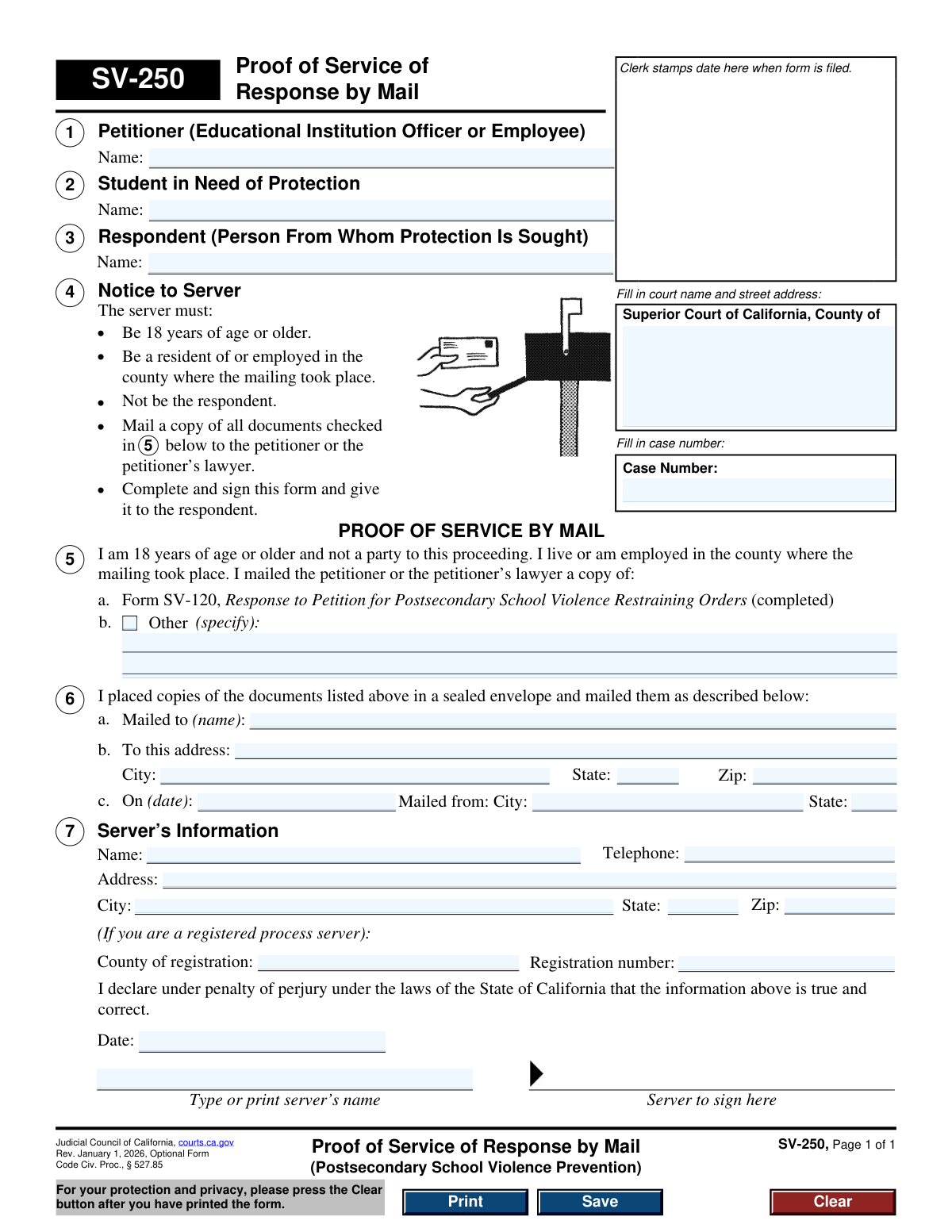
Yes! You can use AI to fill out Form SV-250, Proof of Service of Response by Mail (Postsecondary School Violence Prevention)

Form SV-250, Proof of Service of Response by Mail, is a legal document used within the California court system to provide official proof that a respondent's response to a petition for a postsecondary school violence restraining order has been delivered to the petitioner by mail. This form is completed by a neutral third party (the server) and filed with the court to ensure the legal process is followed correctly. Today, this form can be filled out quickly and accurately using AI-powered services like Instafill.ai, which can also convert non-fillable PDF versions into interactive fillable forms.
SV-250 is part of the California court forms, court response forms and proof of service forms categories on Instafill.
Our AI automatically handles information lookup, data retrieval, formatting, and form filling.
It takes less than a minute to fill out SV-250 using our AI form filling.
Securely upload your data. Information is encrypted in transit and deleted immediately after the form is filled out.

Form specifications

Form name: Form SV-250, Proof of Service of Response by Mail (Postsecondary School Violence Prevention)
Number of fields: 28
Number of pages: 1
Language: English
main-image

Instafill Demo: How to fill out PDF forms in seconds with AI

How to Fill Out SV-250 Online for Free in 2026

Are you looking to fill out a SV-250 form online quickly and accurately? Instafill.ai offers the #1 AI-powered PDF filling software of 2026, allowing you to complete your SV-250 form in just 37 seconds or less.
Follow these steps to fill out your SV-250 form online using Instafill.ai:
  1. 1 Navigate to Instafill.ai and upload or select Form SV-250.
  2. 2 Use the AI assistant to automatically fill in the court name, street address, and case number at the top of the form.
  3. 3 Enter the full names of the Petitioner, the Student in Need of Protection, and the Respondent in sections 1, 2, and 3.
  4. 4 In section 5, check the box for Form SV-120 and list any other documents that were mailed to the petitioner.
  5. 5 Complete section 6 with the name and address of the person the documents were mailed to, along with the date and location of the mailing.
  6. 6 The server must fill in their personal information in section 7, including name, address, and telephone number. If they are a registered process server, they must also provide their registration details.
  7. 7 Review all entered information for accuracy, then have the server date and sign the form to declare the information is true and correct before downloading for filing.

Our AI-powered system ensures each field is filled out correctly, reducing errors and saving you time.

Why Choose Instafill.ai for Your Fillable SV-250 Form?

Speed

Complete your SV-250 in as little as 37 seconds.

Up-to-Date

Always use the latest 2026 SV-250 form version.

Cost-effective

No need to hire expensive lawyers.

Accuracy

Our AI performs 10 compliance checks to ensure your form is error-free.

Security

Your personal information is protected with bank-level encryption.

Frequently Asked Questions About Form SV-250

This form is a legal proof filed with the court to show that the respondent's response to a petition for a restraining order was mailed to the petitioner. It confirms that the petitioner has been officially notified of the response.

This form must be completed and signed by a 'server,' who is a person 18 or older, not involved in the case, and who performed the mailing. The respondent cannot be the server.

No, you cannot. The form explicitly states the server must not be a party to the proceeding, which includes the respondent.

A server must be at least 18 years old, not be the respondent in the case, and be a resident of or employed in the county where the documents are mailed from.

The server must mail a copy of the completed Form SV-120, Response to Petition for Postsecondary School Violence Restraining Orders. Any other documents served must also be listed on Form SV-250.

After the server completes, signs, and returns the form to you, you must file the original signed SV-250 with the court clerk. Keep a copy for your own records.

You can find the court name, address, and case number on the petition documents you received from the petitioner. It is important to copy this information exactly as it appears on those forms.

The Petitioner is the school official who filed the case, the Student is the person the case aims to protect, and the Respondent is the person from whom protection is sought. These names should match the other court documents.

Yes, services like Instafill.ai use AI to help you accurately auto-fill form fields, which saves time and reduces the risk of errors. The server, however, must still provide a physical signature.

You can use a service like Instafill.ai to upload the PDF and fill it out on your computer. This allows you to easily type information into the fields before printing the form for the server to sign.

If you have a non-fillable or 'flat' PDF, you can use a tool like Instafill.ai. It can convert the flat PDF into an interactive, fillable form that you can complete online.

The server must enter their full name, telephone number, and address. If they are a professional registered process server, they must also include their county of registration and registration number.

This is a sworn legal statement confirming that the information provided about the mailing is true and correct. Providing false information can lead to serious legal consequences for the server.

Compliance SV-250
Validation Checks by Instafill.ai

1
Case Number Presence and Format
Verifies that the 'Case Number' field is not empty and follows the expected court format. The case number is a critical identifier for filing and associating this document with the correct legal proceeding. If the case number is missing or incorrect, the form may be rejected by the court clerk, delaying the legal process.
2
Completeness of All Party Names
Ensures that the names for the 'Petitioner', 'Student in Need of Protection', and 'Respondent' are all provided. These fields are essential for identifying all parties involved in the case. Missing information could lead to ambiguity and the rejection of the proof of service.
3
Server Cannot Be the Respondent
Compares the name in 'Server’s Information' (Section 7) against the name in 'Respondent' (Section 3). The law requires service to be performed by a neutral third party, not a party to the case. If the server is the respondent, the service is invalid and will be legally rejected.
4
Conditional 'Other' Document Specification
Checks that if the 'Other' checkbox in Section 5 is marked, the corresponding text field specifying the document(s) is filled out. This ensures a complete record of all documents that were served. Failure to specify the 'Other' documents can render the proof of service incomplete and challengeable.
5
Mailing Date Validity and Logic
Validates that the mailing date in Section 6c is a complete and valid date that is not in the future. The date of mailing is a crucial legal fact establishing when the service was completed. An invalid or future date would make the proof of service logically impossible and legally void.
6
Server Signature Date Validity
Ensures the 'Date' field in Section 7 is a valid, non-future date. This date represents when the server declared the information to be true under penalty of perjury. An invalid or future date would invalidate this declaration and the entire form.
7
Logical Date Sequence
Verifies that the server's signature date (Section 7) is on or after the date the documents were mailed (Section 6c). A server cannot legally attest to having mailed documents before the mailing has actually occurred. An illogical date sequence would invalidate the proof of service.
8
Server's Printed Name Consistency
Confirms that the server's printed name below the signature line matches the server's name provided in the 'Server's Information' section. This consistency is required to clearly identify the person making the declaration. A mismatch could raise questions about the identity of the server and the validity of the service.
9
Server's Telephone Number Format
Checks that the telephone number provided in Section 7 is in a valid format (e.g., 10 digits with an optional area code). This contact information is important in case the court or other parties need to contact the server to verify the service. An invalid number hinders communication and may cast doubt on the server's legitimacy.
10
Completeness of 'Mailed To' Address
Ensures that the full address in Section 6b, including street, city, state, and ZIP code, is completely filled out. A complete address is necessary to prove that the documents were sent to the correct location. Incomplete information could be grounds for challenging the validity of the service.
11
Completeness of Server's Address
Validates that the server's full address in Section 7, including street, city, state, and ZIP code, is provided. This information is required to identify the server and verify they meet the legal requirement of residing or being employed in the county of mailing. Missing address details can lead to the form's rejection.
12
ZIP Code Format Validation
Verifies that the ZIP code fields in both the 'Mailed To' address (Section 6b) and the 'Server's Information' address (Section 7) follow a standard 5-digit or 9-digit (ZIP+4) format. Correct formatting is crucial for mail delivery and data integrity. An invalid format could suggest a data entry error or an invalid address.
13
State Abbreviation Validation
Checks that the state fields in both the 'Mailed To' address (Section 6b) and the 'Server's Information' address (Section 7) contain a valid two-letter U.S. state or territory abbreviation. This ensures address accuracy and standardization. An incorrect or misspelled state could invalidate the address and the proof of service.
14
Mailing Origin Location Completeness
Ensures that both the 'City' and 'State' fields under 'Mailed from' in Section 6c are filled out. This information establishes the jurisdiction from which the service was mailed, which is legally significant. Omitting this information makes it impossible to verify that the server complied with location-based service requirements.

Common Mistakes in Completing SV-250

Using an Ineligible Server

The most critical mistake is having the Respondent (the person the restraining order is against) serve the documents. The form explicitly states in Section 4 that the server must not be a party to the case. This error instantly invalidates the service, meaning the court will not consider the response filed, which can lead to default judgments. To avoid this, the respondent must ask another adult (over 18), who is not involved in the case, to be the server.

Omitting or Incorrectly Entering Case Information

Forgetting to fill in the complete court name and address, or entering the wrong case number at the top of the form, is a frequent error. This information is essential for the court clerk to associate the proof of service with the correct case file. An incomplete or incorrect case number will lead to the form being rejected, causing delays and leaving the court with no record that the response was served. Always copy this information exactly from the petition or other official court documents.

Mismatching Party Names

The names of the Petitioner, Student, and Respondent in Sections 1, 2, and 3 must exactly match the names on the original petition. People often use nicknames, initials, or misspell names, which creates ambiguity and can be grounds for the form's rejection. This can cause legal confusion about who the service pertains to. To prevent this, carefully copy the full legal names of all parties as they appear on the initial court filings.

Failing to Specify Served Documents in Section 5

The server must check the box for each document they mailed. Often, filers overlook Section 5, assuming it's obvious that the Response (Form SV-120) was included. Without checking box 5a or detailing other documents under 5b, the proof of service is incomplete and legally insufficient. This is because it doesn't attest to *what* was served, making the entire proof invalid and subject to rejection by the court.

Using the Wrong Date of Mailing

The date entered in Section 6c must be the exact date the documents were placed in the mail, not the date the form was filled out. A common mistake is to pre-fill the form and then mail the documents a day or two later. Since this form is signed under penalty of perjury, an incorrect date is a false statement and can invalidate the service. The server should fill out this section immediately after mailing the documents to ensure accuracy.

Forgetting the Server's Signature

A printed name in the signature box is not legally binding; a physical signature is required. The server often prints their name on the 'Type or print server's name' line and forgets to sign above it. An unsigned declaration is invalid, and the court will reject the form outright. This means the service is not proven, and the respondent must have the server sign and then re-file the form, causing critical delays.

Prematurely Signing the Declaration

The server signs and dates the form in Section 7 before they have actually mailed the documents described in Section 6. The signature attests, under penalty of perjury, that the mailing has already occurred as described. Signing beforehand makes the declaration technically false at the moment of signing. To avoid this procedural error, the server must complete the mailing first, then fill out and sign the form.

Providing Incomplete Server Information

All fields in Section 7, including the server's full name, address, and telephone number, must be completed. People sometimes leave the address or phone number blank, viewing it as private information. However, this information is required for the court to verify the server's eligibility (e.g., that they reside in the county of mailing) and to contact them if necessary. Incomplete information can lead to the form's rejection or a challenge to the validity of the service.

Not Filing the Original Form with the Court

After the server completes and signs the SV-250, the respondent must file the original signed document with the court clerk. A common misunderstanding is that the process is finished once the server signs the form. If the form is not filed, the court has no official record that the petitioner was served, and the respondent's Response (SV-120) may not be considered by the judge. The respondent should also keep a copy for their own records.

Submitting an Illegible Form

When forms are filled out by hand, illegible handwriting can make it impossible for the court clerk to read critical information like names, addresses, and the case number. If the clerk cannot decipher the information, the form will be rejected, forcing the filer to start over. To avoid this, it is best to type the information. AI-powered tools like Instafill.ai can convert flat PDFs into fillable versions and populate fields clearly and accurately, preventing legibility issues.
Saved over 80 hours a year

“I was never sure if my IRS forms like W-9 were filled correctly. Now, I can complete the forms accurately without any external help.”

Kevin Martin Green

Your data stays secure with advanced protection from Instafill and our subprocessors

Robust compliance program

Transparent business model

You’re not the product. You always know where your data is and what it is processed for.

ISO 27001, HIPAA, and GDPR

Our subprocesses adhere to multiple compliance standards, including but not limited to ISO 27001, HIPAA, and GDPR.

Security & privacy by design

We consider security and privacy from the initial design phase of any new service or functionality. It’s not an afterthought, it’s built-in, including support for two-factor authentication (2FA) to further protect your account.

Fill out SV-250 with Instafill.ai

Worried about filling PDFs wrong? Instafill securely fills form-sv-250-proof-of-service-of-response-by-mail-postsecondary-school-violence-prevention forms, ensuring each field is accurate.

Related forms by category

California court forms Judicial Council of California Form SC-105, Request for Court Order and Answer (Small Claims), Judicial Council of California Form SC-120, Defendant’s Claim and ORDER to Go to Small Claims Court (Small Claims), Judicial Council of California Form SER-001, Request for Sheriff to Serve Court Papers, Judicial Council of California Form SER-001, Request for Sheriff to Serve Court Papers, Affidavit for Collection of Personal Property California Probate Code Section 13100, Form POS-040, Proof of Service—Civil, Declaration of Facts of Death (California Superior Court), declaration-of-marriage-for-court-proceeding-california-family-law, ADOPT-200, Adoption Request, ADOPT-200, Stepparent Adoption Request, ADOPT-210, Adoption Agreement, ADOPT-310, Contact After Adoption Agreement, Judicial Council of California Form ADOPT-200, Adoption Request, Form ADR-107, Mediation Attendance Sheet, Form ADR-110, Order Appointing Referee, Form ADR-109, Stipulation or Motion for Order Appointing Referee, Form ADR-102, Request for Trial De Novo After Judicial Arbitration, Form ADR-108, Referee's Report (Code Civ. Proc., §§ 638, 639), Form ADR-106, Petition to Confirm, Correct, or Vacate Contractual Arbitration Award, Form ADR-104, Rejection of Award and Request for Trial After Attorney-Client Fee Arbitration · + 557 more →
court response forms Form MC 03, Answer, Civil, Request for Reasonable Accommodations and Response, MC 70a, Review of Request for Reasonable Accommodations and Response, Form CH-120, Response to Request for Civil Harassment Restraining Orders, Form CH-178, Response to Request for Release of Minor's Confidential Information (Civil Harassment Prevention), Form CH-620, Response to Request to Modify/Terminate Civil Harassment Restraining Order (Civil Harassment Prevention), Form DV-120, Response to Request for Domestic Violence Restraining Order (Domestic Violence Prevention), Form DV-178, Response to Request for Release of Minor's Confidential Information (Domestic Violence Prevention), Form EA-720, Response to Request to Renew Restraining Order (Elder or Dependent Adult Abuse Prevention), Form CR-402, Prosecuting Agency's Response to Petition/Application Under Health and Safety Code Section 11361.8—Adult Crimes, Form CR-417, Response by District Attorney to Petition to Terminate Sex Offender Registration, Form EA-250, Proof of Service of Response by Mail (Elder or Dependent Adult Abuse Prevention), Form EA-320, Response to Request for Elder or Dependent Adult Restraining Order Allowing Contact, Form CH-720, Response to Request to Renew Restraining Order (Civil Harassment Prevention), Form DV-720, Response to Request to Renew Restraining Order (Domestic Violence Prevention), Form EA-120, Response to Request for Elder or Dependent Adult Abuse Restraining Orders, Form FL-220, Response to Petition to Determine Parental Relationship (Uniform Parentage), Judicial Council of California Form GV-020, Response to Gun Violence Emergency Protective Order (Gun Violence Prevention), Form GV-120, Response to Petition for Gun Violence Restraining Order, Form FL-270, Response to Petition for Custody and Support of Minor Children · + 6 more →
proof of service forms Form POS-040, Proof of Service—Civil, Judicial Council of California Form SC-104, Proof of Service (Small Claims), Judicial Council of California Form SC-104, Proof of Service (Small Claims), Form DV-200, Proof of Personal Service (CLETS) (Domestic Violence Prevention), Illinois Circuit Court Eviction Summons and Proof of Service of Eviction Summons & Eviction Complaint (Form E-S 3507.3), proof-of-electronic-service-appellate, Form APP-009, Proof of Service (Appellate Division), Form APP-109, Proof of Service (Appellate Division), Form GC-020(P), PROOF OF PERSONAL SERVICE OF NOTICE OF HEARING— GUARDIANSHIP OR CONSERVATORSHIP, Form APP-109E, Proof of Electronic Service (Appellate Division), Proof of Personal Service of Notice of Initial Appearance—CARE Act Proceedings, Form CARE-116, Proof of Personal Service of Notice of Hearing—CARE Act Proceedings, Form CR-106, Proof of Service — Criminal Record Clearing, CARE-107, Proof of Personal Service of Notice of Order for CARE Act Report, Form CIV-120, Notice of Entry of Dismissal and Proof of Service, Form DAL-012, Proof of Service—Disability Access Litigation, Form DE-120(P), Proof of Personal Service of Notice of Hearing—Decedent's Estate or Trust, Form EA-200, Proof of Personal Service (Elder or Dependent Adult Abuse Prevention), Form EA-260, Proof of Service of Order After Hearing by Mail (Elder or Dependent Adult Abuse Prevention), Form FL-115, Proof of Service of Summons (Family Law—Uniform Parentage—Custody and Support) · + 30 more →