Yes! You can use AI to fill out Form DE-140, Order for Probate

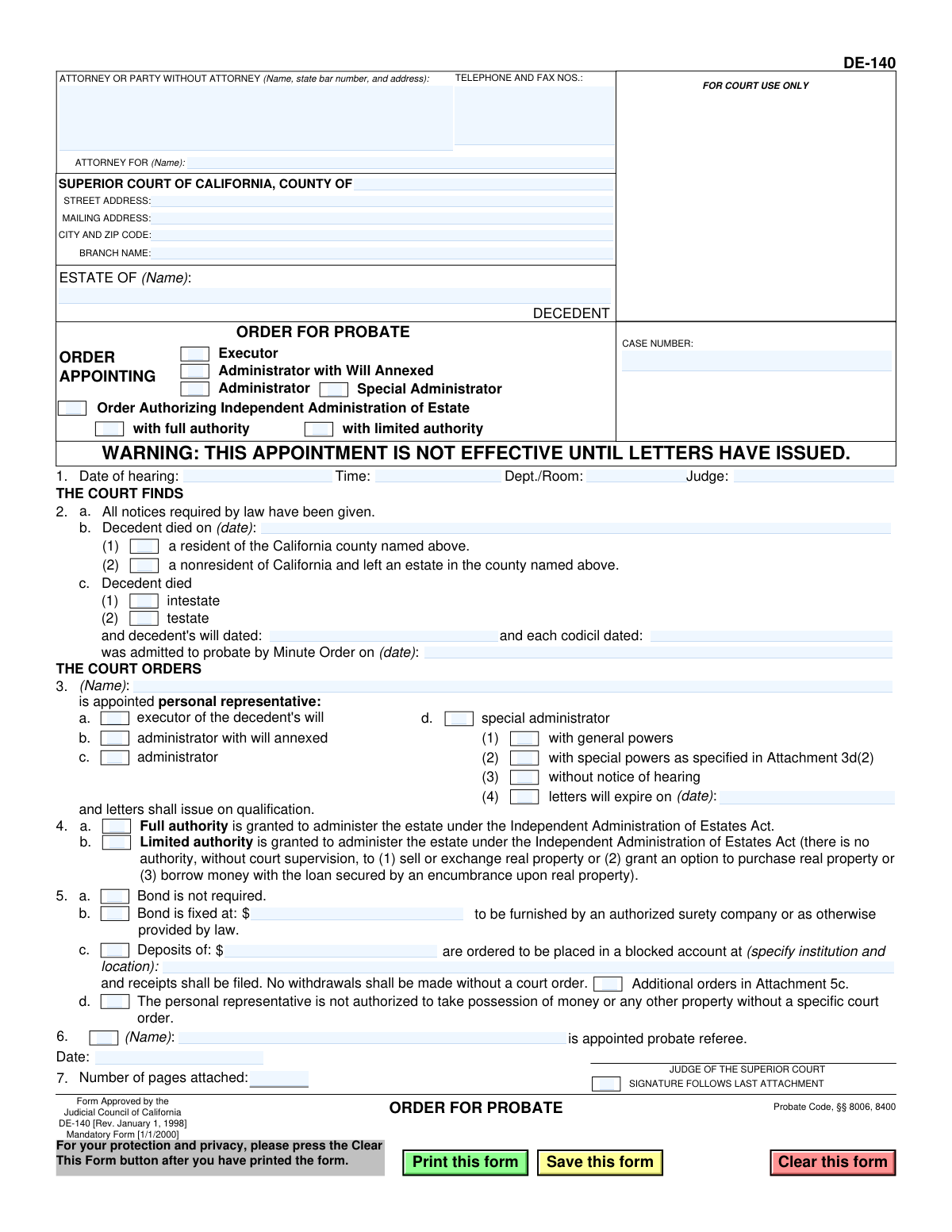
Form DE-140, the Order for Probate, is a legal document issued by the Superior Court of California to formalize its decisions in a probate case. It confirms the date of the decedent's death, admits the will to probate if one exists, and officially appoints a personal representative (such as an executor or administrator) to manage the estate. This order is a critical step in the probate process, granting the appointed individual the legal authority to act on behalf of the estate. Today, this form can be filled out quickly and accurately using AI-powered services like Instafill.ai, which can also convert non-fillable PDF versions into interactive fillable forms.
DE-140 is part of the California court forms, California probate forms and California state forms categories on Instafill.
Our AI automatically handles information lookup, data retrieval, formatting, and form filling.
It takes less than a minute to fill out DE-140 using our AI form filling.
Securely upload your data. Information is encrypted in transit and deleted immediately after the form is filled out.

Form specifications

Form name: Form DE-140, Order for Probate
Number of fields: 58
Number of pages: 1
Language: English
main-image

Instafill Demo: How to fill out PDF forms in seconds with AI

How to Fill Out DE-140 Online for Free in 2026

Are you looking to fill out a DE-140 form online quickly and accurately? Instafill.ai offers the #1 AI-powered PDF filling software of 2026, allowing you to complete your DE-140 form in just 37 seconds or less.
Follow these steps to fill out your DE-140 form online using Instafill.ai:
  1. 1 Navigate to Instafill.ai and upload the DE-140 form or select it from the template library.
  2. 2 Provide the court and case information, including the county, court address, branch name, and case number.
  3. 3 Enter the decedent's name and details about their death, such as the date and their residency status.
  4. 4 Fill in the court's findings, specifying whether the decedent died with a will (testate) or without (intestate), and the date the will was admitted to probate.
  5. 5 Detail the court's orders, including the name of the person being appointed as the personal representative and their specific role (e.g., executor, administrator).
  6. 6 Indicate the bond requirements as determined by the court and specify the level of authority granted under the Independent Administration of Estates Act.
  7. 7 Review all the information you've entered for accuracy, then download the completed Form DE-140 to be signed by the judge and filed with the court.

Our AI-powered system ensures each field is filled out correctly, reducing errors and saving you time.

Why Choose Instafill.ai for Your Fillable DE-140 Form?

Speed

Complete your DE-140 in as little as 37 seconds.

Up-to-Date

Always use the latest 2026 DE-140 form version.

Cost-effective

No need to hire expensive lawyers.

Accuracy

Our AI performs 10 compliance checks to ensure your form is error-free.

Security

Your personal information is protected with bank-level encryption.

Frequently Asked Questions About Form DE-140

This form is a court order signed by a judge after a probate hearing. It officially appoints a personal representative for an estate, admits the decedent's will to probate if one exists, and sets the conditions for managing the estate.

Typically, the attorney for the person petitioning for probate prepares the form for the judge's review. However, it is the Judge of the Superior Court who ultimately signs and issues this form, making it an official court order.

Not quite. As the warning on the form states, the appointment is not effective until 'Letters' have been issued by the court clerk. The signed order is the necessary step that allows the clerk to issue these Letters, which then grant you authority to act.

An Executor is named in the decedent's will to manage the estate. An Administrator is appointed by the court when the decedent died without a will (intestate), or when the person named in the will cannot or will not serve.

This refers to the Independent Administration of Estates Act (IAEA). Full authority allows the personal representative to take many actions, including selling real property, without court supervision. Limited authority requires court approval for major actions like selling, exchanging, or borrowing against real property.

A bond is like an insurance policy that protects the estate's beneficiaries and creditors from financial loss due to mismanagement or fraud by the personal representative. The court determines the amount, though it can be waived in the will or by the heirs.

A probate referee is a state-appointed appraiser assigned by the court to determine the fair market value of the estate's non-cash assets, such as real estate, stocks, and personal property. This appraisal is necessary for managing and closing the estate.

You will need the case number, court details, the decedent's name and date of death, the name of the person being appointed, and the details from the hearing, such as the bond amount and authority level granted by the judge.

A blocked account is a bank or financial account where estate funds are deposited and cannot be withdrawn without a specific court order. This is often used as an alternative to a large bond to protect the estate's cash assets.

Yes, AI-powered services like Instafill.ai can help you accurately pre-fill form fields with case information, which saves time and helps prevent errors. This is especially useful for attorneys and paralegals who prepare these forms for the judge's signature.

You can use a service like Instafill.ai to fill out the form online. Simply upload the DE-140 PDF, and you can fill in all the required fields directly in your web browser before printing it for submission.

If you have a non-fillable or 'flat' PDF, you can use a tool like Instafill.ai. It can convert static PDFs into interactive, fillable forms that you can easily complete and save online.

A decedent died 'testate' if they had a valid will. A decedent died 'intestate' if they did not have a will.

Compliance DE-140
Validation Checks by Instafill.ai

1
Case Number Presence and Format
Ensures the 'CASE NUMBER' field is not empty and conforms to the expected format for the specified court. The case number is a critical unique identifier for filing and retrieving the document within the court system. A missing or malformed case number will lead to filing rejection or misfiling.
2
Decedent's Name Completeness
Validates that the 'ESTATE OF (Name)' field is filled out with the full name of the decedent. This field is the primary subject of the legal order, and its absence makes the document legally meaningless. Failure to provide the decedent's name would render the entire order invalid.
3
Date of Death Validation
Checks that the 'Decedent died on (date)' field contains a valid date in a recognized format (e.g., MM/DD/YYYY). The validation also confirms that the date is in the past and precedes the hearing date. An invalid or future date of death would be a logical and legal impossibility.
4
Residency Status Selection
Verifies that exactly one of the two residency options in section 2b ('a resident of the California county named above' or 'a nonresident of California') is selected. The decedent's residency status is a key jurisdictional fact that must be clearly established. Selecting none or both options creates ambiguity and makes the finding incomplete.
5
Will Date Requirement for Testate Estates
If the 'testate' checkbox is selected in section 2c, this validation ensures that the 'decedent's will dated' field is populated with a valid date. A testate finding is incomplete without identifying the specific will being admitted to probate. This prevents incomplete orders for estates with a will.
6
Appointee Role Consistency
Performs a logical check between the decedent's status (section 2c) and the appointee's role (section 3b). If 'intestate' is checked, the role should be 'Administrator'. If 'testate' is checked, the role should be 'Executor' or 'Administrator with Will Annexed'. This prevents the issuance of a legally contradictory order.
7
Personal Representative Name Requirement
Ensures that a name is provided in section 3a, where the personal representative is appointed. An order appointing a representative is not effective without identifying the specific individual or entity being appointed. A blank field would make this section of the order unenforceable.
8
Administration Authority Exclusivity
Validates that in section 4, either 'Full authority' or 'Limited authority' is selected, but not both. These are mutually exclusive grants of power under the Independent Administration of Estates Act. Selecting both or neither would create ambiguity regarding the representative's powers.
9
Bond Status Logic
Checks for mutual exclusivity among the bond options in section 5. If 'Bond is not required' (5a) is checked, then 'Bond is fixed at' (5b) and 'Deposits of' (5c) must be empty. This ensures the order provides a single, clear directive regarding the requirement of a probate bond.
10
Bond Amount Validation
If the 'Bond is fixed at' checkbox (5b) is selected, this validation ensures the corresponding field contains a positive numeric value. The bond amount cannot be zero, negative, or non-numeric. This is crucial for ensuring the estate's assets are protected to the level ordered by the court.
11
Blocked Account Details Requirement
Verifies that if 'Deposits of' (5c) is selected, the fields for the deposit amount, institution name, and location are all filled out. An order to block accounts is unenforceable without specifying where the funds are to be held. This check ensures the order is complete and actionable.
12
Hearing Date and Death Date Chronology
Confirms that the 'Date of hearing' in section 1 occurs on or after the 'Decedent died on (date)' in section 2a. A hearing about an estate cannot logically take place before the decedent has passed away. This check prevents fundamental chronological errors in the court record.
13
Special Administrator Expiration Date Logic
If the 'special administrator' role is selected and the 'letters will expire on (date)' option is used in section 3d, this check ensures the provided date is a valid future date. A special administration is temporary by nature, and an expired or past date would render the appointment immediately invalid upon issuance. This ensures the appointment has a defined, forward-looking term.
14
Attachment Page Count Format
Ensures the 'Number of pages attached' field contains a valid, non-negative integer (e.g., 0, 1, 5). This number is used by the court clerk to verify that the submitted document is complete and all referenced attachments are present. A non-integer or negative value would be invalid.

Common Mistakes in Completing DE-140

Using an Inconsistent Decedent Name

A frequent error is entering a variation of the decedent's name that does not exactly match the name on the death certificate and the initial Petition for Probate. Using nicknames, initials, or having typos can create significant legal ambiguity about the identity of the deceased. This can lead to the rejection of the form, delays in the probate process, and potential challenges to the validity of the order. Always use the full, correct legal name as it appears on all other official court and vital records.

Selecting the Incorrect Personal Representative Role

This form provides several options for the personal representative's title, such as Executor, Administrator, or Administrator with Will Annexed. People often misunderstand these legal terms and check the wrong box. For example, an 'Executor' is named in a will, while an 'Administrator' is appointed when there is no will. Selecting the incorrect role makes the order legally flawed and will cause it to be rejected by the court, requiring correction and resubmission.

Misunderstanding Full vs. Limited IAEA Authority

The choice in Section 3 between 'full authority' and 'limited authority' under the Independent Administration of Estates Act (IAEA) is critical and often misunderstood. A self-represented person might not grasp that 'limited authority' restricts them from selling real estate or borrowing against it without court supervision. Choosing the wrong option can either grant unintended powers or create unnecessary administrative hurdles and court costs, both of which can harm the estate. This decision should align with the request made in the original petition and the needs of the estate.

Errors in the Bond Section

Section 4, concerning the probate bond, is a common source of mistakes. Errors include leaving the section blank, incorrectly calculating the bond amount, or failing to provide required details for blocked accounts. The bond is a financial safeguard for the estate, and any error or omission in this section will prevent the court from issuing 'Letters,' which are the official documents that grant the representative authority to act. This effectively halts the entire probate administration until the bond is correctly addressed.

Entering Incorrect or Incomplete Court Information

Filers often provide a generic address for the county courthouse instead of the specific street address and branch name of the probate division. Each county may have multiple courthouses, and probate matters are typically handled at a specific location. This mistake can cause the document to be misrouted, delayed, or rejected by the clerk's office. Always verify the precise court address and branch name for probate filings on the county's Superior Court website before filling out the form.

Omitting or Incorrectly Dating Wills and Codicils

When a decedent died 'testate' (with a will), Section 1 requires listing the exact date of the will and any subsequent amendments (codicils). A common mistake is omitting these dates, transcribing them incorrectly, or forgetting to list all codicils. This creates uncertainty about which testamentary documents the court is officially recognizing, potentially leading to future legal challenges and disputes over the will's validity. All dates must be transcribed perfectly from the original documents.

Transcribing the Case Number Incorrectly

A simple typographical error when entering the case number is one of the most common and disruptive mistakes. The case number is the unique identifier for the entire probate proceeding. An incorrect number will cause the clerk to be unable to file the document in the correct case file, leading to its outright rejection or it being lost in the system. This can cause critical delays and require refiling. AI-powered form filling tools like Instafill.ai can help prevent this by saving and accurately populating recurring information like case numbers across all related forms.

Failing to Specify the Number of Attachments

The form includes a field for the 'Number of pages attached.' If the order requires attachments, such as for detailing special powers (Attachment 3d(2)) or additional bond orders (Attachment 5c), filers often forget to fill in this number. If the number is missing or incorrect, the clerk or judge may assume the attachments are missing and sign an incomplete order. This can render crucial provisions of the order unenforceable and require a corrected order to be submitted.

Incorrectly Identifying the Filer in the Header

The top-left box for 'ATTORNEY OR PARTY WITHOUT ATTORNEY' often confuses self-represented individuals. They may not provide all the required contact information or may be unsure where to write their name. This can make it difficult for the court and other parties to send notices and communicate about the case, leading to missed information and deadlines. If you are representing yourself, you should enter your name, address, and phone number here. Since this form is a non-fillable PDF, a tool like Instafill.ai can convert it into a fillable version, making it easier to enter information clearly and correctly.
Saved over 80 hours a year

“I was never sure if my IRS forms like W-9 were filled correctly. Now, I can complete the forms accurately without any external help.”

Kevin Martin Green

Your data stays secure with advanced protection from Instafill and our subprocessors

Robust compliance program

Transparent business model

You’re not the product. You always know where your data is and what it is processed for.

ISO 27001, HIPAA, and GDPR

Our subprocesses adhere to multiple compliance standards, including but not limited to ISO 27001, HIPAA, and GDPR.

Security & privacy by design

We consider security and privacy from the initial design phase of any new service or functionality. It’s not an afterthought, it’s built-in, including support for two-factor authentication (2FA) to further protect your account.

Fill out DE-140 with Instafill.ai

Worried about filling PDFs wrong? Instafill securely fills form-de-140-order-for-probate forms, ensuring each field is accurate.

Related forms by category

California court forms Judicial Council of California Form SC-105, Request for Court Order and Answer (Small Claims), Judicial Council of California Form SC-120, Defendant’s Claim and ORDER to Go to Small Claims Court (Small Claims), Judicial Council of California Form SER-001, Request for Sheriff to Serve Court Papers, Judicial Council of California Form SER-001, Request for Sheriff to Serve Court Papers, Affidavit for Collection of Personal Property California Probate Code Section 13100, Form POS-040, Proof of Service—Civil, Declaration of Facts of Death (California Superior Court), declaration-of-marriage-for-court-proceeding-california-family-law, ADOPT-200, Adoption Request, ADOPT-200, Stepparent Adoption Request, ADOPT-210, Adoption Agreement, ADOPT-310, Contact After Adoption Agreement, Judicial Council of California Form ADOPT-200, Adoption Request, Form ADR-107, Mediation Attendance Sheet, Form ADR-110, Order Appointing Referee, Form ADR-109, Stipulation or Motion for Order Appointing Referee, Form ADR-102, Request for Trial De Novo After Judicial Arbitration, Form ADR-108, Referee's Report (Code Civ. Proc., §§ 638, 639), Form ADR-106, Petition to Confirm, Correct, or Vacate Contractual Arbitration Award, Form ADR-104, Rejection of Award and Request for Trial After Attorney-Client Fee Arbitration · + 169 more →
California probate forms Judicial Council of California Form DE-111, Petition for Probate (Probate—Decedents Estates), Judicial Council of California Form DE-111, Petition for Probate (Probate—Decedents Estates), Affidavit for Collection of Personal Property California Probate Code Section 13100, form-de-142de-111a-3e-waiver-of-bond-by-heir-or-beneficiary-probatedecedents-estates, form-de-150-letters-probate, form-de-154gc-035-request-for-special-notice-probate, form-de-157-notice-of-administration-to-creditors, form-de-120p-proof-of-personal-service-of-notice-of-hearingdecedents-estate-or-trust, form-de-131-proof-of-subscribing-witness-probate, form-de-172-creditors-claim-probate, form-de-174-allowance-or-rejection-of-creditors-claim, form-de-221-spousal-or-domestic-partner-property-petition-probatedecedents-estates, form-de-270-gc-070-ex-parte-petition-for-authority-to-sell-securities-and-order, form-de-315-order-determining-succession-to-primary-residence, form-de-351gc-101-order-appointing-guardian-ad-litemprobate
California state forms Judicial Council of California Form DE-111, Petition for Probate (Probate—Decedents Estates), Judicial Council of California Form DE-111, Petition for Probate (Probate—Decedents Estates), DS 1891, Applicant/Vendor Disclosure Statement (State of California Department of Developmental Services), DL 142, Request for Cancellation or Surrender of a Driver License or Identification Card (State of California Department of Motor Vehicles), Judicial Council of California Form DE-120, Notice of Hearing—Decedent's Estate or Trust, Judicial Council of California Form DE-120, Notice of Hearing—Decedent's Estate or Trust, Murrieta Police Department Citizen Complaint Form (California Penal Code § 148.6 Advisory Statement), California Department of Social Services, Sworn Statement, State of California Department of Transportation California Civil Rights Laws Certification, State of California Department of Transportation Darfur Contracting Act Certification, Form DOT ADM-0077, State of California Department of Transportation, Contract Requirements, State of California Department of Transportation Subcontractor List, State of California Department of Transportation, Certified DVBE Summary, Bidder Declaration GSPD-05-105, State of California Level of Care Rate Determination Protocol Matrix, State of California Accessible Form, State of California Form SOC 321, Request for Order and Consent - Paramedical Services, State of California Darfur Contracting Act Certification, State of California Department of Veterans Affairs COMMERCIALLY USEFUL FUNCTION (CUF) CERTIFICATION FORM, Form ADR-100, Statement of Agreement or Nonagreement · + 25 more →