
Yes! You can use AI to fill out Form DE-172, Creditor's Claim (Probate)
Don't type 112 fields by hand. Tell our AI about yourself, or upload a document you already have, and it fills every field in seconds. You check it, then download, print or sign.
The AI does the filling. You just check it.
No typing into boxes, nothing to install.
What this form asks for
The AI fills all of it, from your answers or your documents.
The AI checks your answers before you download
14 checks built for this form, so a wrong date or a missing answer is caught before anyone else sees it.
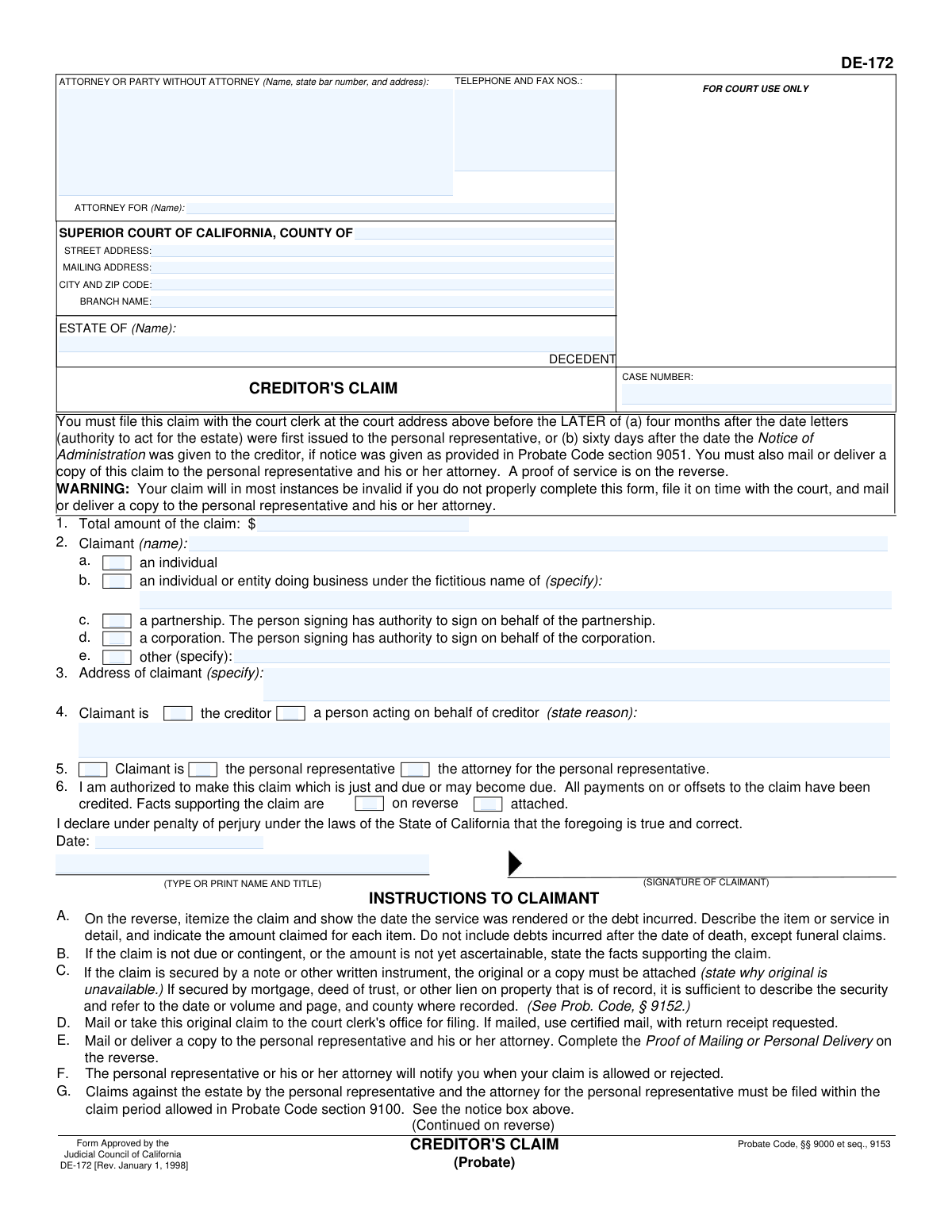
The 'Total amount of the claim' listed in Box 1 on the first page must be a valid positive number. This amount must exactly match the calculated 'TOTAL' of the itemized claims listed on the second page. This check prevents mathematical errors and ensures the claim's primary value is consistent throughout the document, which is critical for court processing. If the amounts do not match, the claim could be rejected for ambiguity.
The 'Claimant (name)' field in Box 2 must be completed, and exactly one checkbox from options 2a through 2e must be selected to identify the claimant's entity type. This is essential for establishing the legal identity of the creditor. A failure to provide this information will render the claim invalid as the estate cannot verify who is making the claim.
If checkbox 2e ('other') is selected to describe the claimant's entity type, the adjacent text field specifying the type must be filled in. This provides necessary clarification when the standard categories do not apply. An empty specification field makes the claimant's legal status unclear and may lead to rejection of the form.
In Box 4, one of the two checkboxes must be selected to declare whether the filer is the creditor or a person acting on their behalf. If 'a person acting on behalf of creditor' is selected, the reason must be provided in the space indicated. This validation confirms the filer's legal standing to submit the claim, and failure to complete it properly can invalidate the submission.
In Box 5, the filer must check either 'on reverse' or 'attached' to indicate where the detailed facts supporting the claim are located. This directs the court and personal representative to the full itemization and evidence for the debt. If neither is selected, the claim may be considered incomplete and unsupported.
The signature block on page 1 must include a valid date and a typed or printed name of the signatory. The date must be a valid calendar date and cannot be in the future. This is required for the declaration under penalty of perjury, and an missing or invalid date can nullify the legal statement.
And 8 more checks
- Ensures Case Information Consistency
- Validates Itemized Claim Dates
- Verifies Itemized Claim Amount Format
- Requires Proof of Service Method Selection
- Validates Mail Service Details Completeness
- Validates Personal Delivery Details Completeness
- Checks Proof of Service Signature Date Logic
- Requires Claimant Address
Let AI fill out your DE-172
No typing. Every field filled in seconds, checked, ready to sign.
How to Fill Out DE-172 Online for Free in 2026
What the AI walks you through.
- Navigate to Instafill.ai and upload or select the Form DE-172, Creditor's Claim.
- Provide the court and estate information, including the county, court address, estate name, and case number.
- Enter your details as the claimant, including your name, address, and your status (e.g., individual, corporation).
- Specify the total amount of the claim and provide a detailed itemization on the second page, including dates, descriptions, and amounts for each item.
- Attach any required supporting documents, such as a copy of a note or written instrument.
- Review all entered information for accuracy, then sign and date the claim under penalty of perjury.
- Download the completed form to file with the court clerk and serve a copy to the estate's personal representative and their attorney.
Common Mistakes in Completing DE-172
The ones the AI is built to catch.
Inconsistent or Incorrect Claim Amount
Vague or Insufficient Claim Description
Forgetting to Complete the Proof of Service
Failing to Attach Supporting Documents
Incorrectly Identifying the Claimant Entity
Mistaking Service for Filing
Including Debts Incurred After Death
Missing Signatures or Dates
Using Incorrect Case Information
Frequently Asked Questions About DE-172
Is it really free for 7 days?
Can I fill other forms too?
How do I cancel?
How does the AI fill out DE-172?
What happens to my information?
How complex is DE-172 to fill out?
What is the purpose of the Creditor's Claim (DE-172) form?
Who needs to fill out this form?
What is the deadline for filing a Creditor's Claim?
Where do I submit this form?
What is the 'Proof of Mailing or Personal Delivery' section for?
What information do I need to provide to support my claim?
What if my claim is secured by a loan or other written document?
What happens after I file my claim?
What if the amount of my claim is not yet certain or depends on a future event?
Can I use AI to help me fill out this form?
How can I fill out the Creditor's Claim form online?
The PDF of the form I have is not fillable. What can I do?
How should I send the form to the court and the personal representative?
Get your DE-172 filled out by AI
$0 today. Cancel before Oct 31 and you pay nothing.
Other forms like this one
California state forms: Judicial Council of California Form DE-111, Petition for Probate (Probate—Decedents Estates), DS 1891, Applicant/Vendor Disclosure Statement (State of California Department of Developmental Services), Judicial Council of California Form DE-120, Notice of Hearing—Decedent's Estate or Trust, Judicial Council of California Form DE-120, Notice of Hearing—Decedent's Estate or Trust, Murrieta Police Department Citizen Complaint Form (California Penal Code § 148.6 Advisory Statement), California Department of Social Services, Sworn Statement, State of California Department of Transportation California Civil Rights Laws Certification, State of California Department of Transportation Darfur Contracting Act Certification, Form DOT ADM-0077, State of California Department of Transportation, Contract Requirements, State of California Department of Transportation Subcontractor List, State of California Department of Transportation, Certified DVBE Summary, Bidder Declaration GSPD-05-105, State of California Level of Care Rate Determination Protocol Matrix, State of California Accessible Form, State of California Form SOC 321, Request for Order and Consent - Paramedical Services, State of California Darfur Contracting Act Certification, State of California Department of Veterans Affairs COMMERCIALLY USEFUL FUNCTION (CUF) CERTIFICATION FORM, Form ADR-100, Statement of Agreement or Nonagreement, Civil Appeal Case Information Statement, Form APP-014, Appellant's Proposed Statement on Appeal (Unlimited Civil Case)
California court forms: Judicial Council of California Form SC-105, Request for Court Order and Answer (Small Claims), Judicial Council of California Form SC-120, Defendant’s Claim and ORDER to Go to Small Claims Court (Small Claims), Judicial Council of California Form SER-001, Request for Sheriff to Serve Court Papers, Judicial Council of California Form SER-001, Request for Sheriff to Serve Court Papers, Affidavit for Collection of Personal Property California Probate Code Section 13100, Form POS-040, Proof of Service—Civil, Declaration of Facts of Death (California Superior Court), declaration-of-marriage-for-court-proceeding-california-family-law, ADOPT-200, Adoption Request, ADOPT-200, Stepparent Adoption Request, ADOPT-210, Adoption Agreement, ADOPT-310, Contact After Adoption Agreement, Judicial Council of California Form ADOPT-200, Adoption Request, Form ADR-107, Mediation Attendance Sheet, Form ADR-110, Order Appointing Referee, Form ADR-109, Stipulation or Motion for Order Appointing Referee, Form ADR-102, Request for Trial De Novo After Judicial Arbitration, Form ADR-108, Referee's Report (Code Civ. Proc., §§ 638, 639), Form ADR-106, Petition to Confirm, Correct, or Vacate Contractual Arbitration Award, Form ADR-104, Rejection of Award and Request for Trial After Attorney-Client Fee Arbitration
California probate forms: Judicial Council of California Form DE-111, Petition for Probate (Probate—Decedents Estates), Affidavit for Collection of Personal Property California Probate Code Section 13100, Form DE-142/DE-111(A-3e), Waiver of Bond by Heir or Beneficiary (Probate—Decedents Estates), Form DE-140, Order for Probate, Form DE-150, Letters (Probate), Form DE-154/GC-035, Request for Special Notice (Probate), Form DE-157, Notice of Administration to Creditors, Form DE-120(P), Proof of Personal Service of Notice of Hearing—Decedent's Estate or Trust, Form DE-131, Proof of Subscribing Witness (Probate), Form DE-174, Allowance or Rejection of Creditor's Claim, Form DE-221, Spousal or Domestic Partner Property Petition (Probate—Decedents Estates), Form DE-270 / GC-070, Ex Parte Petition for Authority to Sell Securities and Order, Form DE-315, Order Determining Succession to Primary Residence, Form DE-351/GC-101, Order Appointing Guardian Ad Litem—Probate, Form DE-115/GC-015, Notice of Hearing on Petition to Determine Claim to Property, Attachment to Notice of Hearing Proof of Service by Mail (Probate—Decedents' Estates and Guardianships and Conservatorships), Attachment to Notice of Hearing Proof of Personal Service (Probate—Decedents' Estates and Guardianships and Conservatorships), Form DE-125, Summons (Probate), Form DE-147, Duties and Liabilities of Personal Representative, Form DE-147S, Confidential Supplement to Duties and Liabilities of Personal Representative (Probate)
court claim forms: Form SC-100, Plaintiff's Claim and ORDER to Go to Small Claims Court, Judicial Council of California Form SC-105, Request for Court Order and Answer (Small Claims), SC-120, Defendant’s Claim and ORDER to Go to Small Claims Court (Small Claims), SC-105, Request for Court Order and Answer (Small Claims), Judicial Council of California Form SC-120, Defendant’s Claim and ORDER to Go to Small Claims Court (Small Claims), Form SC-100, Plaintiff’s Claim and ORDER to Go to Small Claims Court, Certificate of Service (Civil Court Claim), Form N161, Appellant’s notice (All appeals except small claims track appeals and appeals to the Family Division of the High Court), Plaintiff's Claim and ORDER to Go to Small Claims Court (SC-100), Form N161, Appellant's Notice (All appeals except small claims track appeals and appeals to the Family Division of the High Court), Form SC-100A, Other Plaintiffs or Defendants (Attachment to Plaintiff's Claim and ORDER to Go to Small Claims Court), Form N461: Claim for judicial review, Statement of Small Claim and Notice, Trial Court of Massachusetts, State of Michigan, Form MC 25, Notice of Intent to Escheat Unclaimed Personal Property, Form MC 35, Complaint, Claim and Delivery, Form MC 36, Motion for Possession Pending Judgment, Claim and Delivery, Order of Possession Pending Judgment, Claim and Delivery, Form MC 38, Bond, Claim and Delivery, Form MC 39, Judgment, Claim and Delivery, Form MC 55, Claim of Appeal
Let AI fill out your DE-172
Your trial starts once a card is added. You pay nothing before Oct 31.
Our AI already knows this form, all 112 fields of it. Skip the typing: tell it about yourself, or upload what you have, and it fills the whole form in seconds.
- AI fills every field on both pages, checkboxes included
- No typing into boxes: answer a few questions, or upload a document you already have, an old copy of this form, a photo of a document
- The AI checks the answers; you review and change anything before you download
- Download the finished PDF, print it, or sign it online
- Encrypted, and never used to train AI
Cancel before Oct 31 and you pay nothing.
A card is needed to start the trial. Cancel in two clicks from your account.
Terms · Privacy