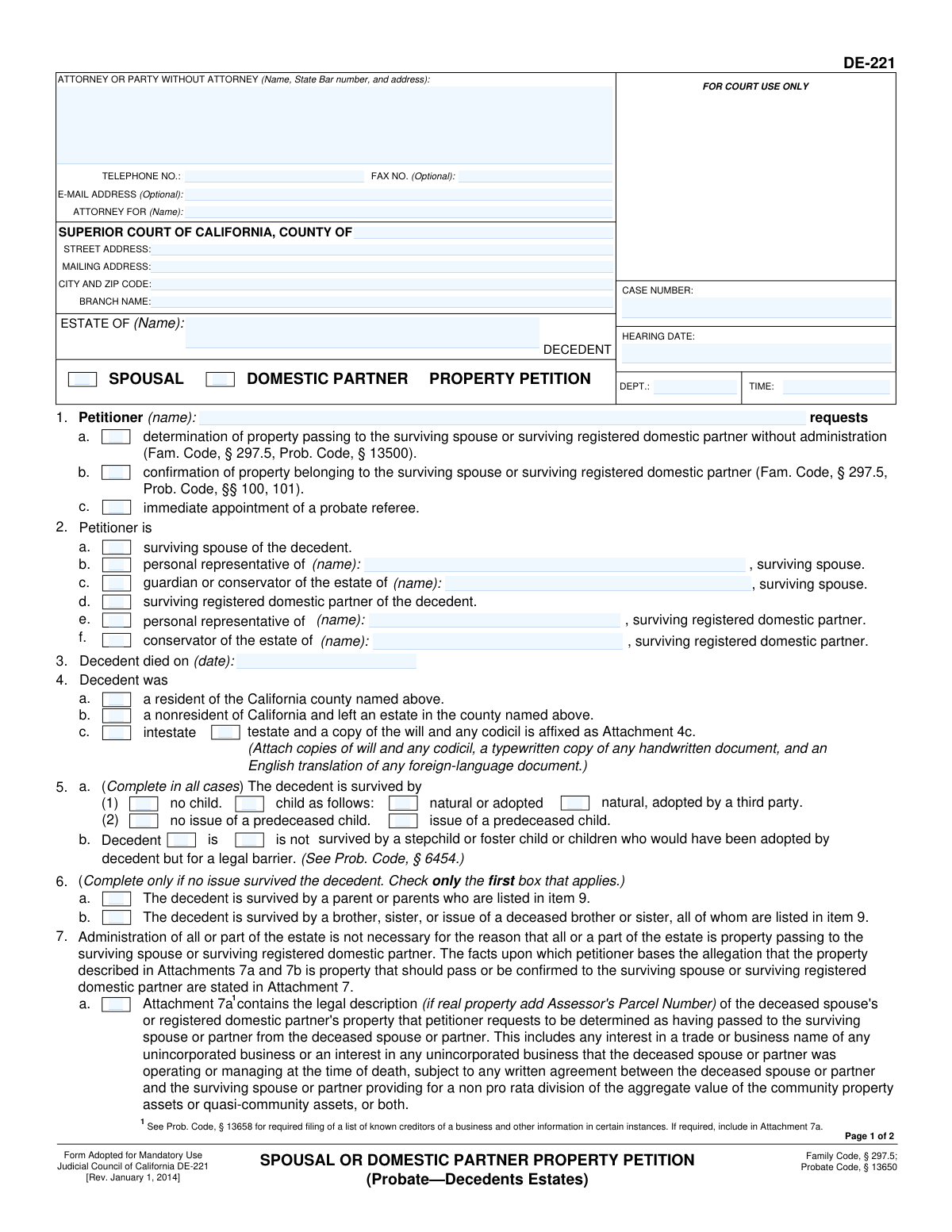
Yes! You can use AI to fill out Form DE-221, Spousal or Domestic Partner Property Petition (Probate—Decedents Estates)

Form DE-221 is a California Judicial Council form used by a surviving spouse or domestic partner to petition the court for the transfer of property from a deceased spouse or partner. It simplifies the process by allowing property to pass to the survivor without undergoing a formal, lengthy probate administration. Today, this form can be filled out quickly and accurately using AI-powered services like Instafill.ai, which can also convert non-fillable PDF versions into interactive fillable forms.
DE-221 is part of the California court forms, California probate forms and California state forms categories on Instafill.
Our AI automatically handles information lookup, data retrieval, formatting, and form filling.
It takes less than a minute to fill out DE-221 using our AI form filling.
Securely upload your data. Information is encrypted in transit and deleted immediately after the form is filled out.

Form specifications

Form name: Form DE-221, Spousal or Domestic Partner Property Petition (Probate—Decedents Estates)
Number of fields: 81
Number of pages: 1
Language: English
main-image

Instafill Demo: How to fill out PDF forms in seconds with AI

How to Fill Out DE-221 Online for Free in 2026

Are you looking to fill out a DE-221 form online quickly and accurately? Instafill.ai offers the #1 AI-powered PDF filling software of 2026, allowing you to complete your DE-221 form in just 37 seconds or less.
Follow these steps to fill out your DE-221 form online using Instafill.ai:
  1. 1 Navigate to Instafill.ai and upload or select Form DE-221.
  2. 2 Provide your personal information as the petitioner and details about the decedent, including their date of death and residency.
  3. 3 Use the AI assistant to accurately describe the property to be transferred, attaching legal descriptions for real property as required in Attachments 7a and 7b.
  4. 4 List the names, relationships, and addresses of all heirs, beneficiaries, and other interested parties as specified in the form.
  5. 5 Answer the questions regarding the decedent's will, other probate proceedings, and any existing written property agreements.
  6. 6 Review the completed form generated by the AI for accuracy and completeness, making any necessary corrections.
  7. 7 Electronically or manually sign the petition under penalty of perjury and file it with the correct Superior Court of California.

Our AI-powered system ensures each field is filled out correctly, reducing errors and saving you time.

Why Choose Instafill.ai for Your Fillable DE-221 Form?

Speed

Complete your DE-221 in as little as 37 seconds.

Up-to-Date

Always use the latest 2026 DE-221 form version.

Cost-effective

No need to hire expensive lawyers.

Accuracy

Our AI performs 10 compliance checks to ensure your form is error-free.

Security

Your personal information is protected with bank-level encryption.

Frequently Asked Questions About Form DE-221

This form is used by a surviving spouse or registered domestic partner to ask the court to transfer property from the deceased person to them without having to go through a full, formal probate process. It is a simpler and faster way to handle the transfer of assets.

The petition can be filed by the surviving spouse, the surviving registered domestic partner, or the personal representative (like a conservator or executor) of the survivor's estate, as indicated in section 2 of the form.

'Determination' asks the court to transfer the decedent's share of property to the survivor. 'Confirmation' asks the court to officially recognize the survivor's existing ownership share of community property. Most petitioners request both.

Yes, if the decedent had a will (was 'testate'), section 4c requires you to attach a copy of the will and any codicils. If any documents are handwritten, you must also attach a typed copy.

Attachment 7a lists the decedent's property you are asking the court to transfer to you. Attachment 7b lists your half of the community property you want the court to confirm as yours. For real estate, you must include the legal description and Assessor's Parcel Number.

If you and your deceased spouse or partner had a written agreement about how to divide community property, you must indicate this in section 8 and attach a copy of the agreement to the petition.

You must list the names, ages, and addresses of all people named in the decedent's will and all living heirs, such as children, grandchildren, parents, or siblings, as specified in sections 5 and 6. This ensures all legally interested parties are notified.

No, this petition is designed to avoid a full probate. In section 12, you must state whether a separate probate case has been filed, is being filed at the same time, or will not be filed at all.

A probate referee is an official appointed to appraise the value of an estate's assets. You might request one (item 1c) if you need a formal valuation of the property for tax purposes or to determine its fair market value.

You must file the petition with the Superior Court of California in the county where the decedent lived. If the decedent was not a California resident but owned property here, you file it in the county where the property is located.

Yes, services like Instafill.ai use AI to help you accurately auto-fill form fields. This can save you time and help prevent common errors when completing complex legal forms.

To fill this form out online, you can upload it to a platform like Instafill.ai. The service will make the document interactive, allowing you to type your information directly into the fields, save your progress, and download the completed PDF.

If you have a flat, non-fillable PDF, you can use a service like Instafill.ai. It can convert the static document into an interactive, fillable form that you can easily complete on your computer.

Compliance DE-221
Validation Checks by Instafill.ai

1
Petitioner and Decedent Name Completeness
Ensures that the petitioner's name (Item 1) and the decedent's name ('ESTATE OF') are both provided. These are fundamental pieces of information required to identify the parties involved in the petition. Failure to provide these names would make the form legally insufficient and result in its rejection.
2
Petitioner Role and Name Consistency
Validates that if the petitioner is acting as a representative (Item 2, checkboxes b, c, e, or f), the corresponding name field for the person they represent is filled out. This is crucial for establishing the petitioner's legal standing to file the petition. If a representative box is checked but the name is missing, the form cannot be processed as the petitioner's authority is unclear.
3
Date of Death Validity
Checks that the date of death provided in Item 3 is a valid, complete date and that it is in the past. A future or invalid date would be a logical impossibility and a critical error. This validation prevents nonsensical data entry and ensures the fundamental prerequisite for a probate action—the decedent's death—is properly recorded.
4
Testate Status and Will Attachment
Verifies that if the 'testate' checkbox in Item 4c is selected, an attachment is indicated. The form explicitly states that a copy of the will must be affixed as Attachment 4c. This check ensures that the necessary legal document (the will) accompanies the petition when required, preventing delays and rejections due to incomplete filings.
5
Survivor Status Completeness
Ensures that in Item 5a, one option from group (1) regarding children and one option from group (2) regarding issue of predeceased children are selected. This information is critical for determining legal heirs and the proper distribution of the estate. An incomplete selection in this section would leave the decedent's survivor status ambiguous, halting the legal process.
6
Conditional Logic for Non-Issue Heirs
This check enforces the rule for Item 6, which should only be completed if the decedent had no surviving issue (as indicated in Item 5). If Item 5 indicates there are surviving issue, Item 6 should be disabled or flagged as an error if filled. This prevents contradictory information about the decedent's line of succession.
7
Written Agreement and Attachment 8
Validates that if the 'exists' checkbox in Item 8 is selected, indicating a written agreement for non pro rata division, an attachment is also indicated. The form mandates that a copy of the agreement be attached. This check ensures that this critical piece of evidence is included with the petition, as it directly affects how property is divided.
8
Heir Information Completeness
Verifies that in Item 9, either the 'listed below' or 'listed in Attachment 9' checkbox is selected and the corresponding information is provided. If 'listed below' is chosen, at least one full row of heir information must be entered. This is essential for ensuring all legally required parties receive notice of the petition, and failure to list them can invalidate the entire proceeding.
9
Executor Information Selection
Ensures that one of the three options in Item 10 (listed below, listed in attachment, or none) is selected. This clarifies the status of any named executors in the decedent's will. If the decedent was 'testate' (Item 4c), selecting 'none' might trigger a soft validation warning to double-check the will for an executor clause.
10
Probate Petition Status and Date
Checks that one of the options in Item 12 regarding a petition for probate is selected. If option '12b. was filed' is checked, it further validates that the corresponding date field is filled with a valid past date. This information is crucial for the court to understand the context of this petition in relation to any broader estate administration.
11
Attachment Count Consistency
Validates that the number entered in Item 13 ('Number of pages attached') is a non-negative integer and is greater than zero if any checkboxes indicating an attachment (e.g., 4c, 7, 8, 9, 10, 11) are selected. This serves as a final cross-check to ensure that all referenced documents are accounted for. A mismatch could lead to the clerk rejecting the filing for being incomplete.
12
Petitioner Signature and Date Requirement
Ensures the petitioner's printed name and the date are filled in the signature block at the end of the form. The signature declares the information true under penalty of perjury. Missing a name or date invalidates the declaration, making the entire petition void until corrected.
13
Cross-Page Header Consistency
Verifies that the 'ESTATE OF (Name)' and 'CASE NUMBER' fields on page 2 match the corresponding values entered on page 1. This is a data integrity check to ensure the pages of the document are correctly associated with each other. A mismatch could lead to confusion and processing errors, especially in a busy court system.
14
Petitioner Name Consistency Check
Validates that the petitioner's name entered in Item 1 is the same as the printed name in the petitioner's signature block. This confirms that the individual who initiated the petition is the same person attesting to its contents. Discrepancies could indicate an error or a potentially unauthorized filing.

Common Mistakes in Completing DE-221

Providing an Incomplete or Incorrect Property Description

Petitioners often list only a street address for real property in Attachments 7a and 7b, but the court requires the full legal description and the Assessor's Parcel Number (APN) from the property deed. Failing to provide this precise information will lead to the petition being rejected or delayed, as it is essential for creating a clear and enforceable court order transferring title. To avoid this, locate the official property deed and transcribe the legal description and APN exactly as they appear.

Failing to Attach Required Documents

This form relies heavily on attachments, and a very common error is forgetting to include them. Specifically, if the decedent was testate, a copy of the will must be attached (Attachment 4c), and property descriptions must be included in Attachments 7a and 7b. Forgetting these documents will result in an incomplete filing that the court clerk will reject, causing significant delays in the probate process.

Incomplete or Inaccurate List of Heirs and Beneficiaries

In Item 9, petitioners must list all persons named in the will and all legal heirs, but they often forget to include estranged children, relatives of a predeceased child, or beneficiaries who are not family. This is a critical error because it results in defective legal notice, which can cause the hearing to be postponed or even lead to the final order being invalidated later. It is crucial to create a complete list with correct addresses for everyone entitled to notice.

Incorrectly Stating Testate/Intestate Status

In Item 4c, a petitioner might incorrectly check that the decedent was 'testate' (had a will) or 'intestate' (did not have a will), or they check 'testate' but fail to attach the will. This is a fundamental error that can halt the entire process, as the existence of a will completely changes how property is distributed and who must be notified. Before filing, you must confirm whether a valid will exists and ensure it is properly attached if you select 'testate'.

Confusing Property Passing from Decedent with Survivor's Own Property

Petitioners frequently misunderstand the distinction between Attachment 7a and 7b. Attachment 7a is for the decedent's share of property that is passing to the survivor, while 7b is for confirming the survivor's pre-existing share of community property. Listing assets in the wrong attachment can lead to an incorrect court order and create significant property title issues in the future.

Entering Incorrect Court or Decedent Information

In the header, petitioners may file in the wrong county or misspell the decedent's name. The petition must be filed in the county where the decedent lived, and the decedent's name must be their full legal name as shown on the death certificate. These mistakes can lead to the case being rejected for improper venue or create identity verification problems that delay the proceedings.

Missing Signatures or Dates

Forgetting to sign and date the petition in the designated signature blocks on page 2 is a simple but fatal clerical error. The court cannot accept an unsigned declaration made under penalty of perjury. This oversight will cause the court clerk to immediately reject the filing, forcing you to refile and delaying your hearing date.

Misstating the Decedent's Survivor Status

In Item 5, people sometimes fail to list all of the decedent's children, such as children from a previous marriage or those who were adopted out to a third party. The form requires a complete accounting of all children and issue of predeceased children to ensure all potential heirs receive proper legal notice. An incomplete list can lead to legal challenges and jeopardize the validity of the court's final order.

Miscounting the Number of Attached Pages

Item 13 asks for the total number of pages attached to the petition, a detail that is easily overlooked or miscalculated. An incorrect count can confuse the court clerk and judge, making them believe documents are missing when they are not, which can cause unnecessary delays while the filing is manually verified. To prevent this, carefully count all attachment pages just before filing and enter the correct number in Item 13.

Selecting the Wrong Petitioner Capacity

In Item 2, the person filing must accurately state their relationship to the case, but they may select 'surviving spouse' (2a) when they are actually the 'personal representative of the surviving spouse' (2b). This mistake questions the petitioner's legal standing to file the petition and can lead to its dismissal. It is essential to read the options carefully and select the one that precisely describes the petitioner's legal role. AI-powered tools like Instafill.ai can help guide users through these choices to prevent such errors.
Saved over 80 hours a year

“I was never sure if my IRS forms like W-9 were filled correctly. Now, I can complete the forms accurately without any external help.”

Kevin Martin Green

Your data stays secure with advanced protection from Instafill and our subprocessors

Robust compliance program

Transparent business model

You’re not the product. You always know where your data is and what it is processed for.

ISO 27001, HIPAA, and GDPR

Our subprocesses adhere to multiple compliance standards, including but not limited to ISO 27001, HIPAA, and GDPR.

Security & privacy by design

We consider security and privacy from the initial design phase of any new service or functionality. It’s not an afterthought, it’s built-in, including support for two-factor authentication (2FA) to further protect your account.

Fill out DE-221 with Instafill.ai

Worried about filling PDFs wrong? Instafill securely fills form-de-221-spousal-or-domestic-partner-property-petition-probatedecedents-estates forms, ensuring each field is accurate.

Related forms by category

California court forms Judicial Council of California Form SC-105, Request for Court Order and Answer (Small Claims), Judicial Council of California Form SC-120, Defendant’s Claim and ORDER to Go to Small Claims Court (Small Claims), Judicial Council of California Form SER-001, Request for Sheriff to Serve Court Papers, Judicial Council of California Form SER-001, Request for Sheriff to Serve Court Papers, Affidavit for Collection of Personal Property California Probate Code Section 13100, Form POS-040, Proof of Service—Civil, Declaration of Facts of Death (California Superior Court), declaration-of-marriage-for-court-proceeding-california-family-law, ADOPT-200, Adoption Request, ADOPT-200, Stepparent Adoption Request, ADOPT-210, Adoption Agreement, ADOPT-310, Contact After Adoption Agreement, Judicial Council of California Form ADOPT-200, Adoption Request, Form ADR-107, Mediation Attendance Sheet, Form ADR-110, Order Appointing Referee, Form ADR-109, Stipulation or Motion for Order Appointing Referee, Form ADR-102, Request for Trial De Novo After Judicial Arbitration, Form ADR-108, Referee's Report (Code Civ. Proc., §§ 638, 639), Form ADR-106, Petition to Confirm, Correct, or Vacate Contractual Arbitration Award, Form ADR-104, Rejection of Award and Request for Trial After Attorney-Client Fee Arbitration · + 216 more →
California probate forms Judicial Council of California Form DE-111, Petition for Probate (Probate—Decedents Estates), Judicial Council of California Form DE-111, Petition for Probate (Probate—Decedents Estates), Affidavit for Collection of Personal Property California Probate Code Section 13100, Form DE-142/DE-111(A-3e), Waiver of Bond by Heir or Beneficiary (Probate—Decedents Estates), Form DE-140, Order for Probate, Form DE-150, Letters (Probate), Form DE-154/GC-035, Request for Special Notice (Probate), Form DE-157, Notice of Administration to Creditors, Form DE-120(P), Proof of Personal Service of Notice of Hearing—Decedent's Estate or Trust, Form DE-131, Proof of Subscribing Witness (Probate), Form DE-172, Creditor's Claim (Probate), Form DE-174, Allowance or Rejection of Creditor's Claim, Form DE-270 / GC-070, Ex Parte Petition for Authority to Sell Securities and Order, Form DE-315, Order Determining Succession to Primary Residence, Form DE-351/GC-101, Order Appointing Guardian Ad Litem—Probate, form-de-115gc-015-notice-of-hearing-on-petition-to-determine-claim-to-property, attachment-to-notice-of-hearing-proof-of-service-by-mail-probatedecedents-estates-and-guardianships-and-conservatorships, attachment-to-notice-of-hearing-proof-of-personal-service-probatedecedents-estates-and-guardianships-and, form-de-125-summons-probate, form-de-147-duties-and-liabilities-of-personal-representative · + 3 more →
California state forms Judicial Council of California Form DE-111, Petition for Probate (Probate—Decedents Estates), Judicial Council of California Form DE-111, Petition for Probate (Probate—Decedents Estates), DS 1891, Applicant/Vendor Disclosure Statement (State of California Department of Developmental Services), DL 142, Request for Cancellation or Surrender of a Driver License or Identification Card (State of California Department of Motor Vehicles), Judicial Council of California Form DE-120, Notice of Hearing—Decedent's Estate or Trust, Judicial Council of California Form DE-120, Notice of Hearing—Decedent's Estate or Trust, Murrieta Police Department Citizen Complaint Form (California Penal Code § 148.6 Advisory Statement), California Department of Social Services, Sworn Statement, State of California Department of Transportation California Civil Rights Laws Certification, State of California Department of Transportation Darfur Contracting Act Certification, Form DOT ADM-0077, State of California Department of Transportation, Contract Requirements, State of California Department of Transportation Subcontractor List, State of California Department of Transportation, Certified DVBE Summary, Bidder Declaration GSPD-05-105, State of California Level of Care Rate Determination Protocol Matrix, State of California Accessible Form, State of California Form SOC 321, Request for Order and Consent - Paramedical Services, State of California Darfur Contracting Act Certification, State of California Department of Veterans Affairs COMMERCIALLY USEFUL FUNCTION (CUF) CERTIFICATION FORM, Form ADR-100, Statement of Agreement or Nonagreement · + 33 more →