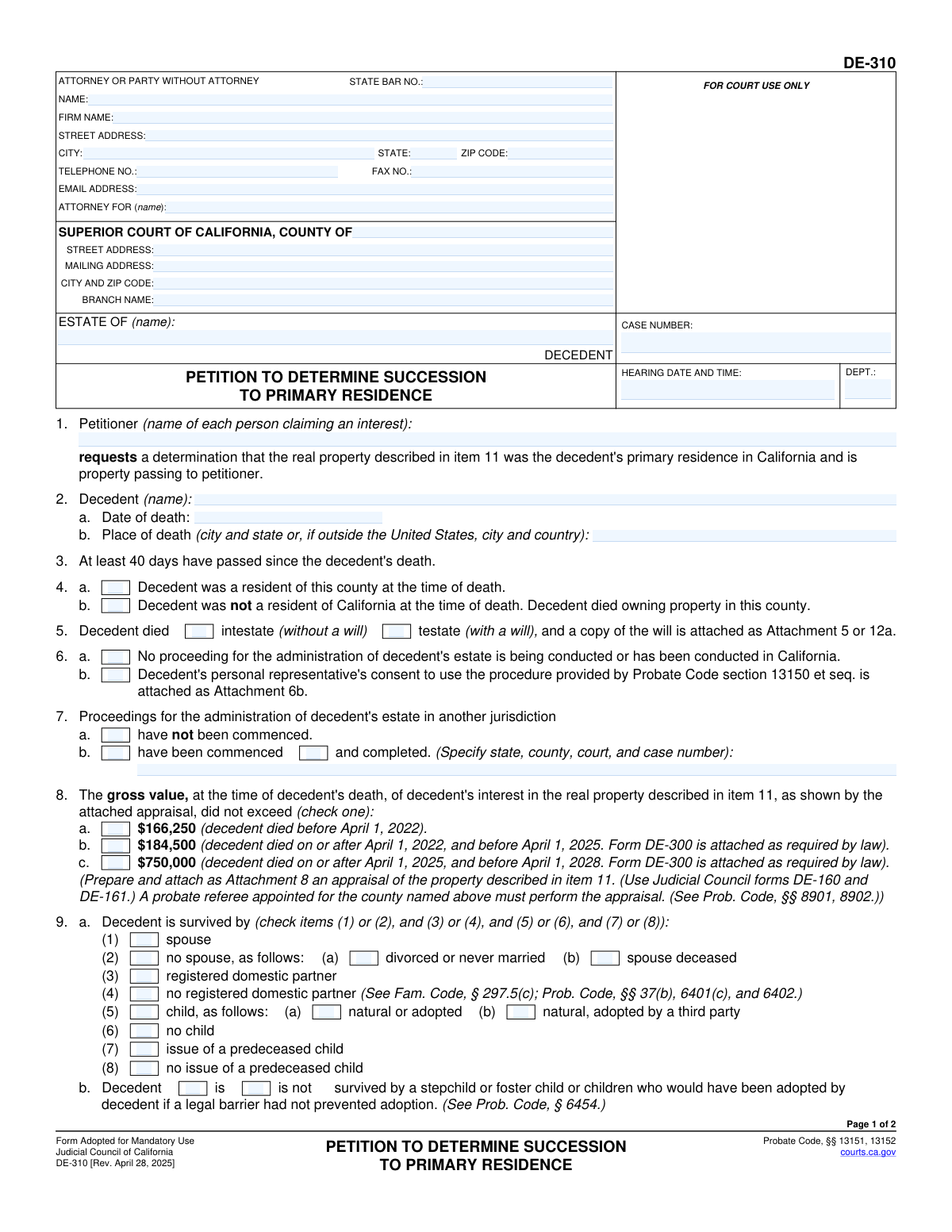
Yes! You can use AI to fill out Form DE-310, Petition to Determine Succession to Primary Residence
Form DE-310, Petition to Determine Succession to Primary Residence, is a legal document filed with the Superior Court of California to transfer a decedent's primary residence to their legal successors without undergoing a full probate administration. This simplified procedure is available for estates where the primary residence falls below a certain value threshold as defined by the Probate Code. Today, this form can be filled out quickly and accurately using AI-powered services like Instafill.ai, which can also convert non-fillable PDF versions into interactive fillable forms.
DE-310 is part of the
California court forms, California probate forms and California state forms categories on Instafill.
Our AI automatically handles information lookup, data retrieval, formatting, and form filling.
It takes less than a minute to fill out DE-310 using our AI form filling.
Securely upload your data. Information is encrypted in transit and deleted immediately after the form is filled out.
Form specifications
| Form name: | Form DE-310, Petition to Determine Succession to Primary Residence |
| Number of fields: | 85 |
| Number of pages: | 1 |
| Language: | English |
Instafill Demo: How to fill out PDF forms in seconds with AI
How to Fill Out DE-310 Online for Free in 2026
Are you looking to fill out a DE-310 form online quickly and accurately? Instafill.ai offers the #1 AI-powered PDF filling software of 2026, allowing you to complete your DE-310 form in just 37 seconds or less.
Follow these steps to fill out your DE-310 form online using Instafill.ai:
- 1 Navigate to Instafill.ai and upload or select Form DE-310, Petition to Determine Succession to Primary Residence.
- 2 Provide the required information for the petitioner(s), the decedent, and the court, including names, addresses, and case details.
- 3 Answer the guided questions about the decedent's will, residency, and any existing estate administration proceedings.
- 4 Input details about the decedent's surviving family members, heirs, and other interested parties as prompted by the AI.
- 5 Attach required documents, such as a copy of the will, an appraisal of the property (like Form DE-160/DE-161), and a legal description of the residence.
- 6 Review all the information auto-filled by the AI across the form for complete accuracy, then electronically sign the petition.
- 7 Download the completed DE-310 and all attachments, ready for filing with the appropriate California Superior Court.
Our AI-powered system ensures each field is filled out correctly, reducing errors and saving you time.
Why Choose Instafill.ai for Your Fillable DE-310 Form?
Speed
Complete your DE-310 in as little as 37 seconds.
Up-to-Date
Always use the latest 2026 DE-310 form version.
Cost-effective
No need to hire expensive lawyers.
Accuracy
Our AI performs 10 compliance checks to ensure your form is error-free.
Security
Your personal information is protected with bank-level encryption.
Frequently Asked Questions About Form DE-310
This form is used to ask a California court to transfer a deceased person's primary residence to their legal heirs without a full, formal probate process. It is a simplified procedure for estates where the home's value is below a specific legal limit.
You can file this petition if you are a legal heir (a successor) to a deceased person's primary residence in California. This process is only available if the property's value is under a certain threshold and no probate administration is currently or has been conducted in California.
The maximum gross value depends on the decedent's date of death. For example, for a death on or after April 1, 2025, the limit is $750,000, but for a death before April 1, 2022, the limit was $166,250.
You must attach an appraisal of the property performed by a probate referee appointed for the county. This appraisal must be documented on Judicial Council forms DE-160 and DE-161.
You must wait at least 40 days after the decedent's death before you can file this petition with the court.
You must attach a copy of the will if one exists, the property appraisal, and a legal description of the property. You will also need to attach lists of all heirs and other interested parties as specified in the form.
Generally, no, as this procedure is meant to avoid formal probate. However, an exception exists if the decedent's personal representative provides written consent to use this process, which must be attached to your petition.
You must provide the property's full legal description, the Assessor's Parcel Number (APN), and facts demonstrating that it was the decedent's primary residence in California. You may also need to state if the property was community, separate, or quasi-community property.
Every person claiming an interest in the property, who is listed as a petitioner in Item 1, must sign the petition under penalty of perjury. If there are more than two petitioners, you must use an attachment for the additional signatures.
If the decedent died 'intestate' (without a will), you must check the appropriate box in Item 5. The property will pass to heirs based on California's laws of succession, and you must identify these individuals in the petition.
Yes, services like Instafill.ai use AI to auto-fill form fields accurately and save time. This can help ensure consistency and reduce errors when entering information like names, addresses, and case details.
You can use a service like Instafill.ai to easily complete the form online. Simply upload the DE-310 PDF, and the platform will convert it into a fillable format that you can type into, save, and print.
If you have a non-fillable or 'flat' PDF, tools like Instafill.ai can convert it into an interactive, fillable form. This allows you to easily type your information into the correct fields before printing for submission.
Compliance DE-310
Validation Checks by Instafill.ai
1
Verifies 40-Day Waiting Period After Death
This check confirms that the date of the petition submission is at least 40 days after the decedent's date of death as entered in item 2a. This is a mandatory waiting period required by Probate Code section 13151. If the petition is dated less than 40 days after the death, it is premature and will be rejected by the court.
2
Ensures Gross Property Value Corresponds to Date of Death
This validation cross-references the decedent's date of death (item 2a) with the gross property value checkbox selected in item 8. For example, if the death occurred before April 1, 2022, option 8a ($166,250) must be checked. This is critical for establishing jurisdiction under the correct statutory limits, and an incorrect selection will lead to dismissal.
3
Validates Consistency Between Will Status and Succession Claim
This check ensures the petitioner's claim basis is consistent. If 'testate (with a will)' is checked in item 5, then item 12a ('a beneficiary who succeeded...under decedent's will') must also be checked. Conversely, 'intestate' in item 5 must correspond to item 12b. Inconsistency indicates a fundamental misunderstanding of the claim and will cause processing delays or rejection.
4
Confirms Will Attachment for Testate Estates
If the petitioner indicates the decedent died 'testate' (item 5) or that they are a successor under a will (item 12a), this check verifies that an attachment is referenced for the will. The will is the primary evidence for a testate succession claim. Failure to attach it will result in an incomplete filing and a likely continuance or denial of the petition.
5
Validates Decedent Residency Selection
This check ensures that exactly one of the two options in item 4 is selected, either 4a (resident of the county) or 4b (not a resident of California but owned property in the county). This information is essential for establishing the court's venue and jurisdiction. Selecting neither or both options makes the petition ambiguous and defective.
6
Ensures Completeness of Survivor Status Checkboxes
This validation verifies that for each pair of mutually exclusive options in item 9a, exactly one box is checked. For example, the petitioner must select either '(1) spouse' or '(2) no spouse,' and either '(5) child' or '(6) no child.' This information is legally required to determine the order of succession, and incomplete or conflicting selections prevent the court from making a proper determination.
7
Conditional Validation of Next of Kin Information
This check ensures that item 10 (listing parents, siblings, etc.) is only completed if the decedent had no surviving spouse, registered domestic partner, child, or issue, as indicated in item 9. The law prioritizes direct descendants, spouses, and partners. Filling out item 10 unnecessarily when direct heirs exist can create confusion and indicates a possible error in identifying the correct successors.
8
Verifies Petitioner Name is Provided
This is a fundamental completeness check to ensure that the name(s) of the petitioner(s) are entered in item 1. The petitioner is the party bringing the action before the court. A petition without a named petitioner is invalid on its face and cannot be processed.
9
Validates Date of Death Format
This check ensures the 'Date of death' in item 2a is entered in a valid date format (e.g., MM/DD/YYYY) and represents a plausible, past date. An invalid or improperly formatted date prevents critical logical checks, such as the 40-day waiting period and the applicable property value limits. This error would halt the processing of the petition until corrected.
10
Confirms Required Appraisal Attachment
This validation confirms that an appraisal attachment is referenced, as mandated by the instructions in item 8. The appraisal, performed by a probate referee, is required to prove the property's value falls within the statutory limits for this simplified procedure. Without the appraisal, the court has no evidence to grant the petition.
11
Verifies Petitioner Signature Count
This check compares the number of petitioners listed in item 1 with the number of petitioner signatures provided at the end of the form. The law requires every petitioner to sign the declaration under penalty of perjury. A mismatch between the number of listed petitioners and the number of signatures renders the petition invalid for the unsigned parties.
12
Ensures Decedent Name Consistency
This validation ensures the decedent's name is consistent across the document, specifically between the 'ESTATE OF' field in the page headers and the decedent's name field in item 2. Consistency is crucial for accurate case identification and record-keeping. Discrepancies can lead to filing errors and confusion in the court's docket.
13
Validates State Bar Number Format
If an attorney's name is provided in the 'ATTORNEY FOR' section, this check verifies that the 'STATE BAR NO.' field contains a numeric value. The State Bar number is the unique identifier for a licensed attorney in California. An invalid or missing number can delay proceedings as the court clerk must verify the attorney's status.
14
Verifies Attachment Count is a Valid Number
This check ensures that the value entered in item 18, 'Number of pages attached,' is a non-negative integer. This number helps the court clerk verify that the submission is complete and all referenced documents are present. An invalid entry or a significant mismatch with referenced attachments can cause the filing to be rejected for being incomplete.
Common Mistakes in Completing DE-310
Petitioners often misunderstand the requirements of Item 8, either by checking the wrong monetary threshold based on the decedent's date of death or by failing to attach a formal appraisal. Many people mistakenly believe a real estate website estimate is sufficient, but the form requires an appraisal by a court-appointed probate referee using specific Judicial Council forms (DE-160/DE-161). This error is critical and will lead to the petition's rejection, as the court cannot verify eligibility for this simplified procedure without the correct valuation and documentation.
In Item 11, filers frequently provide only the common street address of the property instead of the required full legal description and the Assessor's Parcel Number (APN). This information is crucial for the court to legally identify the specific parcel of land. An incomplete description can cause the petition to be rejected or delayed until the correct information, which is typically found on the property's deed, is provided. AI-powered form fillers can help by cross-referencing public records to find and populate the correct legal description and APN.
A very serious mistake is failing to list every required person in Attachment 14. This list must include not only the petitioners but all potential heirs, persons named in the will, and individuals checked in items 9 and 10. This happens because filers may only list those they believe should inherit. This failure can invalidate the entire proceeding, as it violates the due process rights of unlisted parties who were not given legal notice of the hearing.
The signature block at the end of the form requires a signature from every person listed as a petitioner in Item 1. It is common for one petitioner to sign on behalf of others or to forget to gather all necessary signatures, especially if they live in different locations. A petition lacking any required signature is considered invalid and will be rejected by the court clerk upon filing, halting the process before it even begins.
If the decedent died with a will (testate), as indicated in Item 5, a copy of that will must be attached to the petition. People often check the 'testate' box but forget to include the actual document as an attachment. This makes the petition incomplete, and the court cannot proceed without verifying the will's contents and the petitioner's claim as a beneficiary. This simple oversight will cause significant delays until the will is properly filed with the court.
The checkboxes in Item 9 and 10, which detail the decedent's surviving family members, are complex and use legal terms like 'issue of a predeceased child' that can confuse filers. People may check incorrect boxes or fail to check all applicable ones, leading to an inaccurate representation of the line of succession. This can result in legal challenges from overlooked heirs and may require the petition to be amended and re-filed, delaying the transfer of the property.
This petition is specifically for a decedent's 'primary residence.' In Item 11, petitioners must include a statement with facts showing the property was indeed the decedent's main home. Many filers overlook this and only provide the legal description, assuming it's implied. Without this factual statement, the petition fails to meet a core requirement, which can lead to rejection or a request for more evidence from the court.
Judicial Council forms are updated periodically, as indicated by the revision date in the corner (e.g., 'Rev. April 28, 2025'). Filers often download a form from an old link or use a previously saved copy. Courts typically require the most current version of a form, and submitting an outdated one can lead to immediate rejection by the clerk's office. To avoid this, always download the form directly from the official California Courts website before filling it out.
In the header section, filers must specify the exact Superior Court, including the county, street address, and branch name. People sometimes only write the county name or use the address of the wrong courthouse branch. This can lead to the petition being filed in the wrong venue, causing significant delays as the case must be transferred, or worse, dismissed and re-filed in the correct location. AI tools like Instafill.ai can help prevent this by automatically populating the correct court details based on the county.
This form frequently requires information to be provided in numbered attachments (e.g., Attachment 6b, 11, 13, 14, 15). A common error is checking a box indicating an attachment is included but then failing to physically attach the corresponding document. This makes the filing incomplete and forces the court to delay the hearing until all necessary documents are submitted. If the form is a non-fillable PDF, tools like Instafill.ai can convert it to a fillable version and help manage and assemble the required attachments.
Saved over 80 hours a year
“I was never sure if my IRS forms like W-9 were filled correctly. Now, I can complete the forms accurately without any external help.”
Kevin Martin Green
Your data stays secure with advanced protection from Instafill and our subprocessors

Robust compliance program
Transparent business model
You’re not the product. You always know where your data is and what it is processed for.
ISO 27001, HIPAA, and GDPR
Our subprocesses adhere to multiple compliance standards, including but not limited to ISO 27001, HIPAA, and GDPR.
Security & privacy by design
We consider security and privacy from the initial design phase of any new service or functionality. It’s not an afterthought, it’s built-in, including support for two-factor authentication (2FA) to further protect your account.
Fill out DE-310 with Instafill.ai
Worried about filling PDFs wrong? Instafill securely fills form-de-310-petition-to-determine-succession-to-primary-residence forms, ensuring each field is accurate.