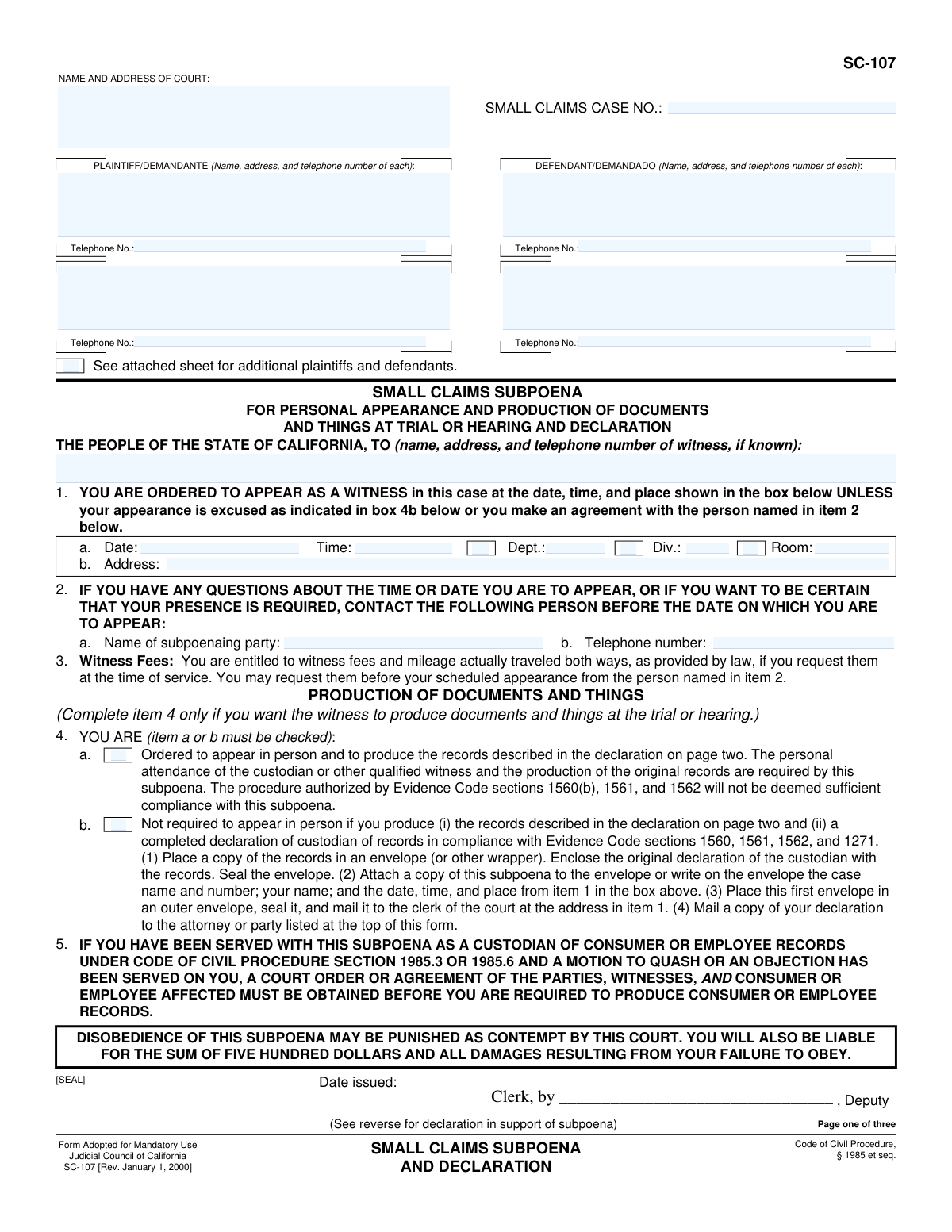
Yes! You can use AI to fill out Form SC-107, Small Claims Subpoena for Personal Appearance and Production of Documents at Trial or Hearing and Declaration
Form SC-107, the Small Claims Subpoena, is a legal document used in California small claims court to compel a person to appear at a trial or hearing, and/or to produce specific documents or other tangible things. It is a crucial tool for parties to obtain evidence and testimony necessary to support their case. Today, this form can be filled out quickly and accurately using AI-powered services like Instafill.ai, which can also convert non-fillable PDF versions into interactive fillable forms.
SC-107 is part of the
California court forms, court claim forms and small claims forms categories on Instafill.
Our AI automatically handles information lookup, data retrieval, formatting, and form filling.
It takes less than a minute to fill out SC-107 using our AI form filling.
Securely upload your data. Information is encrypted in transit and deleted immediately after the form is filled out.
Form specifications
| Form name: | Form SC-107, Small Claims Subpoena for Personal Appearance and Production of Documents at Trial or Hearing and Declaration |
| Number of fields: | 77 |
| Number of pages: | 1 |
| Language: | English |
Instafill Demo: How to fill out PDF forms in seconds with AI
How to Fill Out SC-107 Online for Free in 2026
Are you looking to fill out a SC-107 form online quickly and accurately? Instafill.ai offers the #1 AI-powered PDF filling software of 2026, allowing you to complete your SC-107 form in just 37 seconds or less.
Follow these steps to fill out your SC-107 form online using Instafill.ai:
- 1 Navigate to Instafill.ai and upload your SC-107 form or select it from our template library.
- 2 Provide the court information, case number, and the full names and addresses of the plaintiff(s) and defendant(s).
- 3 Enter the full name, address, and telephone number of the witness you are subpoenaing.
- 4 Specify the date, time, and location of the court hearing where the witness is ordered to appear.
- 5 Complete the 'Declaration in Support' on page two, detailing the specific documents the witness must produce and explaining why they are relevant to the case.
- 6 Review all the information auto-filled by the AI for accuracy, ensuring all required fields and declarations are complete.
- 7 Download the completed form, have it issued by the court clerk, and then arrange for it to be legally served on the witness according to California law.
Our AI-powered system ensures each field is filled out correctly, reducing errors and saving you time.
Why Choose Instafill.ai for Your Fillable SC-107 Form?
Speed
Complete your SC-107 in as little as 37 seconds.
Up-to-Date
Always use the latest 2026 SC-107 form version.
Cost-effective
No need to hire expensive lawyers.
Accuracy
Our AI performs 10 compliance checks to ensure your form is error-free.
Security
Your personal information is protected with bank-level encryption.
Frequently Asked Questions About Form SC-107
This form is a legal court order used in a California small claims case to require a person (a witness) to appear in court, to produce specific documents or items as evidence, or both.
A plaintiff or defendant in a small claims case should fill out this form when they need to compel a witness, who is not a party to the lawsuit, to provide testimony or evidence at a trial or hearing.
In the Declaration, you must specifically list the exact documents or things the witness needs to produce and provide a 'good cause' explanation for why this evidence is material and necessary for your case.
Check box 4a if you require the witness to personally appear in court with the original documents. Check box 4b if the witness is not required to appear in person, as long as they send copies of the records to the court clerk according to the specified procedure.
You must file the form with the court clerk to have the subpoena issued. Then, you must have another adult who is not a party to the case 'serve' (personally deliver) a copy to the witness and complete the Proof of Service on page three.
Yes, as stated in item 3, the witness is legally entitled to witness fees and mileage for travel. The witness can request these fees from you before their scheduled appearance.
Disobeying a subpoena may be punished as contempt of court. The form states the disobedient witness will also be liable for a fine of five hundred dollars and all damages resulting from their failure to obey.
This means there are special privacy rules if you are requesting sensitive records like employment files or customer data. The affected person must be notified and has the right to object, and you may need a court order before the records can be produced.
The 'Proof of Service' is not for you to fill out; it must be completed and signed by the person who personally delivers the subpoena to the witness. This person certifies when, where, and how the witness was served.
Yes, services like Instafill.ai use AI to accurately auto-fill form fields, which can save you time and help you avoid common mistakes.
You can use a service like Instafill.ai to complete the form online. Simply upload the document, and the AI-powered platform will help you fill in your case information quickly and accurately.
If you have a non-fillable PDF, you can use a tool like Instafill.ai. It can convert flat PDFs into interactive, fillable forms that you can easily complete on your computer.
The case number and court address are located on other official documents from your small claims case, such as the 'Plaintiff's Claim' (Form SC-100). You must copy this information exactly onto the subpoena.
Compliance SC-107
Validation Checks by Instafill.ai
1
Case Number Consistency
This check ensures that the 'SMALL CLAIMS CASE NO.' entered on page 1 is identical to the 'CASE NUMBER' populated in the headers of page 2 and page 3. This is critical for ensuring all pages of the document are correctly associated with the same legal case. A mismatch could lead to the document being rejected by the court or misfiled.
2
Future Hearing Date
Validates that the 'Date' specified in Item 1a on page 1 is a valid calendar date that occurs in the future. A subpoena cannot compel an appearance at a past date. If the date is in the past or is not a valid date format, the form submission should be rejected to prevent the issuance of an invalid legal document.
3
Phone Number Format
This check verifies that all telephone number fields for the plaintiff, defendant, witness, and subpoenaing party conform to a standard format (e.g., (XXX) XXX-XXXX or XXXXXXXXXX). Proper formatting is essential for data integrity and ensures that parties can be successfully contacted. An invalid format would prevent submission until corrected.
4
Exclusive Document Production Choice
In Item 4 on page 1, this validation ensures that if documents are being requested, either option 'a' (appear in person) or 'b' (produce records without appearing) is checked, but not both. Selecting both is contradictory. This check prevents ambiguity in the instructions to the witness and ensures the subpoena is legally clear.
5
Conditional Declarant Specification
On page 2, Item 1, if the 'other (specify)' checkbox is selected to identify the declarant, this validation ensures the corresponding text field is not empty. This is necessary to properly identify the person making the declaration if they are not the plaintiff, defendant, or judgment creditor. Failure to specify this role makes the declaration incomplete.
6
Conditional Document Justification
This check ensures that if any documents are listed for production in Item 2 on page 2, then the 'Good cause' (Item 3) and 'Materiality' (Item 4) text fields must be filled out. These justifications are legally required to compel the production of documents. The submission should be flagged as incomplete if these fields are empty when documents are requested.
7
Chronological Date Integrity
This performs a logical check across multiple date fields to ensure they are in a valid chronological order: Declaration Date (Page 2) must be on or before the Date Issued (Page 1), which must be on or before the Date of Service (Page 3), which must be before the Hearing Date (Page 1). This sequence is crucial for the legal validity of the subpoena and its service. An illogical sequence indicates an error and must be corrected.
8
Conditional Witness Fee Amount
On the Proof of Service (Page 3), if the checkbox indicating witness fees 'were offered or demanded and paid' (Item 1e(1)) is checked, this validation ensures the corresponding 'Amount' field contains a valid, positive number. This confirms that the financial transaction was properly recorded. If the box is checked without an amount, the form is incomplete.
9
Server Identity Completeness
This validation confirms that in the 'Person serving' section (Page 3, Item 3), at least one of the checkboxes (3a-3g) identifying the server's status is selected. It also ensures that the server's name, address, and telephone number (Item 3h) are provided. This information is mandatory for a valid proof of service, as it identifies who is attesting to the service.
10
Party Name Consistency Across Pages
This check verifies that the Plaintiff and Defendant names entered in the header sections of page 2 and page 3 match the primary party information entered on page 1. This ensures consistency and prevents confusion about which parties are involved in the action described on subsequent pages. A mismatch would require user correction before proceeding.
11
Required Witness Information
Validates that the name and address of the witness being subpoenaed (Page 1, 'THE PEOPLE OF THE STATE OF CALIFORNIA, TO...') are provided. This is the most fundamental information on the form, as it identifies the person being ordered to appear. The form is invalid and cannot be served without this information.
12
Service Date vs. Issue Date Logic
This check ensures the 'Date of delivery' on the Proof of Service (Page 3, Item 1c) is on or after the 'Date issued' by the clerk on page 1. A subpoena cannot be legally served before it has been officially issued by the court. This validation prevents a critical logical error that would invalidate the service.
Common Mistakes in Completing SC-107
Users often enter the case number, plaintiff, or defendant names on the first page but forget to carry the exact same information over to pages two and three. This happens due to manual oversight when filling out multi-page documents. Any inconsistency can lead to the form being rejected by the court clerk or cause confusion in linking the declaration and proof of service to the correct subpoena, potentially invalidating it. Using a tool like Instafill.ai can prevent this by auto-populating recurring information across all pages of the form.
In the Declaration on page two, item 2a, people frequently use vague language like 'all financial records' or 'any relevant emails.' A subpoena must specify the exact documents to be produced with reasonable particularity. Vague requests are legally 'overbroad and burdensome,' making the subpoena easy for the other party to challenge and have a judge quash (cancel) it. Be specific, such as 'Bank account statements for account ending in 1234 from January 1, 2023, to June 30, 2023.'
Many filers leave sections 3 ('Good cause exists...') and 4 ('These documents are material...') on page two blank or provide weak, conclusory statements like 'Needed for trial.' You must explain *why* you have a good reason to request the documents and *how* they are directly relevant to the issues in the case. Failure to provide a clear, factual justification gives the court a reason to invalidate the subpoena if it is challenged.
On page one, item 4 requires choosing between 'a' (personal appearance and production of records) and 'b' (production of records only). A common error is checking 'b' when you need to question the witness, or checking 'a' when you only need documents, which unnecessarily burdens the witness. This mistake can result in you not getting the live testimony you need or facing a motion to quash from an inconvenienced witness.
Item 2 on the first page asks for the name and telephone number of the person the witness should contact with questions. Filers often leave this blank, assuming the court is the point of contact. This leaves the witness with no one to call to confirm their appearance is still needed, potentially leading to confusion, frustration, and a failure to appear. Always provide a direct contact to facilitate communication.
In item 1 on page one, every detail of the hearing—Date, Time, Dept., Div., and Room—must be perfectly accurate. A simple typo, like the wrong room number or an incorrect time, will cause the witness to miss the hearing. This can be catastrophic for your case, as you lose the opportunity to present their testimony or evidence. Double-check these details against the official court notice.
A person requesting documents might mistakenly believe that only the first page of the subpoena needs to be filled out and served. However, if you are requesting any documents or records (by checking either box in item 4), you must also complete the 'Declaration in Support' on page two. Without this declaration, the part of the subpoena ordering the production of documents is incomplete and unenforceable.
The 'Proof of Service' on page three is frequently filled out by the plaintiff or defendant at the same time they fill out the first two pages. This is incorrect; this page must be completed by the person who actually delivers the subpoena (the process server), *after* they have successfully served the witness. Prematurely or incorrectly filling out this page will invalidate the proof of service, making it impossible to enforce the subpoena if the witness fails to comply.
The law prohibits a party in the case (any listed plaintiff or defendant) from personally serving a subpoena. The service must be performed by a neutral third party over the age of 18, such as a sheriff, registered process server, or a friend. If the server checks 'Not a registered California process server' on page three, they must not be the plaintiff or defendant, or the service is invalid and the subpoena is void.
The process server must accurately document whether witness fees were offered or paid, as noted in item 1e on page three. Witnesses are legally entitled to fees and mileage, and failing to offer them or incorrectly documenting the transaction can be grounds to quash the subpoena. This clerical error on the Proof of Service can undermine the entire process if challenged.
Saved over 80 hours a year
“I was never sure if my IRS forms like W-9 were filled correctly. Now, I can complete the forms accurately without any external help.”
Kevin Martin Green
Your data stays secure with advanced protection from Instafill and our subprocessors

Robust compliance program
Transparent business model
You’re not the product. You always know where your data is and what it is processed for.
ISO 27001, HIPAA, and GDPR
Our subprocesses adhere to multiple compliance standards, including but not limited to ISO 27001, HIPAA, and GDPR.
Security & privacy by design
We consider security and privacy from the initial design phase of any new service or functionality. It’s not an afterthought, it’s built-in, including support for two-factor authentication (2FA) to further protect your account.
Fill out SC-107 with Instafill.ai
Worried about filling PDFs wrong? Instafill securely fills form-sc-107-small-claims-subpoena-for-personal-appearance-and-production-of-documents-at-trial-or-hearing-and forms, ensuring each field is accurate.