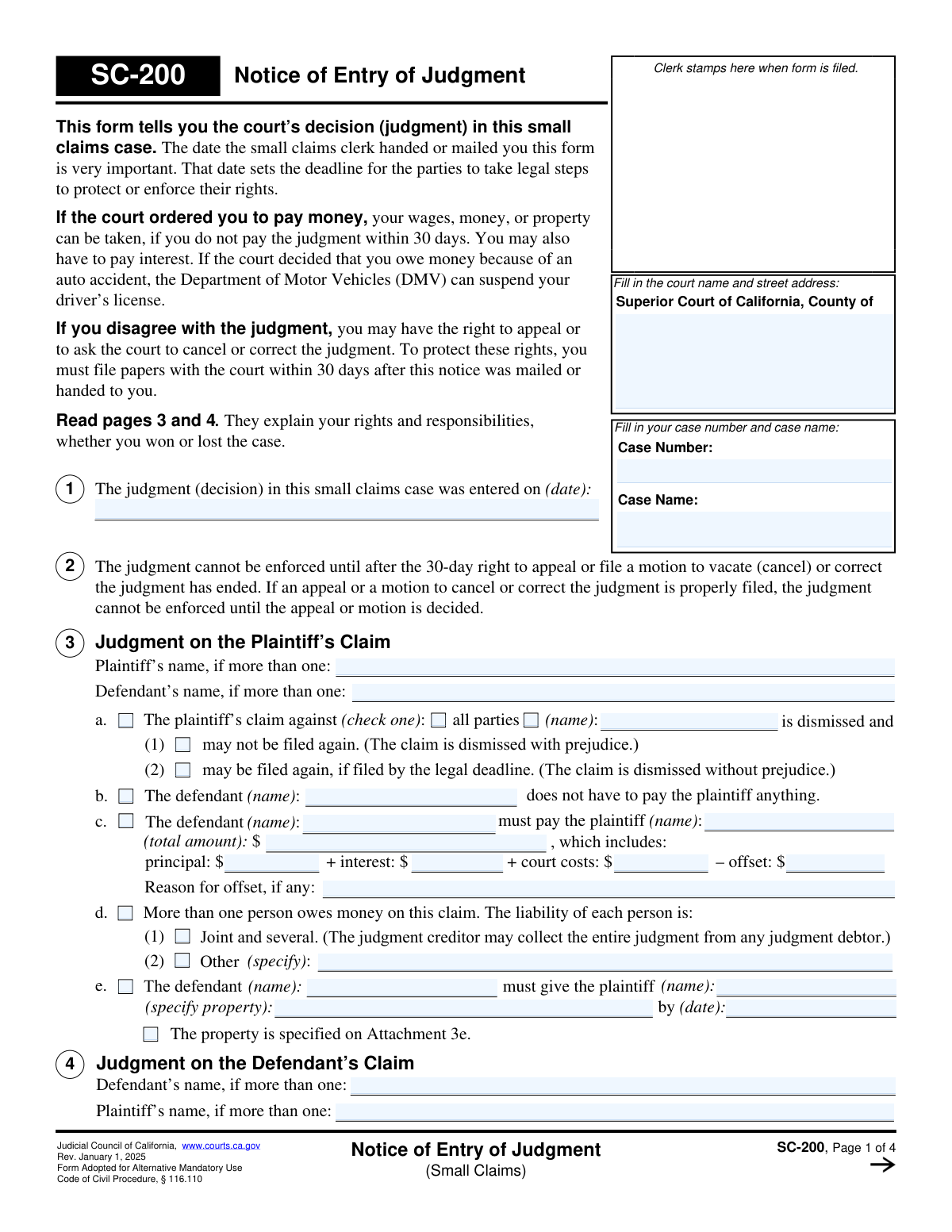
Yes! You can use AI to fill out Form SC-200, Notice of Entry of Judgment (Small Claims)

Form SC-200, Notice of Entry of Judgment (Small Claims), is an official notice issued by the Superior Court of California to inform all parties of the court's decision in a small claims lawsuit. This document is critically important as it outlines the judgment, any monetary awards, and sets strict deadlines (typically 30 days) for appealing the decision or taking action to collect the payment. Today, this form can be filled out quickly and accurately using AI-powered services like Instafill.ai, which can also convert non-fillable PDF versions into interactive fillable forms for your convenience.
SC-200 is part of the California court forms, court claim forms and small claims forms categories on Instafill.
Our AI automatically handles information lookup, data retrieval, formatting, and form filling.
It takes less than a minute to fill out SC-200 using our AI form filling.
Securely upload your data. Information is encrypted in transit and deleted immediately after the form is filled out.

Form specifications

Form name: Form SC-200, Notice of Entry of Judgment (Small Claims)
Number of fields: 107
Number of pages: 1
Language: English
main-image

Instafill Demo: How to fill out PDF forms in seconds with AI

How to Fill Out SC-200 Online for Free in 2026

Are you looking to fill out a SC-200 form online quickly and accurately? Instafill.ai offers the #1 AI-powered PDF filling software of 2026, allowing you to complete your SC-200 form in just 37 seconds or less.
Follow these steps to fill out your SC-200 form online using Instafill.ai:
  1. 1 Navigate to Instafill.ai and upload your SC-200 form, or select it from the template library. The AI will scan and prepare the document for interactive filling.
  2. 2 Provide the court information by entering the full name of the Superior Court of California for the specific county and its street address.
  3. 3 Enter the unique Case Number and Case Name exactly as they appear on other court documents related to your small claims case.
  4. 4 Detail the judgment on the plaintiff's claim in Section 3. Specify if the claim is dismissed, if the defendant must pay, and the breakdown of the total amount (principal, interest, costs).
  5. 5 If there was a defendant's claim, complete Section 4 with the details of that judgment, including any amounts the plaintiff is ordered to pay the defendant.
  6. 6 If the court ordered a payment plan, specify the schedule in Section 5, including the payment amount, frequency (e.g., monthly), and start date.
  7. 7 Review all entered information for accuracy using the AI's summary feature, then download, print, or e-file the completed SC-200 form as directed by the court.

Our AI-powered system ensures each field is filled out correctly, reducing errors and saving you time.

Why Choose Instafill.ai for Your Fillable SC-200 Form?

Speed

Complete your SC-200 in as little as 37 seconds.

Up-to-Date

Always use the latest 2026 SC-200 form version.

Cost-effective

No need to hire expensive lawyers.

Accuracy

Our AI performs 10 compliance checks to ensure your form is error-free.

Security

Your personal information is protected with bank-level encryption.

Frequently Asked Questions About Form SC-200

This form officially informs you of the court's decision (judgment) in your small claims case. It details who won, who lost, and what actions must be taken next by each party.

You do not fill out this form; it is completed and sent to you by the court clerk. It serves as an official notice of the case's outcome, and you must read it carefully to understand your rights and obligations.

You are the 'judgment debtor' and must pay the amount owed within 30 days. You can pay the winner directly, pay the court, or file a request with the court to make payments over time (Form SC-220).

You are the 'judgment creditor,' and you must collect the judgment yourself, as the court does not do it for you. You must wait 30 days for the appeal period to end before you can take legal steps to collect the money if it has not been paid.

The 30-day period starting from when this notice was mailed or handed to you is the deadline to pay the judgment, file an appeal, or file a motion to cancel the judgment. If you are the winner, you cannot start collection actions until this period ends.

If you are the defendant and you lost, you can appeal the decision by filing Form SC-140 within 30 days. A plaintiff cannot appeal the court's decision on their own claim.

If you fail to pay, the judgment creditor can take legal action to collect the money, which may include garnishing your wages or taking your property. Additionally, if the case involved an auto accident, the DMV may suspend your driver's license.

If you are ordered to pay money and do not pay within 30 days, you must complete and send this form to the judgment creditor. It lists your income and property that could be used to pay the judgment.

A claim dismissed 'with prejudice' is permanently closed and cannot be filed again. A claim dismissed 'without prejudice' may be filed again in the future, as long as it is within the legal deadline.

This is noted because if you fail to pay a judgment resulting from an auto accident on a California highway, the DMV can suspend your driver's license.

As the judgment creditor, you must file an 'Acknowledgment of Satisfaction of Judgment' (Form SC-290 or EJ-100) with the court. Failing to do so can result in you having to pay damages and a penalty to the debtor.

Yes, services like Instafill.ai use AI to help you accurately auto-fill related forms, such as an appeal or a motion to vacate. This can save you time and help avoid errors.

You can use a service like Instafill.ai to fill out your forms online. Simply upload the form, and the AI will help you complete the required fields before you print and file it with the court.

If you have a flat, non-fillable PDF, you can upload it to a service like Instafill.ai. It can convert the document into an interactive, fillable form that you can easily complete on your computer.

Compliance SC-200
Validation Checks by Instafill.ai

1
Ensures Case Number and Case Name are Present and Consistent
This check verifies that the 'Case Number' and 'Case Name' fields are filled out on both page 1 and page 2 of the form. It also confirms that the values entered are identical across both pages. This is critical for data integrity and ensures the entire document is correctly associated with a single legal case, preventing filing errors.
2
Validates Judgment Entry Date
This validation ensures that the date entered in Section 1 ('The judgment...was entered on') is a complete and valid date in a recognized format (e.g., MM/DD/YYYY). It also checks that the date is not in the future. An invalid or future date would render the judgment legally nonsensical, as it must reflect a past action by the court.
3
Mutually Exclusive Judgment Outcome for Plaintiff's Claim
This check verifies that for the Plaintiff's Claim in Section 3, only one of the primary outcome options (3a, 3b, 3c, or 3e) is selected. These options, such as 'dismissed' or 'must pay', are mutually exclusive. Selecting multiple conflicting outcomes would create an ambiguous and unenforceable judgment.
4
Conditional Dismissal Type Selection
If a claim is marked as dismissed in Section 3a or 4a, this validation ensures that one of the two sub-options, either 'with prejudice' or 'without prejudice,' is also selected. This distinction is legally critical as it determines whether the claim can be refiled. Failure to specify the type of dismissal leaves the judgment incomplete and open to legal challenge.
5
Verifies Monetary Calculation for Judgment Amount
This check validates the arithmetic in Sections 3c and 4c. It ensures that the sum of the 'principal', 'interest', and 'court costs' fields, minus the 'offset' field, correctly equals the specified 'total amount'. This prevents mathematical errors on a legal document that specifies a financial obligation, which could otherwise lead to disputes and enforcement complications.
6
Ensures Party Names are Specified in Judgment Orders
This check verifies that when a judgment action is ordered (e.g., 'must pay' in 3c or 'must give property' in 3e), the names of the specific plaintiff and defendant involved are filled in. Omitting the names makes the order ambiguous, especially in cases with multiple parties. This validation is essential for creating a clear, legally binding order that can be enforced against the correct individuals.
7
Requires Due Date for Property Return
This check ensures that if a judgment orders the return of property (Sections 3e or 4e), the 'by (date)' field is completed with a valid date. Without a specific deadline, the order is ambiguous and difficult to enforce. The validation prevents the creation of an incomplete order that lacks a clear timeline for compliance.
8
Logical Consistency of Net Offset Judgment
This validation checks the logical consistency of Section 7 ('After offsetting the judgments'). If monetary judgments are awarded to both the plaintiff (Section 3c) and the defendant (Section 4c), this check ensures Section 7 is filled out and the amount equals the difference between the two judgment totals. This ensures the final, net amount owed is clearly and correctly stated.
9
Validates Payment Plan Start Date
For a payment plan defined in Section 5a, this validation ensures the 'starting (date)' is a valid date and is not in the past relative to the judgment entry date. A payment plan cannot logically start before the judgment is entered. This check prevents impossible or illogical payment schedules from being recorded.
10
Payment Plan Details Requirement
If the payment plan option in Section 5a is selected, this check verifies that the payment amount, payment frequency ('month, week, other'), and start date fields are all filled. An incomplete payment plan is unenforceable and fails to provide the necessary details for compliance. The system should flag if any of these key components are missing when the plan is initiated.
11
Ensures Specification for 'Other' Liability Type
In Sections 3d and 4d, if the 'Other' checkbox regarding liability is selected, this validation confirms that the corresponding text field specifying the nature of the liability is not empty. Leaving this field blank would render the judgment vague, as the specific terms of liability for multiple debtors would be undefined. The system should flag this as an incomplete entry.
12
Attachment Reference Check
This validation checks if any of the boxes indicating an attachment are checked (e.g., 'Attachment 3e,' 'Attachment 6,' 'Attachment 11'). If a box is checked, the system should flag that a corresponding attachment document is expected to be part of the submission. This ensures that all referenced parts of the judgment are present, preventing an incomplete filing.

Common Mistakes in Completing SC-200

Entering Incorrect Case or Court Information

Users often rush and enter the wrong case number, misspell the case name, or provide an incomplete court address at the top of the form. This can happen due to typos or confusion if they are involved in multiple cases. An incorrect identifier can lead to the document being filed in the wrong case file or rejected by the clerk, causing significant delays in the judgment being officially recorded and enforced. Always double-check the case number and name against previous court documents before submission.

Mathematical Errors in Judgment Calculation

In sections 3c and 4c, individuals frequently make errors when adding the principal, interest, and court costs, or when incorrectly subtracting an offset to arrive at the total amount. This mistake can lead to an incorrect judgment value, creating disputes and requiring a corrected judgment to be issued. To avoid this, carefully calculate the total on a separate calculator before entering it. AI-powered tools like Instafill.ai can help prevent this by performing the calculations automatically based on the input fields.

Ambiguous Party Identification

The form requires specific names for the plaintiff and defendant in multiple sections (e.g., 3c, 4c, 5, 7). A common error is using vague terms like 'the plaintiff' instead of the full legal name, or omitting names entirely next to the checkboxes. This ambiguity can render the judgment unenforceable, as it's unclear who owes money or property to whom. Always use the full, correct legal names as they appear on the original small claims filing.

Ignoring or Miscalculating the 30-Day Deadline

The informational pages repeatedly warn of a 30-day deadline from the date the notice is mailed or handed to you for filing an appeal or motion. Many people fail to note this date or miscalculate the deadline, causing them to lose their right to appeal or challenge the judgment. This is a critical procedural error with irreversible consequences. To prevent this, immediately mark the date you receive the notice and calculate the 30-day deadline on a calendar.

Specifying an Ambiguous Payment Plan

When filling out a payment plan in Section 5, people often leave fields blank, such as the payment start date, frequency ('day of each month'), or final payment amount. They may also write a vague description under 'Other payment schedule' that is difficult to enforce. An incomplete plan can be rejected by the court or lead to future disagreements about payment terms. Ensure every field in the payment schedule is filled with specific, clear, and mathematically consistent information.

Providing a Vague Description of Property to be Returned

In sections 3e and 4e, if the judgment involves the return of property, individuals sometimes provide a generic description like 'the tools' or 'the computer.' This lack of specificity can create disputes over which exact item is to be returned, especially if the person owns multiple similar items. To avoid this, provide a detailed description including brand, model, color, and serial number if available, making the order clear and enforceable.

Failing to Specify Liability for Multiple Debtors

In cases with more than one defendant who owes money, Section 3d requires specifying the nature of their liability (e.g., 'Joint and several'). People often overlook this section or fail to check a box, leaving it unclear whether one debtor can be held responsible for the full amount. This omission complicates collection efforts and can lead to further legal action to clarify the terms. Always complete this section if more than one party is ordered to pay.

Overlooking Special Judgment Designations

Sections 8 and 9 contain important checkboxes for judgments related to auto accidents or specific debt types (medical, personal). Failing to check the box in Section 8 can prevent the DMV from being notified to suspend a driver's license. Similarly, ignoring Section 9 can affect how post-judgment interest is calculated and what collection methods are available. Carefully review these sections and check any applicable boxes to ensure the judgment has its full legal effect.

Entering Inconsistent Information Across Form Pages

The form requires the Case Name and Case Number to be re-entered at the top of page 2. It's a common oversight to either leave this blank or enter information that doesn't exactly match what was written on page 1. This can cause confusion and potential processing issues, especially if pages become separated. To avoid this, ensure the header information is filled out identically on all required pages. AI form-filling tools like Instafill.ai can automatically populate this information across pages to ensure consistency.

Improperly Applying or Explaining Offsets

In sections 3c and 4c, an 'offset' can be applied if both parties won a judgment against each other. People often miscalculate the final total after applying the offset or fail to provide a clear 'Reason for offset.' This can lead to confusion, an incorrect judgment amount, and potential rejection by the clerk. The offset amount should be subtracted correctly, and the reason should clearly state that it's due to the judgment on the opposing party's claim.

Filling a Non-Fillable PDF Manually

Many court forms are distributed as flat, non-fillable PDFs, leading users to print them and fill them out by hand. This often results in illegible handwriting, which can cause the clerk to misinterpret names, amounts, or dates, leading to filing errors or rejection. Using a tool like Instafill.ai can convert a non-fillable PDF into an interactive, fillable form, ensuring all entries are typed, clear, and legible, which significantly reduces the risk of data entry errors.
Saved over 80 hours a year

“I was never sure if my IRS forms like W-9 were filled correctly. Now, I can complete the forms accurately without any external help.”

Kevin Martin Green

Your data stays secure with advanced protection from Instafill and our subprocessors

Robust compliance program

Transparent business model

You’re not the product. You always know where your data is and what it is processed for.

ISO 27001, HIPAA, and GDPR

Our subprocesses adhere to multiple compliance standards, including but not limited to ISO 27001, HIPAA, and GDPR.

Security & privacy by design

We consider security and privacy from the initial design phase of any new service or functionality. It’s not an afterthought, it’s built-in, including support for two-factor authentication (2FA) to further protect your account.

Fill out SC-200 with Instafill.ai

Worried about filling PDFs wrong? Instafill securely fills form-sc-200-notice-of-entry-of-judgment-small-claims forms, ensuring each field is accurate.

Related forms by category

California court forms Judicial Council of California Form SC-105, Request for Court Order and Answer (Small Claims), Judicial Council of California Form SC-120, Defendant’s Claim and ORDER to Go to Small Claims Court (Small Claims), Judicial Council of California Form SER-001, Request for Sheriff to Serve Court Papers, Judicial Council of California Form SER-001, Request for Sheriff to Serve Court Papers, Affidavit for Collection of Personal Property California Probate Code Section 13100, Form POS-040, Proof of Service—Civil, Declaration of Facts of Death (California Superior Court), declaration-of-marriage-for-court-proceeding-california-family-law, ADOPT-200, Adoption Request, ADOPT-200, Stepparent Adoption Request, ADOPT-210, Adoption Agreement, ADOPT-310, Contact After Adoption Agreement, Judicial Council of California Form ADOPT-200, Adoption Request, Form ADR-107, Mediation Attendance Sheet, Form ADR-110, Order Appointing Referee, Form ADR-109, Stipulation or Motion for Order Appointing Referee, Form ADR-102, Request for Trial De Novo After Judicial Arbitration, Form ADR-108, Referee's Report (Code Civ. Proc., §§ 638, 639), Form ADR-106, Petition to Confirm, Correct, or Vacate Contractual Arbitration Award, Form ADR-104, Rejection of Award and Request for Trial After Attorney-Client Fee Arbitration · + 557 more →
court claim forms Form SC-100, Plaintiff's Claim and ORDER to Go to Small Claims Court, Judicial Council of California Form SC-105, Request for Court Order and Answer (Small Claims), SC-120, Defendant’s Claim and ORDER to Go to Small Claims Court (Small Claims), SC-105, Request for Court Order and Answer (Small Claims), Judicial Council of California Form SC-120, Defendant’s Claim and ORDER to Go to Small Claims Court (Small Claims), Form SC-100, Plaintiff’s Claim and ORDER to Go to Small Claims Court, Certificate of Service (Civil Court Claim), Form N161, Appellant’s notice (All appeals except small claims track appeals and appeals to the Family Division of the High Court), Plaintiff's Claim and ORDER to Go to Small Claims Court (SC-100), Form N161, Appellant's Notice (All appeals except small claims track appeals and appeals to the Family Division of the High Court), Form SC-100A, Other Plaintiffs or Defendants (Attachment to Plaintiff's Claim and ORDER to Go to Small Claims Court), Form N461: Claim for judicial review, Statement of Small Claim and Notice, Trial Court of Massachusetts, State of Michigan, Form MC 25, Notice of Intent to Escheat Unclaimed Personal Property, Form MC 35, Complaint, Claim and Delivery, Form MC 36, Motion for Possession Pending Judgment, Claim and Delivery, Order of Possession Pending Judgment, Claim and Delivery, Form MC 38, Bond, Claim and Delivery, Form MC 39, Judgment, Claim and Delivery, Form MC 55, Claim of Appeal · + 53 more →
small claims forms Form SC-100, Plaintiff's Claim and ORDER to Go to Small Claims Court, Judicial Council of California Form SC-104, Proof of Service (Small Claims), SC-108, Request to Correct or Cancel Judgment and Answer (Small Claims), Judicial Council of California Form SC-105, Request for Court Order and Answer (Small Claims), SC-120, Defendant’s Claim and ORDER to Go to Small Claims Court (Small Claims), Judicial Council of California Form SC-104, Proof of Service (Small Claims), Judicial Council of California Form SC-108, Request to Correct or Cancel Judgment and Answer (Small Claims), SC-105, Request for Court Order and Answer (Small Claims), Judicial Council of California Form SC-120, Defendant’s Claim and ORDER to Go to Small Claims Court (Small Claims), Form SC-100, Plaintiff’s Claim and ORDER to Go to Small Claims Court, Form N161, Appellant’s notice (All appeals except small claims track appeals and appeals to the Family Division of the High Court), Plaintiff's Claim and ORDER to Go to Small Claims Court (SC-100), Form N161, Appellant's Notice (All appeals except small claims track appeals and appeals to the Family Division of the High Court), Form SC-100A, Other Plaintiffs or Defendants (Attachment to Plaintiff's Claim and ORDER to Go to Small Claims Court), Form A, Claim Form, European Small Claims Procedure, Form EJ-001, Abstract of Judgment—Civil and Small Claims, Form SC-109, Authorization to Appear (Small Claims), Form SC-112A, Proof of Service by Mail (Small Claims), Form SC-114, Request to Amend Party Name Before Hearing (Small Claims), Form SC-132, Attorney-Client Fee Dispute (Attachment to Notice of Entry of Judgment) · + 27 more →