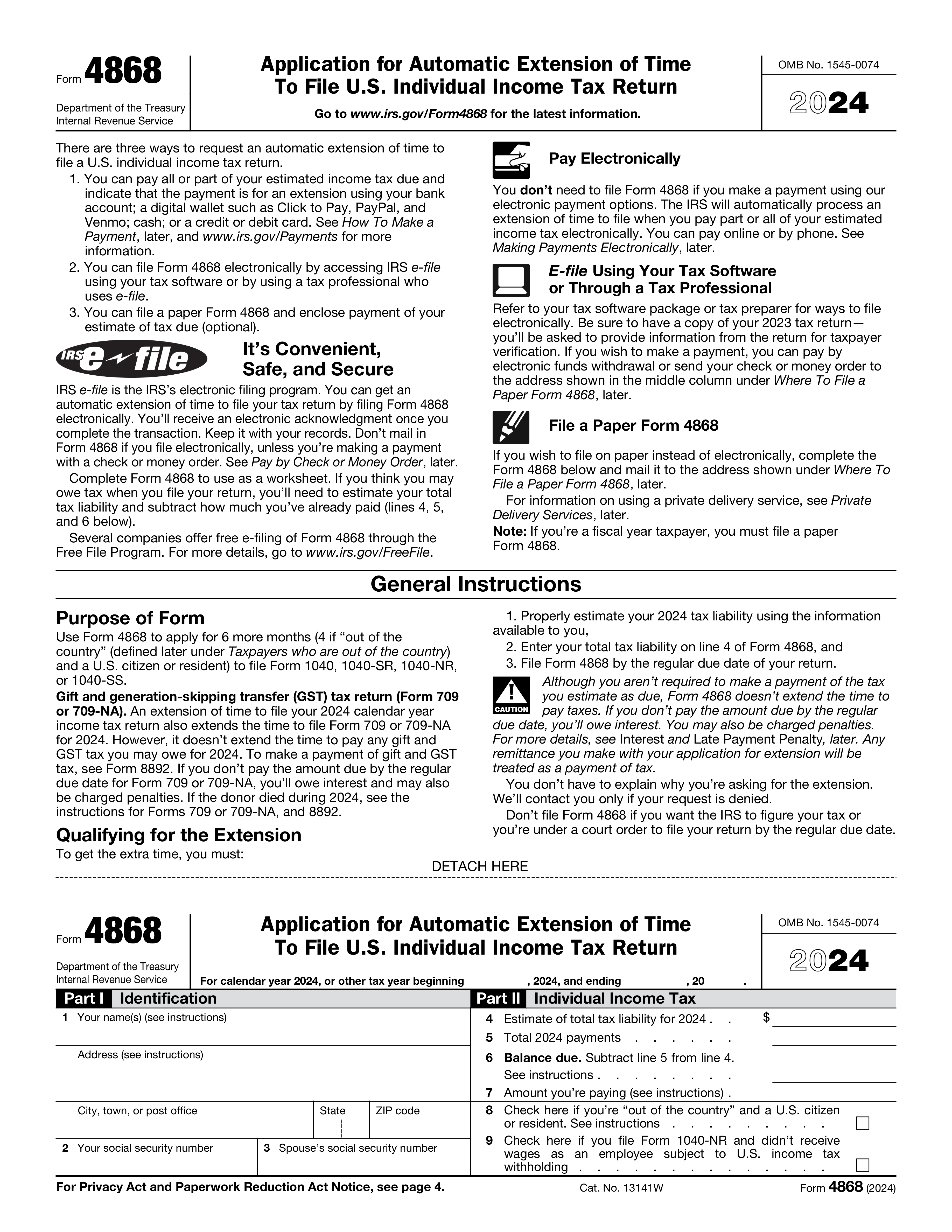
Yes! You can use AI to fill out Form 4868, Application for Automatic Extension of Time To File U.S. Individual Income Tax Return (2024)
| Fillable fields | 17 |
| Pages | 3 |
| Fields per page | 6 |
| Sections | 9 |
| Conditional rules | — |
| Tables & lists | — |
| Instruction pages | 1 |
| OMB Control No. | 1545-0074 |
| Instafill Form ID | IF-FORM-4868-APPLICATION-FOR-AUTOMATIC-EXTENSION-OF-TIME-TO-FILE-U-S-INDIVIDUAL-INCOME-TAX-RETURN-2024 |
Form specifications
| Form name: | Form 4868, Application for Automatic Extension of Time To File U.S. Individual Income Tax Return (2024) |
| Form issued by: | Internal Revenue Service |
| Number of fields: | 17 |
| Number of pages: | 4 |
| FCI: | Basic (35/100) |
| Version: | 2024 |
| Field instructions: | Form 4868 Instructions |
| Language: | English |
Instafill Demo: How to fill out PDF forms in seconds with AI
How to Fill Out Form 4868 Online for Free in 2026
- 1 Visit instafill.ai and select Form 4868.
- 2 Enter your personal and tax information.
- 3 Estimate your total tax liability and payments.
- 4 Indicate if you're out of the country.
- 5 Sign and date the form electronically.
- 6 Check for accuracy and submit the form.
Our AI-powered system ensures each field is filled out correctly, reducing errors and saving you time.
Why Choose Instafill.ai for Your Fillable Form 4868 Form?
Speed
Complete your Form 4868 in as little as 37 seconds.
Up-to-Date
Always use the latest 2026 Form 4868 form version.
Cost-effective
No need to hire expensive lawyers.
Accuracy
Our AI performs 10 compliance checks to ensure your form is error-free.
Security
Your personal information is protected with bank-level encryption.
Frequently Asked Questions About Form 4868
Form 4868 has a Form Complexity Index of 35 out of 100, placing it in the basic complexity tier. This score is calculated deterministically from the form’s own structure using Instafill’s published Form Complexity Index methodology, so it can be reproduced and independently verified — it is not a subjective estimate.
For Form 4868 specifically, the score reflects 17 fillable fields across 3 pages, grouped into 9 sections, plus 1 page of printed instructions. The number of fields is the largest factor in the base score (weighted 36%), followed by how difficult those fields are to complete based on their type, where free-text and signature fields count for more than simple checkboxes (26%). The number of pages that actually contain fields (15%), the amount of conditional “fill-only-if” logic (16%), and how many sections the form is divided into (7%) account for the rest of the base. On top of that base, the index adds points for tables and repeating lists, bundled instruction pages, and dense page layouts — capturing difficulty the base alone can miss.
In practical terms, a basic score means the form is relatively light, but still needs careful, accurate entry. Instafill removes that effort entirely: our AI reads your information, maps each value to the correct field — including the conditional ones — and completes Form 4868 accurately in under a minute, with every field available for you to review before you download. See exactly how the Form Complexity Index is calculated.
Compliance Form 4868
Validation Checks by Instafill.ai
Common Mistakes in Completing Form 4868
“I was never sure if my IRS forms like W-9 were filled correctly. Now, I can complete the forms accurately without any external help.”
Your data stays secure with advanced protection from Instafill and our subprocessors




