Yes! You can use AI to fill out Notice to Employee (Labor Code section 2810.5)
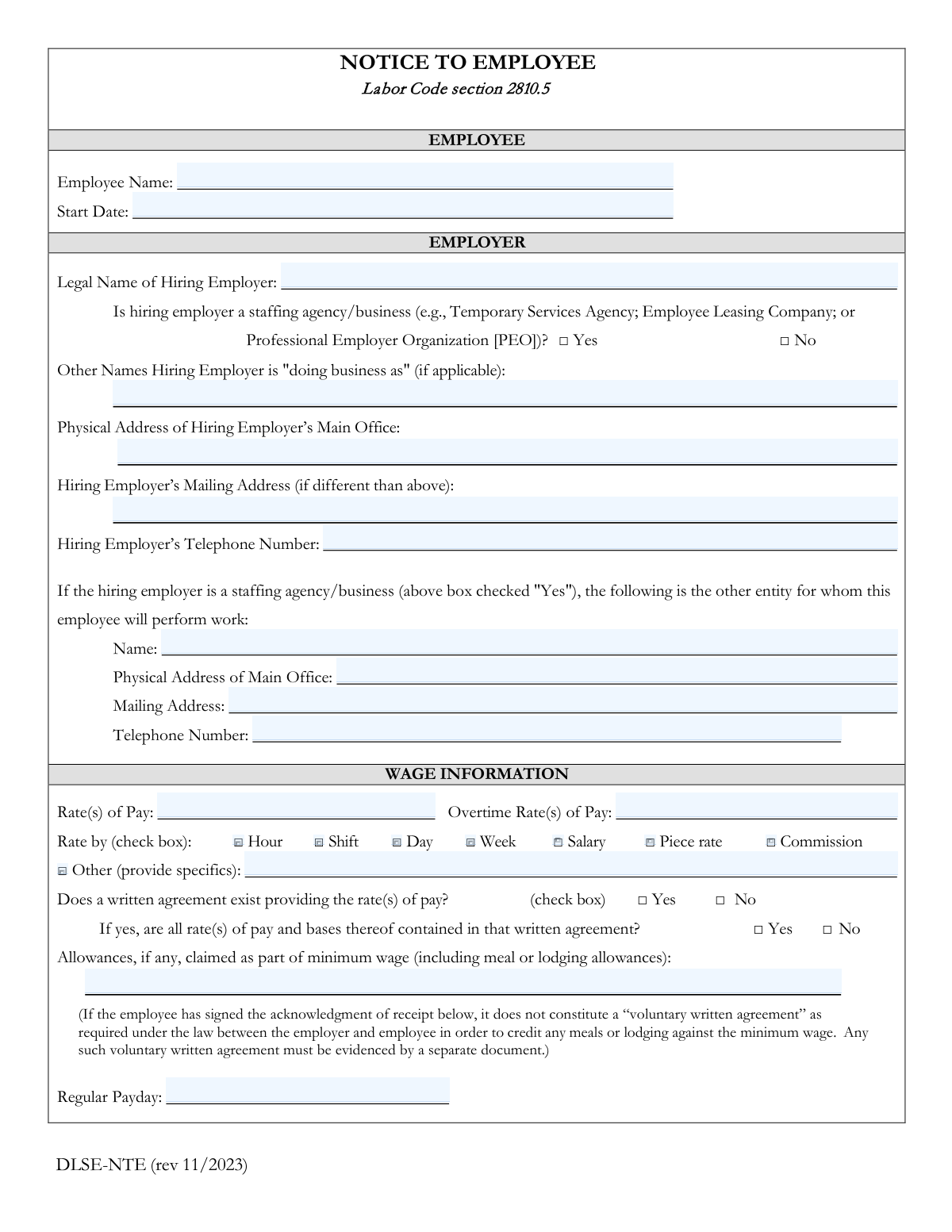
The California Notice to Employee (DLSE-NTE) is a mandatory document that employers must provide to new non-exempt hires, detailing crucial information such as pay rates, payday schedules, and paid sick leave policies. This notice ensures transparency and helps employees understand their rights and the terms of their employment from day one. Today, this form can be filled out quickly and accurately using AI-powered services like Instafill.ai, which can also convert non-fillable PDF versions into interactive fillable forms.
DLSE-NTE is part of the
employee forms, labor forms, SEC forms and Section 8 forms categories on Instafill.
Our AI automatically handles information lookup, data retrieval, formatting, and form filling.
It takes less than a minute to fill out DLSE-NTE using our AI form filling.
Securely upload your data. Information is encrypted in transit and deleted immediately after the form is filled out.
Form specifications
| Form name: | Notice to Employee (Labor Code section 2810.5) |
| Number of fields: | 51 |
| Number of pages: | 2 |
| Filled form examples: | Form DLSE-NTE Examples |
| Language: | English |
More forms in Employee forms
Instafill Demo: How to fill out PDF forms in seconds with AI
How to Fill Out DLSE-NTE Online for Free in 2026
Are you looking to fill out a DLSE-NTE form online quickly and accurately? Instafill.ai offers the #1 AI-powered PDF filling software of 2026, allowing you to complete your DLSE-NTE form in just 37 seconds or less.
Follow these steps to fill out your DLSE-NTE form online using Instafill.ai:
- 1 Navigate to Instafill.ai and upload or select the California Notice to Employee (DLSE-NTE) form.
- 2 Use the AI assistant to automatically populate employer information, including legal name, address, and contact details.
- 3 Enter the specific employee's name and start date into the designated fields.
- 4 Accurately detail the employee's pay rates, pay basis (e.g., hourly, salary), and regular payday schedule.
- 5 Provide the required workers' compensation insurance carrier information and select the applicable paid sick leave policy.
- 6 Review all entered information for accuracy, then have the employer representative and the employee sign and date the acknowledgment sections.
- 7 Securely save and download the completed DLSE-NTE form for your records and provide a copy to the employee.
Our AI-powered system ensures each field is filled out correctly, reducing errors and saving you time.
Why Choose Instafill.ai for Your Fillable DLSE-NTE Form?
Speed
Complete your DLSE-NTE in as little as 37 seconds.
Up-to-Date
Always use the latest 2026 DLSE-NTE form version.
Cost-effective
No need to hire expensive lawyers.
Accuracy
Our AI performs 10 compliance checks to ensure your form is error-free.
Security
Your personal information is protected with bank-level encryption.
Frequently Asked Questions About Form DLSE-NTE
This form serves as a written notice to an employee, detailing their rate of pay, paid sick leave policy, and the employer's workers' compensation information, as required by labor laws. It ensures transparency about the terms of employment.
The hiring employer is responsible for filling out all the required information. The employee's role is to review the information for accuracy and sign to acknowledge receipt of the notice.
This section should be completed if another business entity is involved in the employee's work, such as a staffing agency's client company or a Professional Employer Organization (PEO). The primary employer provides this information if applicable.
The form allows for providing multiple 'rate(s) of pay.' You should list all applicable standard and overtime rates in the 'Pay Rates' section to ensure the employee is fully informed about their compensation for different types of work.
If no separate written agreement exists that specifies the rate(s) of pay, you should check the 'No' box under the 'Written Agreement Inquiry' section. This notice form itself will then serve as the required written documentation of the pay rates.
Select the option that describes your company's policy: choose 'Accrues Minimum Required' for the state minimum, 'Accrues Per Employer Policy' if your policy exceeds the minimum, or '40 Hours Upfront' if you provide the full leave amount at the start of the year.
If your company is self-insured, check the 'Self-Insured (Labor Code 3700)' box and enter your Certificate Number for Consent to Self-Insure. You can then leave the insurance carrier name and policy number fields blank.
No, the form specifies to provide the mailing address only if it is different from the physical address of the main office. If they are the same, you can leave the mailing address field blank.
The employee's signature simply acknowledges that they have received a copy of this notice. It does not necessarily mean they agree with all the information, but rather that the employer has provided it to them as required by law.
This section is to inform the employee if a recent state or federal emergency declaration is active for their work location and might impact their health and safety. If one applies, you must check the box and provide details.
Yes, you can use AI-powered services like Instafill.ai to help complete this form. These tools can accurately auto-fill fields based on your provided information, which helps save time and reduce errors.
You can use a service like Instafill.ai to complete this form digitally. Simply upload the form, and the platform will allow you to type directly into the fields, add signatures, and then download or share the completed document.
If you have a non-fillable or 'flat' PDF, you can upload it to a tool like Instafill.ai. The service uses AI to automatically detect the fields and convert the document into an interactive, fillable form that you can complete on your computer.
Compliance DLSE-NTE
Validation Checks by Instafill.ai
1
Date Acknowledgment Chronology
This check ensures the 'Employee Acknowledgment Date' is on or after the 'Start Date'. An acknowledgment date cannot precede the employment start date, as this would be logically inconsistent. If validation fails, the user should be prompted to correct one or both dates to ensure they are in the correct chronological order.
2
Staffing Agency Status Exclusivity
This validation verifies that exactly one of the two checkboxes ('Yes' or 'No') for the staffing agency question is selected. It is a mandatory binary choice, and selecting both or neither is invalid. This ensures clarity on the employer's business model, which can have legal and reporting implications. A failure would require the user to select one option before proceeding.
3
Overtime Rate Logical Minimum
This check validates that the 'Overtime Pay Rate' is greater than or equal to the 'Standard Pay Rate'. Legally and logically, overtime pay cannot be less than the standard rate. This check prevents data entry errors that could lead to incorrect payroll calculations and legal compliance issues. If the overtime rate is lower, the form should display an error and prevent submission.
4
Conditional 'Other Rate Basis' Specifics
This validation ensures that if the 'Other' checkbox is selected under 'Rate by', the 'Other Rate Basis Specifics' text field must be filled out. This is a conditional requirement to ensure that selecting 'Other' is not a dead end and that the specific, non-standard pay basis is clearly defined. If the 'Other' box is checked and the specifics field is empty, the user must be prompted to provide details.
5
Conditional Written Agreement Follow-up
This check ensures that if 'Written Agreement Exists - Yes' is selected, the user must also select either 'Yes' or 'No' for the 'All Rates Contained in Written Agreement' question. This follow-up question is dependent on the first and is crucial for understanding the completeness of the written agreement. A failure to answer the dependent question when required should block form submission.
6
Workers' Compensation Coverage Exclusivity
This validation ensures that the employer provides information for either the 'Insurance Carrier' (Name, Address, Policy Number) OR checks the 'Self-Insured' box and provides a 'Certificate Number', but not both. An employer must have one form of coverage, so at least one path must be completed. Providing both is contradictory, so the system should enforce this mutual exclusivity to ensure accurate compliance data.
7
Conditional Self-Insured Certificate Number
This check validates that if the 'Self-Insured (Labor Code 3700)' checkbox is checked, the 'Self-Insured Certificate Number' field must not be empty. The certificate number is the required proof of self-insurance status. A failure to provide the number when claiming self-insurance would render the submission incomplete and non-compliant, so the field must be made mandatory based on the checkbox selection.
8
Paid Sick Leave Policy Selection
This validation ensures that exactly one of the four available paid sick leave policy options is selected. These options ('Accrues Minimum', 'Accrues Per Policy', '40 Hours Upfront', 'Employee Exempt') are mutually exclusive. This check prevents ambiguity or contradiction in defining the employee's sick leave benefits. The form should treat these as a radio button group and require a single selection.
9
Conditional Sick Leave Exemption Details
This check validates that if the 'Employee Exempt from Sick Leave' option is selected, the 'State Exemption and Subsection' field must be filled out. Claiming an exemption requires specific justification under the law, which must be documented. If the exemption box is checked but the details are missing, the submission is incomplete and should be blocked until the required information is provided.
10
Conditional Emergency Declaration Details
This validation ensures that if the 'Emergency or Disaster Declaration Applicable' checkbox is selected, the corresponding 'Emergency or Disaster Declaration Details' field is not empty. The checkbox indicates a potential risk, and the details are essential for informing the employee about that risk as required. Leaving the details blank defeats the purpose of the disclosure, so the field must be conditionally required.
11
Employee Name Consistency Check
This check verifies that the value entered in the 'Employee Name' field at the top of the form is identical to the value in the 'Employee Printed Name' field in the acknowledgment section. This ensures the document is being acknowledged by the same individual it is intended for, preventing potential identity mismatches or clerical errors. A mismatch should trigger a warning to confirm the names are correct.
12
Telephone Number Format Validation
This validation checks that all telephone number fields ('Hiring Employer', 'Other Entity', 'Carrier') adhere to a standard format, such as a 10-digit number, optionally with parentheses, spaces, or hyphens. This ensures data consistency and usability for contact purposes. An invalid format could prevent successful communication and should be flagged for correction before submission.
Common Mistakes in Completing DLSE-NTE
Users often enter the commonly known business name or 'Doing Business As' (DBA) name in the 'Legal Name of Hiring Employer' field. This occurs because the legal name may be different from the public-facing brand. This can lead to issues with payroll processing, tax filings, and legal compliance, as official documents require the precise legal entity name. To avoid this, consult official business registration documents for the correct legal name before filling out the form.
In the 'Pay Rates' section, applicants frequently enter ambiguous terms like 'Varies' or 'TBD' instead of specific numerical rates for standard and overtime pay. They also may forget to check a box under 'Rate Basis' (e.g., Hour, Salary, Commission), leaving the pay structure unclear. This creates legal risks and can lead to wage disputes. Always enter the exact pay rates and select the corresponding basis to ensure clarity and compliance with wage notice laws.
The form contains conditional logic, such as the question 'All Rates Contained in Written Agreement', which should only be answered if 'Written Agreement Exists - Yes' is selected. A common error is answering this question out of sequence or when the condition is not met, creating a contradictory and invalid submission. To prevent this, read each field's instructions carefully and answer questions in the order they appear. Smart form-filling tools can also help by hiding or showing conditional fields automatically.
When an employee is marked as exempt from paid sick leave, the form requires the specific 'State Exemption and Subsection' code. People often check the 'Employee Exempt from Sick Leave' box but fail to provide this critical detail. This omission can invalidate the exemption claim during an audit, leading to penalties for non-compliance. To avoid this, the specific legal code justifying the exemption must be looked up and entered accurately.
There is often confusion about whether the hiring employer is a staffing agency, PEO, or a direct employer, leading to incorrect selections on the form. Misclassifying the employer type has significant consequences for liability, workers' compensation, and legal responsibilities. Before completing this section, it is crucial to clarify the exact business structure and employment relationship. This ensures all parties' roles and responsibilities are correctly documented from the start.
A frequent mistake is entering a P.O. Box or mailing address in the 'Physical Address of Main Office' field. This field requires a verifiable street address for legal notices, emergency services, and jurisdictional purposes. Submitting a P.O. Box can lead to form rejection or critical delays in communication. Always use the actual street address for the physical location, and use the separate 'Mailing Address' field if correspondence should be sent elsewhere.
Users often get confused between being insured through a carrier and being self-insured. This can lead to them filling out the 'Insurance Carrier Name' and 'Policy Number' when they are self-insured, or checking the 'Self-Insured' box but forgetting to provide the required 'Certificate Number'. This error can cause significant delays in processing injury claims and may result in compliance violations. Verify the company's workers' compensation status and have the correct policy or certificate number ready before starting the form.
For the 'Regular Payday' field, many people write vague descriptions like 'bi-weekly' or 'twice a month' instead of the specific day or dates. Labor laws often require a clearly defined payday to ensure timely payment of wages. An ambiguous description can lead to employee confusion and potential legal disputes. To avoid this, state the payday with precision, such as 'Every other Friday' or 'The 15th and last day of each month'.
When the hiring employer is a staffing agency or PEO, the 'Other Entity Information' section must be completed to identify the worksite employer, but it is frequently left blank. This omission creates an incomplete record of the co-employment relationship, which can complicate liability and legal matters. It is essential to identify all parties involved and provide the required details for both the hiring employer and the other entity where the employee performs work.
The 'Paid Sick Leave Policy' section presents several mutually exclusive options (e.g., minimum accrual, employer policy, upfront grant), and users may be unsure which one applies to their company. This can lead to checking the wrong box, or multiple boxes, misrepresenting the employee's benefits and creating compliance risks. To avoid this mistake, review the company's official sick leave policy document before filling out the form to ensure the correct option is selected. AI-powered tools like Instafill.ai can help by pre-filling this information based on company profiles, ensuring consistency and accuracy across all employee forms.
Saved over 80 hours a year
“I was never sure if my IRS forms like W-9 were filled correctly. Now, I can complete the forms accurately without any external help.”
Kevin Martin Green
Your data stays secure with advanced protection from Instafill and our subprocessors

Robust compliance program
Transparent business model
You’re not the product. You always know where your data is and what it is processed for.
ISO 27001, HIPAA, and GDPR
Our subprocesses adhere to multiple compliance standards, including but not limited to ISO 27001, HIPAA, and GDPR.
Security & privacy by design
We consider security and privacy from the initial design phase of any new service or functionality. It’s not an afterthought, it’s built-in, including support for two-factor authentication (2FA) to further protect your account.
Fill out DLSE-NTE with Instafill.ai
Worried about filling PDFs wrong? Instafill securely fills notice-to-employee-labor-code-section-28105 forms, ensuring each field is accurate.



