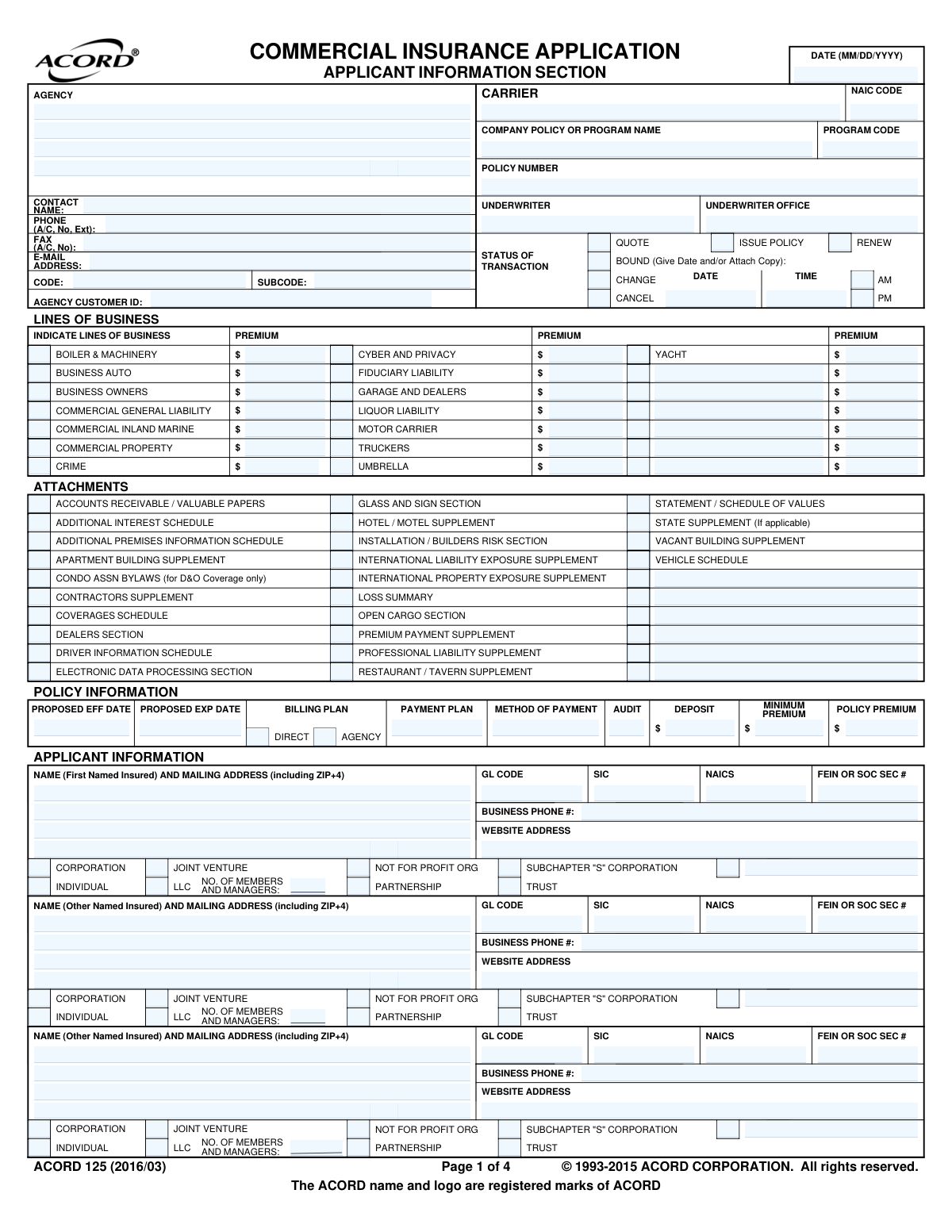
Yes! You can use AI to fill out ACORD 125, Commercial Insurance Application

ACORD 125 is a standardized Commercial Insurance Application form used across the insurance industry to gather essential information from a business seeking coverage. It collects data on the applicant's business operations, locations, prior insurance history, and the specific lines of coverage requested, such as general liability, commercial property, and auto. This comprehensive data allows underwriters to assess risk and determine policy terms and pricing. Today, this form can be filled out quickly and accurately using AI-powered services like Instafill.ai, which can also convert non-fillable PDF versions into interactive fillable forms.
ACORD 125 is part of the ACORD forms, commercial insurance forms and insurance application forms categories on Instafill.
Our AI automatically handles information lookup, data retrieval, formatting, and form filling.
It takes less than a minute to fill out ACORD 125 using our AI form filling.
Securely upload your data. Information is encrypted in transit and deleted immediately after the form is filled out.

Form specifications

Form name: ACORD 125, Commercial Insurance Application
Number of fields: 552
Number of pages: 1
Language: English
main-image

Instafill Demo: How to fill out PDF forms in seconds with AI

How to Fill Out ACORD 125 Online for Free in 2026

Are you looking to fill out a ACORD 125 form online quickly and accurately? Instafill.ai offers the #1 AI-powered PDF filling software of 2026, allowing you to complete your ACORD 125 form in just 37 seconds or less.
Follow these steps to fill out your ACORD 125 form online using Instafill.ai:
  1. 1 Navigate to Instafill.ai and upload your ACORD 125 form or select it from our template library.
  2. 2 Provide your business's basic information, including legal name, address, FEIN, and business structure.
  3. 3 Indicate the specific lines of business you are applying for, such as Commercial General Liability, Property, or Business Auto.
  4. 4 Enter detailed information about your business operations, premises, contact persons, and any additional interests.
  5. 5 Complete the general information and loss history sections, providing details on prior claims and coverage.
  6. 6 Review all the information auto-filled by the AI for accuracy and make any necessary corrections.
  7. 7 Electronically sign and date the application to finalize and submit it to your agent or carrier.

Our AI-powered system ensures each field is filled out correctly, reducing errors and saving you time.

Why Choose Instafill.ai for Your Fillable ACORD 125 Form?

Speed

Complete your ACORD 125 in as little as 37 seconds.

Up-to-Date

Always use the latest 2026 ACORD 125 form version.

Cost-effective

No need to hire expensive lawyers.

Accuracy

Our AI performs 10 compliance checks to ensure your form is error-free.

Security

Your personal information is protected with bank-level encryption.

Frequently Asked Questions About Form ACORD 125

This is a standard application used by businesses to apply for various types of commercial insurance. It gathers essential information about your business, its operations, and history for an underwriter to assess risk and provide a quote.

Any business owner or authorized representative seeking to obtain or renew commercial insurance policies, such as general liability, commercial auto, or property insurance, will need to complete this form. It is typically filled out with the assistance of an insurance agent.

A FEIN (Federal Employer Identification Number) is a tax ID for business entities, while a Social Security Number is for individuals. Use your FEIN if your business is a corporation, partnership, or LLC, and your Social Security Number if you operate as a sole proprietor.

NAICS and SIC codes classify your business by industry and are used for underwriting. You can look them up on the U.S. Census Bureau website or ask your accountant for the code used on your business tax filings.

No, you only need to complete the supplements that apply to your specific business type and the coverage you are requesting. For example, a restaurant would need the 'Restaurant / Tavern Supplement,' and a contractor would need the 'Contractors Supplement'.

The 'Named Insured' is the primary business entity covered by the policy. An 'Additional Interest' is another party, like a landlord or lender, who has a financial interest in your property and is added to the policy to protect their interest.

You must report all claims or losses from the past several years, regardless of fault or whether they were insured. This includes the date of the incident, a brief description, and the amount paid or reserved for the claim.

In the 'Prior Carrier Information' section, you can simply indicate that you have no prior coverage. For the 'Loss History' section, you can check the box that says 'Check if none' to show you have had no previous losses.

Insurers use this information to assess the overall risk and financial stability of the applicant as part of their underwriting process. Honest disclosure is required as this information helps determine eligibility and premium rates.

This application is typically completed and submitted through your insurance agent or broker. They will review it for completeness and forward it to insurance carriers on your behalf to obtain quotes.

Yes, services like Instafill.ai use AI to accurately auto-fill many fields on forms like this, saving you time and reducing errors. It can pull information from your business profile to populate your name, address, FEIN, and other recurring details.

Simply upload the Commercial Insurance Application PDF to the Instafill.ai platform. The AI will make the form fillable and suggest information for many of the fields, which you can then review, complete, and sign electronically.

You can use a service like Instafill.ai, which can convert flat, non-fillable PDFs into interactive, fillable forms. This allows you to easily type your information directly into the fields instead of printing and filling it out by hand.

Compliance ACORD 125
Validation Checks by Instafill.ai

1
FEIN or Social Security Number Format
This check validates that the 'FEIN OR SOC SEC #' field (NamedInsured_TaxIdentifier_A) is a valid 9-digit number. It should conform to either the XX-XXXXXXX format for a Federal Employer Identification Number (FEIN) or the XXX-XX-XXXX format for a Social Security Number (SSN). This is critical for correctly identifying the legal entity for tax, regulatory, and credit reporting purposes. If the format is invalid, the submission should be flagged for manual correction to prevent policy issuance errors.
2
Policy Effective and Expiration Date Logic
Ensures the 'PROPOSED EXP DATE' (Policy_ExpirationDate_A) is chronologically after the 'PROPOSED EFF DATE' (Policy_EffectiveDate_A). A policy's expiration cannot occur before it becomes effective. This validation prevents fundamental data entry errors that would render the policy term invalid and cause significant issues in coverage and billing. An error would require the user to correct one or both dates before proceeding.
3
Conditional Explanation for 'Yes' Responses
This validation verifies that for any question in the 'GENERAL INFORMATION' section where the applicant answers 'YES', the corresponding explanation field is not empty. For example, if 'YES' is checked for 'ANY EXPOSURE TO FLAMMABLES, EXPLOSIVES, CHEMICALS?' (CommercialPolicy_Question_ABCCode_A), the explanation text box must be filled. This is crucial for underwriters to assess risk accurately, and failure to provide details could result in application rejection or delays.
4
Legal Entity 'Other' Description Requirement
If the applicant selects the 'Other' checkbox under the legal entity section (NamedInsured_LegalEntity_OtherIndicator_A), this check ensures that the corresponding description field is populated. This is necessary to understand the applicant's business structure when it doesn't fit standard categories like 'Corporation' or 'Partnership'. Without this information, the underwriter cannot properly assess the legal risks associated with the entity, and the application would be considered incomplete.
5
First Named Insured and Address Completeness
Verifies that the 'NAME (First Named Insured)' (NamedInsured_FullName_A) and the core mailing address fields (Street, City, State, ZIP) are all populated. This information is the primary identifier for the policyholder and is essential for all communications, legal documents, and billing. An application missing this fundamental data is invalid and cannot be processed.
6
Website Address URL Format
Checks if the value entered in the 'WEBSITE ADDRESS' field (NamedInsured_Primary_WebsiteAddress_A) is a validly formatted URL. The validation looks for standard URL structure, such as containing a domain name and a top-level domain (e.g., 'business.com'). This allows underwriters to easily research the applicant's operations, and an invalid format could hinder this due diligence process. The check prevents typos and ensures the provided link is usable.
7
ZIP+4 Postal Code Format
This validation ensures that all postal code fields (e.g., NamedInsured_MailingAddress_PostalCode_A) adhere to a standard 5-digit or 9-digit (ZIP+4) format, such as 'XXXXX' or 'XXXXX-XXXX'. Correct postal codes are vital for accurate mail delivery, location-based risk assessment, and calculating territory-specific premium rates. An invalid format would trigger an error, prompting the user to correct the entry to ensure data quality.
8
Line of Business and Premium Consistency
If a checkbox for a specific 'LINE OF BUSINESS' is selected (e.g., 'BUSINESS AUTO'), this check confirms that its corresponding 'PREMIUM' field contains a valid numerical value. This ensures that every selected coverage has an associated premium amount for quoting and policy issuance. A mismatch, such as a selected coverage with no premium, would indicate an incomplete or erroneous application that needs correction.
9
Loss History Date Sequence
For each entry in the 'LOSS HISTORY' section, this validation confirms that the 'DATE OF OCCURRENCE' (LossHistory_OccurrenceDate_A) is on or before the 'DATE OF CLAIM' (LossHistory_ClaimDate_A). It is logically impossible for a claim to be filed before the loss event has happened. This check maintains the integrity of the applicant's loss history, which is a critical factor in underwriting and pricing.
10
Attachment Supplement Requirement
This check verifies that if a box is checked in the 'ATTACHMENTS' section (e.g., 'CONTRACTORS SUPPLEMENT'), the corresponding document is actually included with the submission. This is important because supplements contain industry-specific information essential for underwriting complex risks. The system should flag applications where a required supplement is indicated but not provided, preventing the processing of an incomplete application package.
11
Applicant Signature and Date Requirement
Ensures that the 'APPLICANT'S SIGNATURE' (NamedInsured_Signature_A) and the signature 'DATE' (NamedInsured_SignatureDate_A) fields are both present. The signature is required to make the application a legally binding document, and the date confirms when it was signed. An unsigned or undated application is not valid and must be rejected until properly completed.
12
Premises Square Footage Logic
Validates that the 'TOTAL BUILDING AREA' (Construction_BuildingArea_A) is greater than or equal to the sum of the 'OCCUPIED AREA' (BuildingOccupancy_OccupiedArea_A) and the 'OPEN TO PUBLIC AREA' (BuildingOccupancy_OpenToPublicArea_A). This logical check prevents data entry errors in describing the physical premises. Inaccurate square footage can lead to incorrect property valuation and premium calculation, so maintaining logical consistency is crucial.
13
Prior Carrier Information Completeness
If a carrier name is entered in the 'PRIOR CARRIER INFORMATION' section (e.g., PriorCoverage_GeneralLiability_InsurerFullName_A), this check ensures that the corresponding 'POLICY NUMBER' and 'EFFECTIVE DATE'/'EXPIRATION DATE' are also filled out. This information is essential for verifying coverage history and identifying potential gaps in coverage. An incomplete record would be flagged for the user to provide the missing details.
14
NAICS Code Validation
This check validates the 'NAICS' code (NamedInsured_NAICSCode_A) against a standard list of North American Industry Classification System codes. Using a valid, standardized code is essential for accurate industry classification, which directly impacts risk assessment, premium rating, and statistical analysis. An invalid or non-existent code would be rejected, requiring the user to find and enter the correct code for the applicant's business type.

Common Mistakes in Completing ACORD 125

Using a DBA or Trade Name Instead of the Legal Entity Name

Applicants often enter their well-known trade name (e.g., 'City Pizzeria') instead of the legal business name registered with the state (e.g., 'CPZ Restaurant Group, LLC'). This happens because the trade name is used daily. However, an insurance policy is a legal contract, and using the wrong name can lead to claims being denied, as the named insured technically does not match the legal entity that suffered the loss. Always use the full legal name as it appears on formation documents and tax records, and list any DBAs separately if a field is provided.

Providing a Vague or Incomplete 'Description of Operations'

This is one of the most critical sections for underwriting, yet it's often filled with generic phrases like 'contracting' or 'retail store'. Underwriters need specific details to accurately assess risk and calculate premiums. An incomplete description can lead to endless follow-up questions, processing delays, or incorrect classifications that result in improper coverage or pricing. Be specific: instead of 'contractor', write 'Residential roofing contractor, 70% tear-offs and replacements, 30% new construction, no work on buildings over 3 stories'.

Incomplete or Inaccurate Loss History

Applicants may forget small claims, omit incidents that didn't result in a formal claim, or fail to list claims from all prior policies, despite the form asking for all occurrences. Insurers run their own claim reports (like CLUE), and any discrepancy will be a major red flag, causing delays and raising questions about the applicant's truthfulness. It is crucial to disclose all losses and occurrences for the specified period, regardless of fault or whether a claim was paid, to avoid having the policy voided for material misrepresentation.

Failing to Explain 'Yes' Answers in the General Information Section

The form contains numerous 'yes/no' questions about high-risk exposures like bankruptcies, foreign operations, or past policy cancellations. Many applicants will correctly check 'yes' but then leave the required explanation field blank. This automatically renders the application incomplete and stops the underwriting process. An underwriter cannot proceed without understanding the context of the 'yes' answer, leading to guaranteed delays. Always provide a concise but complete explanation for every 'yes' response.

Using Incorrect NAICS or SIC Codes

Many business owners are not familiar with their North American Industry Classification System (NAICS) or Standard Industrial Classification (SIC) codes. They may guess, leave it blank, or use a code that is only partially accurate. These codes are fundamental to how insurers classify and price risk. An incorrect code can lead to being placed in the wrong risk pool, resulting in inaccurate premiums (either too high or too low) and potential coverage gaps if the described operations don't match the classification.

Forgetting to Attach Indicated Supplements and Schedules

The main application acts as a cover page, with detailed information often required in separate forms like a 'Contractors Supplement' or 'Restaurant/Tavern Supplement'. Applicants frequently check the box indicating a supplement is attached but then fail to include the actual document. This leaves a critical information gap, making it impossible for the underwriter to provide a quote. It's essential to gather and attach all relevant schedules and supplements before submission. AI-powered tools like Instafill.ai can help by identifying which supplements are needed based on your business type.

Confusing 'Additional Interest' Types

The form lists various types of additional interests, such as 'Loss Payee,' 'Mortgagee,' and 'Additional Insured,' each with distinct legal rights. Applicants often incorrectly select the interest type, for example, listing a landlord as a 'Loss Payee' when they should be an 'Additional Insured' on the liability policy. This mistake can lead to a breach of contract with the third party and significant delays in issuing the correct certificates of insurance. It's vital to refer to your contracts (e.g., leases, loan agreements) to determine the correct status required.

Mismatching Applicant and Tax ID Information

A common error is providing a Social Security Number (SSN) for a business that has a Federal Employer Identification Number (FEIN), or vice versa. This typically happens with sole proprietors who later incorporate but continue to use their SSN out of habit. The tax ID must match the legal entity structure; corporations and LLCs must use an FEIN. A mismatch will cause data validation failures, delays in policy issuance, and potential issues with regulatory and tax reporting. If the form is a non-fillable PDF, a tool like Instafill.ai can convert it to a fillable version and help validate that the FEIN format is correct.

Inaccurate Square Footage and Occupancy Details

In the 'Premises Information' section, applicants often confuse 'Total Building Area' with their 'Occupied Area,' especially if they are a tenant in a larger building. They might also guess at the square footage open to the public. These figures are key rating factors for property and liability insurance. Incorrect data can lead to improper premiums and, in a worst-case scenario, a finding of underinsurance after a loss, which could reduce the claim payout. It is important to use precise figures from a lease or building records.

Omitting Other Business Ventures

Question 13 asks if the applicant has other business ventures for which coverage is not requested. People often answer 'no' if the other ventures are unrelated or small, believing they aren't relevant. However, underwriters need a complete picture of the applicant's total operational risk, as liabilities can sometimes cross between entities. Failing to disclose other ventures could be considered material misrepresentation and jeopardize coverage under the policy. Always disclose all business ventures and provide a clear description as requested.
Saved over 80 hours a year

“I was never sure if my IRS forms like W-9 were filled correctly. Now, I can complete the forms accurately without any external help.”

Kevin Martin Green

Your data stays secure with advanced protection from Instafill and our subprocessors

Robust compliance program

Transparent business model

You’re not the product. You always know where your data is and what it is processed for.

ISO 27001, HIPAA, and GDPR

Our subprocesses adhere to multiple compliance standards, including but not limited to ISO 27001, HIPAA, and GDPR.

Security & privacy by design

We consider security and privacy from the initial design phase of any new service or functionality. It’s not an afterthought, it’s built-in, including support for two-factor authentication (2FA) to further protect your account.

Fill out ACORD 125 with Instafill.ai

Worried about filling PDFs wrong? Instafill securely fills acord-125-commercial-insurance-application-1 forms, ensuring each field is accurate.