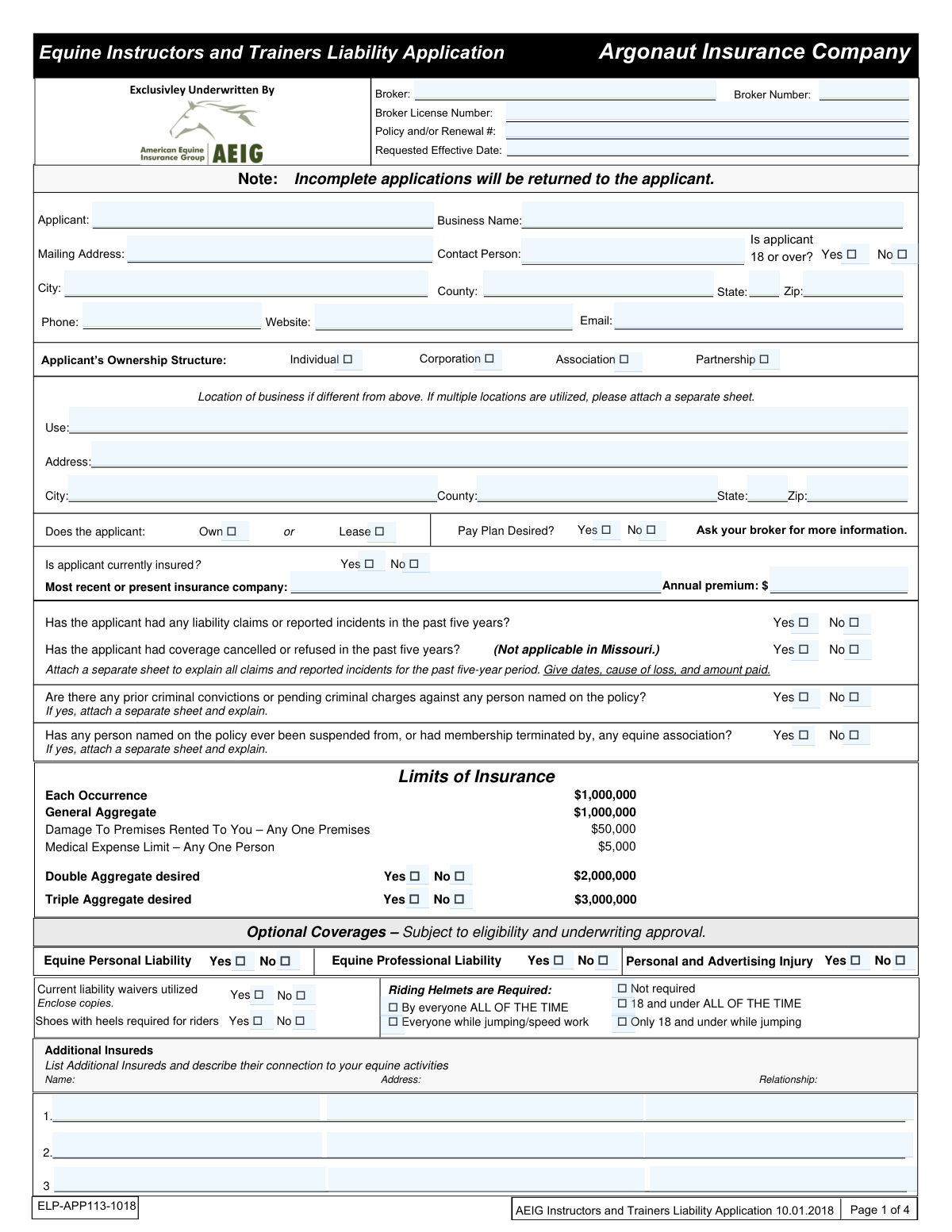
Yes! You can use AI to fill out Argonaut Insurance Company, AEIG Instructors and Trainers Liability Application
This form is an application for equine instructors and trainers to obtain liability insurance from Argonaut Insurance Company. It gathers detailed information about the applicant's business operations, experience, revenue, and specific activities like training and clinics to assess risk and determine appropriate coverage. Today, this form can be filled out quickly and accurately using AI-powered services like Instafill.ai, which can also convert non-fillable PDF versions into interactive fillable forms.
Our AI automatically handles information lookup, data retrieval, formatting, and form filling.
It takes less than a minute to fill out ELP-APP113-1018 using our AI form filling.
Securely upload your data. Information is encrypted in transit and deleted immediately after the form is filled out.
Form specifications
| Form name: | Argonaut Insurance Company, AEIG Instructors and Trainers Liability Application |
| Number of pages: | 4 |
| Language: | English |
| Categories: | insurance forms, insurance application forms, company forms |
Instafill Demo: How to fill out PDF forms in seconds with AI
How to Fill Out ELP-APP113-1018 Online for Free in 2026
Are you looking to fill out a ELP-APP113-1018 form online quickly and accurately? Instafill.ai offers the #1 AI-powered PDF filling software of 2026, allowing you to complete your ELP-APP113-1018 form in just 37 seconds or less.
Follow these steps to fill out your ELP-APP113-1018 form online using Instafill.ai:
- 1 Navigate to Instafill.ai and upload or select the AEIG Instructors and Trainers Liability Application form.
- 2 Provide your personal and business contact information, including ownership structure and broker details.
- 3 Detail your equine operations, including years of experience, types of activities (instruction, training, sales), and annual revenues for each.
- 4 Select your desired liability limits, optional coverages like Care, Custody, or Control (CCC), and specify your safety protocols.
- 5 Answer all yes/no questions regarding your insurance history, liability claims, and any prior incidents or convictions.
- 6 Review all the information populated by the AI for accuracy, then electronically sign and date the application in the declaration section.
- 7 Download the completed application for your records and for submission to your insurance broker.
Our AI-powered system ensures each field is filled out correctly, reducing errors and saving you time.
Why Choose Instafill.ai for Your Fillable ELP-APP113-1018 Form?
Speed
Complete your ELP-APP113-1018 in as little as 37 seconds.
Up-to-Date
Always use the latest 2026 ELP-APP113-1018 form version.
Cost-effective
No need to hire expensive lawyers.
Accuracy
Our AI performs 10 compliance checks to ensure your form is error-free.
Security
Your personal information is protected with bank-level encryption.
Frequently Asked Questions About Form ELP-APP113-1018
This is an application for Equine Instructors and Trainers Liability Insurance. It should be completed by equine professionals seeking liability coverage for their business operations, such as riding instruction, horse training, clinics, or judging.
You must enclose copies of your current liability waivers. You also need to attach a separate sheet to explain any 'Yes' answers regarding past liability claims, criminal history, or equine association suspensions.
CCC coverage protects you if a non-owned horse in your care is injured or dies due to your negligence. You should select this coverage if you train, board, or transport horses belonging to clients.
Your policy will only cover activities that you declare on the application. To ensure you are fully protected, you must disclose all operations and revenue sources, as any undeclared activities are not covered in the event of a claim.
The form has a section for one business location if it's different from your mailing address. If you use more than one business location, you must attach a separate sheet listing the full address and use for each additional property.
Not necessarily, but you must disclose it by checking 'Yes' and attaching a separate sheet. You need to explain all claims from the past five years, including the date, cause of loss, and amount paid.
No, the application explicitly states in bold that no coverage is provided for commercial trail riding activities. You would need to secure a different type of policy for that specific exposure.
The standard General Aggregate limit is the maximum total the policy will pay in a year, which is $1,000,000. Selecting 'Double Aggregate' increases this total annual limit to $2,000,000, providing more overall protection if you have multiple claims.
You can still apply for coverage, but you must provide written notice of the clinic dates to the insurance company before each clinic takes place. The form notes that coverage is not provided for clinic dates that have not been declared in advance.
The form clearly states that incomplete applications will be returned to the applicant. To avoid delays in processing, be sure to answer every question and attach all required documents and explanations before submission.
After you fill out and sign the application, you must provide it to your insurance broker. The broker will also sign it (if required) and submit it to the insurance company on your behalf for underwriting and approval.
Yes, services like Instafill.ai use AI to accurately auto-fill form fields, which can save you significant time and help prevent errors. This is especially useful for recurring information and complex sections of the application.
Simply upload the Equine Instructors and Trainers Liability Application to the Instafill.ai platform. The AI will identify all the fields, allowing you to answer questions in a simple format and have your information automatically and accurately placed onto the form.
You can still use a service like Instafill.ai, which is designed to convert flat, non-fillable PDFs into interactive, fillable forms. This allows you to complete and sign the application digitally without needing to print it.
Compliance ELP-APP113-1018
Validation Checks by Instafill.ai
1
Applicant Age Eligibility
This check verifies that the applicant has selected 'Yes' for the question 'Is applicant 18 or over?'. This is a fundamental eligibility requirement for the policy, as minors typically cannot enter into legal contracts. If 'No' is selected, the application should be flagged for immediate rejection or require a legal guardian's information and signature.
2
Conditional Disclosure for Adverse History
This validation ensures that if an applicant answers 'Yes' to questions about prior liability claims, criminal convictions, or equine association suspensions, a corresponding explanation or attachment is provided. This information is critical for underwriting to accurately assess the risk profile of the applicant. A failure to provide the required explanation will result in an incomplete application and prevent processing.
3
Gross Revenue Summation Accuracy
This check calculates the sum of all individual revenue sources listed under 'Annual Gross Revenues from Equine Activities' (Training, Riding Instruction, Horse Sales, etc.) and verifies that it matches the value entered in the 'Total Annual Gross Revenue' field. This ensures the financial data is consistent and accurate, which is vital for determining the correct premium and coverage levels. If the amounts do not reconcile, the form should prompt the user to correct the entries.
4
Current Insurance Details Requirement
This validation enforces that if the applicant checks 'Yes' for 'Is applicant currently insured?', the fields for 'Most recent or present insurance company' and 'Annual premium' must be completed. This information provides the underwriter with important context about the applicant's insurance history and prior risk assessment. An application with 'Yes' selected but missing these details will be considered incomplete and returned.
5
Care, Custody, or Control (CCC) Section Completeness
If the applicant selects 'Yes' for 'Is CARE, CUSTODY, OR CONTROL (CCC) coverage desired?', this check ensures that at least one CCC limit option is selected and that the fields for average/maximum number and maximum value of non-owned horses are filled. These details are essential for calculating the premium and defining the scope of CCC coverage. Without this information, the desired coverage cannot be quoted or bound.
6
CCC Coverage Limit Adequacy
This check compares the 'Maximum value of an individual non-owned horse' with the 'Maximum Limit Per Horse' from the selected CCC coverage option. The validation ensures the selected coverage limit is greater than or equal to the maximum value of a single horse in the applicant's care. This prevents a situation where the applicant is unknowingly underinsured for the most valuable animal they handle, which would lead to significant financial exposure in the event of a loss.
7
Logical Experience Chronology
This validation verifies that the value for 'Professional years operating this type of an operation' is less than or equal to the value for 'Years experience with horses'. It is logically impossible for professional experience to exceed total experience. This check helps ensure the data provided is thoughtful and accurate, reflecting a true history of the applicant's expertise.
8
Activity-Specific Data Entry
This check ensures that if an applicant indicates 'Yes' for a specific equine activity (e.g., 'Riding Instruction', 'Training', 'Riding Clinics'), the corresponding detailed fields for that activity are completed. For example, if 'Riding Instruction' is 'Yes', then 'Total lessons given annually' must have a value. This ensures that all declared exposures are properly quantified for risk assessment and premium calculation.
9
Applicant Signature and Date Presence
This validation confirms that the 'Applicant's Signature' and 'Date' fields at the end of the application are not blank. The signature legally binds the applicant to the statements made in the application and is a non-negotiable requirement for the policy to be valid. An unsigned or undated application is legally incomplete and will be immediately returned.
10
Email Address Format Validation
This check ensures that the value entered in the 'Email' field follows a standard email format (e.g., '[email protected]'). A valid email address is crucial for all electronic communication, including policy documents, billing notices, and other important correspondence as indicated by the electronic delivery preference. If the format is invalid, the system should prevent submission and prompt the user for a correction.
11
Equestrian Day Camp Supplemental Trigger
This validation checks if 'Equestrian Day Camps — Yes' is selected. If it is, the system flags that the 'Equestrian Day Camp Supplemental Application' must also be completed and submitted. This is a critical workflow step, as day camps represent a unique and significant liability exposure that requires more detailed underwriting than the main application covers.
12
Horse Sales Count Reconciliation
This check validates the 'Horse Sales' section by ensuring the 'Total Horses Sold Annually' field is equal to the sum of 'Horses Sold Annually (Owned by you)' and 'Horses Sold Annually (Owned by others)'. This cross-references the data for internal consistency and accuracy. A mismatch would indicate a data entry error that needs to be corrected before the revenue and exposure from horse sales can be properly evaluated.
13
Requested Effective Date Logic
This validation ensures the 'Requested Effective Date' is a valid date and is not in the past. Insurance policies cannot be retroactively initiated through a standard application process. This check prevents errors and ensures the policy coverage starts on a valid, future-or-present date as intended by the applicant and the insurer.
14
Conditional Broker Signature for New Hampshire
This check is triggered if the applicant's mailing address state is 'NH' (New Hampshire). It verifies that the 'Broker Signature' and 'Broker Signature Date' fields are completed, as the form explicitly states this is required in NH. This rule ensures compliance with state-specific regulations, and failure to comply would render the application invalid for applicants in that state.
Common Mistakes in Completing ELP-APP113-1018
Applicants often check 'Yes' to questions about prior liability claims, criminal history, or association suspensions but fail to attach the required explanatory document. This is a critical omission that deems the application incomplete and will cause it to be returned, delaying coverage. To avoid this, carefully review each 'Yes' answer and ensure a separate, detailed sheet is attached for each; AI-powered tools like Instafill.ai can flag these conditional requirements to prevent submission with missing information.
A frequent error is when the sum of individual revenue sources (Training, Instruction, Sales, etc.) does not match the 'Total Annual Gross Revenue' figure provided. This discrepancy raises red flags for underwriters and requires clarification, delaying the quoting process. Double-check all calculations before submitting, or use a smart form-filling tool that can perform these calculations and validations automatically to ensure accuracy.
The form explicitly states that undeclared activities are not covered, yet applicants often forget to list infrequent operations like hosting a single annual clinic or occasional horse hauling. This oversight can be catastrophic, leading to a denied claim if an incident occurs during an undeclared activity. To prevent this, thoroughly list every single equine-related business activity, no matter how small; Instafill.ai can help by providing prompts based on your business description to ensure nothing is missed.
The application requires attaching copies of current liability waivers and separate sheets for various explanations, but these are commonly forgotten. Submitting without these documents guarantees the application will be considered incomplete and sent back, halting the underwriting process. Create a checklist of all required attachments before submission. If the form is a non-fillable PDF, a tool like Instafill.ai can convert it to a fillable version and manage digital attachments seamlessly.
In the Care, Custody, or Control (CCC) section, applicants may choose a limit that doesn't align with the 'Maximum value of an individual non-owned horse' they list, or they may fail to answer the conditional follow-up questions about transportation. This leads to incorrect premiums and potential coverage gaps if a non-owned horse is injured. Carefully read all notes in this section and ensure the selected limits and activities align with your actual exposure.
When adding an Additional Insured, applicants often provide an incomplete address or a vague relationship like 'landlord' or 'partner.' Insurers require precise information, including a full address and a specific description of the entity's connection to the equine operation (e.g., 'Owner of premises located at [address]'). Incomplete entries require follow-up and delay policy issuance.
An applicant might check 'Yes' for an activity like 'Riding Instruction' but then enter '$0' in the corresponding revenue field, or vice-versa. This contradiction forces the underwriter to question whether the activity actually occurs or if the revenue was simply forgotten. Ensure that for every activity you check 'Yes' to, you provide a corresponding revenue figure, and that you provide revenue only for activities you have declared.
The 'Description of your operation' is a key field that provides context for all the data on the form, but it is often left too brief (e.g., 'Horse trainer'). A detailed description helps the underwriter understand the full scope of your business and assess risk accurately, preventing unnecessary questions and delays. Provide a comprehensive summary of your services, client types, and facility use to paint a clear picture for the insurer.
An unsigned or undated application is legally invalid and cannot be processed, representing one of the most common and easily avoidable reasons for rejection. The signature legally binds the applicant to the statements made in the form, and the date establishes a clear timeline. Always perform a final review of the last page to ensure the applicant's signature and the current date are present before submitting.
Applicants may provide conflicting numbers for owned, leased, and school horses on page 2. For example, listing 5 total owned/leased horses but 10 horses used for riding instruction would create a discrepancy that requires clarification from the underwriter. Ensure all horse counts are logical and consistent across the application to avoid processing delays.
Saved over 80 hours a year
“I was never sure if my IRS forms like W-9 were filled correctly. Now, I can complete the forms accurately without any external help.”
Kevin Martin Green
Your data stays secure with advanced protection from Instafill and our subprocessors

Robust compliance program
Transparent business model
You’re not the product. You always know where your data is and what it is processed for.
ISO 27001, HIPAA, and GDPR
Our subprocesses adhere to multiple compliance standards, including but not limited to ISO 27001, HIPAA, and GDPR.
Security & privacy by design
We consider security and privacy from the initial design phase of any new service or functionality. It’s not an afterthought, it’s built-in, including support for two-factor authentication (2FA) to further protect your account.
Fill out ELP-APP113-1018 with Instafill.ai
Worried about filling PDFs wrong? Instafill securely fills argonaut-insurance-company-aeig-instructors-and-trainers-liability-application-1 forms, ensuring each field is accurate.