Yes! You can use AI to fill out Recommendation and Attestation Form Rollovers, Transfers and Changes to Account Type

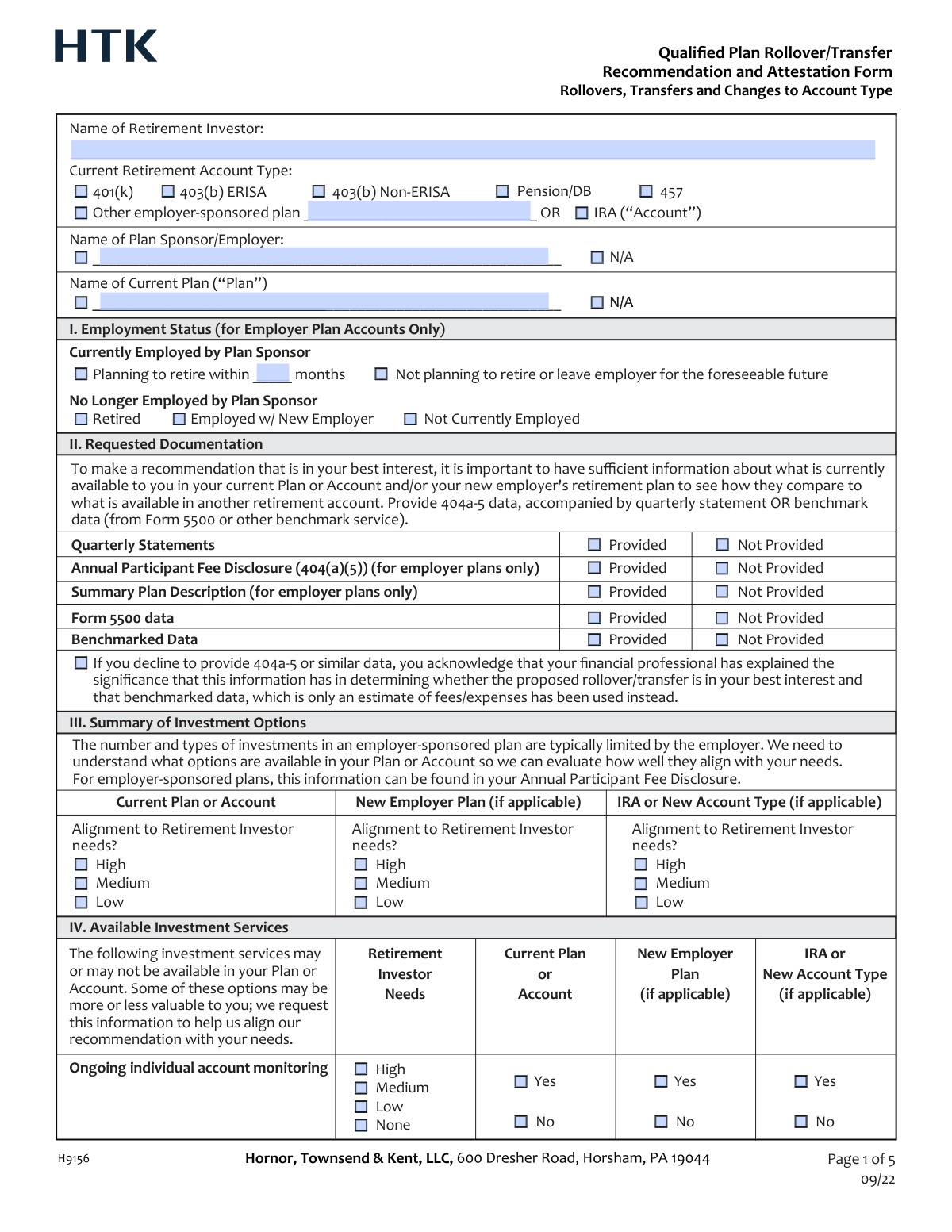
Form H9156 is a comprehensive document used by financial advisors to evaluate and record the rationale behind recommending a change to a client's retirement account, such as a rollover from a 401(k) to an IRA. It compares the fees, services, and investment options of the current plan against potential new accounts to ensure the advice is in the client's best interest. Today, this form can be filled out quickly and accurately using AI-powered services like Instafill.ai, which can also convert non-fillable PDF versions into interactive fillable forms.
H9156 is part of the account transfer forms, rollover forms and transfer forms categories on Instafill.
Our AI automatically handles information lookup, data retrieval, formatting, and form filling.
It takes less than a minute to fill out H9156 using our AI form filling.
Securely upload your data. Information is encrypted in transit and deleted immediately after the form is filled out.

Form specifications

Form name: Recommendation and Attestation Form Rollovers, Transfers and Changes to Account Type
Number of fields: 193
Number of pages: 5
Filled form examples: Form H9156 Examples
Language: English
main-image

Instafill Demo: How to fill out PDF forms in seconds with AI

How to Fill Out H9156 Online for Free in 2026

Are you looking to fill out a H9156 form online quickly and accurately? Instafill.ai offers the #1 AI-powered PDF filling software of 2026, allowing you to complete your H9156 form in just 37 seconds or less.
Follow these steps to fill out your H9156 form online using Instafill.ai:
  1. 1 Navigate to Instafill.ai and upload or select the Recommendation and Attestation Form H9156.
  2. 2 Use the AI assistant to automatically populate your name and details about your current retirement account, such as account type and employer information.
  3. 3 In Section II, check the boxes to indicate which supporting documents, like quarterly statements or fee disclosures, you have provided.
  4. 4 Complete Sections III, IV, and V by evaluating and comparing your current plan, a potential new employer plan, and an IRA across investment options, available services, and associated fees.
  5. 5 In Section VI, rate the personal importance of additional factors such as tax considerations, distribution options, and creditor protection for each potential account type.
  6. 6 Carefully review the special disclosures in Section VII and the final recommendation provided by your financial professional.
  7. 7 Complete the Retirement Investor Attestation in Section VIII by providing your electronic signature and the date to confirm your understanding and independent decision.

Our AI-powered system ensures each field is filled out correctly, reducing errors and saving you time.

Why Choose Instafill.ai for Your Fillable H9156 Form?

Speed

Complete your H9156 in as little as 37 seconds.

Up-to-Date

Always use the latest 2026 H9156 form version.

Cost-effective

No need to hire expensive lawyers.

Accuracy

Our AI performs 10 compliance checks to ensure your form is error-free.

Security

Your personal information is protected with bank-level encryption.

Frequently Asked Questions About Form H9156

This form is used by your financial professional to document the information and factors considered when recommending a rollover, transfer, or change to your retirement account. It helps ensure the recommendation is in your best interest by comparing your current plan to potential new options.

This form is completed by your financial professional in collaboration with you, the 'Retirement Investor.' You will need to provide information about your needs and priorities, review the comparisons, and sign the attestation section to confirm your understanding.

You should provide documents for your current retirement plan, such as Quarterly Statements, the Annual Participant Fee Disclosure (404(a)(5)), and the Summary Plan Description. This information allows for an accurate, side-by-side comparison of your options.

If you cannot provide specific plan documents, your financial professional may use publicly available benchmark data, like from a Form 5500, to estimate your plan's fees and features. You will have to acknowledge that you understand the limitations of using such estimates instead of actual plan data.

In this section, you will work with your financial professional to rate the importance of factors like tax implications, creditor protection, and account consolidation. You will then identify which account option (Current Plan, New Employer Plan, or IRA) best aligns with your needs for each factor.

In Section I, under 'No Longer Employed by Plan Sponsor,' you should check the box for 'Not Currently Employed.' This accurately reflects your current situation for the purpose of evaluating your retirement options.

By signing this section, you are confirming that you understand your options, were able to ask questions, and made an independent decision about your retirement account. You also acknowledge any potential conflicts of interest and the importance of the documents you were asked to provide.

The form is designed to cover multiple scenarios. If a new employer plan is not applicable to your situation, the columns related to the 'New Employer Plan' will simply be left blank or marked as not applicable during the comparison.

The conflict of interest arises if your financial professional will earn more compensation if you move your assets to a new account, like an IRA they manage, than if you leave them in your current plan. The form requires you to acknowledge you are aware of this potential conflict before proceeding.

This question helps determine if receiving personalized, ongoing financial advice is one of your goals. An IRA often provides more flexibility to work closely with a chosen financial professional compared to a typical employer-sponsored plan.

Yes, services like Instafill.ai use AI to help you accurately auto-fill form fields, which can save time and reduce errors. While your financial professional will guide the recommendation, you can use such tools to manage the document itself.

You can use a service like Instafill.ai to upload the PDF and fill it out electronically. This allows you to type directly into the fields, add signatures, and easily share the completed form with your financial professional.

If you have a non-fillable or 'flat' PDF, you can use a tool like Instafill.ai. It can convert the document into an interactive, fillable form, allowing you to complete it easily on your computer.

Compliance H9156
Validation Checks by Instafill.ai

1
Ensures 'Other employer-sponsored plan' is specified
If the user checks the box for 'Other employer-sponsored plan', this validation ensures the corresponding 'Other Employer-Sponsored Plan Name' text field is not empty. This is crucial for accurately identifying the source account type, which impacts the entire analysis. A failure would prompt the user to specify the plan name before proceeding.
2
Validates Plan Sponsor/Employer Name based on Account Type
This check ensures that if the selected 'Current Retirement Account Type' is any employer-sponsored plan (not an IRA), then either the 'Plan Sponsor/Employer Name' field is filled or the 'N/A' box is checked. It prevents ambiguity about the employer associated with the plan. If the account is an IRA, this section should be disabled or not required.
3
Enforces a single selection for Employment Status
The form presents multiple employment statuses under 'Currently Employed' and 'No Longer Employed'. This validation ensures that a user can only select one status across all options. This is critical for determining which rollover options are viable and what documentation is relevant.
4
Requires month value for 'Planning to retire'
If the user selects the 'Planning to retire within ____ months' option, this validation confirms that a positive integer is entered in the corresponding 'Months until planned retirement' field. This specific timeframe is a key data point for financial planning and recommendation suitability. Failure to provide a valid number would prevent submission until corrected.
5
Ensures exclusive selection for Document Provision Status
For each item in the 'Requested Documentation' section (e.g., Quarterly Statements, Form 5500), the user can select 'Provided' or 'Not Provided'. This validation ensures that for each document type, one and only one of these options is selected. This prevents contradictory data and ensures a clear record of what information was used for the analysis.
6
Validates acknowledgement if 404a-5 data is not provided
This is a critical compliance check. If the 'Annual Participant Fee Disclosure (404(a)(5))' is marked as 'Not Provided', this validation confirms that the user has checked the acknowledgement box regarding the use of benchmarked data. This is legally significant as it documents that the client understands the limitations of the analysis. The form cannot be submitted without this acknowledgement if the document is missing.
7
Validates relevance of 'New Employer Plan' data
This check ensures that data fields related to a 'New Employer Plan' (such as alignment ratings, service availability, and fees) are only filled out if it's relevant to the investor's situation. This would be triggered if the investor is 'Employed w/ New Employer' or if a 'Rollover to new Employer Plan' is the selected recommendation. This prevents the submission of confusing or irrelevant data.
8
Validates context for 'Desire to sever relationship with former employer'
This validation checks that the importance rating for 'Desire to sever relationship with former employer' is only provided if the investor's status is one of the 'No Longer Employed by Plan Sponsor' options. It is illogical for a current employee to rate this factor. This ensures the investor's needs are captured in the correct context, preventing nonsensical data entries.
9
Enforces single selection in rating groups (High, Medium, Low, None)
Throughout the form, various factors are rated on a 'High, Medium, Low, None' scale. This validation ensures that for each factor (e.g., 'Ongoing individual account monitoring', 'Tax considerations'), only one rating is selected. This is fundamental for creating a clear and unambiguous profile of the investor's needs.
10
Requires description for 'Other' factor if rated
In Section VI, there is an 'Other (please describe)' factor. If an importance level ('High', 'Medium', or 'Low') is selected for this factor, this validation ensures that the corresponding 'Other Factor Description' text field is not empty. This prevents the submission of an undefined need, ensuring all rated factors are clearly documented for the recommendation.
11
Ensures a final recommendation is selected
The form's purpose is to document a recommendation. This validation confirms that one of the final recommendation options (e.g., 'Remain invested in Current Plan', 'Rollover from Plan to IRA') has been selected. Without a clear, selected recommendation, the form is incomplete and fails its primary purpose.
12
Verifies Retirement Investor Signature and Date
The 'Retirement Investor Attestation' is a legally binding section. This validation ensures that the 'Client Signature' and 'Date Signed' fields are both completed. This confirms the investor has read, understood, and agreed to the statements in Section VIII, which is a critical compliance and legal requirement.
13
Ensures at least one Financial Professional has signed
To be a valid record, the form must be signed by the professional who provided the advice. This check verifies that the signature, printed name, and date fields for the 'First Financial Professional' are all complete. This establishes accountability and a clear record of who was involved in the recommendation process.
14
Validates that the client signature date is not after the professional's signature date
This validation checks that the 'Date Signed' by the client is on or before the 'First Financial Professional Date'. This ensures the logical flow of events, where the client attests to the information before or on the same day the professional finalizes and signs the recommendation. An illogical date sequence could invalidate the form's attestation.

Common Mistakes in Completing H9156

Neglecting to Provide Requested Documentation

Investors often fail to attach the required documents listed in Section II, such as the Annual Participant Fee Disclosure (404(a)(5)) or quarterly statements, because they are not readily available. This is a critical error, as the form states that a lack of this information forces the financial professional to use benchmark estimates, which may not accurately reflect the specific costs and features of your plan. To avoid an incomplete comparison and a potentially unsuitable recommendation, you should gather all necessary documents before beginning the form.

Inconsistent Needs and Alignment Ratings

The grids in Sections IV and VI require you to first rate the importance of a factor (e.g., 'High' for Tax Considerations) and then select which account type best aligns with that need. A common mistake is to rate a need as 'High' but then fail to select an alignment option, or to rate a need as 'None' while still selecting an alignment. This conflicting information makes it impossible to determine your priorities, leading to a flawed recommendation. Always ensure each row is completed logically and consistently.

Confusing Plan Sponsor with Plan Name

People frequently enter their employer's name in the field for 'Name of Current Plan'. The 'Plan Sponsor/Employer' is your company, while the 'Name of Current Plan' is the official title of the retirement account itself (e.g., 'Global Corp 401(k) Savings Plan'). This mix-up causes processing delays as the financial institution must contact you for clarification. To prevent this, find the official plan name on your account statement or Summary Plan Description.

Omitting Fee and Cost Comparison Data

The form includes detailed fields for comparing investment, service, and administrative fees across different accounts, but this section is often left blank due to the effort required to find the information. Omitting these figures prevents a true 'apples-to-apples' comparison of costs, which is a primary goal of this attestation. Without this data, you cannot make a fully informed decision and may unknowingly roll over into a more expensive account, negatively impacting your long-term returns.

Misidentifying the Current Retirement Account Type

The form distinguishes between multiple plan types, such as 401(k), IRA, and different versions of 403(b) plans (ERISA vs. Non-ERISA). Many individuals are unsure of their exact plan type and may guess or check the most familiar option. An incorrect selection is a major error, as the rules, creditor protections, and rollover options vary significantly between account types, potentially leading to compliance issues or unexpected limitations. Verify the exact plan type from your plan documents before filling out the form.

Selecting Contradictory Employment Statuses

In Section I, investors sometimes check boxes from both the 'Currently Employed' and 'No Longer Employed' categories, for example, selecting both 'Retired' and 'Not planning to retire'. This creates an ambiguous record that requires follow-up to clarify the investor's true employment situation, delaying the entire process. To avoid this, carefully read both categories and select only the single option that accurately reflects your current status with the plan sponsor.

Signing the Attestation Without Full Understanding

The 'Retirement Investor Attestation' in Section VIII is a legally binding statement where you acknowledge understanding your options, conflicts of interest, and the consequences of not providing complete information. A frequent mistake is to sign this without reading it carefully, assuming it is standard boilerplate. This is risky, as you are formally accepting responsibility for the decision and for any information you failed to provide, which could weaken your position in a future dispute.

Incomplete Comparison Across All Account Options

The form's comparison grids are designed to evaluate the 'Current Plan,' 'New Employer Plan,' and 'IRA' options side-by-side. Investors often ignore the 'New Employer Plan' column if they don't think it's relevant, leaving it blank. This creates an incomplete record and fails to document that all potential options were considered, which is a key compliance purpose of the form. You should complete all applicable columns, even if it's just to confirm a feature is not available or that the option is not being considered.

Entering an Informal or Abbreviated Employer Name

When providing the 'Name of Plan Sponsor/Employer,' individuals often use informal names, acronyms, or abbreviations instead of the full legal entity name. This can cause verification problems and processing delays, as the financial institution needs the exact name to identify the correct plan. Always use the complete, official name of your employer as it appears on plan documents. AI-powered tools like Instafill.ai can help prevent this by validating and auto-populating correct legal names.

Failing to Fill Conditional Fields Correctly

The form contains several conditional fields, such as the number of months in 'Planning to retire within _____ months'. A common error is to fill in the number of months but forget to check the box, or vice-versa. This creates an incomplete or illogical entry that requires clarification. To avoid this, ensure that whenever you select an option with a corresponding text field, you complete both parts of the entry. Advanced form-filling tools like Instafill.ai can help by highlighting these dependencies and ensuring all related fields are completed.
Saved over 80 hours a year

“I was never sure if my IRS forms like W-9 were filled correctly. Now, I can complete the forms accurately without any external help.”

Kevin Martin Green

Your data stays secure with advanced protection from Instafill and our subprocessors

Robust compliance program

Transparent business model

You’re not the product. You always know where your data is and what it is processed for.

ISO 27001, HIPAA, and GDPR

Our subprocesses adhere to multiple compliance standards, including but not limited to ISO 27001, HIPAA, and GDPR.

Security & privacy by design

We consider security and privacy from the initial design phase of any new service or functionality. It’s not an afterthought, it’s built-in, including support for two-factor authentication (2FA) to further protect your account.

Fill out H9156 with Instafill.ai

Worried about filling PDFs wrong? Instafill securely fills recommendation-and-attestation-form-rollovers-transfers-and-changes-to-account-type forms, ensuring each field is accurate.