Yes! You can use AI to fill out Superior Court of New Jersey Civil Action Order for Summary Jury Trial (CN 10878)
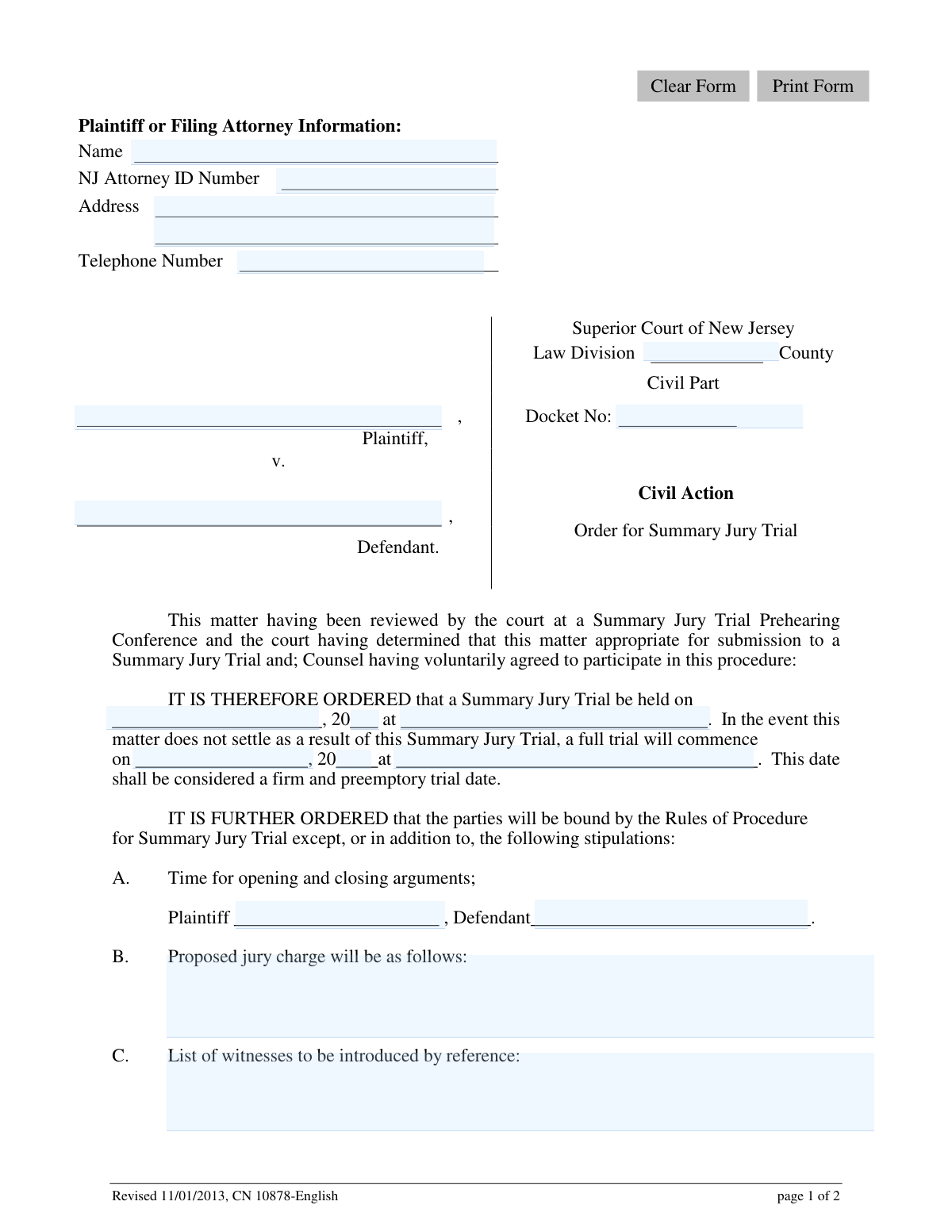
The Order for Summary Jury Trial, form CN 10878, is a legal document used by the Superior Court of New Jersey's Civil Part to formalize the agreement between parties to participate in a summary jury trial. It outlines the specific procedures, timelines, and evidence to be used, serving as a binding court order once signed by the judge and consented to by the parties. Today, this form can be filled out quickly and accurately using AI-powered services like Instafill.ai, which can also convert non-fillable PDF versions into interactive fillable forms.
CN 10878 is part of the
civil action forms, civil court forms, New Jersey forms and superior court forms categories on Instafill.
Our AI automatically handles information lookup, data retrieval, formatting, and form filling.
It takes less than a minute to fill out CN 10878 using our AI form filling.
Securely upload your data. Information is encrypted in transit and deleted immediately after the form is filled out.
Form specifications
| Form name: | Superior Court of New Jersey Civil Action Order for Summary Jury Trial (CN 10878) |
| Number of fields: | 35 |
| Number of pages: | 1 |
| Language: | English |
Instafill Demo: How to fill out PDF forms in seconds with AI
How to Fill Out CN 10878 Online for Free in 2026
Are you looking to fill out a CN 10878 form online quickly and accurately? Instafill.ai offers the #1 AI-powered PDF filling software of 2026, allowing you to complete your CN 10878 form in just 37 seconds or less.
Follow these steps to fill out your CN 10878 form online using Instafill.ai:
- 1 Navigate to Instafill.ai and upload or select the 'Order for Summary Jury Trial' form.
- 2 Use the AI assistant to input the case details, including the county, docket number, and the names of the plaintiff and defendant.
- 3 Enter the complete information for the filing attorney, including their name, NJ Attorney ID number, address, and telephone number.
- 4 Fill in the specifics of the court order, such as the date and location for the summary jury trial and the subsequent full trial if needed.
- 5 Specify the stipulations for the trial, including time limits for arguments, proposed jury charges, and lists of witnesses and exhibits.
- 6 Carefully review all entered information for accuracy before the plaintiffs, defendants, and their respective attorneys provide their consent signatures.
- 7 Download, print, or e-file the completed and signed order as required by the court.
Our AI-powered system ensures each field is filled out correctly, reducing errors and saving you time.
Why Choose Instafill.ai for Your Fillable CN 10878 Form?
Speed
Complete your CN 10878 in as little as 37 seconds.
Up-to-Date
Always use the latest 2026 CN 10878 form version.
Cost-effective
No need to hire expensive lawyers.
Accuracy
Our AI performs 10 compliance checks to ensure your form is error-free.
Security
Your personal information is protected with bank-level encryption.
Frequently Asked Questions About Form CN 10878
This form is a court order that officially schedules a Summary Jury Trial for a civil case in New Jersey. It documents the voluntary agreement between parties to participate in this process and sets the specific rules and dates for the proceeding.
This form is typically prepared by the attorneys for the plaintiff and defendant after a prehearing conference. It must be signed by all parties and their attorneys to show consent, and it is ultimately signed and entered by a Judge of the Superior Court.
No, participation is voluntary. The form explicitly states that counsel has 'voluntarily agreed to participate in this procedure,' and all parties must sign to consent to the order.
If the case does not settle, a full, traditional trial will proceed on a pre-scheduled date. This form sets both the date for the Summary Jury Trial and the 'firm and preemptory' date for the full trial.
This section is for customizing the rules of your specific Summary Jury Trial. You and the opposing party must agree on details like time limits for arguments, proposed jury instructions, and lists of witnesses and exhibits to be presented.
You must provide the case details (County, Docket No.), plaintiff and defendant names, and the agreed-upon dates for both the Summary Jury Trial and the potential full trial. Additionally, you need to detail all stipulations, including witness and exhibit lists.
Not necessarily. For a Summary Jury Trial, evidence is often presented in a summarized format, so you are listing the witnesses and exhibits that will be 'introduced by reference' or discussed during the proceeding.
Once all parties and their attorneys have signed the form, it is submitted to the judge for their signature. After the judge signs it, it becomes an official court order and is filed with the Clerk of the Superior Court.
The proposed jury charge is the set of legal instructions that the parties agree will be read to the summary jury. These instructions explain the relevant laws the jury should apply to the facts of the case to reach their advisory verdict.
All named plaintiffs, defendants, and their respective attorneys must sign the form. These signatures indicate that everyone consents to the terms of the Summary Jury Trial as outlined in the order.
Yes, AI-powered services like Instafill.ai can help by accurately auto-filling your case information, attorney details, and other standard fields. This can save time and reduce the risk of clerical errors.
Simply upload the Summary Jury Trial form to the Instafill.ai platform. The AI will identify the form fields, allowing you to easily type your information directly into the document online and then download the completed PDF.
Services like Instafill.ai can solve this problem by converting flat, non-fillable PDFs into interactive, fillable forms. Just upload your document, and the platform will make it easy to complete electronically.
Compliance CN 10878
Validation Checks by Instafill.ai
1
Validates Docket Number Format
This check ensures the 'Docket No' field follows the standard New Jersey court format (e.g., 'COU-L-001234-23'). Correct formatting is crucial for the clerk's office to accurately file the document and link it to the correct case file in the system. An invalid format could lead to filing rejection, delays, or the document being misfiled.
2
Ensures NJ Attorney ID is Numeric
This validation verifies that the 'NJ Attorney ID Number' field contains only numbers. This ID is a unique identifier for attorneys licensed in New Jersey, and validating its format helps ensure the filing party is a registered attorney in good standing. Failure to provide a valid ID could call the legitimacy of the filing into question.
3
Verifies Filing Attorney Information is Complete
This check confirms that the 'Name', 'Address', and 'Telephone Number' fields for the filing attorney are all filled out. This contact information is essential for the court and opposing counsel to send notices, orders, and other communications. Incomplete information can cause critical communication failures and procedural delays.
4
Confirms Plaintiff and Defendant Names are Provided
This validation ensures that the 'Plaintiff' and 'Defendant' name fields in the case caption are not empty. A civil action legally requires at least one party on each side to be valid. Submitting a form without these names would render the order unenforceable and result in immediate rejection by the court clerk.
5
Validates County Selection
This check ensures that the 'County' field is filled in with a valid New Jersey county name. The county determines the specific venue and jurisdiction for the case. An incorrect or misspelled county could lead to the order being filed in the wrong court, causing significant jurisdictional problems and delays.
6
Validates Summary Jury Trial Date is a Future Date
This validation checks that the date entered for the Summary Jury Trial is a valid calendar date and occurs in the future. Scheduling a court event for a past or invalid date is nonsensical and would be rejected. This ensures the order is procedurally sound and actionable.
7
Validates Full Trial Date is a Future Date
Similar to the summary trial date, this check ensures the date for the full trial is a valid calendar date set in the future. This date is considered firm and preemptory, so its accuracy is paramount for court scheduling and for all parties involved. An invalid date would make the order defective.
8
Ensures Logical Sequencing of Trial Dates
This validation performs a logical comparison to ensure the 'Full Trial' date is on or after the 'Summary Jury Trial' date. The purpose of a summary jury trial is to facilitate settlement before a full trial, so it must logically occur first. An inverted schedule would be procedurally incorrect and would require correction before the order could be signed.
9
Verifies Trial Locations are Specified
This check confirms that the location fields for both the Summary Jury Trial and the Full Trial have been filled out. This information is essential for all participants, including the judge, jury, attorneys, and parties, to know where to appear. Omitting the location would make the order incomplete and create confusion, leading to non-appearance and potential sanctions.
10
Validates Argument Time Stipulation Format
This check ensures that the time allocated for plaintiff and defendant arguments (Stipulation A) is entered in a valid format, such as a number representing minutes. These time limits are a key part of the agreement to participate in the summary trial. An unclear or invalid entry would make the stipulation unenforceable and could lead to disputes during the proceeding.
11
Requires at Least One Plaintiff or Plaintiff Attorney Consent
This validation ensures that at least one of the printed name fields for either a Plaintiff or an Attorney for Plaintiff is filled out. The form is a consent order, meaning all parties must agree to its terms. Without a signature from the plaintiff's side, their consent is not documented, and the order is not valid.
12
Requires at Least One Defendant or Defendant Attorney Consent
This check verifies that at least one printed name field for either a Defendant or an Attorney for Defendant is completed. Just like the plaintiff, the defendant's consent is mandatory for the order to be binding. A missing signature from the defendant's side signifies a lack of agreement, rendering the entire order invalid and unenforceable.
Common Mistakes in Completing CN 10878
Users often enter the docket number with typos, incorrect formatting, or omit the county-specific prefix (e.g., 'L' for Law Division). This is a critical error as the docket number is the primary identifier for the case file. An incorrect number can lead to the form being rejected by the clerk's office, misfiling, or significant delays in processing the order. Always double-check the number against official court documents for accuracy.
A frequent mistake is having discrepancies in the names of plaintiffs or defendants between the main case caption and the signature blocks at the end. For example, using 'John Smith Inc.' in the caption but 'J. Smith Inc.' in the consent section can create legal ambiguity. This can cause the order to be questioned or rejected, so ensure all party names are spelled out completely and consistently throughout the document.
Filers may enter vague information like 'To be determined' or leave the date and location fields for the Summary Jury Trial and full trial blank. The purpose of this order is to set firm, preemptory dates, so ambiguity defeats its purpose and will likely result in the judge rejecting the form. Ensure a specific date, year, and location (including courtroom number, if known) are entered for both trial events.
Attorneys filing the form sometimes forget to include their unique New Jersey Attorney ID Number in the top section. This ID is used by the court system to verify the attorney's standing and to properly associate the filing with their record. Forgetting this information can halt the processing of the form until the clerk's office can manually verify the attorney's identity, causing unnecessary delays.
In sections for witnesses (C) and exhibits (D), parties often provide overly broad or vague lists, such as 'all witnesses' or 'medical records'. This lack of specificity can lead to disputes down the line about what was actually agreed upon for inclusion in the trial. Parties should list each witness by full name and each exhibit with a specific, identifiable description to create a clear and enforceable record.
In cases with multiple plaintiffs or defendants, a common oversight is failing to list all required parties and their attorneys in the consent signature blocks on page two. The form provides multiple lines for this reason, and every party who is consenting to the order must be listed. An incomplete list of consenting parties can invalidate the order or require it to be resubmitted, delaying the case.
When a form is only available as a non-fillable PDF, people often print it and fill it out by hand, which can result in illegible handwriting. This leads to data entry errors by court clerks and can cause critical information like names or dates to be misinterpreted. To avoid this, use a tool like Instafill.ai, which can convert flat PDFs into fillable forms, ensuring all entries are clear, legible, and professional.
The form explicitly requires the user to specify the County in which the action is being heard. Filers sometimes leave this field blank or, in a rush, enter the wrong county. This simple mistake can cause the document to be routed to the wrong courthouse, leading to significant filing delays or the document being lost in the system until the error is discovered.
In section B, parties may write 'Standard Jury Instructions' or leave it blank, assuming the court will fill it in. However, the purpose of this section is for the parties to agree on the specific, tailored legal instructions relevant to their case. Failing to provide a detailed, proposed charge can lead to the judge rejecting the order and requiring the parties to confer and resubmit with more specific language.
For stipulation A, which specifies time for opening and closing arguments, users might enter a single number or use inconsistent units (e.g., '1 hour' for Plaintiff, '60' for Defendant). The form has separate fields for Plaintiff and Defendant, and both should be filled in clearly and with consistent units (e.g., '30 minutes'). This clarity prevents confusion and potential disputes on the day of the trial. AI-powered tools like Instafill.ai can help by validating data formats to ensure consistency.
Saved over 80 hours a year
“I was never sure if my IRS forms like W-9 were filled correctly. Now, I can complete the forms accurately without any external help.”
Kevin Martin Green
Your data stays secure with advanced protection from Instafill and our subprocessors

Robust compliance program
Transparent business model
You’re not the product. You always know where your data is and what it is processed for.
ISO 27001, HIPAA, and GDPR
Our subprocesses adhere to multiple compliance standards, including but not limited to ISO 27001, HIPAA, and GDPR.
Security & privacy by design
We consider security and privacy from the initial design phase of any new service or functionality. It’s not an afterthought, it’s built-in, including support for two-factor authentication (2FA) to further protect your account.
Fill out CN 10878 with Instafill.ai
Worried about filling PDFs wrong? Instafill securely fills superior-court-of-new-jersey-civil-action-order-for-summary-jury-trial-cn-10878 forms, ensuring each field is accurate.